


This Topic is the third in a series of ‘Reader’s Digests’ bringing together facets relating to ecological and sustainability issues. We consider these to be a physical manifestation of the spiritual dimensions informing the work of our community, Ecovillage Findhorn.
In the first topic of this series, The Park Ecovillage Findhorn – Early Conferences (1976-1995), we looked at early pioneers of the environmental movement, such as E.F Schumacher, who visited Findhorn and brought their influence to bear on its development. The second topic in the series, Developing a Planetary Village (1982 – 1995), looked at how the spiritual and sustainable ecological dimensions at work here led to the emergence of a ‘planetary village’ . This third topic, Ecovillage Findhorn: In the World (1995-2024), explores the impact Ecovillage Findhorn has had so far on sustainable environmental issues in the UK and across the world, through networks, education and work on the ground. The fourth topic in this series Ecovillage Findhorn: Tours of the Park tracks the evolution of the settlement through the different Tours to the Park over the last three decades. The fifth is Ecovillage Findhorn: Nature, Ecology and Biodiversity.
Introduction to the Topic
Ecovillage Findhorn broadened its sphere of influence following the seminal 1995 conference ‘Ecovillages and Sustainable Communities’ and became a key player in the worldwide transition towards a sustainable future.
The breadth and depth of Ecovillage Findhorn’s influence on the world in relation to sustainability issues has been breathtaking. It has grown from its humble beginnings as a refuge for the Caddy family in 1962, growing organic vegetables with love in the face of homelessness, unemployment and poverty, to a world leader in sustainability issues, recognised twice by the United Nations as a model of Best Practice for holistic and sustainable living. The Education Programmes and Organisational workshops arising from Ecovillage Findhorn have been far-reaching and influential. Regeneration of eco-systems at home and abroad has been achieved with the same love that went into the original garden. Eco-houses have been built across the world that have defined the future for sustainable development.
It is impossible to do justice to the impact the Ecovillage Findhorn has had in the World. So many of the visitors and community members have taken their experience in the community out into the world and it has shaped what they did and continue to do. Please forgive us if we have left out a crucial aspect you are aware of, and write a Comment at the end of this post, so that we can redress that omission.
For a ‘catch-all’ we have created a tag In the World where you can browse through a large number of stories.
The Topic begins by describing the development of the Global Ecovillage Network following the 1995 conference.
It then outlines Ecovillage Findhorn’s recognition by the United Nations as a NGO in 1997 and its designation as an UN-Habitat model of Best Practice for holistic and sustainable living in 1998 and again in 2018. It outlines the Official collaboration with the UN which led to the Ecovillage Trainings at Findhorn, including the Ecovillage Design Education (EDE) and CIFAL programmes.
The development of Findhorn College is described with its academic university links, creating formal training opportunities in subjects related to sustainability. The 2009 ‘Building Bridges’ initiative, providing informal learning opportunities for small groups of people according to their needs, is introduced.
We also look at education in a wider sense through publications including Findhorn International Centre for Sustainability (FICS), and the involvement with national and international initiatives and networks, including the UN’s COP21 on Climate Change where the Paris Agreement was signed.
We list some of the work on the ground worldwide through charities that had their beginnings in the community, such as Ecologia Youth Trust, Nepal Trust, Trees for Life, and WILD, that drew its inspiration from the Findhorn Foundation. Last but not least, there are examples of innovative technology with roots in Ecovillage Findhorn which contributed significantly to the evolution of their respective fields: AES, Simply Build Green, and Biomatrix (Living Machine).
***
Our Topic in more detail (click on arrows to read more)
Global Ecovillage Network (GEN)
Following the 1995 conference emerged the Global Ecovillage Network (GEN), Kosha Joubert, former president of GEN International, describes the beginnings of GEN and the role of the 1995 Ecovillages and Sustainable Communities conference in hosting its inauguration event.
 An article in One Earth 21 in 1996 described ecovillages as being at the ‘leading edge’ in the movement towards developing sustainable human settlements. World leaders at the Earth Summit in Rio (1992) made a commitment to support programmes that would move humanity to sustainability in the 2Ist century. The Global Ecovillage Network (GEN) was established to fulfil this purpose. It encompassed ecovillages at different stages of development across Europe, Russia, Australia, the US and India, including Ecovillage Findhorn. Common to all was their focus on education and a desire for the integration of ecology, spirituality, and community and business development. International Networking would enable ecovillages to rapidly increase their knowledge through the sharing of information, work exchanges, training and outreach. A special emphasis was placed on youth training and exchange. More information is available on the Global Ecovillage network website.
Two Ecovillage Findhorn residents are currently actively involved with GEN. Carolin Waldmann is Global Ecovillage Network Europe’s Membership Manager. Click here to listen to her story.
Jake Jay-Lewin has been active in the Ecovillage movement since 2013 and was recently elected to GEN-Europe’s Council and Board of Trustees.
In 2005 Ecovillage Findhorn hosted a conference to celebrate 10 years of GEN, entitled ‘GEN 10: Ecovillages – New Frontiers For Sustainability’ focalised by May East and Jonathan Dawson, former President of GEN. In 2015, the Global Ecovillage Network’s ‘GEN+20 Summit: Living the New Story’ conference at Findhorn brought 269 representatives of ecovillages and environmental initiatives from 48 countries to the Findhorn Foundation. Participants built networks, shared ideas and celebrated GEN’s 20 years of growth. Click here to watch the talks on GEN+20 Summit.
United Nations

A defining moment in Ecovillage Findhorn’s history came in December 1997 when the Findhorn Foundation was accredited as a non-governmental organisation (NGO) associated with the United Nations Department of Public Information (DPI), now known as the Department of Global Communications (DGC). The recognition marked a series of collaborations between the Findhorn Foundation and the UN. Click here to read May East’s description of her work to develop that relationship.
Ecovillage Findhorn was designated as an UN-Habitat model of Best Practice for holistic and sustainable living in 1998 and again in 2018. It has been incorporated into the UN Habitat database of initiatives making outstanding contributions to improving the quality of life in cities and communities around the world.
Click here to read more information on the Findhorn Foundation website.
Ecovillage Findhorn has contributed to three main areas within the UN itself: lifelong learning, sustainable development applied to human settlements, and spirituality/values. Since 1998, Frances Edwards and John Clausen have been its representatives at the UN New York Headquarters attending conferences, briefings, and other events, as well as organising various events, workshops, and presentations (click here for some examples). They are members of the Values Caucus; founding members of the Spiritual Caucus, organizing regular meetings and meditations in support of the UN since 2000; founding members of the NGO Major Group Unitive Cluster in 2023 and The DRTC (Deep and Rapid Transformation Convergence) at the UN in 2024. Twenty years of official collaboration have seen over 90 official conferences, seminars and trainings and thousands of participants.
See also Mike Scott’s ‘The Living Record’ which documents Ecovillage Findhorn’s links with the UN on
pp. 70-71.
Ecovillage Education at Findhorn
Official collaboration with the UN led to the renowned Ecovillage trainings including the Ecovillage Design Education (EDE) and the CIFAL Findhorn capacity building programmes using the ecovillage as a learning environment for local authorities and professional organisations worldwide.
CIFAL is a global network of training centres associated with the United Nations Institute for Training and Research (UNITAR). Its mission is to strengthen the capacities of government officials and civil society leaders, thereby supporting them in advancing the multifaceted sustainable development agenda encapsulated by the UN Sustainable Development Goals (SDGs).
CIFAL Findhorn was established in 2006 as a partnership between the Findhorn Foundation, the Global Ecovillage Network, the Moray Council, and UNITAR. CIFAL Findhorn offered a diverse range of one-, two-, and three-day seminars. Over the course of a decade, it hosted more than 100 seminars on various topics, including climate change mitigation and adaptation, renewable energy, biodiversity, low-carbon housing, the Sustainable Development Goals (SDGs), the circular economy, green jobs, local and bioregional food systems, the hydrogen economy, sustainable islands, and many other themes. Click here for more details of CIFAL presentations.
The seminars brought together public servants, business representatives, community groups and experts from academia and industry to work together to advance the sustainable development agenda. It later moved to Edinburgh and was renamed CIFAL Scotland. It ran until 2015 when May East stepped down as CEO to lead Gaia Education.
Gaia Education was established in 2005 with the aim of providing education for sustainable development that equips individuals and communities to design regenerative societies. Drawing inspiration from the pioneering practices of ecovillages worldwide, Gaia Education launched its flagship programme, the Ecovillage Design Education (EDE) programme, shortly after its founding. The EDEs provide participants of all ages with the knowledge and practical skills to design communities, projects and organisations with stronger social systems, greater efficiency and healthier environments. EDE programmes and Mini-EDEs are based on the four core dimensions of Gaia Education’s Ecovillage Design Curriculum: the Social, Worldview, Ecological and Economic dimensions of sustainability. The Curriculum was developed drawing on the experience and expertise developed throughout a network of some of the most successful ecovillages and transition settings around the world.

Two papers by Daniel Christian Wahl give useful information on Ecovillage training at Findhorn:
- Beyond Sustainability: Natural Design and Resilience
- Integrated Sustainable Community & Ecovillage Design Education
Click here for May East’s paper ‘Current thinking on sustainable human habitat: the Findhorn Ecovillage case‘ published in Nov 2018.
Findhorn College (2001-2023)
Findhorn College was established in 2001 to develop further and higher education programmes and partnerships based on the ecovillage project. It coordinated Field Study Visits for further and higher education groups interested in community studies and sustainability, also hosting residential researchers and students undertaking an independent study semester at Findhorn.
Daniel Christian Wahl, who facilitated some of the early seminars of CIFAL Findhorn, was co-director from 2007-2010. This presentation from 2018 gives a glimpse of Daniel’s extensive work.
In this short introduction Daniel describes the MSc in Sustainable Community Design which was created alongside Herriot-Watt University in Edinburgh.
Building Bridges
The Building Bridges initiative was launched at Findhorn in 2009 creating and coordinating one-off visitor programmes for local and national groups who wished to visit, and for proposing and seeking funding for programmes designed especially for groups of people with learning disabilities. Up to five days’ activities for groups wanting to experience the Findhorn Foundation Community were offered under the ‘Building Bridges’ programme.
Depending on the group’s particular interests, a programme was put together covering most aspects of living in and developing a sustainable spiritual community. The programme was purpose built depending on the needs of the visiting group. In 2015 Graham Meltzer described in his blog an example of a Building Bridges programme delivered to the Hurdal Ecovillage in Norway.
Findhorn Bay Care Farm provided a day-service (once a week) for adults with learning disabilities, from 2014 to 2023. The project provided a space for them and their carers to take part in the life of the Findhorn Ecovillage Community. The gentle pace of life enabled everyone to explore their potential and touch the hearts of those who may not have normally come in contact with the many gifts they have to offer. The project fostered genuine belonging and self-worth among the participants as they contributed to the community through food production at Cullerne Garden and various other creative projects in the community.
Opening Doors for Young People
For many years schools visited Ecovillage Findhorn for half-day ecological tours. In 2007 we realised there existed the potential for another level of learning, experience and discovery when Rokeby School, a multicultural, multi-faith inner-city school in east London, asked to spend ten days at The Park to experience the community and its ecological lifestyle, and learn and practise nonviolent communication.
The students wanted their school to be eco-friendly and the school culture to be based on a new respect policy they had created. Willie Deighan, the Deputy Head at the time, had been inspired by the positive approach of a conference, What Schools Are Getting Right, held at the Findhorn Foundation in September 2006, so he asked if 24 boys aged 12 to 15 could visit Findhorn to help them have real experience of what they were aiming to achieve.
In 2010 the Park Ecovillage Trust launched the ‘Eco-Kit Project’, a sustainability education package for schools, funded by the Scottish Climate Challenge Fund. By the end of the project two years later there were EcoKits in 95% of Moray schools.
In 2013 the Youth Empowerment Project (YEP) became part of the ‘Building Bridges’ initiative. This was a service for 16-24 year olds who
- were unemployed for 6 months or more
- didn’t have a positive destination at the point of leaving school
- were care leavers not in training, education or employment.
It offered a space for local youth to expand their horizons and worldviews, to reignite their hope and passion and see a broader range of opportunities to create the life they want for themselves. Through an experience in a safe environment they could strengthen their sense of belonging, self worth, self confidence and self efficacy. They were empowered by actively engaging them in working in a community. The project supported the Scottish government’s agenda of improving the life chances and life choices in particular of the most vulnerable of Moray’s young people.
A 12 week programme ran twice a year, two half days and one full day per week with a week residential trip on Erraid. The programme was designed to inspire and empower young people to make good choices for their future from a place of increased self awareness, emotional intelligence, and self-confidence. It also aimed to raise a sense of belonging in participants which strengthens self-esteem and self-efficacy in all that they will endeavour in their futures.
In addition and in partnership with Action for Children Scotland, participants could use the experience to help them achieve an SQA in employability skills.
Findhorn International Centre for Sustainability (FICS)
To serve the business community, Findhorn International Centre for Sustainability (FICS) operated within Ecovillage Findhorn from 2010-2023, with the aim of supporting organisational leaders working towards a sustainable future. FICS brought together changemakers from all fields to launch ideas and actions which support a regenerative and compassionate world. Click here to read how co-founder of FICS, Yvonne Cuneo , describes her journey. Advisors to FICS, Paul Dickinson and Helen Wildsmith also tell their stories, click here to read Paul’s, and here to read Helen’s story.
Paul Dickinson is co-presenter of the most widely listened to global Climate Change podcast, ‘Outrage and Optimism’, along with Christina Figueres and Tom Rivett-Carnac.
Christiana Figueres was a key negotiator of the 2015 Paris Climate agreement, in her role as Executive secretary of UN Framework Convention on Climate Change. She joined the first climate finance retreat FICS hosted in the run-up to the Paris Agreement. Helen Wildsmith co-convened these retreats, which have brought investors, their membership bodies and relevant NGOs together to increase the scale and pace of investor climate action since 2012. Christina gave a presentation of her work during her visit to Findhorn in 2014.
Climate Action and Politics
The COP21 2015 Paris Agreement
Twenty-one climate finance experts met at the Ecovillage Findhorn to attend a Climate Finance retreat, organised by FICS in advance of the Paris Climate Agreement. Community members also attended and represented the Findhorn Foundation at the Paris Climate Conference . Kosha Joubert gave a presentation at the conference via Skype.
The Findhorn Foundation declared its support for the COP21 agreement by signing the Paris Pledge. The board of the Park Ecovillage Trust also signed the Paris Pledge leading them to initiate a Carbon Strategy, including a carbon footprint assessment programme, a carbon offsetting service and a feasibility study for the Ecovillage Findhorn to become carbon-neutral by 2030.
IPCC Climate Change Report 2022
 In 2022 the UN International Panel on Climate Change (IPCC) report gave a 50% chance of the world managing to stay within the 1.5° change in temperature goal negotiated in the 2015 Paris agreement. The East Whins housing cluster at Ecovillage Findhorn is on the front cover of this influential report. Click here to read the full report.
Scottish Communities Climate Action Network (SCCAN)
Ecovillage Findhorn and the Scottish Communities Climate Action Network (SCCAN) collaborated in an exhibition in the Green Zone at the COP26 conference in Glasgow in 2021. John Talbott and Tara Gibsone created a brief introduction video for the occasion.
A grant from the National Lottery Community Fund enabled a range of climate-focused Scottish groups to gather at Ecovillage Findhorn in 2022 to pool their learnings about climate action. SCCAN supports community led action in Scotland to address the climate and nature emergency. Tara Gibsone gave a presentation at the SCCAN Retrofit Skillshare event in August 2023 where she went into more detail about ecological building techniques at Ecovillage Findhorn and the evolution from the early houses to those built today.
Scottish Green Party
Ecovillage Findhorn community members are actively involved in politics. Ariane Burgess has been a Member of the Scottish Parliament for Highlands and Islands since 2021. She represents the Highlands and Islands region supporting rural communities of a similar size to the Park Ecovillage to address the depopulation issues they face along with supporting them tackle the climate and nature emergencies on their doorstep.
She is the Scottish Parliament’s Convener of the Local Government, Housing and Planning Committee and also sits on the Rural Affairs Committee.
As the Scottish Green Party’s spokesperson on rural affairs she was responsible for getting the word “regenerative” in relation to agriculture, inserted into the 2021 power sharing agreement with the Scottish Government. This one word change transformed discussions about food and farming in Scotland – opening up the opportunities to ensure Scottish farming contributes a reduction in carbon emissions and greatly restored and regenerated natural environment.
Prior to being elected, using permaculture principles she designed and installed the Edible Woodland Garden which is located behind the Barrel Houses cluster. From 2006 she was a member of the Ecovillage Design Education (EDE) delivery team, leading sessions alongside May East, Kosha Joubert, Alex Walker and others. She brought a strong regenerative design element to the course which she now brings to her work in the Scottish Parliament. She designed the stone labyrinth to the north of the Findhorn Hinterland pine forest which was installed with the help of participants from an EDE course.
There are now two Green party politicians in Scotland who are part of the Findhorn community since the election of Draeyk van der Horn, who became the first green party councillor on Moray Council in the local elections in May 2023.
Carbon Disclosure Project(CDP)
The Carbon Disclosure Project was co-founded by Paul Dickinson, former Trustee of the Findhorn Foundation. The project aims to reduce carbon emissions by requesting detailed emission data from FT 500 corporations, with the added benefit of identifying cost-saving measures through reduced energy use. Many corporations have become highly competitive in finding means of reducing their emissions as this leads to climbing the Climate Leaders’ scale. The global results for the Climate Leaders are reflected in improved share value. In 2006 Amanda Haworth, now an Ecovillage Findhorn resident, then based in Stockholm, was invited by Paul Dickinson to open a secretariat for CDP to cover the Nordic countries. She worked for the Carbon Disclosure Project as Nordic Regional Director from 2006 until 2014 and tells her story.
By 2024, CDP had grown substantially, with 700 signatory investors representing $142 trillion, and 22,000 corporations responding, covering almost two-thirds of global market capitalization.
Work on the Ground
In addition to work in the private and public sectors, several Ecovillage Findhorn community members have established national and international charities, including amongst others: Liza Hollingshead (Ecologia Youth Trust), Alan Jacobsen (The Nepal Trust), Vance Martin (WILD) and Alan Watson Featherstone (Trees for Life). Expertise in innovative technologies grew in Ecovillage Findhorn resulting in the formation of several successful and award winning enterprises, including AES Solar, Simply Build Green and Biomatrix Water.
Ecologia Youth Trust

Ecologia Youth Trust (1995-2024) was an international charity founded by long-term resident of Ecovillage Findhorn, Liza Hollingshead. The charity promoted the welfare of young people by providing places of safety and secure learning environments, whilst promoting intercultural cooperation and friendship. It enabled young people to discover and develop their potential to make a contribution to their communities through ecological awareness and environmental protection.
Liza describes the beginnings of Ecologia Youth Trust here.
Ecologia began working with Kitezh Children’s Community in Russia to build two foster communities and facilitate several international youth exchanges. It later partnered with the Sathirakoses-Nagapradeepa Foundation (SNF) in Thailand on projects to restore livelihoods and empower communities of migrant workers devastated by the 2004 tsunami, and to foster human rights for Myanmar migrants. In 2013 it developed a long-term partnership with Kenyan organisation, International Peace Initiatives (IPI) (Post 4) with further projects developing in Uganda, and Growing2gether in northern Scotland.
Ecologia was drawn to a close on 30th September 2024 having achieved its original mission set out on its inception in 1995. With the help from its supporters, Ecologia has helped transform the lives of over 56,000 children, young people, and families affected by poverty, inequality, disease and climate change. Its projects are now self-sufficient and capable of sustaining themselves.
The Nepal Trust

Alan Jacobsen, a long-time Community member, founded the Nepal Trust. The charity aims were to relieve poverty, advance education and provide medical facilities. This took the form of building health posts in the remote Humla region of Nepal and training health workers as well as providing funds for medical supplies.
This was supported by volunteers joining treks led by several Community members, including Peter Lloyd, Thomas Warrior and Jim and Liz Donovan, to help with the construction of the health posts. One such trek included woodworker Richard Brockbank who had created a carved doorway here at Findhorn which was shipped to Nepal, carried on a 4 days trek and erected at the entrance of a health post. That doorway is still represented in the logo of the trust. Click here for more stories about the Nepal Trust.
The Nepal Trust is still active, now based in Glasgow. It focuses on raising funds to support partner organisations in Nepal.
Trees for Life
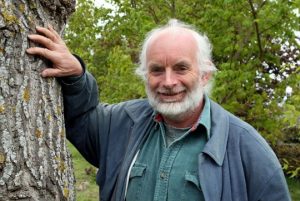
Founded by long-term Community member Alan Watson Featherstone, Trees for Life grew from a Findhorn Foundation work department into a Scottish charity set up in 1993. From humble beginnings with the the Trees for Life Calendar and volunteers cutting down non-native species in Glen Affric it has evolved to become the landowner of the Dundreggan Estate, operating the Dundreggan Rewilding Centre.
Click here for many different stories about Trees for Life in our collective autobiography.
WILD
Vance Martin lived and was widely-involved in the Community for ten years, 1974-84. Amongst many other responsibilities, he was at one time focaliser of the Core Group, the Garden, initiator of the first Tree Programme, ‘Warden’ of Traigh Bahn (Iona) for seven years, and the coordinator of FF’s early involvement with the emerging global environmental movement. He and Ian Campbell co-focalised guest workshops for several years under the theme “From the Garden to the Wilderness” and co-produced the presentation and original music score, “Festival of the Seasons.”
A significant part of introducing FF to the general environmental movement—both governmental and NGO – was through his mentorship by South African conservationist Ian Player. They collaborated to convene the 3rd World Wilderness Congress (3rd WWC, 1983), with its global opening in Inverness followed by 5 full days in the Universal Hall … the first conference in the Hall immediately following its formal approval (by the Moray authorities) as a public conference centre. The 3rd WWC was chaired by Scottish Forester and piper, Finlay MacRae, with Sir Laurens van der Post as patron. Click here for many more details about the 3rd WWC.
Vance and family departed the Community to create and be President of the WILD Foundation from 1984 to 2023, based in the United States. WILD is an international conservation organisation dedicated to protecting wilderness, communicating the values of wilderness and its benefits for human communities, and promoting the importance of Indigenous knowledge and involvement in nature conservation. For a number of years, Leona Graham worked closely with him as he created WILD and the WWC. He discusses the work of WILD in this YouTube video.
After handing-over WILD to next-gen leadership, he continues to be fully active with many conservation organizations and projects around the world.
AES Solar
It all started with Weatherwise Homes in 1979. The solar thermal panel originally designed by Lyle Schnadt became the driving force behind what today is AES Solar. George Goudsmit tells the story of his 34 year involvement with AES, from the beginnings as a small aspect of New Findhorn Directions to a major award winning producer, distributor and installer of solar thermal and PV panels in the UK.
Simply Build Green
Simply Build Green is technical guide to the ecological houses built in the Park Ecovillage from 1990. Authored by John Talbott it was first published by Findhorn Press in 1993. At the time this was quite ‘far out’ but attracted the interest of many experts in the field in Scotland. Over the years the different features used in those eco-houses contributed to the technical specifications in the subsequent revisions of building regulations issued by the Scottish government.
Biomatrix Water
 One of the exciting events during the Ecovillages and Sustainable Communities Conference 1995 was the opening of the Living Machine.
It is now operated and cared for by the staff of Biomatrix Water, founded by Community members Galen Fulford and Lisa Shaw. Whilst our Living Machine was the first in Europe, Biomatrix Water, still based in the nearby town of Forres, is providing solutions for cleaner water and greater biodiversity all around the world – including in many places in the UK, as well as projects in France and in the USA.
Click here for more stories about wastewater treatment and the Living Machine.
***
From small beginnings the creativity and inspiration of community members in relation to creating holistic, sustainable environments in harmony with nature has known no bounds. Their work has had far reaching consequences at home in the UK and across the world. The agenda of sustainability at Ecovillage Findhorn has set a standard and led the way for others to follow in a myriad of ways, described in this Topic, ‘Ecovillage Findhorn: In the World’.
***
Featured image: Painting and photograph by Kate Bewick. For many years the painting was mounted on the wall of the Lollypop Shop (now La Boheme) facing the entrance to the Park Ecovillage.

I first visited Findhorn in 1979 and came back regularly before buying my caravan when I retired in 2019. I worked as Director of an NHS Training School running a clinical and doctorate programme.


Leave A Comment