


This article was previously published in One Earth magazine Volume 1 Issue 2 Autumn 1980.
***
The garden itself becomes the major classroom of life, nature the teacher, and we, in our unfolding evolution, the subjects.
_________
About nine years ago, just prior to my coming to Findhorn, I lived in the west of Sweden with a small group of young people who had chosen to leave the bustle of the big city to learn organic farming from a remarkable old man. Anders Björnsson, now 79, introduced us to the living soil through the ‘friendly farming’ approach he had developed over forty years. “Life is the greatest teacher,” he constantly impressed on us, and it was by observing how plants, trees, animals and insects interrelated that Anders gained his knowledge of horticulture and his insights into the workings of nature. On my arrival at the farm he took one look and suggested I take off my shoes and socks and walk on the earth. “Feel the life force and know that you are part of a great natural cycle.” That brief remark seemed to invite my hitherto fragmented life to step into a living concept of wholeness: it was the first time I realised I was actually living on the planet Earth.
Later Anders told how he had spent a number of years observing a particular meadow. He was intrigued by how, from seemingly nowhere, a new crop of wild flowers would suddenly spring up. He concluded that the earth is full of dormant seeds, each awaiting its time in the ordered procession of growth. Each plant type adds to the micro-life of the soil and so prepares the way for the next group of plants with their particular requirements and gifts. This is what at Findhorn is called ‘right timing,’ when earthly conditions are suitable for germination to take place.
It is certainly with a sense of right timing that I have seen the seed of the Garden School germinate from that cornerstone in the foundation of Findhorn, communion with nature. From 1978, around the nucleus of Fred and Dick Barton, the idea of a ‘school within a garden’ has grown and taken shape at Cullerne, a ten-acre property adjacent to the caravan park overlooking Findhorn Bay. Fred and Dick are a father and son team, community members since 1974, who are carrying on a three-generation family tradition of tending the land.
Nowhere is the co-creative effort of humans and angels more clearly visible than in a garden and so the ‘school within a garden’ is a natural concept. The garden itself becomes the major classroom of life: nature the teacher and we, in our unfolding evolution, the subjects. The school, however, does not include attunement to nature in the content of its programme; rather, this attunement is the context within which the education unfolds.
When I asked Dick what it was like starting a garden school he gave a rather elfish grin and said, “Well, it’s like sending up a firework rocket—you stick it in the ground, point it in the general direction of God and light the bottom end. It fizzes a bit and you wonder whether it will ever fly. Then whoosh! It’s gone out of sight leaving a tiny trail of light—and then an amazing blaze of colours appears miles above your head.”
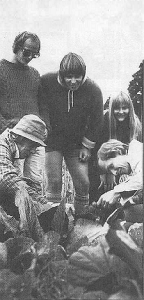
From left: Dick Barton,Ian Campbell, Michael Lindfield, Frances Edwards and Vance Martin. photo Michael Burgess
Cullerne has become the first centre of the Findhorn Foundation Garden School and its potential is now inviting other people and gardens to join in. Several gardeners, long-term members with a deep experience of community life, have formed a core group for the evolving school, thereby broadening its operational base. The present core group, in addition to Dick, are Vance Martin, Frances Edwards, and myself, Michael Lindfield.
Vance, core group focaliser for over two years and former focaliser of the Findhorn garden, has a background in organic gardening and forestry. He is interested in promoting an increased ecological awareness, particularly about re-afforestation. Frances, who grew up and received her training in a traditional English country garden, is focalising the Drumduan garden. I, who have a basic knowledge of organic gardening and focalised the education branch for four years, am currently tending the Findhorn vegetable garden.
Many visitors to Cullerne have remarked on its peaceful aura, like a bridge to angelic awareness. The Garden School itself is a function of the need for humans and angels to come into communion. I asked Dick how he intended to deal with possible glamorous expectations attached to communing with angels among would-be students. He replied very clearly, “I cannot stress too strongly that the Garden School is not designed to be a peep show into the angelic world; rather, that reality is simply accepted as axiomatic to all that happens. The courses will aim to create attitudes of communion rather than contact. However, any conscious experience of an angelic being is bound to produce profound changes in one’s personal life and system of values. The school is set up to allow for these changes and to assist in their assimilation. We’re not forecasting anything, but the sudden impact of an angelic awareness can bring tears of love and compassion to a person’s eyes. Old blocks can melt away, inhibited emotion suddenly flow or a wave of joy quite destroy one’s ability to build a compost heap in any coherent fashion.”
Dick is very concerned with the practical demonstration of this inner communion, and the Cullerne curriculum reflects this. It is designed to help students become skilled both in perceiving what needs doing and why, and then in acquiring the knowledge needed to carry out the task. Learning comes through the applied focus of daily work.
Reflecting on the venture so far Dick says, “There has been plenty of interest and the first two three-month students are nearing the end of their time. Two more have signed up for September, and half a dozen plan to come for spring 1981. Next year we shall conduct our first scientific trial for a Southern college on the viability of an ancient wheat variety.
“So far this year we have achieved our horticultural aim. The land use has increased with more greenhouse space, another one-third acre plot in cultivation and one area sown with its second crop. At present there are only about one hundred square yards not actually growing something. We are currently growing 24 varieties of vegetables and have introduced an asparagus trial bed. The plastic-covered solar tunnel is producing corn and maize, tomatoes and zucchini. The bedding plant trial was a success and we hope to expand this trade next year using our garden shop as a retail outlet.
“Generally speaking crop returns have been acceptable, though the poor summer meant low returns of some crops. Now the Brussel sprouts are fattening up on all 1400 plants and hundreds of cabbages are covering the ground. Nature has been bountiful and with autumn I am tired, with that lovely slowing down feeling after months of activity.”
The Garden School represents another ray of hope for me, in a world suffering from pollution of the air, sea, and soil. Unfortunately the pollution does not stop there, as through countless separative and unconscious acts, humanity has also created an emotional and mental mist around itself. This has darkened the inner sky of the planet and has obscured from us the collective part that we play in the greater cycle of life. How do we become the solution to this problem? Frances sums up the general feeling of the gardeners about how our everyday life can address itself to the world situation:
“The Findhorn gardens have always been educational in the way they have developed the idea of loving and harmonious co-creation with the nature kingdoms. As gardeners we now have sufficient knowledge and experience to take co-creation a step further, blending more traditional methods with intuitive approaches. Our five very different gardens offer opportunities to work with very different methods, allowing us to be truly eclectic and open to new ideas from a variety of sources. We also have the experience of care taking the island of Erraid which is a wonderful opportunity to revitalise a piece of land, both socially and ecologically.
“One of my greatest joys in working in the Findhorn gardens has been the sense of identification with the land and everything upon it. As I work I see my garden as part of the whole planet, in the same way as when I wash my hands I see them as part of my whole body. Everything I do affects the greater picture and through that connection I am also changed. I hope our Garden School will offer the opportunity for more people to experience this sense of oneness with the Earth on all levels. We must live lightly on the Earth in ecologically sound ways by taking care of our forests and wild places with just as much consideration as we have for our own vegetables.”
Once again, it is up to us as individuals within the human kingdom to make the choice. Do we wish consciously to participate in the Garden School of the Earth and learn the priceless lessons of caring for creation, or do we choose to ignore the inner call? The former choice will cost us nothing whereas the latter, I fear, will cost us the Earth.
____________
Friends of Findhorn are invited to support the evolving Garden School by helping buy Cullerne from the Foundation. The purchase of the property in 1978 was funded almost entirely by bank loans, and escalating interest rates have made it necessary for the Foundation to sell the property to maintain its financial integrity—either on the open market or to friends who will help the Garden School grow through their participation.
Those interested are invited to buy one or more £10 ($25) shares in Cullerne. Initially these will be in the form of interest-bearing loans, secured by a mortgage on the property (up to 12% interest will be paid). Later, participants in the scheme will have the opportunity to convert their loans to a percentage ownership share, still secured by a mortgage. Shares are transferable at any time, with right-of first-refusal reserved by the Foundation.
The Trustees have given till the end of the year for the raising of the £85,000 at which Cullerne has been valued. If this deadline is not met, all money will be offered for refund, with interest paid to date of refund. Your participation is welcomed. For further information write to A.D. Barton or Fred Gordon, Findhorn Foundation, The Park, Forres IV36 OTZ Scotland.

Michael seeks to live the Ageless Wisdom teachings. Co-founder The Science of Group Work, Board President, Meditation Mount in Ojai, California and member of the Community of Living Ethics in Italy.


Leave A Comment