


This topic, written by Janet Shaw and Sean Reed, is one of the series of topics relating to environmental and sustainability themes at Ecovillage Findhorn. Other topics in the series include
Early Eco-Conferences at Findhorn (1976-1995)
Developing a Planetary Village (1982-1995)
Ecovillage Findhorn: In the World (1995-2024).
A Topic on climate action is in process.
This Topic follows nature, ecology and biodiversity at Ecovillage Findhorn, starting from the founders’ initial attunement to the spiritual dimension of nature to the current embracing of national biodiversity priorities in response to the world-wide biodiversity crisis. It is a personal view of the authors, based on lived experience, historic COIF articles, and recent discussions with community members.
The Topic is divided into a number of sections. Please click on the arrows on the left to access more information.
Summary
In the early days Dorothy McLean, one of the founders of the community, attuned during meditation to the intrinsic nature of each plant grown in the original garden, leading to an extraordinary flourishing of the garden which drew attention to the Park at Findhorn from far and wide. The focus widened from the garden surrounding the caravan in which the founders lived to the environment of the caravan park, which consisted mostly of bare sand and shingle, and a tree planting programme was established. In the 1970s, influenced by increasing global environmental concerns and a rapidly growing green movement, the concept of a ‘planetary village’ was born at the Park. The three guiding principles of the Community were established, including Co-creation with the Intelligence of Nature.

Ecovillage Findhorn developed rapidly in the 1980s and 1990s, with the main ecological focus being on housing, energy, waste and food. The purchase of the Wilkie Estate in 1997 led to the beginning of a new phase of working with nature at the Park Ecovillage, focused more on biodiversity. The Findhorn Hinterland Trust was created and has flourished and housing development at the Whins was based on ecological impact assessment for the first time. A growing worldwide awareness of the biodiversity crisis has led to an increase of interest in the subject throughout the Park.
Growing the Park Garden
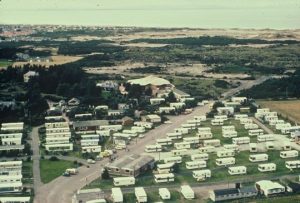
Aerial of the Park, early 1980s photo Jonathan Caddy
The founders of Ecovillage Findhorn, Peter and Eileen Caddy and their three children moved their caravan to the Findhorn Bay Caravan Park with their friend Dorothy Maclean in 1962. A former RAF officer and hotelier, but recently unemployed and with six people to feed, Peter began to dig a vegetable garden. In meditation Dorothy discovered she was able to connect with the overlighting intelligence of the plants. She describes how she attuned to the essence of the living world of nature for the first time in the following video.
During meditation Dorothy learned to focus her energy on the essence of each plant in the original garden in the Park, beginning with the pea plant. She came to the conclusion that she was contacting the archetypal energy and pattern for growth for the plant, not an individual entity for each plant but rather an overarching collective intelligence intrinsic to the life of the species and overseeing its development. She named the plant energies she connected with in meditation the Devas.
In The Findhorn Garden book Peter Caddy described building the original garden based on the specific guidance Dorothy received in meditation when aligning her consciousness with the Deva for each plant in the garden. During the first season following Dorothy’s meditations many kinds of vegetable, fruit and herbs were grown, resulting in the famous Findhorn Garden. Our June 2025 Topic Co-creation with Nature takes up this story.

Original garden photo Findhorn Foundation
Eileen received guidance during meditation in 1967 that trees, shrubs and flowers should also be planted to make the garden a place of beauty. This was all achieved on soil which, only eighteen months previously, had been sand and gravel. Nearly 600 beech trees were planted to form a hedge enclosing the whole area, paths were made and the area cleared of the couch grass. A dilemma with local gorse bushes intruding into land set aside for fruit bushes transpired at this time. They were cut back when in flower causing a ripple of controversy throughout the community. Advice was given by Robert Ogilvie Crombie (ROC) on the importance of establishing a wild garden to enrich cooperation with the forces of nature. His advice was followed and a place for ‘wildness’ was established next to the cultivated original garden.
Tree Planting Programme and Project Cullerne
Tree planting featured strongly in the early days, providing shelter on an exposed peninsula, and wood for community use, and diversification of wildlife habitats. Planting started at St. Barbe’s wood on Pineridge, named after Richard St. Barbe Baker who encouraged those at the Findhorn Foundation to “Plant trees for your life!” At this stage a mixture of quick-growing trees was planted, including non-native and exotic trees, such as poplars, to provide wood for log fires in the community.
A wider tree planting programme was then established, by community member Vance Martin at Cullerne Gardens. Vance worked on the project until he left the Findhorn Foundation after the 3rd World Wilderness Congress in 1983 to become president of the Wild Foundation. Planting continued to develop organically as the Community grew. At times planting was apparently somewhat haphazard though no doubt always with attunement, sensitivity, and a desire to co-create with Nature. Jonathan Caddy and Craig Gibsone took over focalising the work of planting out the tree nursery seedlings. Alan Watson Featherstone inherited the name ‘Trees for Life’ for the rewilding project he had started in Glen Affric, which became a major charity of the same name. Please click here to read the Tree Chronicle compiled by Vance in 1984 which documents the history of the early planning and planting of trees at the Findhorn Foundation.
In addition to tree planting on the Park, a ten-hectare coniferous plantation – ‘Wilkies Wood’ – was planted on the neighbouring private Wilkie Estate, to stabilise the shifting sand dunes.
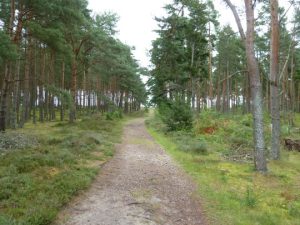
Wilkies Wood photo Sean Reed
Tree planting at the Park created shelter from the wind, the area being an exposed caravan park on the edge of mostly open sand dunes in the 1960s. As the trees have grown up in and around the Park in the last 60 years – under the stewardship of the Findhorn Foundation’s Park and Cullerne Garden teams, and the Findhorn Hinterland Trust – and as private gardens have matured, a wonderful habitat for humans and nature developed.
During the early development period of the Park at Findhorn, connection and communication with nature was a central focus, building on the spiritual and meditative practices of the founders. The Findhorn Garden grew and matured and provided the context for the teachings on the interconnectedness of all life and beings within it. Nature has been at the heart of the Community from the very beginning, and continues to be so. In this post Findhorn Hinterland Trust Land Manager Kajedo Wanderer comments on the connection to nature in the early days of the Ecovillage.
In addition to being the focus of the Tree Programme, a Garden School was established at Cullerne Gardens in 1980, converting a livestock smallholding into a community horticulture and education project. In the 1970s, influenced by increasing global environmental concerns and a rapidly growing environmental movement, the concept of a ‘planetary village’ was born at the Park. Three guiding principles of the Community were established, including Co-creation with the Intelligence of Nature.
Reflections on Co-Creating with Nature
Work at the Findhorn Foundation with nature was sometimes controversial in the wider world. In the 1970s an ecologist, John Seymour criticised the Community’s work with ‘nature spirits’ in the press. In the post ‘Elemental Ecology’ Richard G Elen interviewed community member, Dick Barton for an article in the magazine ‘Undercurrents’ in 1976/7 to discuss Seymour’s criticisms and to explain the Ecovillage Findhorn’s understanding of nature spirits.
Dick Barton’s professional background was of an electronics engineer. He viewed nature spirits as patterns of electromagnetic energy that were familiar to him from his scientific background. Dick explained that a good gardener has always tuned into the forces of nature and argued that it is possible to contact energies from higher dimensions to enhance work in progress. He said “You don’t come by two decades of experience by sitting in a dark room and meditating. You’ve got to go out into the world and learn it. When you’ve become an expert in the field, then you can do it with that plus… then you’ve got something.”
Writing in the 1990s and reflecting on the early development of the Findhorn Foundation, William Bloom commented on the shift in emphasis at the Findhorn Foundation from a primary focus on nature spirits towards other aspects of consciousness. He explained that there are archetypal patterns for every form of existence including the plant kingdom, and that this has been recognised in all mystical, tribal and esoteric traditions. The pattern or blueprint can be seen as an energy matrix of perfect potential. He claimed that “Working consciously and co-operatively, human beings can attune to this perfect matrix—in gardening, healing, creating, cleaning and so on—and thus attune their own actions more gracefully and creatively to the work.”
Ecological Developments in the 1980s
The 1980s saw a rapid acceleration of development of the Park Ecovillage. A focus on global awareness-raising emerged, including the hosting of a series of influential international conferences. Bringing together the very latest thinking on sustainability from around the world is also likely to have had a significant influence on the physical development of the Park itself. Alex Walker described how by the end of the 1970s the work of the Findhorn Foundation had shifted from work with the nature kingdoms towards developing educational programmes, with a focus on ‘growing people’ in all aspects of consciousness, and how the Community’s work is to stay on the cutting edge of ecology.
Land purchases were made and thoughts turned towards how to manifest a Planetary Village. This included the development of a ‘Statement of Land Ethic’, drafted in 1982 at the time the caravan park was purchased, as the Findhorn Foundation’s formal statement about its working relationship with the nature kingdom. The Land Ethic recognised the vital importance of the natural environment in creating a model sustainable community and expressed a wish to create an integrated environment, providing the growing conditions for all life and creatures within it, and harmonising the needs of people with the needs of nature. It included the statement, ‘We are further committed to the conservation of our adjacent wild areas, including primarily the sand dunes of the Moray coast and the tidal marshes of the Findhorn Bay.’ Alan Featherstone Watson emphasised integrating Co-creation with Nature into the Wholeness of our Lives in 1987.
An ecovillage ‘model’ was created in 1986, led by community members John Talbott and Andrew Yates, with five pillars of sustainability: planetary, spiritual, economic, ecological, and cultural. Ecological building methods were explored, the barrel houses and Nature Sanctuary were built, and many more trees were planted. The ecovillage model was a ground-breaking blueprint for action, at a time when human caused climate change was only just beginning to register in the public consciousness and action around the world was still largely at the ideas stage. While the Model referred to the Land Ethic and its recognition of the importance of nature, the main interpretation of ‘ecology’ was in terms of housing, energy, food, and waste – reflecting the recognised ecological priorities of the day.
True to all the careful and inspired planning, a ‘Planetary Village’ blossomed during the late 1980s and through the 1990s. Ecological building took place on Pineridge and the Field of Dreams. Our first wind turbine was erected in 1989, a community supported agriculture scheme (Earthshare) was established in 1994, and the Living Machine sewage plant opened in 1995. Land was set aside for nature, mostly at Wilkies and Diamond Woods.
Stewardship of the Land at Ecovillage Findhorn
In the 1990s and 2000s the climate crisis had been widely recognised and Ecovillage Findhorn continued to step up its response to it, mainly through innovative ways of building ecological housing, energy resources, growing food and dealing with waste. More wind turbines were erected, a biomass boiler installed, an international climate conference was held, carbon footprints were calculated, and ecological specifications for building were improved, including at the Field of Dreams.
At the Field of Dreams, as with earlier housing developments, biodiversity doesn’t appear to have featured in housing development design with the woodland areas and gardens considered as contributing to biodiversity, in general terms. An eco-tour of the Park written 1995 and updated over the years took visitors to see the various eco building and technology innovations.

Field of Dream aerial photo Gunter Pibernik
In 1997 private investments from many community members led to the establishment of the company Duneland Ltd. that acquired the 400+ acre Wilkie Estate adjacent to the land already owned by the Findhorn Foundation.
From the beginning, Duneland’s goal was to co-create with nature – to conserve and enhance the natural environment. It reserved a small percentage of the land for building projects to further develop the ecovillage (see next section).
Two different organisations were set up to conserve the natural habitats of the Findhorn hinterland.
Firstly, in 2000 Duneland Ltd gifted 170 acres to the Findhorn Dunes Trust, a charity and a joint project made up of representatives of Findhorn Village and the Findhorn Foundation Community.
Secondly, the Findhorn Hinterland Group was founded in 2006, drawing its membership again from both the village of Findhorn and Ecovillage Findhorn. Its aim was to steward the land between the residential areas on the peninsula and the wilderness reserve. The land included a pine wood plantation, Wilkies Wood, that produced firewood and some timber for local buildings, and the land on which the four windmills owned by Findhorn Wind Park are located that supply energy to Ecovillage Findhorn. An area within Wilkies Wood became the first green burial site in Morayshire.
Findhorn Hinterland Trust: Ecology and Biodiversity
‘Biodiversity’ began to emerge as a new focus for the Ecovillage community in the 2010s. Biodiversity is defined as the variety of life on Earth, including all plants, animals, fungi, and microorganisms. ‘Ecology and ecological’ are better known terms than biodiversity. In strict definition, ‘ecology’ is actually a biological science – the study of relationships between organisms and their environment. In general use, however, the word ‘ecology’ can cover a huge spectrum of related interests – including human ecology, lifestyles, building and food production methods, and products – whereas ‘biodiversity’ is more clearly focused on species of living beings.
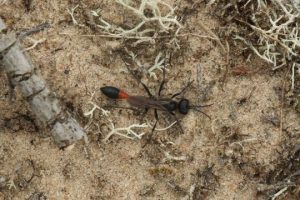
Red-banded sand wasp (Ammophila sabulosa) photo Alan Watson Featherstone
In 2015 the Findhorn Hinterland Trust became a registered charity, aiming to promote nature conservation and education, build local community and provide recreational facilities. A woodland management plan was developed by a local forestry consultant in 2018, detailing how to restructure and diversify what was at that point a stunted conifer plantation.
Jonathan Caddy, Chair, has held the vision and been the driving force behind the Hinterland Trust from the outset. Son of the founders Peter and Eileen Caddy, Jonathan came to the role with a degree in Ecological Science and professional experience in woodland management.
Trustees include Alan Watson Featherstone, former director of the charity Trees for Life, and international ecological restoration consultant Neil Meikleham.
Topic working groups, drawing from the local community, organise the Trust’s work. The Land Management Subgroup includes: trustees Neil Mickleham and Alan Watson Featherstone, Hinterland Land Manager Kajedo Wanderer, lichenologist Heather Paul, long-term volunteer George Paul, woodland owner and manager Hugh Andrews, and former Findhorn Foundation grounds person Ash Balderson. Birgit Carow handles marketing and promotion.
Biodiversity on the Hinterland is rich and varied due to a diverse landscape ranging from heath, shingle, sand dunes, grassland, and gorse, to the – now ecologically transformed – Wilkies Wood. Species such as red squirrel, sparrowhawk, roe deer and tawny owl, common lizard, and brown hare can be found.
Findhorn dunes are a tiny fragment of what was once one of the largest sand dune systems in Europe. The sandy habitats are of the greatest ecological significance, supporting some exceptionally rare and threatened species of lichens, invertebrates and fungi, with nationally important populations being found. The Trust’s website provides some detail on the remarkable biodiversity present, including articles by trustees Alan Watson Featherstone and Heather Paul, and reports from visiting specialists.
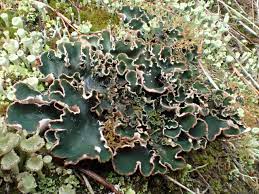
Endangered Felt Lichen photo Heather Paul
A draft Local Biodiversity Action Plan was produced by ecologist Sean Reed in 2013 based on biodiversity priorities set-out in the Scottish Biodiversity Strategy and Scottish Biodiversity List. This identified the threat of scrub encroachment to the biodiversity of the dunes. The plan was developed further in 2020, with recommendations of protecting the best areas of lichen-rich dune heath through regular scrub control, and creating a sand dune restoration project focused on targeted clearance gorse to create new areas of bare sand.
Despite Covid pandemic restrictions, being a resident of the Park Ecovillage, Land Manager Kajedo Wanderer was able to make a very good progress on the best areas of dune heath between 2020 and 2023, using a hand-held brushcutter.
The first phase of the dune restoration project, using heavy machinery, was completed in 2024. The restoration project is re-establishing natural ecological processes, in particular wind-blown sand. In this respect it is a rewilding project, tree and scrub encroachment not being natural on the dunes, but the result of previous human intervention, causing habitat loss, and fragmentation through reduced wind speeds and spread of wind-blown tree seeds.
At the time of writing, the Hinterland area is under consideration for official recognition as a site contributing to the Scottish government’s target of 30% of Scotland protected for biodiversity by 2030, due to the dune restoration work that is being done.
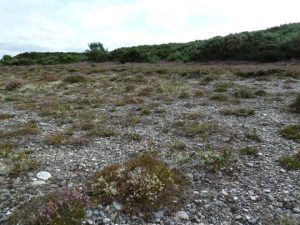
Vegetated shingle and dune heath with encroaching gorse photo Sean Reed
Conservation alongside Human Homes
Duneland Ltd began the Whins housing developments on the land that it retained in 2012 following a period of intensive community engagement.
East Whins was built on a brownfield site of very low biodiversity value in 2013. Surveys show that the gardens and buildings there now support much greater bird interest than before construction.
Ecological appraisals for West Whins (2012) and North Whins (2019) revealed that the land was of local ecological significance only, but that it contained areas of natural dune heath habitat supporting nationally rare lichens. An area of heath protection – the ‘Fire Pit’ – was identified and it was recommended that where it was not possible to retain dune heath elsewhere the rarest lichens be translocated to a safe area – now known as the ‘Lichen Garden’. The North Whins ecological assessment included the creation of rare dune grassland, a pond, and a requirement that information on biodiversity be provided to new residents. Eian Smith, Duneland’s Chair gives an overview of the development in a Hinterland Trust newsletter article. Heather Paul explains the mitigation of the effects of development on the local lichen population in Caring for Lichens in our local Environment.
Landscaping at North Whins represented a new phase in housing development at the Park Ecovillage. Here, rare sand dune habitats – of recognised high biodiversity priority – are being incorporated within the residential area, and dune habitat restoration work has taken place on adjoining land as part of the development. This approach preceded the Fourth National Planning Framework which was published in 2023 by the Scottish government, requiring all development to contribute to the enhancement of biodiversity, including where relevant restoring degraded habitats.
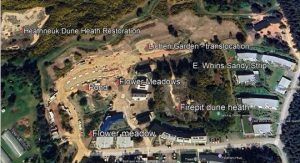
Ecology and biodiversity photo Google Earth Imagery ©2025 Airbus, CNES/Airbus, Maxar Technologies
North Whins is a special case, in terms of its focus on rare species and habitats, due to its proximity to the open dunes, which are of national biodiversity importance. Elsewhere in Ecovillage Findhorn, there is much more scope for community-led design for biodiversity and there has been a growing interest in the subject at the Park over the last few years, including as part of consultations for a Local Plan Plan, during 2023 and 2024. In 2023 the Findhorn Foundation commissioned a strategic ecological assessment of the Park, in anticipation of releasing ownership of areas of land.
Ecovillage Findhorn resident, Saille Mawson works as a Nature Proxy in the Park Planning Group to represent nature’s voice in the review of applications for development, in alignment with the Moray Council’s declaration of a nature emergency. Her role includes assessing tree felling proposals and she has undertaken a bat survey to gather essential information for their survival. In this link Saille described in detail the bats at Ecovillage Findhorn, here you can find a summary.
The Climate Crisis Work remains a high priority at the Park Ecovillage, with a series of studies on the Community’s carbon footprint taking place since the early 2000s (2006 report, 2018 summary, 2022 report, Building design, methods and materials are continually being improved and there is an aim to achieve carbon neutrality by 2030. Click here for four feasibility studies from 2022/3 funded by the Just Transition Fund.
Co-creation with the intelligence of nature, pioneered by Dorothy MacLean in the 1960s, is still alive and well in the Park. A Nature Group inspired by Dorothy, ROC and Frances Ripley continues, and a weekly nature meditation is held by Karen Grant, the Nature Sanctuary Focaliser. Attunement to nature continues as a personal practice for many and forms the basis of a wide variety of workshops which are offered at the Park Ecovillage Findhorn.
***
This Topic was jointly researched and written by Janet Shaw and Sean Reed.

Local ecologist


Leave A Comment