

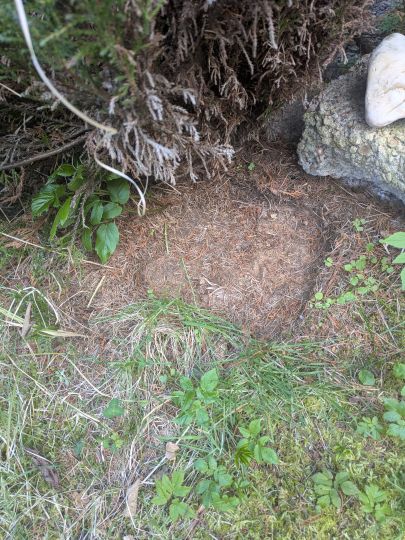
It had its moment of glory, beautiful amongst the honeysuckle and heather, steadfast support for a tower of muted colour. It looked amazing, I was told, against the blue-green cypress. Each stone so individual, all different, and balanced. But of course it was not a stone at all, but a chunk of iron ore, of value not so much for itself as for its connections and its history.
I was not aware of this at the time but went looking, stories of meteorites and sanctuaries nudging me on. Just maybe … and asking around it seems I was the only one who knew it was there or suspected where it might once have been.
There is a great deal of stone lying about the Park: quartz pebbles from the beach; smooth rounded cobbles – some of the flat ones, sourced locally with permission, had lain for a while on the Universal Hall roof; chunks of sandstone; large angled blocks in various shades of grey. Where had these last come from? How had they been moved? I could not begin to lift one. Much of this sharp edged rock has beautiful pink veins running through it, and there are also rarer rounded stones of pinkish red. But no heavy, dense, black block. Not one.
I looked in the Universal Hall Sanctuary, then in and around the Light of Findhorn Sanctuary as someone said they had heard it had been moved there, not actually knowing that it was this rock, the large stone that had sat by the low wall under the evergreen tree for at least the last five years. Look at the depression left in the grass; not just a casual stay. Though who had put it there, and why, it was hard to tell. It did indeed look dumped, hidden by its very ordinariness, especially once the exposed side grew weather-stained.
Later, after the story was brought to light, a friend asked, “why do you care?” then repeated, “why do you care? It’s just a lump of rock”. So I began to think – all that time, those worried two days, I had been putting two and two together and maybe making five hundred? Only later did I discover it was a chunk taken from the same mine as a very large piece placed in the meditation room at the UN in New York. No doubt many chunks were produced, yet this one, being placed here, may have had some special purpose? And we had noticed it was gone. Only I apparently, and the artist who, seeing it pulled out a little way, had moved it further for one of his natural sculptures. (“Not far, it was too heavy”, he said.)
A few hours, not more, it stood there, then vanished. So surely I had to look? Because also, many years before, I had taken a compass into the Universal Hall and been unable to get a reading: the needle just kept spinning round. Was that because of what sat in the small sanctuary below? And it had not sat there for quite a while.
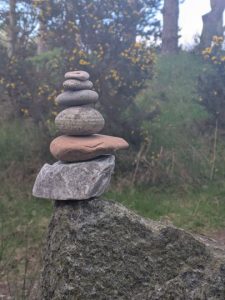
Stone sculpture
You see it was I who had agreed to pile unused stones on the low wall behind the Hall so that these ephemeral installations, so precariously balanced, should not unwittingly incorporate the edging of paths, or of flower beds, or stones weighing things down against the wind, or somebody’s favourite lunch-time seat. And that place for available stones was right next door to the one waiting in obscurity.
Yet it wasn’t I who turned its face to the light, nor was it the stone artist. He found it. Then we both lost it. No-one thought it mattered except the person who took it, and after some further travels around the Park, put it back in the St Germain Sanctuary in the Park Building, its former home.
All this happened over the Easter weekend (3rd – 5th April 2026). How I wish I had examined the stone more closely! For years it seemed just a large lump of black rock lying under the low branches of a tree at the back of the Universal Hall. As to the nature of the rock, due to its high magnetic properties it can only be either the iron ore magnetite or an iron meteorite. Magnetite, also known as loadstone, is a dark dense mineral, one of several oxides from which iron is produced by smelting. Iron occurring naturally in a pure state is extremely rare in terrestrial rocks. It occurs in stony meteorites but these are usually quite small in size. Iron meteorites, however, can be of great size, over 30,000 kg. They are made up of two different alloys of nickel and iron – the polished face of an iron meteorite would be spectacular, showing light and dark bands lying parallel to the faces of an octahedron.
It is not necessary to speculate whether iron’s magnetic power and ability to conduct heat and electricity extends to other energies. Science will answer that question soon enough. Even taken merely as a symbol, the placing of these pieces in the UN Sanctuary and in the community at Findhorn strengthens the links between meditators in the two locations. And any doubt about the nature of the stone now in the Park Building Sanctuary can surely be resolved by referring to those who, in order to augment the connection between the Findhorn Foundation and the UN, went to the Swedish mine to collect it.
So I have been running around when others knew all about things; for I have since learned that the status of this connection is due to change and to be transferred from the FF Trust to the FF SCIO, and that to honour these changes a meditation was held in the Light of Findhorn Sanctuary on Good Friday, the day two of us thought the stone had gone missing.

Born London, grew up in Teesdale in the north-east of England; Teesside Art College and St. Hugh’s College, Oxford; work in Birmingham – health authority, market research company, small charity. Environmental conservation, Birmingham Organic Gardeners (BOG), volunteer with local credit union, drawing and painting, hill walking in Wales (HFTH).



Leave A Comment