

 THE GARDENS THEN AND NOW

Attunement to Nature
 When I arrived in 1979 I had almost no training in gardening at all. My professional background was in forestry and I knew little about carrots and cabbages. I had no time to read books, there was so much work to do and the seasons didn’t wait. So I learnt to listen deeply for guidance and to have all my work in the garden based on attunement – it was the expected Findhorn thing to do.
As most of the people working in the gardens today don’t have the long inner training that Dorothy, Eileen and Peter had, we’re a safe place to develop our ability to attune to each other, to the land and its seasons, and to the specific tasks.
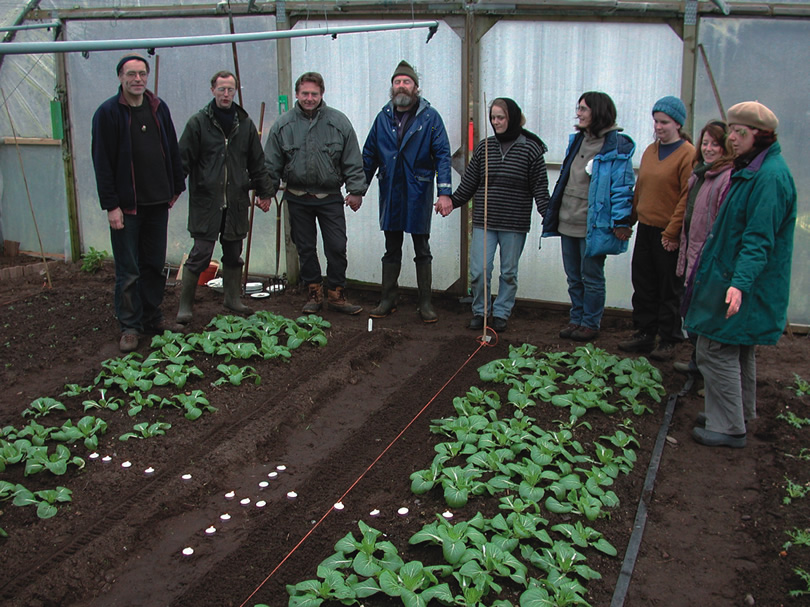 It helps that many of us have little formal training in horticulture. Our attempts to listen to the wisdom within all living things is often the only guidance available and the longer we practise the more attuned to the garden we become. However we do value opportunities to learn from those with more experience — we attend courses, read books and nowadays research online too.
Even with 30 years of gardening experience it still pays to pause and look and listen, and open to the ‘still small voice within’ which offers guidance in the here and now and whispers through every flower and tree. . . .
When I arrived, the community had already begun transforming the landscape by planting trees, which was essential on our windswept peninsula, and the famous Findhorn Gardens were still very much a focus for the community and guests. As a newcomer I had the impression that the gardeners here were just that little bit closer to the Great Mystery than others. The gardens and trees were smaller and flowers seemed to grow everywhere. I’m lucky to have seen some of the famous giant vegetables. By then, Cullerne Garden had reduced the pressure on the original garden to produce food for our tables.
Today many of those early trees are quite tall and would seriously crowd each other if we didn’t thin them out in winter. They provide shelter from the wind and are home to delightful creatures: birds and squirrels, and the tame deer we can see with the naked eye, as well as countless ‘little folk’, or ‘spirit people’.
Over time the trees cast shade, spread their roots and slowly changed the gardens. The emphasis began to shift. We applied the lessons learned while weeding, pruning or compost-making, to our inner gardens and inner landscapes. To the wild places within as well as the natural sanctuaries of our heart and soul. The gardens became background to the many programmes we offered, a safe place to experience the gentler aspects of nature, and to explore the interconnectedness of life.
Today we consciously cultivate food for the soul as well as the body. As the ecological aspect of the community grows in strength, the gardens are an important aspect of our quest for possible solutions to global challenges. There’s more emphasis on the integration of body and soul, expressed through the ‘edible landscape’ element, blending ornamental and culinary plants and herbs on our land.
We’re more conscious of what we as caretakers of this land can do to support a diverse wildlife population and help the dwindling honeybee population recover. Bumblebees, butterflies and even bats are important residents we try to support here as best we can.
We believe that the way we work with each other has almost a ritual quality, trying to plant seeds of hope, caring for our planet, cultivating fruits of spirit, and applying the values we believe in to the simple task of gardening in community.
Kajedo Wanderer

Digital Routes is a web design and development company based in beautiful Lossiemouth on the Moray Firth of Scotland




Leave A Comment