


The year was 1988. The world was in a state of change, and Gorbachev had brought forth the idea of Perestroika and Glasnost. There was an excitement amongst forward thinkers that peace and connectedness with the Soviet Union was imminent and possible for the first time in a generation. Citizen Diplomacy had arrived, initiated by groups in the USA, notably by Esalen and Danaan Parry, and this filtered through to Findhorn. Roger Doudna decided to organise a Findhorn Fellows Citizen Diplomacy trip to the Soviet Union, accompanied by Danaan Parry.
My personal history growing up in South Africa was a mixture of fear of, and attraction to, Communism – it was severely illegal to have anything to do with Communism, punishable by imprisonment without trial by the Nationalist government. This was one reason Richard and I left South Africa in 1973. There was also fear that the Communists were planning to take over the world, and the threat of nuclear war was there too. We joined the Findhorn Foundation Community in Scotland in June 1974.
So when I heard about the 2-week Citizen Diplomacy visit to the Soviet Union, I was inflamed with the desire to join. Roger D said I couldn’t join because it was only for Fellows, but he finally relented and allowed me and a couple of others like Henrietta Rose and Kim-Ellen Graham and Kresanna Aigner on to the tour. The whole idea was to break through the barriers and to meet as many Russians as possible, and make friends.
We arrived in Leningrad on 1st May 1988. It was Mayday, the Communist day to celebrate the Workers. We were taken in our Intourist bus to the university, near the statue of Lomonosov, where a large group of students were waiting for the parade to begin. We were fascinated by each other, the first time for everyone on both sides to meet someone from ‘the enemy’. One of the students, Natasha, was asked to interpret as she spoke English – she is one of my dearest friends to this day. We were so curious about each other, had so many questions. Then came the call to begin! The students hoisted their red flags onto their shoulders, and to our surprise our guide encouraged us to walk in the parade with them! So we did – along with grandparents, small children, young people playing guitars, balloons and lots of doves of peace everywhere! Not a tank or a gun in sight.
A young man walked with me and told me that he had done his military service in a submarine in the North Sea. I told him that I lived next door to the RAF base whose airplanes were searching for Soviet submarines in the North Sea! The irony was not lost on us – here we were, walking along in the spring sunshine together, and not a hint of enmity or hostility anywhere. We were just people.
As we walked through the square in front of the Winter Palace, in front of rows of dignitaries, groups raised their flags and shouted ‘Long Live the Makers of Thread! Hoorah!” and “Long Live the Builders of ships! Hoorah!” Not a gun or a tank in sight.
By the time we reached the end of the parade, a few hours later, we had already made friends, and were invited to visit them in their university dormitory. I leapt at the chance, and along with Henrietta, Kresanna and Kim persuaded the bus driver to take us there – bribed with a packet of Marlborough cigarettes. He happily did.
We walked up three flights of very worn stone stairs, to the dormitory where 5 students lived – 5 metal beds, 5 chairs and one table. About 10 students crowded in to meet us, and we were given the chairs to sit on. They made tea for us, but had no milk or sugar. One girl, Sayana, from Buryatia, produced a large jar of black caviar, and apologised profusely that they had no bread, so we had to eat it with a spoon out of the jar! Her family had sent it from the Volga.
During the four days we spent in Leningrad I totally fell in love with the students, the connectedness that we all felt and I was deeply moved by the idea that we could build a bridge between the Soviet Union and the West, simply through friendships. I also had a profound realisation about the nature of prejudice – if we have never met a person from the ‘other side’ we can only believe what we are told, what propaganda tells us. Once we know someone, we have our own experience to draw upon which may or may not be the same. I understood that from growing up under apartheid, where I never had a black friend, the only black people I knew were those who worked in our house, and similarly I had never met anyone from the Soviet Union, so how could I know if the propaganda was true or not?
From this, the idea of a 3-way International Youth Wilderness Exchange was born. What could happen if we brought together young people from The Soviet Union, from Europe and from Africa in an exchange where they could live together and learn about each other? The context was the Wilderness, that for me had been so important in my formative years, and the country was Botswana. One year later, in July 1989, 45 young people gathered in Maun, Botswana, 15 Soviets including a film crew from Leningrad TV, 15 from Europe, including 4 from Sweden, and the others from Findhorn and other parts of UK, and 15 from Botswana, including the National Youth Council and the National Wildlife Department, and set off on a 5-week expedition across the Kalahari desert, the Okavango and Victoria Falls, back to Francistown.
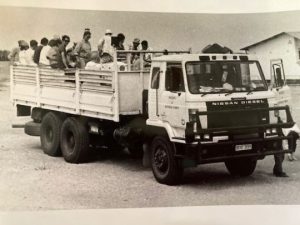 It was an idea whose time had come. The Botswana Wildlife Department and National Youth Council offered to host us and provided the 10-ton truck and camping equipment, Soros Foundation covered the cost of the Soviet group, airfares etc, and the Europeans covered the costs of their airfares and food for the whole group. It is a miracle that we pulled it off, especially as the Soviets had to get passports and visas, and we had NO internet, NO Fax machines, and had to book long distance phone calls 24 hours ahead. The Soviet Embassy in Francistown was flabbergasted when they heard that a large group of Soviets had arrived in Botswana without any prior information!! We were under the radar!
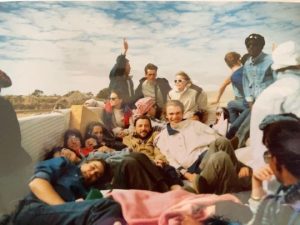 The participants were chosen for their interest in the social element, and also in the Wilderness and were between 18 and 25 years old. Of course, the Russians had their own way of doing things, and we ended up with half of the group ecologists, and the other half a mixture of students from Leningrad who were there for their own reasons, one of whom had no interest in anything, she just desperately wanted to get out of the USSR! The British group was a mixture of people from Findhorn, including Shirley Barr and Andrew Shorrock, one guy from the Centre for Alternative Technology, another from Easterhouse in Glasgow, and four from Sweden.
We camped out in a huge tent, and created a rota of cooks with one from each country that created all sorts of interesting dynamics. The Russians decided to sleep in the back of the truck, which caused some accusations of separateness, and the Botswanan girls quietly slept in their own small tent, with absolutely no intention of sleeping alongside men, particularly white men! No argument.
The group dynamics were fascinating, complex and very often extremely irritating. We sat for hours under a tree arguing about garbage; each nationality had their own take on it, and there was no common agreement. Similarly with making soup, and as some of the group were vegetarian, when the Botswanans killed an Impala for food, there was an outcry. We had got very tired of eating dried soya meat substitute and the venison was well received by almost everyone.
The cultural differences were fascinating. The westerners were the most groupy, determined that everyone should do all the tasks together, all at the same time. The Russians were the most individualistic, they refused to be coerced into anything, and said they had been forced to do everything communally for 70 years and would do so no longer. The Botswanans were like water – they never entered into a conflict, but quietly did what they felt they should do in their own way.
We would stop at a campsite after a long day on the back of the truck, and the westerners would insist that we had to set up camp, and put up the tent immediately and then rest. The Russians would first go and sit down and light up a cigarette. The Botswanans watched, and quietly went about their business.
One time we stopped at a campsite, where there was a huge pit full of cans and rubbish left by tourist campers. The western group leaped off the truck and immediately insisted that everyone take shovels and put all the rubbish into black plastic bags. The Russians reluctantly complied, and the Botswanans looked on, shaking their heads. Finally half the truck was full of bin bags, with not enough room left for people. And our Wildlife Leader said quietly: “So now where do you think this will go?” We stopped to think and said “We’ll take it to a Municipal Rubbish dump of course.” “And where is that? 300 miles south to the nearest town, and then it would be emptied out into another big hole and left to rot. Why not leave it here to do the same thing?” So guess what? We emptied all the bin bags back into the hole and covered it over with earth.
When we were near the end of the journey, we had been without water for washing for several days. When we stopped, all the westerners filled up all the buckets, and did a massive clothes wash spreading it all out on bushes to dry. Then came time to make soup for lunch. When it was ready, the Botswanans refused to eat it. Why? “Because,” they said sadly, “we explained many times that it is impossible to eat food from a container that has been used for washing clothes. In our tradition it is too dirty and we cannot eat it.” I felt so ashamed, we had simply dismissed their tradition, their point of view for the sake of our needs. We just didn’t value them at all. And it was too late to do anything to repair the damage. The Botswanans did without soup that day.
At the end of 5 weeks we departed, some back to the Soviet Union, some back to UK and Sweden. We already had plans to repeat the exchange the following year, next time in the Soviet Union, at Lake Baikal , then to Sweden, and finally to the UK, via the Centre for Alternative Energy, the Easterhouse in Glasgow, finishing up at Findhorn.
And we did it, in 1990 – with almost the same group as before, a few additions and drop outs, but mostly the same. Sayana organised Baikal, as her family is from Ulan Ude. It was the time when there were no organisations, no rules and actually it was pretty chaotic in the Soviet Union. We all met in Moscow, the Botswanans were out of their country for the first time, and very excited about that. Somehow we managed to get this huge group to the airport to fly to Irkutsk and there we waited, for hours, in a sort of metal cage, behind bars.
I noticed that Sergey, one of the Russian leaders, had a box of vodka bottles with him. I was really annoyed as one of the rules of the exchange was no drinking and said so, pretty sharply. He looked at me with patient compassion, and said, “Liza, this is currency, not for drinking.” And indeed it was. Throughout our journey in Russia, he paid bus drivers and food merchants with a bottle of vodka, and in that way we managed to get where we wanted to go and to see what we wanted to see.
This second half of our International Wilderness Youth Exchange was as exceptional as the first half, more so culturally than environmental, although to be on Lake Baikal and see 80 metres deep into the clear waters was astonishing. We saw how the paper pulp mill was polluting this great lake, and we saw fish that are unique to Baikal.
But it was living together in that environment that was the eye opener – the amount of rubbish was far, far less than when we were together in Botswana. Because packaging was basic – one paper bag for sugar, one for flour, one for tea. All recyclable, because it was non commercial! When we got to Sweden, the mountain of garbage was stunning in comparison.
Our group was under the radar, we were not official and therefore did not have any state support for organisational matters. When we arrived in Irkutsk, we had to take a short flight across the lake, and the flight was delayed. We sat around and waited, the Russians went to the flight desk to enquire – no information. The Botswanans and Russians just settled down against a tree to wait, but the westerners could not deal with the uncertainty. They even accused the Russian leaders of withholding information. The truth was – no information means NO information. Seven hours later, a plane arrived and the pilot was persuaded (with a bottle of vodka) to take us across the lake to Ulan Ude.
The drama did not end there – the next day there was no bus to take us to the lake shore. We had no official leverage, so all we could do was to start to walk the 10 miles in boiling hot sunshine. Nine miles later, a bus turned up, the driver also bribed with vodka, and he took all our luggage to our lakeside camp.
We spent an amazing time on the boat, exploring the depths of Lake Baikal, the hot springs, eating a special Baikal fish and again getting to know each other in a different cultural environment. We were struck by the lack of garbage our large group generated – all our food supplies were packaged in brown paper bags, with no identifying labels other than ‘sugar’, ‘rice’, ‘flour’. All were disposed of in a bonfire at the end of our camp, and nothing was left to show we had been there.
Sweden was a shocking contrast to the Soviet experience – a camp on an island, very civilised, trips on a great big sailing boat on the Baltic Sea, and tons of garbage!
Finally the UK; our time at the Centre for Alternative Technology in Wales was informative and uneventful, and then we went to stay in Easterhouse in Glasgow, in a hostel in the centre of the most deprived area of Glasgow. We had a work project to paint a mural in the community centre, and felt we had made a contribution to the poorer section of society. Ironically, the Soviets didn’t see it like that at all as the high rise apartment buildings and inadequate shops and facilities were all too familiar. When we returned to our hostel, we were met with a shock – local thieves had scaled the drainpipes and stolen cameras, clothes and equipment that were treasures to our group. Everyone was incredulous – how could they steal from people who had spent all day making their Community Centre beautiful?? A wake up call.
Then finally to Findhorn: to a project for Trees for Life in Glen Affric. Our task was to cut down all the non indigenous trees in a particular area. Paradox: the Botswanans were horrified because trees in their country are precious, and no one would dream of cutting them down to get rid of them! It was painful for them to do the project. And then there were the midgies! The Russian rebelled! No way were they going to go out of their tent and be eaten alive! So they stayed inside, the Botswanans didn’t want to cut down precious trees, and the westerners felt obliged to do what was expected of them…
That was the end of the International Youth Wilderness Exchange. My friend Sergey’s last word was: “Before I didn’t know anything about Europe, or Botswana. Now I can say that I know people from Sweden, from Britain, from Botswana. Some of them I like, some of them I don’t. But that is normal amongst people. That is why the Exchange was useful to us all.”
Two people got together and married – one English, one Russian; Sayana and Natasha have remained close friends with me for a lifetime; Sergey and I organised Ecology Camps in the Urals for 7 years for students from Edinburgh University Ecology Department; the others remained friends or didn’t, and for sure, everyone’s lives were indelibly changed by the experience. Sadly, the only copy of the film that was made was stolen from Sergey’s flat in Ekaterinburg.
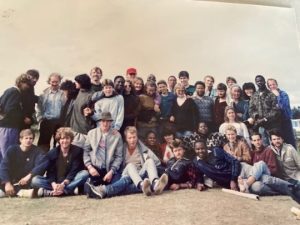
Kitezh Children’s Community and the Birth of Ecologia Youth Trust
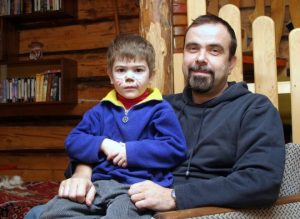
Morozov-with-son
In 1993 I was introduced to Dmitry Morozov, the founder of Kitezh Children’s Community. I met Alexander Shubin at an Ecology conference in the Urals forest camp and as we walked back to the vehicles, he told me all about his friend and colleague Dmitry Morozov. He was very interested in the Findhorn Community. So Alexander told me I had to meet Dmitry Morozov and took me to his flat in Moscow. We clicked immediately. His aim was an inspiration: to rescue orphaned children from impersonal, Dickensian institutions, and to give them homes, families and education in a supportive community. He understood the principles of Findhorn as he had spent time with a teacher in India, and we shared similar values. He felt that the only hope for change in the world was through the children.
I first visited Kitezh in Kaluga Region, 300 kilometers south of Moscow in winter time! 20ºC below freezing, deep snow, a howling wind, 90 hectares of land, forest, a lake, land stretching forever, begging to be used. One small house with a cluster of adults and children living together, children taken from the streets of local villages, adults drawn from all over Russia inspired by the vision of one man. The only source of water was from the well outside, and the toilet was outside too. How could people survive like that? Their hearts opened and drew me in and I returned again, and again.
I took others with me, groups of adults and eighteen teenagers from the Findhorn Youth Project in 1996. We brought the Kitezh children to Findhorn in 1997. They felt at home and the connection was made. In 1998 Dmitry Morozov was invited to speak at the Findhorn Foundation Sustainable Communities Conference.
1998 was the year of the economic crisis in Russia when all the banks folded, literally closed their doors. “Sorry no money left, it’s lost.” I was crazy with worry about the children at Kitezh. So Ecologia Youth Trust came into its new raison d’etre. Fundraising! That year we raised £20,000 for Kitezh. The following year we raised £30,000. The village doubled in size as a result.
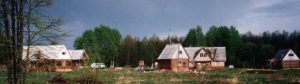
Kitezh village
Our ‘Adopt a Godchild’ idea took off and people from all over the world ‘adopted’ Godchildren at Kitezh. We successfully applied for funding to run a Social Work, Therapeutic Education and Community Building Training at Kitezh. Play Therapy became part of the Kitezh way of working with children’s healing process. We ran a Community Building Workshop every year.
In 2002 the British National Lottery funded a big project to expand the impact of the Kitezh model in Russia. In 2004 we started to build the second Kitezh village, Orion, with Maria Pichugina, previously a teenager at Kitezh, at the Head. DEFRA and the British Council paid for biological waste water treatment reedbeds at both Kitezh and Orion. Our volunteers’ programme grew and grew, with students from all over the world coming to take part in the community and to improve their Russian.
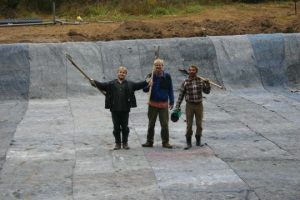
Reedbed at Kitezh 2005
So Ecologia Youth Trust came into its own, transformed from an idea into a substantial charity with a vision and a mission.

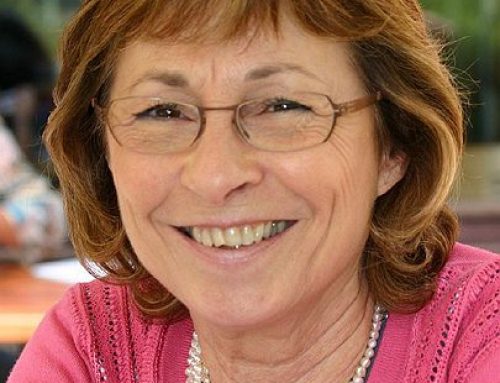
Born in South Africa, came to Findhorn in 1974 with Richard Stern. Married Lyle Schnadt in 1977. Worked with the Game of Transformation as a Guide, co-author with Eileen of her autobiography Flight Into Freedom and Beyond. Went to Russia in 1988 and started Ecologia Youth Trust in 1995. Still living in the Findhorn Community today.


Leave A Comment