


This article was previously published in One Earth magazine Volume 2 Issue 2 November/December 1981.
***
The Findhorn Foundation has changed considerably over the years. Like a true organism, it has developed new facilities to cope with the effects of a rapidly changing world. No other place within the Foundation shows more evidence of this change than the garden, if for no other reason than that it is the oldest department. In the beginning was the garden, and the garden continues, but the forms that express this spirit are today far different from those of nineteen years ago.
Today the Garden School provides an umbrella for all of our work with nature. Based at Cullerne House, it has been operating for three years and was officially announced just twelve months ago (see One Earth, Oct ’80). This past year has seen the number of students grow to twelve, with a central staff of seven charged not only with the student programme and the evolution of the Cullerne property itself, but also with liaison between the various Foundation gardens and contact with the greater environmental network throughout the world. Most of the work is based at Cullerne, but the Garden School includes activities throughout the Foundation, with students who stay longer than one three-month term working increasingly in the other areas. One fascination is watching the students themselves become teachers as new students arrive and assume tasks which they themselves found new and unusual only a few months previously. The work programme is project orientated, in order to facilitate an increased sense of responsibility and partnership, and is based around three principal areas: food production, ornamental plants, and appropriate technology.
Our efforts in appropriate technology come collectively under a programme we call ATEC, or Appropriate Technology Exchange between Communities (see One Earth, April/May ’81). Our commitment to this type of development has increased dramatically this past year, and has been generously and completely funded through donations from friends and co-workers in other parts of the world. So far the 1981 programme is three-quarters complete, providing valuable data and experience.
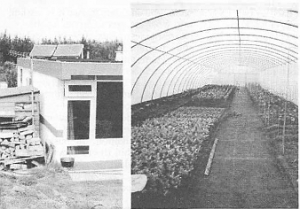 Two private homes have been fitted with solar-assisted hot water facilities, and the community centre at the caravan park has six square metres of solar panels providing seventy per cent of its hot water requirements. The new family centre at Pineridge is virtually complete with an attached greenhouse/solar collector and a Russian fireplace. Two more solar greenhouses are to be constructed (at Cluny Hill and Erraid) and we are doing considerable work at Cullerne with modified plant environments. Various combinations of net and polythene coverings achieve different micro-climate effects, and currently our largest polythene tunnel is being retrofitted with solar-assisted undersoil heating. This is, in part, a cooperative project with Arcosanti in Arizona, where Roger Tomalty, who works with solar techniques there, is also investigating and installing this innovative system. Other ATEC plans include an expanded irrigation system at Cullerne, a large-scale domestic hot water retrofit of Cluny Hill College (involving sixty square metres of collector!) and a wind power programme on Erraid.
Our approach to appropriate technology is not all hardware, however. Our tree programme has just taken root, so to speak, and is rapidly branching out. This winter we will be establishing a principal tree nursery at Cullerne, with auxiliary nurseries at the other gardens. Our aim is not only to produce large numbers of trees for ourselves and neighbours but also to establish species best suited to our area as a source of shelter, food and fuel. The beauty, wisdom and stability which these great trees provide is of course another factor. The Cluny Hill area already has a lot of mature trees, planted up to 150 years ago by local residents. Drumduan House benefits from some of this planting, and gardeners there will be establishing a woodland walk through the grounds, as well as providing a home for the Findhorn Forest Library.
Along with our work at home we continue to reach out to other individuals and organisations who share similar values. Drumduan House, home of our Communications centre, is also the base for our continually expanding network of environmentally concerned groups. Among several with whom we have established working arrangements recently are: Gardens for All (USA), Centre for Human Ecology (Edinburgh), Wilderness Leadership Foundation (South Africa), Men of the Trees, Children of the Green Earth. With these and others we are planning a series of gatherings and seminars over the next two years to facilitate cooperation within and communication of the work we are all doing for the environment.
These are only some of the planks of what seems to be an increasingly well-established environmental platform at Findhorn. Other efforts, such as recycling of paper and home insulation also continue to operate. The continued evolution of this programme is only partially dependent on new forms. The most important factor is the attitude and consciousness of community members. As long as each of these environmental planks is created as a channel for spirit and form to interact more freely, then our efforts will yield an ecological village which is sacred as well as planetary.

Working for wild nature, wild people, wild planet


Leave A Comment