


The connection between Ecologia and Thailand and Myanmar was made through Jane Rasbash and her husband Pracha Hutanuwatr in 2006. Pracha was visiting Findhorn to support Jane who had just completed serious medical treatment in hospital. She brought him to meet Liza as she had helped Ecologia Youth Trust with grant applications for our youth project in Russia. Coincidentally, we had found an announcement that the UK National Lottery Fund offered funding for victims of the Tsunami. As we talked about young people who need support, Pracha gently, in his inimitable way, suggested we form a partnership to support the young people in migrant workers families from Burma to integrate into Thai schools and form relationships with Thai youth.
Partnership with the Sathirakoses-Nagapradeepa Foundation (SNF)
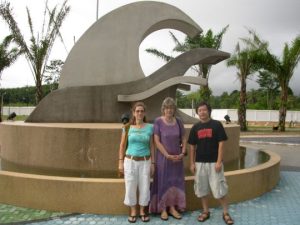
Jane, Liza & Moo Tsunami Memorial
The scope of the project rapidly grew into a substantial 3-year project in southern Thailand. Ecologia, supported by funding from the UK Big Lottery Fund, worked with Somboon Chungprampree (Moo) in partnership with the Sathirakoses-Nagapradeepa Foundation (SNF) to promote the human and workers’ rights of Myanmar Migrants in Thailand. When the huge Tsunami hit Southern Thailand in 2004 it caused devastation to coastal communities, many thousands died and many more became homeless. The large number of migrant workers from Myanmar in the area, mostly unregistered, struggled to access relief facilities provided by the Thai government and international donors. Additionally, they found it difficult to access their human rights, both socially and economically.
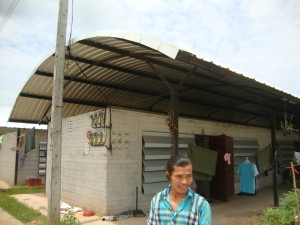
Plan Toy eco-accommodation for workers in Thailand
Ecologia worked with SNF to restore the livelihoods and empower devastated communities of 50,000 traumatised and marginalised migrant workers and their families after the tsunami for an initial 3-year project. It was successful in increasing awareness of and access to human and legal rights and supporting nationality verification for thousands of migrant workers. The project also supported migrant workers to gain nationality verification, an important part of the registration process.
After the project was completed, it was clear that there was still much work still to be done in relation to migrant workers’ rights and in the huge gaps between policy and practice. In 2011 a second phase was established and in operation until 2014: Promoting Human Rights, Good Governance and Accountability for Migrant Workers from Burma in Southern Thailand
The second project aimed to further empower the migrant workers to organise themselves to get their rights protected and entitlements granted.
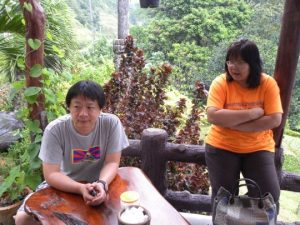
Project Managers Moo and Ame
The partnership between Ecologia and SNF built relationships between migrant workers from Myanmar, local officials, employers and the Thai community through human rights trainings and awareness raising. Migrant worker community-based organisations were launched providing leadership training for community leaders and undertaking active peace building events to strengthen ties between communities. Pilot legal clinics were established to support the migrant workers’ access to their rights and entitlement. Burmese and Thai youth took part in peacebuilding activities that helped to overcome national prejudices, and the Burmese children were able to learn Thai and go to school.
Over eight years, the two phases of the project built up policies from grassroots aimed at overcoming problems and benefiting migrant workers, particularly in the Andaman region. Overall, the project succeeded in improving awareness of human trafficking and human and labour rights for both Thai and migrant workers as well as increasing migrant worker access to rights.
For further information read the article: Seeds of Peace Journal 2015 “Migrant Workers are Human too” by Jane Rasbash, Thai Projects Consultant, Ecologia Youth Trust.
In 2015 Ecologia set up a project in Myanmar aimed at directly addressing the Myanmar migrant worker problem at source.
Partnership with NGO Kalyana Mitta Foundation (KMF) in Myanmar
From 2015-2018 Ecologia, funded by a grant from the UK Big Lottery fund, worked alongside partners in Myanmar, local NGO Kalyana Mitta Foundation (KMF) to implement a project at Inle Lake, Myanmar.
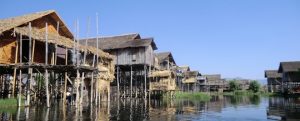
Lake Inle Myanmar photo Ecologia
Myanmar, formerly known as Burma, had been the rule of a military junta from 1962 to 2011 that had suppressed almost all dissent and stood accused of gross human rights abuses, prompting international condemnation and sanctions. A gradual liberalisation began in 2010, leading to free elections in 2015 and the installation of a government led by veteran opposition leader Aung San Suu Kyi the following year.
An increase in tourism to Myanmar in 2015 led to pollution problems and pressure to provide facilities to serve the increased visitor numbers at locations such as Inle Lake, a beautiful, freshwater lake with a unique eco-system on the Southern Shan State plateau in Eastern Myanmar. Most farmers at Inle lake had previously relied on small-scale traditional farming, but mono-cropping agri-business models with high pesticide/herbicide use arrived and contributed to severe environmental degradation of the lake and resource bases. This led to debt cycles, exploitation and loss of livelihoods as Myanmar emerged from years of isolation. Local people were aware of environmental issues but did not understand the causes. Climate Change was an unknown phenomenon to locals. Lack of opportunities for young people led to many leaving as migrant workers to Thailand or to resorting to illicit ways of earning a living.
The project aimed to improve the livelihoods of disadvantaged youth, while protecting the environment of the area, through sound agricultural practices that increased sustainable land use and improved resilience to climate change. The focus was on restoring the local environment, and on supporting social enterprise and training for young people. The young farmers set up 25 demonstration plots as examples of eco farming that inspired other farmers, showing them its effectiveness in contrast to the highly chemicalised practices that had become customary in the area. As a result, nearly a thousand households in 50 villages actively practiced eco-farming with increased diversity of crops, having moved away from mono-agriculture.

We love Inle Eco-Cafe: photo Ecologia
The young people in the project set up an Eco Café on the banks of Inle Lake.
By 2018 this project was completed. Tragically, the military continued to exert a grip on the country. In 2017 an army operation had driven more than half a million Muslim Rohingyas to flee to neighbouring Bangladesh. Aung San Suu Kyi and her government were overthrown in a coup by the military in February 2021, abruptly halting the country’s fragile transition towards democracy. More than 15,500 people had been arrested as of September 2022. Aung San Suu Kyi was detained and sentenced to 20 years in prison.
Ecologia Youth Trust (1995-2024) was a Scottish based charity based at the Park, Ecovillage Findhorn, founded by Liza Hollingshead and brought to a close in 2024. Over the years it helped transform the lives of over 56,000 children, young people and families affected by poverty, inequality, disease and climate change in 7 different countries: Russia, Georgia, Thailand, Myanmar, Kenya, Uganda and Scotland.

Ecologia Youth Trust, 1995 – 2024, supported children, young people and families in many countries, including Russia, Thailand, Myanmar, Scotland, Kenya and Uganda. Founder Liza Hollingshead.




Leave A Comment