

A Topic is a “Readers’ Digest” of a specific aspect of our Community history.
Click the arrow to learn more.
Topics give a synopsis and a compilation of stories that give more depth and background information to that facet. In the Topic post we aim to offer a broad view of a subject, to present facts more than personal views of the writers, to represent the breadth of the smorgasbord which is on the website, with links to personal stories as well as relevant documents. We leave the personal views and perspectives to the individual stories, where we relish different, even contradicting angles on the same event/fact, as we see the wisdom in the saying “if you step on a paradox, you likely have some truth on your shoe”.
Topics are often written by more than one person, and represent the available knowledge at that time. We aim to keep Topics updated. Topic posts endeavour to be factual. However as they are often based on personal recollections, we may get things wrong. If you have suggestions for improvements, please leave a Comment below here or in the relevant Topic post. Thank you!
To group the Topics we have applied the Dimensions of Sustainability used by the Global Ecovillage Network (GEN) and Gaia Education.
Click on the arrow to read more about them.
The early expressions of the concept was presented in the One Earth Magazine 1986/7.

The 4 dimensions have been evolved in slightly different ways by GEN and GAIA Education.
-

- GEN 4 D logo
-
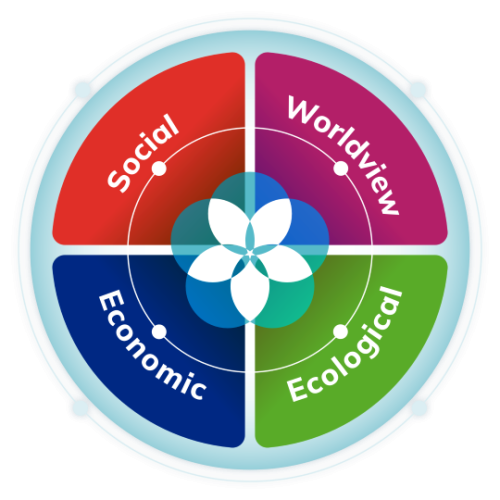
- GAIA Education 4D mandala
-

- GAIA Education 4D mandala illustrated
This shows that they are adaptable to whatever is appropriate in each person/community’s socio-cultural and geographical context.
This collation is not perfect and some papers may be listed in one or more dimensions. <we will hyperlink the post explaining the dimensions once it is published – it’s work in progress>
Please click on the arrow on the left to expand the sections.
Worldview
We list topics here that relate to the underlying worldview and values, this includes the arts and education (concepts and content). At the heart of regenerative culture lies a transformation of consciousness — a shift away from the disconnected, extractive worldview that underlies so many of our current crises, and toward a more holistic understanding of what it means to be human. In the original planetary village diagram of the Findhorn Foundation from 1986 this was called ‘spiritual’.

Our Foundations – founders and formative people

Our Foundations – more formative people and networks


The Park Ecovillage Findhorn – early conferences (1976-1995)

Vision and Purpose of the Community


Ecology
The ecological dimension addresses the practical, material fabric of regenerative living: green building and retrofitting, local food and nutrient cycles, water, renewable energy and appropriate technology, rural and urban regeneration, and disaster recovery. Community-led design processes are central.

Developing a Planetary Village (1982-1995)


Cullerne Gardens – Early Years


Ecovillage Findhorn – Tours of the Park

Ecovillage Findhorn: Nature, Ecology and Biodiversity

Ecovillage Findhorn: Transition to a Sustainable Future

Economy
Shifting toward sustainability, and in particular nurturing local economies. Core values include right livelihood (earning an income that nurtures rather than extracts from people and the natural world) and conscious consumption (how much is enough?). Eco-social enterprise, community banks, and local currencies are all expressions of this work.


Social
Regenerative communities are built on the quality of their relationships. Peaceful communication, participatory decision-making, healthy governance, conflict management, and inclusivity are all priorities. Leadership structures consciously distinguish between power with and power over. Art, ritual, celebration and social creativity are deeply valued as vital aspects of thriving community life. The development and delivery of regenerative education, nurturing of networks, and peaceful activism are embedded throughout.

Decision-making and Governance

Whole Systems Design
Whole systems design is what weaves the four dimensions together — not as a checklist, but as a living, holographic way of thinking and planning.


Inspired by CommUnity, a group of NFA volunteers, manages this website. Hearing each others stories, and learning about the history of this community can help us all to find more cohesion and a sense of belonging. Read more.<




Leave A Comment