

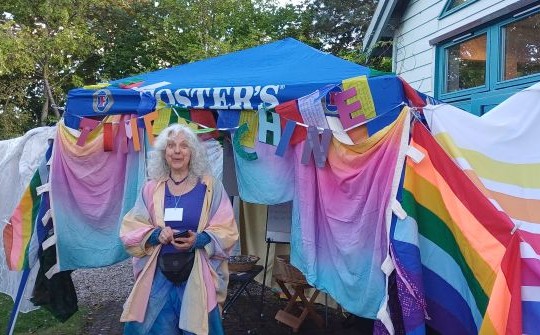
This story starts in May 2025 with listening to a podcast where Rob Hopkins introduces his upcoming book, How to Fall in Love with the Future.
I came away with a powerful inner prompt: Loving a thriving future into being as spiritual practice. And it was clear to me that imagination is essential and that a time machine is a powerful tool to support it. I was delighted when I was given the chance by Ekopia to try it out at the CHI’26 Storyfest.
The invitation Ekopia sent out introduced this part of the storyfest:
“The 2031 Community Hub. Imagine we are time travellers returning from 2031. What does our Community Hub look like? Where is it? What happens there? What can we see, hear, smell and taste? Who uses it and what does it bring to our community? This is our opportunity to imagine what could be possible.”
In this post I want to share the magic, how it all came together, the process, the outcomes and a bit more background from Rob Hopkins. There are lots of photographs for you to be able to partake in the amazing event. I hope that this simple but effective tool of collective visioning may be useful for others.
Preparations
I was delighted when the organising team was willing to embark on the idea and gave me free hand to flow with it. Some logistical challenges became the perfect solution and created an environment that supported the magic.
The storyfest took place in the Moray Art Centre (MAC) and our initial assumption was that we would use the reception area for the time machine.
However that wasn’t available, as an exhibition was being prepared at the time of the storyfest.
What seemed a problem became a magical solution. We decided to have the entrance at the back of the MAC. This allowed us to send 2031 time travellers into a little known corner of the garden which added to the magic of the exercise.


The Time Machine Structure
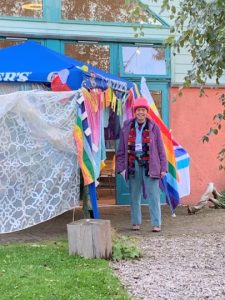
The time machine itself was a simple gazebo enhanced with lots of colourful fabric that funnelled the participants past a welcoming host who ‘wove the magic’, handed out the 2031 glasses and scent bottles with labels, read out the instructions then sent them on their way. One exit led into 2031 and the other into 2026.


Weaving the Magic
The host welcomed the participants into the time machine, where there were information displays from the mundane and the magical. The host recited the ‘instructions’ and the wee ditty.
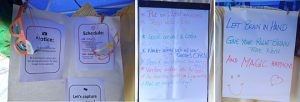
- Put on 2031 glasses
- Step into 2031
- Take your time
- Look around and listen
- Notice the smells
- Wander along with all your senses open
- Does it feel different from 2026 – How?
- Venture further into the Park
- Are there new buildings? What are they?
- What are people doing?
And a there was wee ditty we recited:
With left brain in hand
Give your right brain free rein
And magic happens
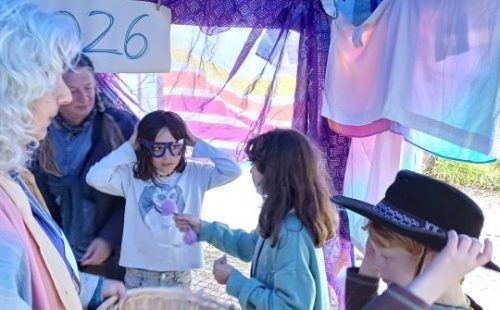

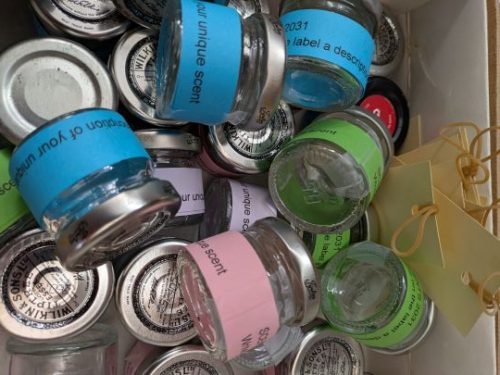
Participants of all ages chose their magic 2031 glasses and a little bottle to capture the 2031 scents which they could describe on the labels provided.
Journeys into 2031
Once inducted, participants were sent out through the 2031 door.

That door led into the ‘secret garden’ behind the MAC which many people were unfamiliar with. This helped with the sense of entering a new world.
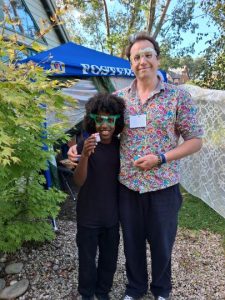


They were met by messages: We Made It and Loving a Thriving Future Into Being


And they found copies of our community newsletter, the Rainbow Bridge and a newspaper from 2031 which many read with interest.


Fictional 2031 news
The time travellers wandered around the garden and further afield, sampling perceptions, impressions and scents which they brought back to the time machine.
Coming back to 2026
When participants came back to the time machine from 2031 they were welcomed back by the host. They returned the glasses which were hung up in the tent and were ushered into 2026 where they found the ‘CC-of-the-day’ social space.
-
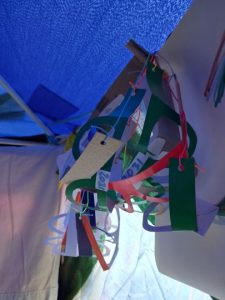
- Returned 2031 glasses (LW)
-
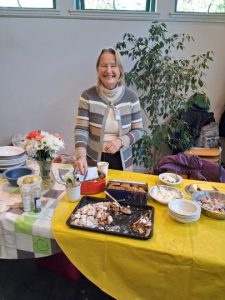
- Serving in the CC-for-the-day (LW)
-

- KP for the day (LW)
-

- Enjoying the CC-for-the-day (LG)
The outcomes
Participants were invited to leave their findings, impressions and scent bottles in the consultation room.
-

- Day 2 display wall (LW)
-

- 2031 scents (CF)
Sadly we can’t share the scents but these labels may give you an idea to help conjure up the smells.


All the detailed information of the contributions are in the main report of the CHI’26 Storyfest. There were writings, drawings, even a wee performance and also recorded stories, which have been turned into posts on this website, and in the evening there was a harvesting round where participants reported back. Please click here to read all about those findings.
The Inspiration Behind the Time Machine
Rob Hopkins is the author of several books and there are many YouTube videos where he is interviewed, or gives presentations. I took the following quotes and directions from his interview with Nate Hagens.
“The future must enter into you a long time before it happens.” Good storytelling around this future enables us to do that”
Rainer Maria Rilke (Timestamp 36:30)
About Longing:
Don DeLillo in his book Underworld, says
“Longing on a large scale is what makes history.”
(Timestamp 1:10:23)
Nate in his introduction says
- there are tools and practices to cultivate what he calls longing at scale, a deep felt sense of what we’re building toward, not just running from. This includes the concept of evidence-based dreaming (2:20)
Rob recommends
- if you can create … an event where people come together with other people, they laugh, they have fun, it’s colorful, it’s an adventure. They get to imagine in that future in a way that cultivates a deep longing for that future, then what they do is, they create a memory of the future … (38:06)
- to the senses: What would it smell like? What would it feel like on your skin? What would that world taste like? He says about smell: Human beings can remember ten thousand smells, and we can attach memories and emotions to all of those smells. And so I do an activity that’s called making scents of the future. (1:01:08)
Thank you Rob, for this wonderful inspiration. It was a blessing on our day.
***
Photo credits: Thank you to Caroline Geurtsen, Lora Wedge, Pip Lee Meer, Marilyn Hamilton

Originally German, I came to Findhorn in the search of ‘It’. I found ‘It’ in our way of sharing our spirituality in our daily lives, privileged to work with my focus on Healing in the widest sense.




Leave A Comment