

The following is a summary by Carolin Waldmann adapted from an article in our weekly newsletter, Rainbow Bridge on 11th Sept 2026.
Imagining HerStory & the Archetype of the Artist
I am delighted to share some reflections on the latest Your Community, Your Story – Spiritual/Worldview workshop, held as part of our ongoing journey towards November’s Heritage Week: A Living Story. (Now renamed to When We’re 64: A Living Story)

For me, each of these workshops has become something I enter with anticipation, curious about what wants to emerge. Perhaps, as I have written previously, this is the Generative Potential at work: once the theme, the people and the space are present, what might be the most fruitful thing to explore together?
This session felt very much like the creative, spiritual process itself: a blank canvas, a not-knowing to start with and then, gradually, a presencing of the story ready to unfold. We began with a large group conversation, exploring the role of the Arts in community – both in the past and today – and contemplating some bigger questions. Why do the Arts still seem marginalised? Why are they often among the first sectors to experience funding cuts? And why does an artist working in community so often have to justify their work, as though it somehow carries less value or credibility than professions with a more clearly defined and predictable trajectory? We reflected on this in the context of our own history and Laura Pasetti, one of the co-facilitators, also reaffirmed the archetype of the artist, its utter relevance in this time and its superpowers of soul and imagination.
 From there, Laura and I found ourselves moving into a deeper exchange, sparking ideas between us and towards the end, I found myself connecting with another treasure box: Community magazines of the past such as the One Earth magazines, or the later Network News. And wow – those early writings, particularly around community, creativity, spirituality and the arts, still hold so much wisdom and relevance today.
Once again, I am reminded that these sessions are not simply about looking back, they are about connecting past, present and future and listening for the threads that weave between them. What a privilege it is to find ourselves in this always-unexpected orchestra of Community members, each sounding a different note, perspective and experience and to have the space to enquire, to wonder and to ask the deeper questions arising from our emerging collective consciousness that writes herstory. Right here, right now.
***
Synopsis
This workshop had a particular flavour of being unscripted as the day before when the COIF team met to prepare there were no bookings. The option to cancel was discussed but then the flow of the sharing became so inspiring that we decided to go ahead and hold the event just for ourselves. And the universe responded, for over the next 24 hours bookings started to come in, and in the end a group of twelve gathered for the four-hour session exploring the spiritual dimension of community culture (Worldview) through the lens of the Arts.
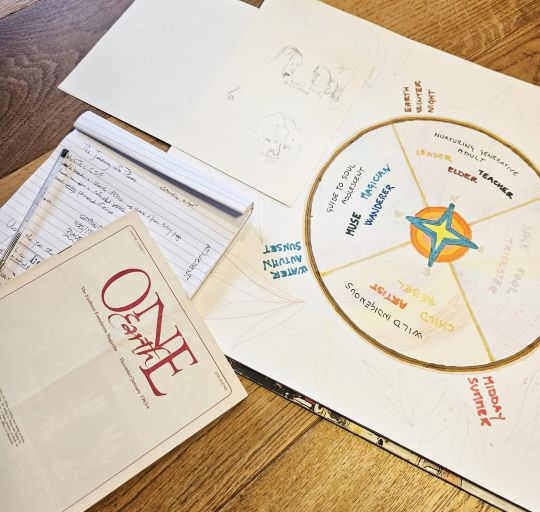
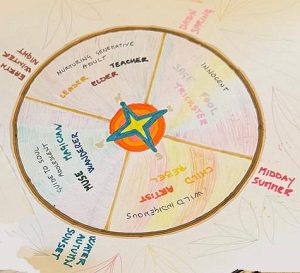
 The afternoon opened with an Introduction Round, moved into a framework of the seven directions, adapted from the Jungian medicine wheel — as a map for the exploration, then gave way to an unstructured Open Space, and closed with a Show and Tell Round in which the individually made pieces were shared, witnessed, and woven together.
What follows draws together the themes that ran through the workshop’s conversation — not a blow-by-blow account of who said what, but the shape of what the group was collectively working through. It is followed by personal stories and practical outcomes that surfaced during the session.
***
In Detail
Please click on the arrow on the left to expand the sections. We offer here the threads that were woven throughout the session, not necessarily in chronological order.
A Living Map: The Seven Directions
 The short attunement meditation at the beginning ended with a Mayan Prayer
From the East, House of Light
May wisdom Dawn in us
So we may see all things in clarity
From the North, House of the Night
May Wisdom Ripen in Us
So we may know all from within
From the West, House of Transformation
May Wisdom be transformed into right action
So we may do what must be done
From the South, House of the Eternal Sun
May right action reap the harvest
So we may enjoy the fruits of Planetary being
From Above, House of Heaven
Where star people and Ancestors gather
May their blessings come to us Now
From Below, House of Earth
May the heartbeat of her crystal core
Bless us with harmonies to end all war
From the Center, Galactic Source
Which is everywhere at once
May everything be known
As the light of mutual love
Oh Yum Hunab Ku Evam Maya E Ma Ho
All Hail the Harmony of Mind and Nature
The seven directions, brought by Laura Pasetti, artistic director of the Theatre of the 7 Directions, as a working map rather than a doctrine, rooted in the medicine wheel and the four seasons — East as dawn and infancy, the white canvas of pure possibility; South as summer and the body, fire, freedom and curiosity; West as sunset, transformation, the falling-in-love of the muses; North as winter, the warrior and the leader, the place of true adulthood and service — with above (collective consciousness), below (soul and purpose) and centre (the spider’s web from which all directions can be reached and served) completing it.
Laura encouraged the group to use the concept loosely with an invitation to locate themselves where they felt drawn (the freedom of the South, the deepening of the East, the North’s demand for structure and sustainability etc.) and using that as a lens for the stories and objects they went on to make. Some reflected on nature’s seasons, with the coming darkness of Winter, remembering that the seed needs darkness to germinate, and how the founders, three people, arrived in the dark “not knowing a thing,” with no money, in a caravan.
Laura recited the Emily Dickinson poem “Not knowing when the Dawn will come, I open every Door” — and this wove as a thread through the workshop: that creativity begins in the place before you know what you are making.
Arts and Creativity Shaping Community Culture Across Generations
The group traced a loose timeline:
- The fun nights and the Lollipop Shop of the early years, when Community members created skits making fun of Peter Caddy. It is said that Peter himself supported this and someone wondered whether that may even have been part of why the Community survived his leaving in 1979.
- In the early 1970s, the New Troubadours, and the Arts and Performance group that performed not only in the Community but also locally and even went on tour with Peter and Eileen.
- In 1976 Bernhard Wosien brought Sacred Dance to the Community. The fiftieth anniversary was marked by the weeklong Sacred Dance Festival going on at the same time as this workshop.
- Five Rhythms arriving around 1990; evolving into Open Floor.
- Theatre and dance work of the 1990s and 2000s led in part to what is now Dance North, and so much more, work that carries the Community’s culture and values out into local schools and groups.
- The many different singing traditions, such as Taizé Singing and Kirtan, and the many different choirs.
- The Moray Art Centre and the tradition of fine arts, media
- … there is so much that the list will always be incomplete.
What connects it all is the insight that art and creativity can convey, so much more than words, the underlying values and practices of our Community’s culture.
The Economics of Soul
A strong thread of the afternoon was a shared, sometimes painful, reckoning of how the arts have been valued — and undervalued — in the world, but also in the Community. Several participants traced this back through decades of lived experience:
- a movement and drama therapist arriving in 1989 and having to argue her way into a work department that could hold what she did;
- another was told that “the community is a work of art, it doesn’t need works of art”. She went on to channel her practice outward into the local community instead, because creating work inside the Findhorn Foundation’s structures wasn’t supported;
- the sting, still remembered clearly, of being asked to provide some music for a tea break at a 2019 conference and feeling her expertise treated as a ‘filler’ rather than substance.
The group named the pattern directly: a felt hierarchy between work and art, in which artists were sometimes seen as having the easier, more self-indulgent path, free to do what they wanted rather than what was “needed.” Is was stated emphatically that art is not entertainment, it is the soul of a place, and being an artist is a mission that can be as painful as it is joyful.
The Universal Hall and the Moray Arts Centre were named as two of the largest buildings in the Park devoted to the arts. Present fundraising for the Universal Hall is focused on bricks and mortar rather than the people and practice inside it, and the charity that had been supporting the Moray Arts Centre had just given up its tenancy in the building due to financial constraints.
The Universal Hall fundraiser recently evoked a barrage of hostile Facebook comments from some people in the local area showing that more bridges still need to be built between the Community and its wider neighbourhood, particularly with areas experiencing real deprivation.
The group commented on the global pattern, that when budgets are tight, arts, creativity and community funding are cut as politicians seem to prioritise the ‘urgent’ needs of criminal justice and health care systems. As a counterpoint, the group proposed that this is the wrong way round, considering that demands on those systems increase in a society that is ‘less hospitable to the soul’, where the strength of ‘goodness, truth and beauty’ is eroded.
The example of an ecovillage in Spain, Los Portales, was mentioned. The founders’ inspiration was drawn from Jungian dreamwork, and art, theatre and dream-sharing are woven into the structure of community life rather than sitting outside it.
This prompted the question of how Ecovillage Findhorn compares, and led to a broader conversation about universal basic income as one route to a world where people’s whole expression — intellect, spirit, psyche, soul, art — can be held and supported rather than squeezed to the margins.
The reflections kept returning to imagination, its essential nature and how it is at risk. Without protecting and cultivating imagination, a community or a culture risks losing itself.
Reclaiming the Arts as Spiritual Practice
The fundamental value of the Arts and the need for protection, even in the face of impermanence (or perhaps because of it) was reflected in many ways. The following are sharings from the Show-and-Tell round:
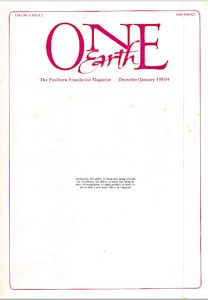 One participant shared that they found some magazines at the very end. “I’m really intrigued, I’d love to read them — this one from 1983/4 had this beautiful quote on it, unattributed, that I want to read out.”
creativity: the ability to bring into being or form
out of nothing. The ability to bring into being by
force of imagination, to make, produce, or form, to
invest with a new form, office, or character.
Two clay creations were presented, each intended to be given back to the earth.

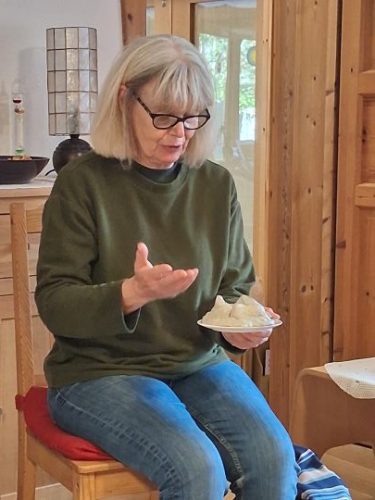
A protective clay wrapping over leaves, berries, a feather, deliberately including shrivelled fruit to honour our relationship with death and renewal. In the process of needing to ask for help which doesn’t come easy. A meditation on impermanence, paradigm change, and the slow pull from clock time into kairos time.
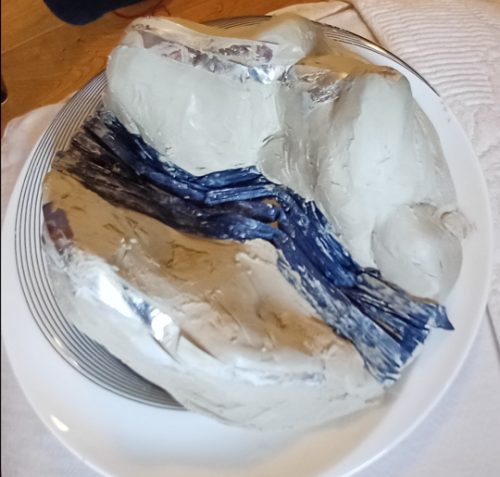
A temporary landscape, mountains lit with beauty, a river running through carrying echoes of Nepal, where she’d visited a village shortly before it was buried by the 2015 earthquake, and of course now the devastating floods. “The earth is telling us, we must rely on nothing, no matter how beautiful or permanent we think it is. We need to learn that lesson, and do what we can to provide some stability in a time when there’s very little.”

Presence, Transmission and Trust in Not-Knowing
The gift of Art and Creativity which can’t easily be measured or produced on demand: presence, spaciousness, and the transmission that happens between performer and audience, maker and witness.
One participant spoke of the minimalism in a recent summer-camp theatre piece that gave her, as an audience member, the time and space to actually be with what was being transmitted and framed this as close to the founding spirit of the Community itself: valuing the unseen as much as the seen.
Another described the particular, hard-to-schedule, rhythm of the creative process — the ten minutes it can take simply to cross from clock time into what she called kairos time, the deeper time of making.
This connected back to the day’s opening theme of not-knowing: resisting the pressure to know in advance what a piece, a story, a day or even a life is going to become, and about the discipline of staying with that uncertainty rather than resolving it too quickly.
The role of “muse” — someone who simply witnesses and draws out the ideas of others, rather than making something visible themselves — was named explicitly as a valid and undervalued creative contribution in its own right.
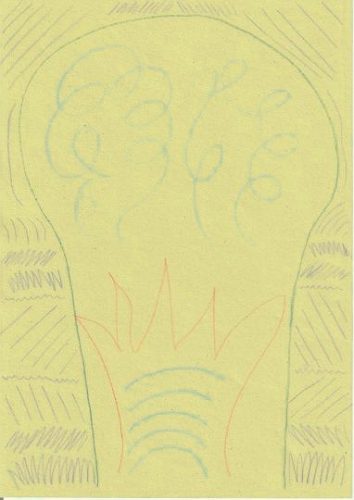
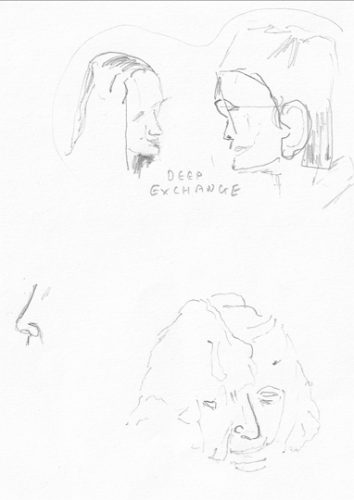
An ‘energy sketch’ and some life drawings shared in the Show-and-Tell expressed that relationship.
The group also addressed the ‘power of love’, the reality that everything is energy:
- How the immediacy and intimacy of the workshop created a sense of connection, prompting one participant to state emphatically “I love you all”.
- Another recalled an exercise in a Tantra workshop, where you had to say to a packet of tissues, for one hour, “I love you.” It sounds insane, or silly, but you really do start to love that box of tissues; the resistance goes, within the hour.
- And Giles wondered whether his love for the hammer made the hammer catch the box of tacks so gently. (Click here to read his story.)
Personal stories
Throughout the workshop personal stories emerged, each one a gem and some have been added to the collective autobiography as separate posts – please see the list at the end.
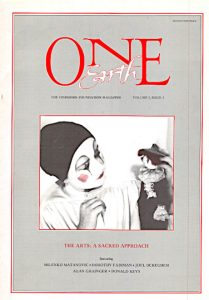
Ruby arrived in the Community at eighteen months old, raised among artists, and later became a socially engaged creative practitioner herself. Browsing the Community magazines on display this one caught her eye as the cover shows her as a 10 year old. She shared: “This is a picture of me when I was 10 years old, probably when I was living in Station House Cottage. I remember my mother painting my face, and I remember this doll quite clearly. And I remember Edwin who came to take the photograph. I had a little read of what he said, and something was very beautiful at the end:
“I still delight in photography as a silent alchemy. In fact, photography provided, perhaps, my first disciplined approach to meditation. Yet, it is also preeminently a meditation in the midst of action. An inconspicuous form of dancing in the street.”
She also read out the four points of the Charter for the Guild of Artists on page 14/5:
- Excellence: Our creation should be developed to the best of the artist’s ability at the time.
- Discipline: Artists are expected to maintain the optimum conditions in which to work, remaining free from outside distractions.
- Productivity: Artists are to ensure that their work reaches completion and that a reasonable output is maintained.
- Appropriateness: Our work produced should give form to new revelation, be in accordance with the aims of the foundation, and add to the quality of life.
At Show-and-Tell, she presented us with a beautiful mixed-media presentation in which she shared her story of “The Piper at the Gates of Dawn” — a vivid childhood memory of dancers, shifting green light and slide projections in the old Lollipop Shop, still luminous fifty years on. Click here for her story. It completed with the offer of 2 minutes of tender group movement.
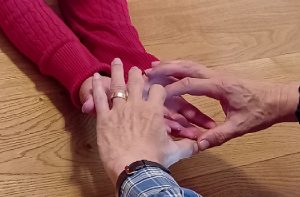
Giles remembered his connection with a beautiful hammer which saved the day in an almost magical way – click here to read The Hammer that Caught the Falling Box of Tacks.
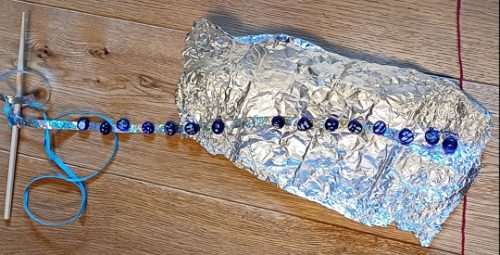
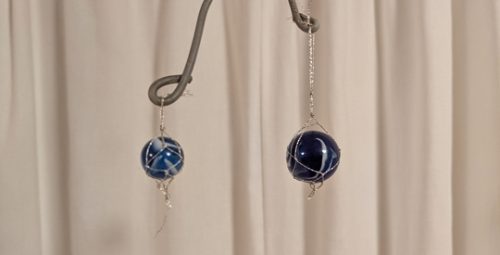
 Caroline who was visiting the Community for the first time shared a dream she had four weeks ago. It felt meaningful for her unexpected participation in this workshop: a group deliberating humanity’s future, blue, white and silver bead-like symbols resembling a Turkish Tespi prayer chain. (Click here for the story of her dream).
She invited the group to make their own beads with her – and these were the outcomes:
A Community Experience Week Through the Lens of the Arts
Marilyn explored the design of an Experience Week for Community members entitled “Spiritual Deepening Through the Arts“. Structured around four levels of commitment
- a dip (an hour)
- a float (a day)
- a dive (a weekend)
- a full deep dive (the week)
The design was mapped onto the four-dimensions framework (economy, ecology, social, spiritual), re-imagined as movement/currency, gardens, music and archive-treasure, and stillness/meditation, each led by a different group — dancers, gardeners, singers, and children respectively.
This led to an exploration of the dimensions of a regenerative culture, described in the 1986 diagram developed by John Talbott and Andrew Yates, which evolved into the dimensions used by the Global Ecovillage Network and Gaia Education. We considered the benefits of using a common language across the global networks. We used these concepts for our Your Community Your Story workshop series and the proposal is to embed them in the newly designed Community Archive cataloguing system.

Outcomes/Upcoming Events
- Co-creating a “Manifesto for the Arts”
- Exploring a Community Experience Week “Spiritual Deepening Through the Arts”
- Co-creating the CHI’26 Storyfest – envisioning the future of a Community Hub and the Moray Art Centre (click here for more information)
- Your Community Your Story Module 7 Whole Systems Design on 3rd October 2-6pm – the last module in this series of workshops (click here for more information)
- Healing Our World: From Despair to Repair conference 16-20 October 2026
- When We’re 64: A Living Story – Findhorn Foundation programme over the 64th Birthday week 14-21st November.
Posts in our collective autobiography:
Ruby’s Story by Ruby Worth
The Hammer That Caught the Falling Box of Tacks by Giles Christian
The Blue Bead Dream by Guest Author Caroline Geurtsen
Through marvellous synchronicity the following were submitted for the website within a couple of days of the workshop – another Expect a Miracle moment :-).
Randy Klinger sent us three beautiful catalogues of exhibitions at the Moray Art Centre:
- John Byrne Catalogue Moray Art Centre Findhorn 2008
- Nameless Catalogue Moray Art Centre 2010
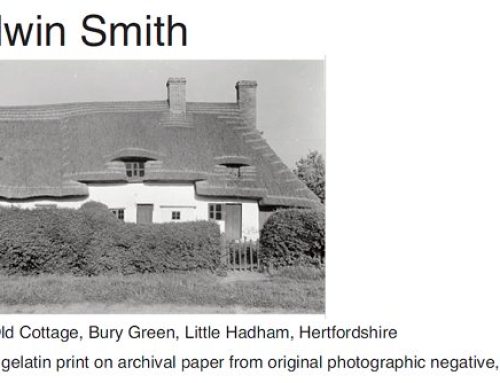
- Edwin Smith Exhibition in Moray Art Centre 2011
- Masters and Champions Exhibition Moray Art Centre (2012)
And Sharon Took-Zozaya sent in the summary she wrote for the Local Place Plan in 2024:
Arts in the Ecovillage Findhorn (2023)

Inspired by CommUnity, a group of NFA volunteers, manages this website. Hearing each others stories, and learning about the history of this community can help us all to find more cohesion and a sense of belonging. Read more.<




Leave A Comment