


Editor’s Note: to give an overview of the post we have used hidden text. Please click on the arrow on the left to expand each section.
***
It was an adventure to offer an Empathy Tent as part of the community consultation, the CHI’26 Storyfest 22-24 Sept 2026 in the Moray Art Centre (MAC). In this post I will give some background to the Empathy Tent movement, share my experiences of the event, and describe some of the nuts-and-bolts of the setup as well as the outcomes.
About the Empathy Tent Movement
I first heard about the Empathy Tent movement in the USA created by a Nonviolent Communication (NVC) trainer Edwin Rutsch who wanted to offer opportunities for people with conflicting political leanings to speak with each other face to face. He formed the idea to set up a tent in the carpark of a political rally and invite people from both parties to speak with each other to help them to identify the areas where they were on the same page and to provide the opportunity for people with diametrically opposed views to eyeball each other, listen, and see each other as human beings just like themselves, with the same needs.
Even though I was inspired by this initiative, initially I did not see an appropriate application for it here at Ecovillage Findhorn.
Organising my first Empathy Tent
That opportunity came when I became part of the CHI Tenders team preparing for the CHI’26 Storyfest. I felt that an Empathy Tent could bring positive support to the community consultation process at the MAC with regards to having the MAC be an ‘Interim Community Centre (CC)’.
I was aware that there had been much distress and pain around the loss of the CC, some of it still present after five years.
The Empathy Tent approach felt a great way to support the community consultation by allowing freedom of speech; openness to hearing all those who needed to be heard; a flow of communication; ease and efficiency for the consultation process; and a safe place for powerful/challenging emotions to be expressed and heard without judgement.
Information provided before the event
A short article in our weekly community newsletter, the Rainbow Bridge, gave some basic information.

The Empathy Tent
A safe place to bring your emotions, complaints, queries, suggestions, requests.
Acknowledging that as human beings living in an intentional community, conflicts are inevitable, especially when there is change, uncertainty, and perhaps a sense of powerlessness. It can be uncomfortable to experience strong emotions and difficult to know how to express your feelings.
We would like to support you by offering free empathy sessions during the CHI’26 Story Fest Event.
Come and see our team of Giraffes in the tent, be heard and express yourself. We will hold space for you, listen with empathy non-judgement and compassion.
We will be actively seeking (and helping you to formulate) your requests.
Blessings, Bridget
The setup
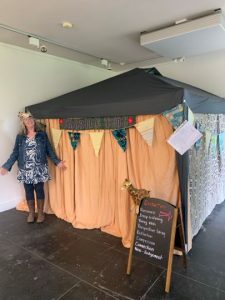
 We had a good sized gazebo which we turned into an enclosed tent in a corner of the consultation space.
It was easily seen and inviting, with a sense of spaciousness.
Our blackboard gave information to allow a sense of security and relaxation. The ’empathy volunteers’ mingled with participants, chatted and explained what was available.
We also had a couple of information sheets with more detail available.

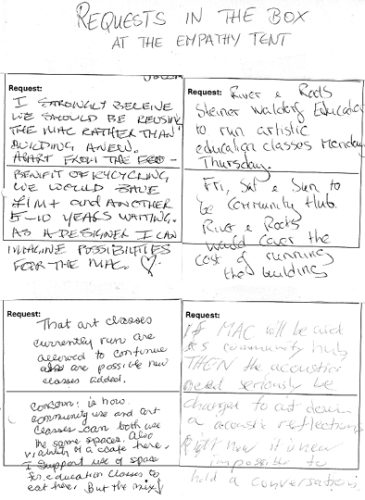
Our requests table
One aim was to support participants to formulate requests that could flow into the community consultation process, or even lead to further events to address issues raised.
We added most requests to the consultation report. For that purpose they were anonymised.


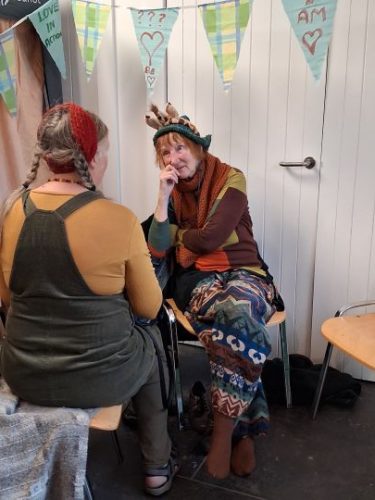

Whilst many conversations took place outside the tent, some participants appreciated the opportunity to step into the tent. The inside was cosy and gave a sense of privacy.


It was rewarding to see that people attending the event were willing to approach us and ask questions, and to receive empathic listening from our team of volunteers. People reported feeling grateful to have access to this type of support.
Outcome
We submitted our summary for the consultation report.
Empathy Tent Summary
Requests Received
- Out of the ten requests received, all of the requests were from people wanting a community centre, some permanently sited in the MAC building, and some temporarily housed there.
- 3 requested that acoustic remediation be attended to so that we can hear each other.
- 2 requested that the art classes continue to be offered, alongside community use of the space.
- 2 suggested the youth and young people could use the space during the day, paying rent, and the community could use the space at night and weekends.
- One requested attention to accessibility requirements in the planning phase.
- One requested a community wide Healing/Restorative/Forgiveness process re the fires and the person who lit them.
Response to the Empathy Tent
- People reported being grateful to have a place to be heard, and valued the space to express themselves, being received without judgement.
Follow-up planned
- Acknowledging the trauma/pain/impacts of Covid/the fires/Brexit.
- Explore, plan and progress a year long process of healing/mourning/sharing.
- Perhaps including inviting facilitators to host land healing/grief work/restorative work.

I am open to offering an Empathy Tent at future gatherings within the community when it is deemed appropriate and helpful. I am particularly keen to support those community events where there are concerns held by the facilitation team regarding conflict and resistance to something that the team are trying to bring forward.
My aim is to support conflict to happen in a positive way where everyone can be heard and precious needs be understood, so that informed decision making and clear delivery of information can happen to support positive change and movement forward as we learn and grow as a community, towards a future where everyone’s needs are met.
***
Photo credits: A big Thank you to Lora Wedge, Pip Lee Meer, Caroline Geurtsen for the use of their photographs.

Born in Birmingham, raised in Adelaide, double certificate Registered nurse 1984. Certified trainer in NVC since 2023. Practicing Iyengar yoga 35 yrs. Married for 31 yrs, 1 beautiful son. Australian.




Leave A Comment