


Editor’s Note: This post was created from the recording of an interview which was part of the community consultation, the CHI’26 Storyfest 22-24 Sept 2026 in the Moray Art Centre (MAC).
***
I’ve been here at the Park since 2002. Prior to that I was at Cluny and Newbold in the eighties, and in the nineties I was at Cluny again.

General Office
I came back here in 2002 after travelling around the world a little bit, with no real intentions of how long I was going to stay. Very soon after I arrived I was made the focaliser — the manager — of the General Office. Then I was also put on the Park Campus team.
One of my roles since those early days was what some people called a “policeman.” As a member of the Park Campus team, my focus was the whole area, but specifically the Community Centre (CC) by day. I would be the person called upon if there was something going on at the Community Centre that needed attention, help, or support.
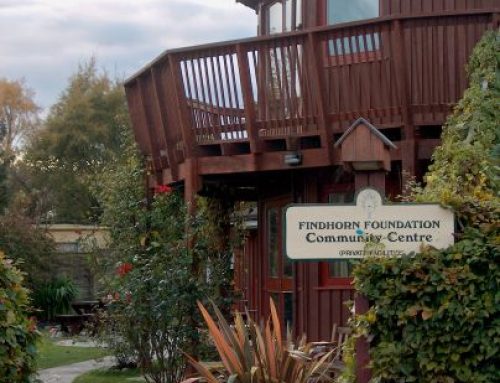
 The Community Centre was a very, very open space. What often used to happen was people staying at the holiday park would wander in, think it was a restaurant, and sometimes just queue up, get food, and sit down. Sadly I would need to remind them that it was actually a private facility. I told them, that they were welcome to leave a donation for the food, but in future it would be better to use the café in the Universal Hall. The café has gone by various names over the years, first the Greenroom Café, then Helios, then the Blue Angel and now it’s the Phoenix Café. For me it was always a pleasure to meet these people, but they needed to be directed to the places which were open to the public, or told how they could get information to access the great variety of Findhorn Foundation programmes.
There was one occasion, which is more delicate, but I want to mention it as it shows the breadth of my CC experiences: I was called in because there was a guy sitting right in the middle of the floor in the Community Centre, and he was freaking out. People were avoiding him and were a bit worried about him. I just sat down beside him and was drawn to put my hand on his shoulder. He calmed down a little bit, and we started talking. I said, “Hey, what’s going on, man? You okay?”
He was out of his head on psilocybin — he’d taken loads of mushrooms. That was an experience I’d had in the past myself, so I had an idea of where he might be coming from, and we were able to relate and chat together. After ten or fifteen minutes of just sitting on the floor — with people then feeling more relaxed about doing what they needed to do in the Community Centre — I said, “Well, why don’t we go somewhere more nature-oriented, so you can connect a bit with nature?”
He agreed, so we walked out and slowly went up to the Pineridge area in Wilkie’s Wood and spent some more time there. It was a very delightful experience. I think I left him up in the woods, but I made quite sure that he was safe and okay — and that anyone around him would be safe too, because he wasn’t freaking out anymore by then. I think he freaked out in the CC because the mushrooms must have come on there, right as it was mealtime and getting busy with people coming in. But that was an experience that came up for me just now, thinking about the CC.
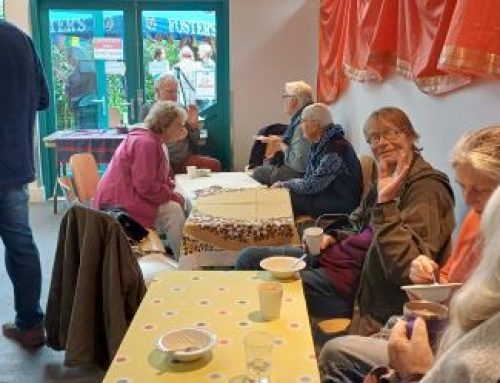
I’ve had so many experiences there, and I really miss the Community Centre for what it was. It was where we had so many events, celebrations, and, obviously, meals. Pretty much every one of my weekday meals was eaten in the Community Centre, apart from breakfast — as a staff member we had breakfast at home but we had subsidised food in the Community Centre as part of our remuneration.
I had a bit of a reputation because I was often the guy at the front of the queue. I don’t like queuing very much, so I used to get there a bit early to get the food, and then either sit in the Community Centre to meet people or, when it became really busy, go back down to the Park Campus office opposite the General Office where I was based, and have my meal there.
There was another occasion when I set up a Bingo night in the Community Centre. Before I left school, even before I was sixteen, I was a Bingo caller on Eastbourne Pier. One day I had the inspiration to organise a Bingo night in the CC, so we advertised it through the Rainbow Bridge. Loads of people came, and it was a lot of fun. David Janes helped me set up the equipment. I don’t even remember where the equipment came from, but we managed to get the balls and everything, and I had my microphone.
On about three different occasions we had Bingo nights, and it was so much fun. We had the elders, some of the trustees, if they were there, and guests all sitting around. The bar in the CC would have been open at that time, so people were having a drink after their meal. Then around eight o’clock we started Bingo. I probably asked for donations of prizes, so people would win various hampers and things — I think the Phoenix shop even donated a basket.
It was just such a great place to go at any time of day. Outside of mealtimes you could inevitably meet people there — friends, colleagues, or people on workshops — and introduce yourself. There was always a lot of social interaction. In the winter, when it was dark and there wasn’t much to do, you could pretty much always find someone there to connect with.


Because of my role as Park Campus Manager at the time, I was called in on the night of the fire. It was April, five years ago now. At about four o’clock in the morning I was woken up and went to the site. The chief fireman wanted to know where the hydrants were on site. I had a list in my office, so I said, “well, I’ve got one in my office, but on that side you’ve got a flaming Community Centre, and on that side you’ve got a flaming sanctuary.”
He said, “We’ve really got to know — guide me through.” I’ll never forget the experience of walking past the Community Centre, which was going up like a volcano because of the amount of accelerant the person had put in there. The Community Centre had almost fizzled out by then, but it had been completely destroyed, and there were still flames and a lot of heat coming up. I went into my office, he got the fire hydrant chart off the wall, and we walked back to the runway. I just watched in horror at the sight of both the Community Centre and the Sanctuary disappearing forever. It was horrific.
The police interviewed me that night and asked if I had any idea who it might be. I had an definite idea of who it was, and it turned out to be that person. I led the police to where he had been staying, and he was due to leave that night. The place had been emptied, and I remember he’d taken one of those rubber washing-up gloves and left it with the middle finger sticking up. The police took a photograph of it, and I took a photograph of it too. By that time he’d already handed himself in — after torching both places, he walked down to the police station. But I was able to tell them his exact name and details.
During the Covid period, although we weren’t running any programmes, the residential staff who weren’t put on furlough were able to pick up food in the Community Centre by way of raw materials. They weren’t cooking, but they were providing us with vegetables, oils, fruits, and all kinds of stuff for our weekly take. It was still functioning in that way, and it was completely quiet. There was a sense of mystery, because those first few weeks of Covid were such an incredible transition from how things used to be. It almost felt like a breathing period, because so little was happening.
Then more and more people were made redundant or furloughed, and — since I live on site — it became a bit of a ghost town. Then, of course, there were the government regulations where you weren’t supposed to go out or meet more than one or two people. Fortunately, we have the dunes and the sea, so you could circumscribe that a little bit by sneaking through the woods to be on the beach on your own, without feeling like you were contravening regulations.
The Findhorn Foundation’s operations might have survived, were it not for the arson attacks, because when the regulations lifted, we no longer had the facilities to feed guests or use the Sanctuary. Unfortunately, we still don’t have a Community Centre. I am one of the people who felt very strongly that we should have built a Community Centre before building the Sanctuary — even using part of the Community Centre as a Sanctuary during the process, if possible.
I love the Sanctuary — it’s a beautiful building. One of my roles at the moment is checking it overnight and putting it to bed, which I love to do. But I still felt it would have been more important to have a main meeting place where food could be prepared for staff, the local community, and guests, which we can’t do anymore.
I think we may have only about thirty-eight accommodation spaces if we have programme people here. With only about forty people, you can utilise areas like the Universal Hall for feeding people, but there’s no way you can host the hundreds we used to have. That was the spirit of this place for me.
It wasn’t a very good business plan either. The Foundation only ever made enough money through the educational programmes — about eighty per cent came from those, and twenty per cent came from grants and gifts. In terms of what happened during that whole period, in a way it was meant to happen, but the way it happened was so horrible. We needed to transition into another way of doing things; it wasn’t environmentally sound, or a good idea, to have people flying in from Sydney, Japan, and New York for a two-week programme and flying back. The air miles were against the ethos of what this place stands for.
Stuff like that needed to change, and more is happening online now. But it was the terribly aggressive way that it happened that still stings my heart, because it was an act of pure malicious anger.
The person who committed the arson attacks was given a decent redundancy package, and offered accommodation at the caravan park because he had to leave his residential accommodation at the Park. Everything was laid out for him, but it was just his malicious attitude towards being let go. As you may have heard, he didn’t get a custodial sentence for what he did — he was given a community service penalty, which he finished quite quickly.
I try not to hold on to things, because it only hurts me, but in that particular case, it’s really not easy to let go. We talk about forgive and forget, and people do exercises on forgiveness for him, The person himself doesn’t even think he’s done anything wrong to be forgiven for. That’s what makes it so hard. He has shown no sign of remorse or contrition at all. In fact, he sees it as something good to have done, and even explained to me at one point that it made the Foundation a lot of money in insurance — which isn’t true. There was an insurance payout, but that needed to go toward redundancy packages for staff, and many other things, before we could even consider rebuilding either space.
So, yeah, it’s how it is. You can’t turn back the clock, but it changed my life a lot. I was also one of the people made redundant in the last tranche. I was thinking there would be a time when I’d need to leave the Foundation anyway, but I would have preferred it to be my heart making that decision, rather than an act of aggression.
I don’t want to moan about this whole thing, but it was a big event, and that’s why we’re here right now. There’s an empathy tent and everything, because the arson attack affected pretty much everyone who lives on site in a very dramatic or traumatic way.
***
Photos: Findhorn Foundation; Adriana Sjian Bijman; Cornelia Featherstone; Mark Richards

I did my FF Experience Week in 1984 at Cluny after having lived at Newbold House on and off from 1982.
In the 1980’s I lived mainly between New York, India, Berlin and Findhorn. I’ve lived since 2002 at The Park.



Leave A Comment