

It is often said “History is not what actually happened. History is what is being recorded and so often it is ‘written by the victors’.”
We want to ensure that our Community’s story is told in the voices of those who have lived the history … as messy as that may be 😊. We endeavour to map the evolution of the beautifully complex ecosystem which is our Community, as it has unfolded over more than six decades. We delight in the many different perspectives, reassured by the notion “If you step on a paradox, you’re quite likely have some truth on your shoe.”.

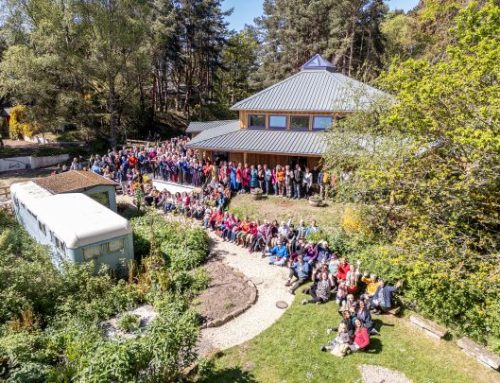
COIF Core Team 2026
The present phase of our Community History Project started in May 2021, not as a designed process but guided through inspiration, synchronicities, and quite often by necessities, working with what was possible with the resources available. Co-creating the ‘COIF’ website, our amateur volunteers are walking in the footsteps of those who have come before us as we bring together their compilations. We also support the telling of current stories, as history starts today.

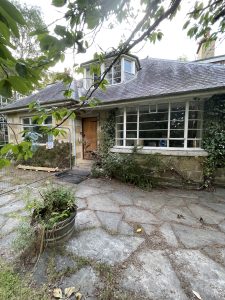
Park Library in Park Building 2014 photo Steve Busby
As we write this synopsis, the scope of our work has expanded beyond the website. We are in the process of creating a Community Archive which aims to bring together organisational and private collections to preserve and catalogue them, thus ensuring appropriate ways to make them available for future generations. In addition to that, we are seeing the first shoots of a Community Library emerging to give new life to the many books which have been in storage since the closure of the last library in 2019.
The history of these collections reflects a shift from a centralised, private archive within the Findhorn Foundation to a decentralised, public-facing, largely digital Community record. This transition has been accelerated by the organisational changes, the physical loss of Community buildings and the desire to preserve the legacy of the original “Network of Light” for future generations.
We hope that the sharing of our meandering journey may support other communities, ecovillages, groups and organisations to gather the threads of their own histories and legacies. Like mycelial networks we can nourish each other with inspiration and learnings, broadening our horizons and creating resilience for us all.
As usual this Topic provides layers of detail for those readers who wish to delve deeper.
***
Findhorn Foundation Archive
The Findhorn Foundation Archive is the physical and institutional bedrock of the Community’s history. It preserves the records of the “unintentional Community” founded in 1962 by Peter and Eileen Caddy, Dorothy Maclean and Lena Lamont.
For decades, the Foundation maintained records of its development, including the early guidance received by Eileen Caddy, horticultural records, and the administrative papers of the Findhorn Trust (established 1968) and the Findhorn Foundation (established 1972).
The story of the beginnings of the formalised archive has not yet been fully told. During our research in 2022 we heard slightly different stories: that the local Forres Library played a role in making the connection, or that the National Archives of Scotland approached the Findhorn Foundation directly.
Click on the arrow to read personal recollections in 2022/3
Vita de Waal
The first group to deal with the archives was Ike, Michael L and myself. That was late ’70s onwards.
Ike spoke of the FF to the then archivist of the Forres library who suggested that the Royal Archives of Scotland might be interested in what he (archivist) described as a Scottish attempt at a utopian community 😂😂😂. Ike took it to core group who authorised him to look into this. The archivist gave him a contact in Edinburgh and Ike went to Edinburgh to investigate.
Edinburgh Royal archives were indeed interested as few utopian experiments had survived (😂) and told him what would be relevant. They would then put all on microfilms and it would be at all times available.
My involvement in this, relatively soon after I arrived, was that I found stuff lying around in the library downstairs as well as the small room above the St Germain Sanctuary that were letters to/from Peter, guidance, stuff from ROC, Sir George T and much from the Glastonbury ‘time’ – I was concerned that anybody could walk away with these papers and they would not be missed as did few people knew about their existence.
Ike Isaksen
When I read [the email from Vita], I became even less clear as to the actual sequence of events!
From memory, it was someone from the National Archives of Scotland (held by the National Library of Scotland) who approached the Foundation first. I don’t remember there being a connection through Forres library, although I was good friends with the librarians there.
In order to clarify exactly what was needed, I went down to the Archives in Edinburgh and spoke to one of the curators.
One of the things he impressed on me was that they wanted EVERYTHING, including what is often referred to as ephemera. So as well as the minutes from all meetings, they also wanted old copies of the Rainbow Bridge, tickets to shows in the Lollipop Theatre, hand-written notes and notices from the Noticeboard, etc. They asked for everything to be sent unsorted, as they would sift through it themselves in order to decide its ultimate relevance.
To begin with there was a huge number of boxes that had been stored in the attics in the Park Building. Eventually, it was agreed that they would collect all new material annually.
I remember that Vita took this on after I stopped being Chair of Executive Committee. What I’m not clear on is whether there had actually been a connection with the National Archives before me.
Roger Benson
If memory serves me, in late ’88 before I left, I happened to be in the Park Building when some cleaning out was going on. There were boxes of docs and tapes (including early transmissions) set to be chucked out which I thought should absolutely be saved. […] we stopped them from being thrown out and someone took on to see if they could be stored for posterity’s sake somewhere, like the museum. I left in December ’88 and in ’89 the first batch was sent down followed by the other 3 batches a few years later.
Deposits of archival records have been made since the 1980s. They are held in a ‘deposited collection,’ (as opposed to a donation) the material and the rights to it belong to the Findhorn Foundation, and access is by written permission only. The inventory lists are viewable on the National Library website (search Findhorn Foundation). This search gives a glimpse of the amount of material available and lets us appreciate the huge task to make relevant records available.
Archivists working in the Findhorn Foundation
In the late 1990s until 2007, Mike Scott gave the archive systematic attention and established several invaluable compilations. With kind permission from Mike and the Findhorn Foundation we have been able to publish the complete The Living Record on the website.
“The Living Record is a map to aid us in our seeing.
May it serve to clarify what has been, to shed light on what is,
and to embolden our highest dreams of what yet will be.”
(Mike Scott, 2004)
In addition to the complete pdf in the above post, many of the chapters have already been turned into individual posts to make them more accessible.
The Timeline is based on the chapter entitled Year-to-Year History. It has been updated annually to create a high-level overview of the Community’s evolution.
Keith Armstrong served as the Foundation’s archivist from 2010 to 2019. He played a crucial role in organising and digitising decades of disparate records, compiling an online archive which was made available as a link to a Google Drive. With the permission of the Findhorn Foundation the COIF team has been able to create many posts from this fantastic resource.
Keith also made the archive alive within the Community. Through an exhibition display in ‘Gateway’ the bungalow next to the Visitor Centre and with regular film nights in the Community Centre, he made the treasures accessible to many.
Keith left Findhorn in 2019 and captured his experiences in his book The Archivist: A Handbook for Amateurs published in 2020. It is a useful resource intended to help circumvent introductory problems likely to be encountered, with helpful suggestions as to procedures and methods of working. Despite now living in Wales, Keith has been a huge support to the present undertaking and continues to contribute his experience and knowledge.
In 2020 Abbott Chrisman undertook a major review of the archives and produced an Archive Proposal on behalf of the Asset Department of the Findhorn Foundation.
Sadly, the pandemic and resulting changes to the organisation of the Findhorn Foundation did not allow that proposal to come to fruition.
The COIF Journey so far
In brief
- The Story of COIF in 5 minutes.
Our core team member Sylvia Robertson told this story as part of a special edition of the Artist Hunt entitled The Stories that Took Root. Organised by Laura Pasetti of the Theatre of the 7 Directions, it was part of the 2026 Easter Conference Economics As If Life Matters. - We created this 2 minute video for the Enterprise Fair 2025.
A summary
The website was officially launched during the 60th Birthday Celebrations in November 2022. At that stage there were over 250 stories available, over 150 of those were from the wonderful 50th Birthday Book which laid a strong foundation for our collective autobiography.
This was built upon with other previous publications such as The Kingdom Within and of course the Community Magazines such as One Earth and Network News. At that stage we realised that our work, in many ways, continued the tradition of those magazine editors who captured Community life at the time. Whilst we still encourage spontaneous submissions from people who have contributed to the building of this centre, we are now more proactive in creating content. That journalistic aspect is still small but we hope it will grow in future.
In 2024 we added a new feature – Community News. This has developed into a Community Log where we collate updates from Community organisations and members. This is not EVERYTHING that’s happening but it is a good glimpse into the vibrant and complex Community we are today.
In short, the collective autobiography is now made up of many personal narratives of past and present members, videos, podcasts, memoirs, historical documents and several research papers. It features a range of Topics – such as this one – which provide a “Readers’ Digest” of a specific Community facet, giving a summary and a compilation of stories that give more depth and background information to that facet.
Our August Newsletter 2024 celebrated 1000 posts and in October 2025 we reached 1500 stories. As we write this Topic in April 2026 there are 1660 posts published.
COIF Education – a new adventure!
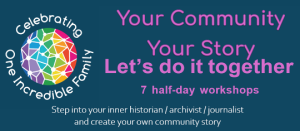
We are creating a variety of educational offerings – for young people, a series of half-day workshops and a weeklong offering with the Findhorn Foundation over the Community Birthday in November.
- 7 independent modules (June to Sept 2026): Join Community members as we explore the stories in the different aspects of our collective autobiography. The workshops will be in person in the Park Ecovillage.We are evolving the concepts as we go along – so we’ll see what we can co-create – one thing is guaranteed – it will be fun!
- Findhorn Journeys – Your personal story – What drew you here? What did you learn? Sat 13th June 2-6pm
- Our Roots – stories about founders, formative influences, core principles, vision and purpose – and what they mean to each one of us. Sun 14th June 2-6pm
Cost: £30 per workshop • 2 or more workshops: £25 each • loyalty card: attend 6, get the 7th free – Bursaries available — don’t let cost be a barrier.
Booking is essential – please contact us to secure your place!
- We are delighted to work with some young people, exploring what they can learn with us. Contact us if you want to find out more!
- In collaboration with the Findhorn Foundation, 13th – 20th November 2026, a week designed around what’s going on over the Community Birthday week, explorations of our legacy, our personal stories and what we may want to share with the world. Click here for the details which will be added to the website soon.
Community Archive
As we shared above the Findhorn Foundation has tended historical records over the decades but this does not include the many other organisations and initiatives in and around the Community which have also built this centre.
Mike Scott concluded The Living Record on page 205 with a long list of Phenomena not covered by this record.
Those ‘phenomena’ have been calling to us and we have held the vision that we may be able to do them some justice at some point. That point came much closer in June 2025 when we recieved a generous grant from Thierry Bogliolo of Kaminn Media Ltd.
This allowed us to embark on a steep learning curve which resulted in Lydia Pappas, our archivist, joining us in March this year. Lydia is tracking her process and will create a blog to share as part of the collective autobiography, creating a record which may help other groups, organisations, communities and ecovillages to tend to their own archives and so share their knowledge and inspiration with the world.
Some of our learnings:
- An archive is only as meaningful as it is alive in the community it serves.
- It is a contemporaneous documentary by-product of human activity retained for its long-term value, a chronological audit trail of how organisations and individuals conducted themselves.
- Knowledge sharing is the essential purpose. Dusty records in a hidden vault is not what it is about.
- Building an archive has more to do with personal relationships and building trust than with shelves and catalogues (though they are important too).
For more detail:
Our recruitment process
Knowing where to start was one of the hardest things for our amateur volunteer team. Many conversations, synchronicities and dead-ends later, we were ready to circulate our invitation to apply through various archivist networks, in October 2025.
We were delighted to receive a good number of quality applications and to hear that some of the applicants had been forwarded our invitation from others.
After a short-listing and interview process we were ready to present our findings to a Community stakeholders group and with that support we made the final decision.
Our Job Description
Job Description: Project Designer (Archivist/Librarian)
Project Title: Scoping and Strategic Plan for Community History Archive
Overview
COIF has received a £10,000 scoping and feasibility-study grant to initiate a community archive project. We are seeking an experienced and detail-oriented Project Archivist or Librarian to lead this initial phase. The primary objective is to assess the archival needs of multiple Community organisations, particularly the Findhorn Foundation, and to develop a high quality and comprehensive plan that will form the basis of a full grant application.
Our vision for the Community archive project is to preserve the history of the Findhorn Foundation and Community, and to make that history attractively available to the Community and the public, in digital form in a context that supports reflection on the values of the Community.
This role requires a blend of professional archival or library science expertise, project management skills, and the ability to work collaboratively with diverse Community groups and historical materials.
Background
Since the 1960s, documentation and artefacts about the Findhorn Foundation (FF) and Community’s activities have been created by individuals, FF departments and offshoot organisations. Stored variously in private and organisational hands, there is no master list of records.
In the late 1980s the National Library of Scotland approached the FF offering secure storage for historical materials. Since 1989, the FF has been sending documents, photographs, printed material, audio tapes, video and films for safekeeping. The unindexed ‘deposited collection’ includes roughly 32 running metres of paper and audio documents and ten banker’s boxes of photo negatives plus video and film stored separately.
In the early 2000s Mike Scott compiled The Living Record, a chronicle of the FF with a collection of transcripts and articles that form a good overview of the FF’s roots and development. This work offers a ready-made beginning for an accessible archive.
In recent years, Keith Armstrong digitised several FF publications, documents, audio tapes and videos. He created the beginnings of a digitised collection which still needs to be indexed and catalogued to be fully accessible.
In 2021 a group started building the COIF (Celebrating One Incredible Family) WordPress site which offers some historical material but is not suitable for a full scale archive. The COIF group has become the holder of the archival impulse at the Ecovillage Findhorn Community.
Much historical material is in the hands of related organisations and in private hands. With the recent demise of the FF, the remainder of its records are in storage on The Park site. Meanwhile, new material of historical value is accumulated every day as the community reorganises itself. Much of the new material is already in digital form and could be immediately incorporated into the archive.
Key Responsibilities
The Project Designer (Archivist/Librarian) will be responsible for the following key tasks:
- Project Management and Planning
- Develop a detailed project plan for setting up a Community Archive
- Collate all information necessary for a comprehensive funding application
- Preparation of funding application (might be delegated)
- Manage timelines, resources, and deliverables to ensure the design project stays on track.
- Communicate regularly with COIF liaison to enable regular updates to participating community organisations.
- Scoping and Assessment
- Conduct a comprehensive assessment of historical materials from multiple community organisations, including the extensive collection at the Findhorn Foundation.
- Evaluate the physical and digital condition of various media, such as paper documents, photographs, negatives, slides, audio/video tapes, and born-digital content.
- Identify existing archival practices (or lack thereof) within each organisation to determine baseline needs.
- Strategy and Framework Design
- Create a decision matrix to systematically evaluate each type of historical material. This matrix will help determine the appropriate next steps based on criteria such as:
- Significance: Is the material essential to the community’s history?
- Condition: Is it fragile, damaged, or at risk of loss?
- Format: Is it a unique physical item or a digital file?
- Ownership/Rights: Are there clear rights and permissions for its use and publication
- Develop a clear strategy for the safeguarding of all relevant materials, including both physical and digital preservation methods.
- Establish criteria for the digitisation of materials that should be converted for preservation and access. This will include identifying appropriate digital standards and file formats.
- Propose suitable publication platforms for material intended for the public domain. This could involve recommending digital archives, online exhibitions, or other public-facing platforms.
- Create a decision matrix to systematically evaluate each type of historical material. This matrix will help determine the appropriate next steps based on criteria such as:
- Project Outputs
- Survey of relevant Community organisations’ archival status
- Implementation plan detailing all steps for the successful setting up of the Community Archive
- Completed plan and Funding Application for grant to set up Community Archive
Required Qualifications and Skills
- Professional experience in Archival Science, Library and Information Science, or a related field.
- Proven experience in project management, ideally within a cultural, heritage, or non-profit setting.
- Demonstrable knowledge of archival and preservation standards for both physical and digital materials.
- Experience with metadata standards (e.g., Dublin Core) and content management systems.
- Excellent communication, organisational, and interpersonal skills.
- The ability to work independently, problem-solve, and manage multiple tasks simultaneously.
- Familiarity with the National Lottery Heritage Fund or similar grant-making bodies to create a high-quality funding application
Onboarding
This will be part of Lydia’s blog – watch this space.
Community Library
There have been several libraries in the Community over the years.
 The first library was established in 1969 in a hut near the Caddy’s caravan and run by Mary Coulman. Two years later it moved to a ground floor room of Park Building where it remained until 2018.
Constance Marcham built up the Park Library collection to around 5,000 books. In 2000 Dina Leigh studied librarianship at Moray College and introduced the simple-but-effective borrowing system. Sian Mackay started working with Dina in 2006 and continued until she moved back to Edinburgh in 2014. Penny Johnson took care of the library, first in the Park Building, and then in the West Whins Common House where it sadly was housed only for a short time before being packed up for the duration.
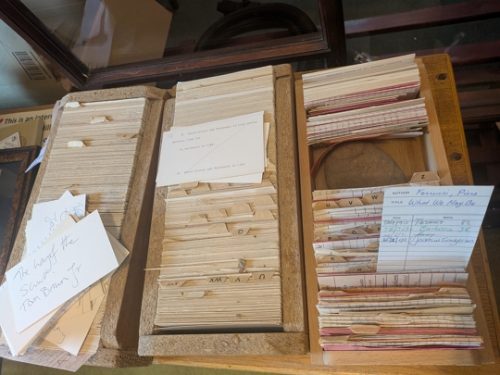
The one in Cluny Hill College was smaller, yet in a beautiful setting, just off the Beechtree Room, a large group space, and lead on to the sunroom. Anniese Worth Guintini recounts her time looking after Cluny Library for 25 years.
-
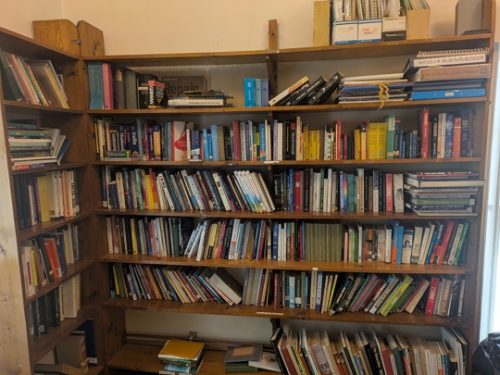
- Cluny Library photos Cornelia Featherstone
-
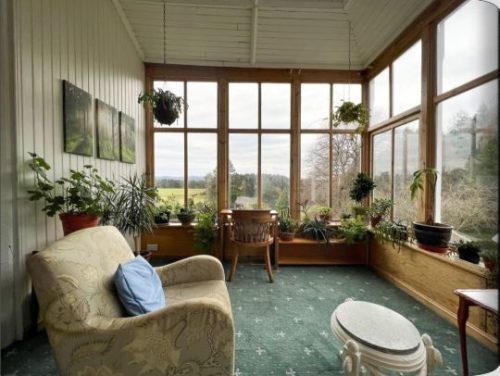
- Cluny Sun Room photo Lars Runken
The library in the Cluny Family Room was also much loved and had an extensive selection of more ‘light-weight’ books. After the closure of Cluny in 2023 many of those library books were added to the multitude of boxes and bags in storage.

In 2026 there is renewed inspiration to create a Community Library. As we write this post, the books have all been gathered together. Over the next few weeks they will get sorted, catalogued and made accessible, as and when library space becomes available. There are several promising leads at this point for partial short-term solutions and the vision for a proper library, perhaps as part of a heritage centre or Community hub – time will tell.
Timeline
Foundations and Early Records (1960s – 1970s)
1962
The “unintentional Community” is founded by Peter and Eileen Caddy, Dorothy Maclean, and Lena Lamont.
1968
The Findhorn Trust is established.
1969
The first Community library is established in a hut near the Caddy’s caravan, run by Mary Coulman.
1972
The Findhorn Foundation charitable trust is set up.
The library moves to a ground-floor room in the Park Building, where it remains for nearly five decades.
Late 1970s
The first formal archival group is formed, including Vita de Waal, Ike Isaksen, and Michael Lindfield.
Formalising the Archive (1980s – 2000s)
In the 1980s
The National Library of Scotland (National Archives) approaches the Foundation to offer secure storage for historical materials.
1989
The Foundation begins sending the first batch of documents, tapes, and photographs to Edinburgh for safekeeping.
Late 1990s – 2007
Mike Scott gives the archive systematic attention, completing The Living Record in 2004.
2000
Dina Leigh introduces a formal borrowing system to the Park Library.
Digitisation and Transition (2010 – 2020)
2010 – 2019
Keith Armstrong serves as the Foundation’s archivist, organising and digitising decades of records into a Google Drive resource.
2018
Facilitated by NFA, the Park Library moves from the Park Building to the West Whins Common House.
2019
The Park Library closes, and the collections are placed into storage.
2020
Abbott Chrisman conducts a major archive review and produces a proposal for the Findhorn Foundation’s Asset Department.
The COIF Era (2021 – Present)
2021
On 21st May the present phase of the Community History Project begins.
2022
17th November – the COIF (Celebrating One Incredible Family) website is officially launched during the Community’s 60th-birthday celebrations.
2023
Cluny Hill closes; its library books are added to the Community’s stored collections.
2025
A grant from Kaminn Media Ltd allows for the start of the Community Archive Project.
October – The website reaches a milestone of 1,500 stories published online.
2026
March – Lydia Pappas joins the team as the Project Archivist/Librarian to lead the scoping and strategic plan.
April – efforts begin to sort and catalogue the stored books for a new Community Library.

Inspired by CommUnity, a group of NFA volunteers, manages this website. Hearing each others stories, and learning about the history of this community can help us all to find more cohesion and a sense of belonging. Read more.<



Leave A Comment