


Click to view e-book
Editor’s Notes: The following was published in Faces of Findhorn, in Section II entitled Experience.
***
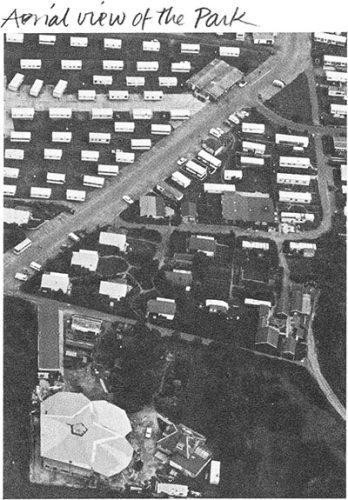
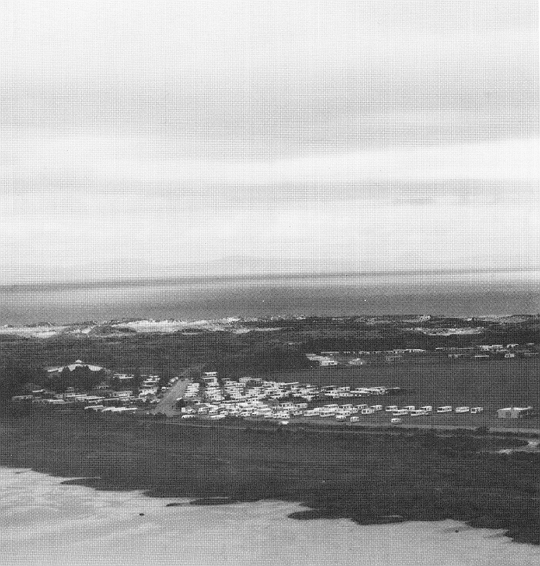
Tom: 3 a.m. Pineridge. A midsummer’s day. Sunrise is already tipping the pine trees with pink and gold. A gull flies silently in the high clear sky. I sit with the beginnings of this chapter and a strong cup of coffee. Outside a black cat emerges from the undergrowth, looks around and yawns: pink mouth. A baby in the next caravan is crying for the breast. Morning emptiness inside the skull experiences sounds and colors and beings for themselves without interior commentary.
I like to write at this time of the morning even during the dark winter months. It’s the time when I get most of my work done – in silence and, particularly with poetry, in a sort of crystalline hypnagogic state between dream and waking. I cannot type during this period for fear of waking my son, Lewis, through the frail partitions of our caravan trailer. So I write in longhand.
I doze off around seven and am reawakened by Lewis’ friend Mark who lives across the road with his parents and grandparents. He has called to see that Lewis is up and ready for school in the nearby town of Forres.
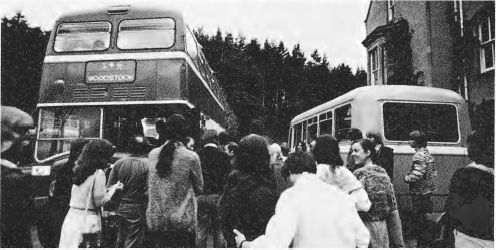
8:20. Scattered groups of people have passed, mostly on foot, on their way to morning meditation in the sanctuary. Others are now leaving on foot or by bicycle or motorcycle for their morning “attunements” with their work groups. “Woodstock”, the big blue double decker bus arriving from Cluny Hill, will have already disgorged up to sixty members and guests for a day’s activity in the many work departments at Findhorn.
Mark Lerner, one of our resident astrologers, whizzes past with a carload of diaper buckets in his little red Honda with California plates. Leona and Dieter leave, like a pair of tousle-haired twins, in their ancient bottle-green Volkswagen: Dieter, who is German, to work as a stone mason with the construction crew and Leona, a Canadian, to the Androgyny Workshop she is giving five miles away at Newbold House in Forres.
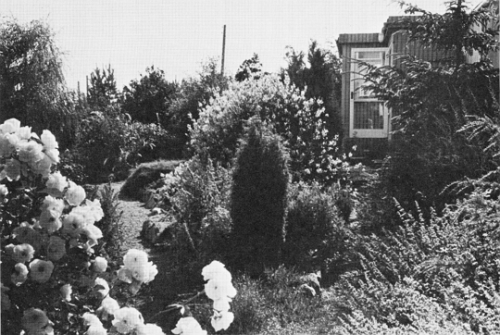
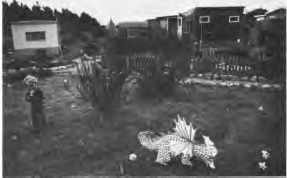
The day is now quite hot. I leave the doors and windows of the caravan open and walk down towards the center of the community, pausing to enjoy my garden, which is a mass of long grass, dandelions, celandines, poppies, wild trefoils and heathers. Pineridge itself has something of the feel of a frontier town in contrast to the more suburban center of the trailer park. ln winter, when it would be dark still at this time of day, the air would be fragrant with wood smoke; today the sea of yellow gorse over the nearby sand dunes fills the air with a scent like incense.
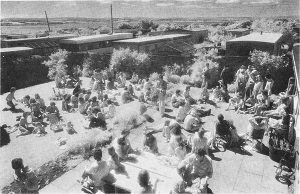
Outside the Universal Hall, and again by the potting shed and compost heaps in the central gardens, I pass circles of working groups, members and guests holding hands in a ring with their eyes closed for a few moments of silent attunement.
I arrive early for an editorial meeting. While we’re waiting, Jeremy and I exchange notes on our dream lives, and Jeremy tells me of a series of dreams he’s had that have totally changed his working relationship with “Apple”, the community computer.
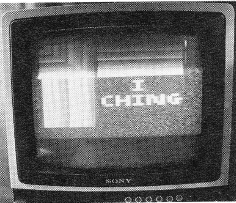
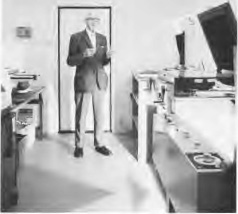
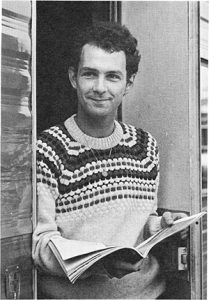 Jeremy: Part of my networking job, linking with other new age groups, communities and individuals around the world, has been to computerize our filing systems. Our files are growing so fast that this is the only way we can keep up. At the moment a letter can come in saying: “Please send me a list of spiritual communities and centers in southern Europe,” and it takes too long to go through the cards manually and reply to all the similar letters with specific requests that are coming in at the same time.
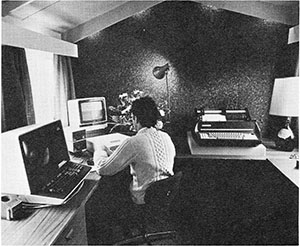
Shortly after I started the networking job I had a recurring dream about “Apple”, our computer. ln the dead of night I would get out of bed and sneak down to the room in which it is housed in the bowels of the Universal Hall, and sit down and attune with the machine and type on the keyboard, “Apple, are you ready to make contact?” Each time the computer would reply, “Syntax Error,” which is its way of saying it doesn’t understand. Night after night, in my dream, I sneaked down and typed, “Apple, are you ready to make contact?” Then one night the single word “Yes” appeared on the screen.
From then on, before doing any work with “Apple”, I would sit down with it and attune to the intelligence that lay beyond the machine, the consciousness behind its physical form. I found that the contact was powerful and came remarkably easy. My learning about the workings of the computer came from that rather than from the manual I’d been laboring to understand.
After a brief meditation we continue with the almost interminable process of trying to write, design and edit a book as a group. Such meetings can go on for hours and can talk themselves into circles – particularly editorial meetings in which one is often talking about words. It can seem a terrible way to write a book, but it’s a great education. The endlessness of the process, whatever else it may be, is a constant reminder that one’s real work is not so much in the external activity as in a kind of inner attentiveness that is going on all the time.
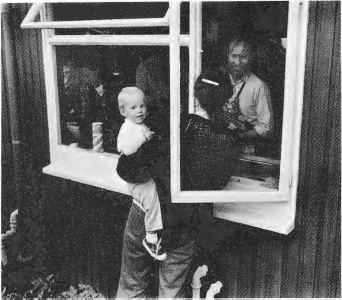
I usually feel completely whacked at the end of an editorial meeting, as if I had done a day’s work in two or three hours. I stop in the Publications building to do some photocopying. It’s a warm day. Everyone is in shorts; many are barefooted. The radio plays softly, the dozen or so people in the room have their heads down working. Bruvver, a huge white cat, lies in the sun. All the windows are open. I love the feeling of a lot of hard work being done in a totally relaxed atmosphere.
I spend the rest of the morning working in the new vegetable gardens in a five-acre field by Cullerne, an old Scottish house the community has recently bought half-a-mile down the road between the caravan park and Findhorn village.
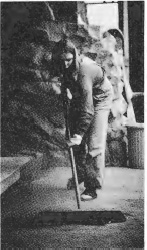
We’re tilling the soil by hand, digging through a thin layer of turf to sand, shale, and what used to be beach stones, removing the couch grass and putting manure down to the depth where roots will need it. Although the work is back-breaking, there is a powerful connectedness which comes from the sense of helping build and deepen the soil.
Before lunch a busload of hot and dusty people from the community drives down the dirt road to the beach, where they swim and skim Frisbees in the icy waters of the Moray Firth.
Lunchtime itself is the hub of the social day. The lawn outside the Community Center is strewn with brightly clothed people of all ages and nationalities, all eating the vegetarian fare and talking in the sunlight. People are rushing about, tripping over children, eating, making contact, exchanging information like bees at the center of the hive.
After lunch I wander up to Reception to collect my mail and then go on to meet the afternoon tour at the grocery store which the community runs for the owner of the site. Although the caravan park may look like the most inappropriate setting imaginable for a new age community, there are not many other locations in which a community like this could have grown to such a size so unobtrusively. However, a clear and open relationship with our neighbors is very important to us, and we have tours every day to show our neighbors and many visitors around the whole community, so that they can see for themselves what we’re up to.
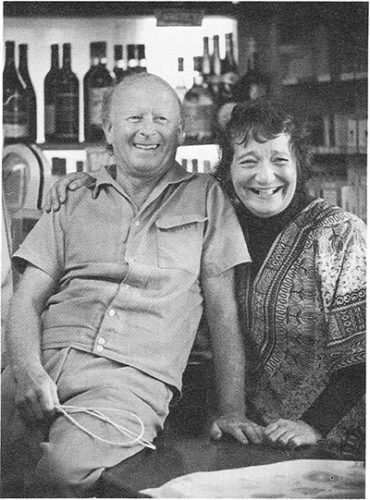 I swap banter with Roy and Muriel, two fellow Scots who are running the shop. Muriel is at the counter and her irrepressible laughter ripples around the shelves. We joke about life on the five pound-a-week member’s allowance.
Muriel: We have a little bit of money of our own. We have always kept some money back. At one point we were going to give everything to the community; then we realized that would make us dependent, and we wouldn’t be able to run a car. We felt we needed to be independent, and the car is useful for going into town, to collect things for the shop, and just to get away from the community at times – that seems important.
At 2:00 I muster the tour. I never know who I’ll get: suspicious Scots full of questions about the community’s finances; an American minister or two guarded against our esotericism; several curious tourists who are here to see the gardens; and the odd backpacker expecting to see devas or nature spirits behind every bush. At the height of our summer season we can have over fifty visitors a day, but today there are only a dozen or so.
First we go to the Community Center where I give a brief outline of the origins of the community: how Peter and Eileen Caddy and Dorothy Maclean’s long years of spiritual training had led them to Cluny Hill Hotel where Peter was manager; how their actions were directed by guidance from the voice of the God within; how, despite trebling the hotel’s business and raising it from a three to a four-star rating within five years, Peter was suddenly transferred to another hotel without warning and then given the sack; how the three of them, together with Peter and Eileen’s three boys, were led by Eileen’s guidance to live for the next seven years in a small caravan next to a rubbish dump on the edge of the sand dunes in the trailer park near Findhorn; how, in accordance with the guidance they received, they set about establishing a small garden in the sand and scrub; and how, to the astonishment of experts, their results were phenomenal, producing plants whose variety and vigour could not be conventionally explained. It was finally revealed that the garden’s extraordinary growth resulted from a unique experiment in conscious cooperation between humanity and nature, based on Peter’s intuition, Eileen’s guidance, and the contact of Dorothy Maclean with the Deva (or archetypal intelligence) of each plant species.
As the garden began to attract worldwide attention, others were drawn to this nucleus and there evolved, in this unlikely caravan park setting, a thriving spiritual community of over three hundred people.
Many are already familiar with this part of the story. What is harder to describe is the way the community has been learning to cope with the challenges that fame has brought. After a flood of articles and books and a movie about Findhorn in the mid-seventies, the community was faced with a growing influx of visitors, and responded with the development of its educational programs and a phase of rapid expansion. We have greatly benefited from the support and encouragement we have received for the continuation of our work, but at the same time we have been creaking at the seams with the strains of accelerated growth.
ln five years we have moved from the original cluster of caravans and prefabricated houses into a community of groups living in a dozen different places. We are fast becoming a group of small communities, and are still evolving the internal structures to adapt as an organism.
For a number of years it was easy for community members to sit back and feel vicariously important because of all the attention coming to Findhorn, without their always seeing the necessity of creating the magic for themselves. However, the community as a whole seems to have been moving through a rite of passage from adolescence to maturity. There’s been an increasing realization that the real work, which is only beginning, is not just to establish this one community but to help establish a network of Light, or a critical mass, if you will, of many thousands of individuals, groups and communities which together can transform this planet.
ln talking of the network of Light I am invariably reminded of the story of the monkey on an island colony who one day got the idea of washing the mud off sweet potatoes before eating them. Soon most of the colony had learned the trick until, say, ninety-nine monkeys were doing it. Then one day, the hundredth monkey picked up the knack, and simultaneously, on several other islands, for the first time monkeys started to wash their food. Lyall Watson, who recounts this story, believes that the transformative power of myth spreads through human societies in the same kind of way.
We do a lot of collective thinking, probably more than any other social species, although it goes on in something like secrecy. We don’t acknowledge the gift publicly, and we are not as celebrated as the insects, but we do it. Effortlessly, without giving it a moment’s thought, we are capable of changing our language, music, manners, morals, entertainment, even the way we dress, all around the earth in a year’s turning. We seem to do this by general agreement, without voting or even polling. We simply think our way along, pass information around, exchange codes disguised as art, change our minds, transform ourselves.
Lewis Thomas
The Lives of a Cell
We leave the Community Center and go outside into the bright sunlight, through the gardens – whose smallness often surprises people – the Sanctuary, the Communications Center, the Universal Hall, the publications building, the craft studios in Pineridge, and back towards the store. Always new questions to stop and consider, or familiar ones to deal with afresh.
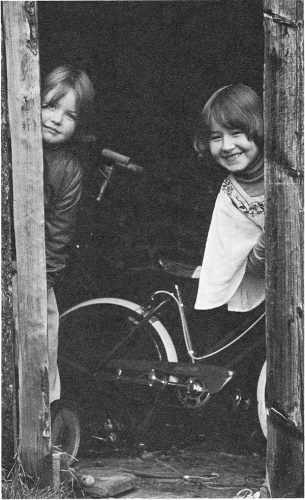 As I’m walking home after the tour I meet Ruby and Amber lolloping home from school like a couple of naughty, cuddly kittens.
“Hullo, Haggis,” says Amber. She is smoking a candy cigarette.
Ruby is ten and Amber is eight. They attend the local primary school in Kinloss. I ask them if the kids are any different there.
RUBY: Not very different. They bring different food – more sweets – and they swear all the time.
TOM: Living in the community you have lots of people to relate to, instead of just your parents. What’s that like?
AMBER: It’s fun.
RUBY: Like Louise. I invited her to the community on Open Day. And when she came she said,
“You’re lucky to have all these things here.” I didn’t realize that before, because I’m used to it. Like having the playground; and you know everyone’s names; and you can be funny with everyone and just be friends with everyone, and things. Some times the village kids call us Caddys. They take all the bus seats and say, ”Don’t let the Caddys have any,” or, “The next stop is the Caddys’.”
TOM: What are some of the things you do in the community?
RUBY: We help cook or work in publications sometimes. ln the children’s program we went for picnics and walks in the woods, and did things with clay and painted pictures. We had a sanctuary in the children’s pavilion.
TOM: What did you do in the sanctuary?
RUBY: ln the morning, just meditate. Sit in a circle and close our eyes.
TOM: If you were trying to tell someone who didn’t know about meditation what it was, what would you say?
RUBY: Tuning in to God.
TOM: What’s that mean?
AMBER: You ask God things.
TOM: What do you say?
RUBY: You don’t have to say anything. He just understands what you think. Don’t you know how to meditate? You just close your eyes and be silent.
On my way back to Pineridge I pause and look across the barley field to the airbase half a mile away. Nimrods are taking off to go on patrol over the North Atlantic, Phantoms taking off in twos and fours, their afterburners glowing pink even in the sunlight. Noises of the airbase are always there in the background of our life at Findhorn, like rumbles of thunder, as a reminder of the different realities that impinge on us constantly.
Back home I sort through a pile of tape transcripts to piece into the mosaic of this book. All around me are folders full of manuscripts, letters, scribbled lists and statistics, together with transcripts of the dreams, reflections, opinions and personal fables of a whole community. The theme that emerges consistently through all this material is the struggle to ground a visionary life in everyday experience.
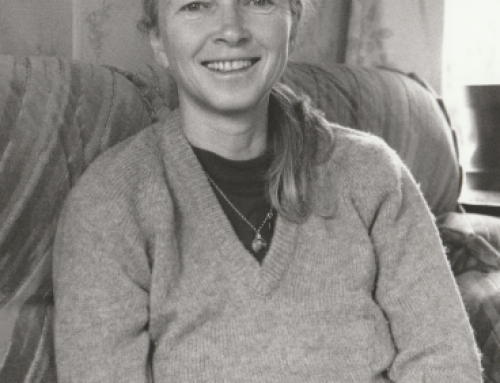
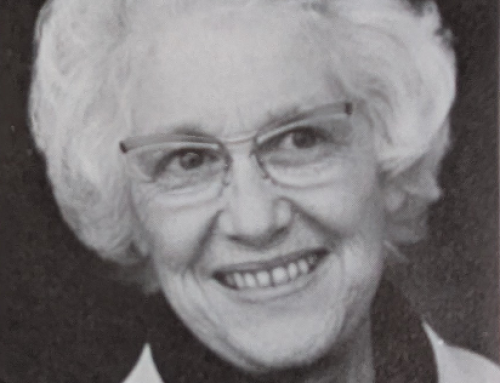
I pick out two interviews to edit. The first is with Elsie, an elderly member of the community. The second is with Liza, a thirty-year-old South African friend who, like so many others, stumbled unwittingly on this nondescript caravan park and stayed.
Elsie: I first came here with my husband eleven years ago. Eileen’s guidance was what drew us to Findhorn. There was something from the very first page of her book, God Spoke to Me, that struck home.
It took us a year to make the move. My daughter and friends thought we were mad to up and leave everything at our age, but that didn’t put us off, and we got here in the end. Then my husband died when we’ d been in the community only a few weeks. My daughter and all our friends in Cornwall said, “Well, of course you’ll come back with us now, won’t you?” Yet that was further from my mind than ever. I knew that this was where I should be, although there was nothing here then but the sanctuary, the garden, Peter and Eileen’s caravan, and one or two bungalows.
Sometimes I feel a bit dismayed at the way things are moving, at the loss of the intimacy we had when the community was small, are at the rate of the community’s expansion. But I accepted it from the beginning because, you see, Eileen’s guidance has always said that we would grow from a family, to a village and then to a city of Light.
The transitions haven’t been easy and we’ve made our share of mistakes as a community. So our passage has been stormy at times. It could never be completely peaceful here, and I’m glad of that. I wouldn’t want that sort of static perfection. But there can always be inner peace; that’s what drew me here, and that’s what keeps me here still.
Liza: One of the major challenges Findhorn has come through in the last five years is in learning to work from the ground up with the emotional and personality aspects of community members’ lives. Many of these aspects were suppressed or denied during the early days when people were trying to live purely from the visionary level on which the community was founded.
When I came in 1974, it was work, work, work, except on Sundays or on particularly hot days in summer when everyone would drop everything, pile into buses and go hiking in the mountains. The energy level was very high, and a lot of music came out of that time. But what also happened with all that cooperation and love was that people started to fall in love with each other, and some marriages and established relationships started falling to bits. There was this universal energy of love, and all of a sudden it could hit you with somebody else’s partner. Because there was an openness towards anything that God sends in one’s direction, some people would then – Richard, Lyle and myself included-dive into these relationships, and would find themselves in a tangle with no clear way of handling the complications.
It was like an epidemic. Not everyone involved was mature or sensible or experienced enough to know what was happening. I really feel it was an inexperienced or immature way of handling the powerful love energy that was pouring through the community. It really rocked the community, but it finally brought Findhorn down to earth and into a far more whole and inclusive sense of how we had to grow up.
After a couple of hours’ work I go down to the Community Center for supper. Several community members, particularly those with families, are collecting their evening meal to take home for dinner. I join those eating in the dining room. After a washing-up stint at the kitchen sink, I go back to the caravan to feed the cat and do a few chores. Luckily my son, Lewis, requires very little practical looking after. He often washes the dishes and cleans up the caravan, particularly when he needs another accessory for his electric guitar!
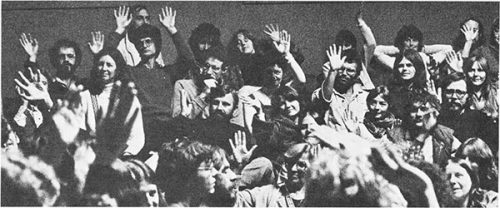
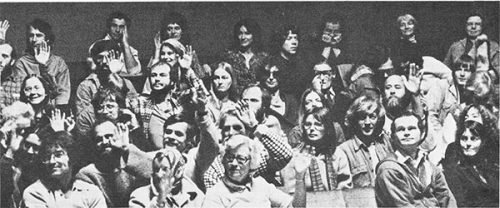
8:15. There is a community meeting tonight, and everybody is gathered expectantly under the multicoloured lights of the Universal Hall. Amid the subdued hum of conversation before the meeting starts, Vadan, Nandano and Lissen are knitting quietly. Jeff is sewing a patch on his jeans. Linda is sketching faces in her notebook. Some of the older folk are settling back in their seats.
The lights dim. We start with a few moments of silence, during which Mark and Isha’s baby hiccups. As the lights brighten, people look around at the baby and laugh.
The meeting takes a while to get under way. There is a lot of information to be shared about the forthcoming Midsummer Festival, and after other community business has been dealt with, we get to the main purpose of the meeting: to review our vision or overall plan as a community in relation to the growth-strain we’ve experienced in becoming what Eileen’s guidance has called a planetary village.
David: I’ve been here for over two years now, and I’ve seen my perceptions of the community change and expand. I came in response to the story of the Findhorn garden, which was very inspiring to me. The vision of the community itself has expanded: the Findhorn garden has grown to become a garden of the new humanity.
Now it feels like a new pattern is beginning to emerge, moving us into another phase of the community’s growth. Many of us are feeling it beneath the unclarity and the polarizations being expressed in issues that we’re dealing with as a whole community. It seems that whenever we express polarities or take sides against each other, it is telling us about something more than an inability to make up our minds. It’s telling us that something new is emerging. Lots of things have come up recently that would seem to indicate this: polarization around the issue of the number of guests that we have here in relation to the lack of housing space for our families and children; polarization around the continued physical expansion of the community when we’re already deeply in debt. I’d like for us all to look at these issues and then look beyond them to a new vision of Findhorn that may be seeking to emerge at this time.
Daniel: I’ve been going through a discovery in myself that I think is similar to what the community’s been experiencing. Up until a year ago, I would hardly admit that I had a lower self, or at least I’d ignore it completely. I lived in the illusion that I didn’t have to deal with my shadow and that all I had to do was to let the Light in, to meditate. My last year’s experience in the community has changed my opinions.
Looking at the shadow side of life, I discovered all sorts of things in myself and in the community that I didn’t particularly like, such as jealousy, greed, and arrogance, among other things.
It was a very difficult time for me to be in a community where people had such high ideals. I looked at myself, didn’t like what I saw, and tried to be different. I tried to change myself by using affirmations and meditations. What I didn’t realize was that, not having accepted myself, I was merely strengthening my idealized self-image. So I became more and more frustrated, until I realized that my idealized self-image was not necessarily my higher Self but rather a mask for my lower self, which was very much like a little boy who develops all sorts of defenses, misconceptions, and wrong conclusions to cover his need for acceptance.
As a community I think we also have an idealized self-image to deal with. It often appears under the mask that we are really creating something “new”, that makes us believe we are pioneering new forms of government, for instance. It is this mask which uses words like “guidance” to prevent us hearing the authority of others. Unless we learn to accept the authority of others by opening ourselves to experience the healing pain of not always getting our own way, we are only demonstrating our illusions. The question of accepting each other’s authority involves being totally honest and open to challenge, being committed to look for our own mistakes, and being willing to expose any negative intent. And that takes courage.
I would like to suggest that we start looking at our idealized self-image as a community, to describe it and see where we sell it to the outside world, to expose when and where we do not live up to this image, and to reaffirm the true vision it masks.
François: I’ve come to see the community’s evolution, over the years, as a process of unfoldment from one aspect of our identity to another. ln David’s words, “Each stage becomes the womb for the stage to come, and as the new stage emerges, it shatters the womb of its previous incarnation.”
Whenever old boundaries are transcended there is always a period of what seems like chaos and confusion until the new boundaries of identity are defined and in tum outgrown.
The dangers of this process come when an individual or group identifies with any one of the identity-aspects we grow through; because really we don’t have to limit ourselves by choosing between identities. So we don’t have to choose between being an ashram or a community, or being a school or becoming a village. ln a way, one can see each of these identities as facets or sub-personalities of the whole which transcends and unites these various aspects.
Our vision, as I see it, is not a crystallized perspective of our future development. It is something that is always unfolding as a result of the feedback we receive. We’re always getting feedback both from within the community and from the outside world, and there’s always a grain of truth in even the wildest feedback, which has helped to balance us out in some way. ln evolutionary terms we should be grateful for our degree of non-equilibrium, because it is only through it that an open system can not only withstand the influx of other energies but actually synthesize them so that the whole system is raised into a higher order and complexity.
When all have had their say, the meeting ends with a meditation.
We open our spirits to the eternal Presence of the Light. We open our minds to the thoughts and creative visions and dreams that are shared by our fellow community members. And we open our eyes to the Light streaming forth from each other. And we give thanks.
At this time of year it does not get dark at night. The sun dips below the northern horizon, skims beneath the earth’s rim, and rises again a few hours later. There is just enough darkness to see the stars.
Back in the caravan, after the community meeting and a couple of beers, I check my son’s room: he’s not home yet. Before turning in I light a tall green candle and leave it for him.
Emptiness comes flooding in. Snatches of thoughts flare into concentration like moths into the flame. And the end of meditation is death … Everything becomes meditation … People are almost invisible, vanished inside, almost gone … we are not “human beings” – that is just a notation. We are all divine beings, and there is no word in the dictionary for us.
© 1980 by the Findhorn Foundation. Published by Findhorn Publications





Leave A Comment