

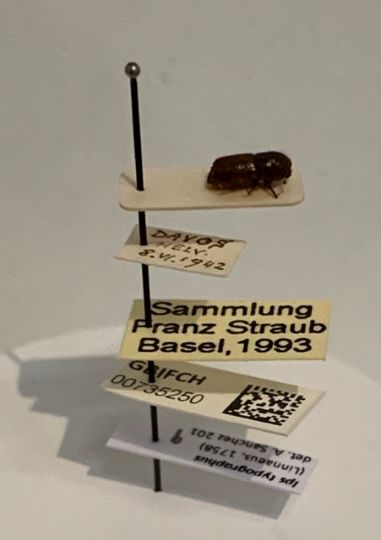
The core of an archive is it’s indexing system, hence the illustration above, with thanks to the insect who can be seen with the metadata apparatus which has become attached since 1942: from the top, place and date of collection, ownership, QR code leading to the catalogue and species identification.
I completed the archive proposal for the Findhorn Foundation (FF) Asset Department in April 2020. I organised it as a text/visual presentation on an Excel spreadsheet which you can see as a pdf flipbook. Underneath is a more readable (and searchable) form of the text.
To browse through the presentation please use the < > arrows at the left and right of the window. For easier reading, use the buttons at the bottom of the window: use Zoom (the + and – buttons) or Toggle Fullscreen (the four arrows pointing outwards).
***
Proposal for an accessable digital archive and historical website
A community project of the Findhorn Foundation
Prepared for Assets by Abbott Chrisman, April 2020
TO PRESERVE THE LEGACY OF THE FINDHORN IMPULSE Information about the founding impulse and all its manifestations will become more and more useful in the coming decades as older members pass on.
TO ENRICH OUR EDUCATIONAL OFFERINGS A searchable database will allow education planners to find appropriate resources and incorporate them into the curriculum.
TO SUPPORT OUR EXTERNAL COMMUNICATION Easy access to a wide variety of texts, photographs, audio recordings and video would be a useful resource for marketing in print, social media and the web.
TO SPREAD THE WORD Parts of the archive can be presented on a public website which could broaden the foundation’s educational reach.
TO CREATE A NEW INCOME STREAM Short public website pages about conferences, lectures and other events could include an invitation to pay a fee for access to complete video, audio and print-based materials.
The sections of this proposal
Please click on the arrow on the left to expand the text.
The current situation of the Foundation’s archives
Since the beginning, documentation and artefacts about the Foundation and community’s activities have been created by individuals, departments and offshoots. Storied variously in private and public hands, often in musty Scottish sheds, there is no master list of records.
At some point before 1989 the National Library of Scotland (NLS) approached the FF offering secure storage for historical materials related to the FF and the community. Since 1989, the FF has been sending documents, photographs, printed material, audio tapes, video and films for safekeeping in a temperature-controlled vault in Edinburgh at no cost to the FF. Held in a ‘deposited collection,’ (as opposed to a donation) the material and the rights to it belong to the FF, and access is by written permission only. Ten 16mm films have been donated (while reserving the FF’s intellectual property rights) to the NLS’ Moving Images branch in Glasgow, which will not accept deposits.
In the early 2000s Mike Scott compiled The Living Record, a chronicle of the FF and a collection of transcripts and articles that form a good overview of the FF’s roots and development. This work offers a ready-made beginning for an accessible archive.
In recent years, Keith Armstrong digitised several FF publications, documents, audio tapes and videos. He created the beginnings of a digitised collection which still needs to be indexed and catalogued to be fully accessible. Some pdf files are not searchable and some images are too low resolution to be useful, so some rescanning or reprocessing will be needed, along with a careful inventory of video material.
Much material is still in private hands (boxes of old photos, diaries, letters, emails, blogs…), in secret storage caches or perhaps sitting on departmental shelves. Even more material resides only in the memories of co-workers and community members. Meanwhile, new material of historical and practical value is accumulated every day. Much of the new material is already in digital form and could be immediately incorporated into the archive.
Preservation and access
Preservation of records is an intrinsic goal of any archive. Much good work has already been done in this area by locating and consolidating records and bringing them to safe, climate-controlled storage.
While this proposal focuses on access, it should be understood that the FF archive should always work to preserve the records in its care and to locate and secure vulnerable records. There is also an option to proactively create new records of FF and community activities. Preservation activities could include:
- Combing departmental storage for relevant records
- Digitising ageing audio and video tapes
- Adding current materials from GoogleDrive, Findhorn Live, etc. to the archive database
- Establishing a system of regular uploads of current materials to the archive database
- Unearthing hidden troves of material kept by well-meaning individuals in safe hiding places
- Seeking donations of privately held photos, diaries and other materials (physically or scanned copies)
- Inviting the community to identify unidentified photos and documents
- Recording interviews with elders and others (and training volunteers to hold interviews).
Access
The primary goal of this proposal is to make the FF’s historical resources easily available to co-workers, community members, friends, donors and eventually the general public.
The proposed IT platforms give the FF the ability to control who sees what. The public website would be suitable for a worldwide audience. Co-workers, NFA members and friends could login to access a richer selection of information on the community wiki, and could perhaps add comments to its pages. Co-workers in Communications, Education and other departments could have direct access to the searchable database as needed. Known information about rights and reproducability would be a part of each item’s record.
Interested persons could apply for deeper levels of access, overseen by a board. Some could also be empowered to create wiki pages, participating in the creation of the community’s history.
IT infrastructure
Searchable database
-
-
- Functions:
- Holds selected records
- Indexed
- Searchable text
- Includes rights info
- Divided into internal and external use
- High level access:
-
- Add records
- Indexing
- Tailor users’ access
-
- Ordinary access:
- Search text
- Browse index
- Download most records
- Options:
- (none)
- Functions:
-
Community wiki
-
-
- Functions:
- Presents historical topics linked to each other
- Includes scans of photos and original documents
- Supports audio and video
- Allows user comments to collect knowledge and opinions
- High level access:
- Create new topic pages
- Ordinary access:
- Browse pages
- Post comments
- Identify mystery records
- Download some records
- Upload donated material
- Options:
- Could include capability to record oral history
- Functions:
-
Public website
-
-
- Functions:
- Presents historical summaries and topics illustrated with documents, photos, video and audio
- High level access:
- Create and edit web pages
- Ordinary access:
- Browse pages
- Pay for detailed access to conferences and other resources
- Options:
- Might allow user comments
- Functions:
-
The content of the archive collection, copyright and GDPR
The content of the archive collection
The archive collection (in Edinburgh and at Findhorn) includes:
- FF and Findhorn Press publications (Network News, One Earth, pamphlets, books)
- FF administrative papers (minutes (some audio), reports, correspondence, accounts)
- FF and associated publicity material (brochures, press cuttings, booklets, posters)
- Photographs and negatives of FF subjects
- Conferences, lectures and teaching material (audio, video, transcripts, printed materials)
- Interviews (audio, video, transcripts)
- Personal papers of Eileen, Peter and ROC (diaries, journals, book drafts, letters, papers, interviews)
- Transmissions of guidance and channelled material (diaries, typescripts)
- Materials from FF satellites (Erraid, Sacred Dance, Community Music, NFA and others)
- Various non-FF publications, documents, audio and video tapes
In Edinburgh there are roughly 32 running meters of paper documents, ten banker’s boxes of photo negatives, and more still at Findhorn. There are thousands of hours of audio tape and quite a lot of video in Edinburgh. There are many more hours of recent digital recordings and many digital documents that are not stored in Edinburgh.
Copyright and GDPR
In general, the FF own rights to some publications like the first series of One Earth and the earliest books and pamphlets (not exclusively: individual authors may also own rights). These items may be re-published on the web. Findhorn Press and its successor Inner Traditions own rights to most Findhorn publications, while the individual authors own the rights to unpublished material and material published in their name; permission must be obtained to present such material. The FF holds the rights to organisational written material (reports, brochures, records, etc.); and to photographs, audio tapes and video recordings where production was paid for by the FF (photographers may also hold rights to some photos). In brief, FF holds clear rights to much material, and there is also a lot of material that would require permission for publication.
In terms of GDPR, generally there are no privacy issues with previously published material. Some of the correspondence in the collection may contain sensitive information about living persons. Since access to the Edinburgh material is by permission only, the GDPR responsibilities can be clarified to individual readers.
Ownership and control of access
- Foundation owns – archive department manages
- Edinburgh deposit
- Physical vault
- FF decides what is scanned, sensitive documents are not scanned
- FF can choose to grant access to researchers
- Database
- Requires log-in
- Divided into internal use and external use areas
- FF in consultation with Board decides who has access to both internal and external areas
- Includes digital vault for paper-free records
- Edinburgh deposit
- Community owns – board manages Wiki
- Requires log-in
- Board decides who can log in and monitors who can write new pages
- Wiki writers can request access to external area of database
- Wiki readers can post comments
- Foundation owns – FF manages Public website
- FF selects material from wiki and other sources in consultation with Board
- FF collaborators could be Archive, Communications and other departments
Copyright holders’ rights and preferences honoured at all stages.
In the structure proposed above, the FF retains tight control of the material while a new entity, the Board, offers the community a protected space to create and debate our history. Through the independent wiki and consultation about access and publication, community-based stakeholders have a voice in how our history is formed and presented to the world.
Relationship with the National Library of Scotland (NLS)
The NLS and the FF have different interests in the collection at Edinburgh. The NLS sees itself as curating a deposit of historical material. It recognises that the material is somewhat of a jumble, and would like at some time to sort it all out, catalogue it into the NLS catalogue and digitise it, but because it does not own the material and cannot open it to public use without permission from the FF, it has little incentive to put resources into a comprehensive and expensive reorganisation. Because it is a deposit, such a project would also be unlikely to receive outside funding unless the FF were to donate the collection to the NLS, which is probably not in the FF’s interest.
Meanwhile the FF has no need to index or digitise the entire collection at Edinburgh, nor would it be trusted to do so by the NLS. Some material is already digitised (though not catalogued), and many items on deposit at Edinburgh are not relevant to the current project. It is in the FF’s interest to continue to deposit materials for safekeeping and to be able to digitise the useful parts of the deposit .
Recent conversations with Olive Geddes (who recently retired as Curator of Social History, Archives & Manuscript Collections; NLS Edinburgh) suggest that it would be possible for the FF to withdraw material in moderate-sized batches, transport it to Findhorn, digitise it and return it to the NLS as long as the locations of the contents of the boxes and files within the boxes were preserved in the process. In this way the FF can pursue its project while NLS’ curatorial role is honoured and its options to reorganise the material remain open. Along the way, the FF may produce improved descriptions of box and sub-box contents, which might help the NLS.
The ten 16mm films at the NLS’ Moving Images Archive in Glasgow are subject to a different arrangement than the paper and audio tapes in Edinburgh. Moving Images takes responsibility for the preservation and restoration of film and video tapes, in return for the right to offer them for free on its website. Deposit agreements are not possible. Currently these films are classified as ‘donations with rights withheld’, so the FF retains its rights for all uses beyond the offer on the Moving Images website. FF has authorship rights of only a few of the ten films.
A process to finalise GDPR-compliant 30-year deposit (Edinburgh) and donation-with-right- withheld (Glasgow) agreements is underway. New deposits and donations could be added to the agreements as needed.
Human resources
Searchable database
-
-
- Board
- Filter community access requests
- Staff, LEAP
- Manage access
- Locate useful NLS material
- Select material for scanning
- Determine rights issues
- Catalogue and index
- Liaise with FF departments
- Delegate when appropriate
- Committed volunteer
- Support staff
- Community
- Donate material
- Help with digitising
- Collect oral history
- Immediate tasks
- Create indexing system
- Split and index Keith’s scans
- Index video
- Upload Living Record
- Board
-
Community wiki
-
-
- Board
- Invite page creation
- Advise on content
- Staff, LEAP
- Write pages
- Host comment chats
- Host identification requests
- Delegate when appropriate
- Committed volunteer
- (none)
- Community
- Write pages
- Help identify records
- Add personal perspectives
- Immediate tasks
- Determine basic structure
- Populate structure
- Beta test
- Plan roll-out
- Board
-
Public website
-
-
- Board
- Advise on content
- Staff, LEAP
- Select and edit material
- Create web pages
- Curate display of archive
- Host comment chats
- Delegate when appropriate
- Committed volunteer
- Support staff
- Community
- Help when needed
- Immediate tasks
- Design website
- Determine content
- Populate
- Board
-
Timeline
Year One Main Tasks
- Design and/or acquire 3 interlocking IT platforms (seek advice)
- Set up secure workspace with scanners, files, computers
- Design catalogue and index systems for database
- Plan content and design of starter wiki: begin assembling pages using Mike Scott framework
- Move Mike Scott and Keith Armstrong material into database and wiki
- Gather photos, videos and tapes relevant to starter wiki from NLS and other sources
Year One Secondary Tasks
- Negotiate rights arrangements as needed (David Spangler, Mike Scott, others)
- Establish board to advise on content and make gatekeeping decisions
- Sort out video holdings, digitise where needed
- Explore collecting oral history
- Seek external funding for outsourced video and audio digitalisation and transcription
- Explore collaborating with academic historians
- Survey and prioritise conference and lecture material for paid-access part of public website
- Set up display cases for historical materials in Cluny and The Park
Year Two Main Tasks
- Beta test starter wiki – open to co-workers and community when ready
- Begin assembling public website
- Copy useful material from GoogleDrive into archive database
- Establish routine for adding contemporary FF, NFA and other records to database as they are created
Year Two Secondary Tasks
- Support community members to use wiki
- Explore methods of transcribing and indexing audio records
- Plan archive event for 60th birthday 2022
- Begin systematic survey of NLS material
- Train FF co-workers to use database
Costs
IT platforms
- Free database, wiki and website platforms should be sufficient. Cloud hosting might be free or cost £20-40/month, perhaps more if large quantities of storage are needed for video on demand.
- £ 0-500/year
Software
- Programs to manage pdf, audio and video files and convert them to searchable text may come with scanners or may need to be purchased separately. These needs may grow as the project grows; or be solved by freeware.
- £ 500
Scanners
- £ 250 Office-type sheet scanner with sheet feeding and flatbed
- £ 100-400 Overhead camera scanner for books and large sheets
- £ 200* Flatbed negative scanner (or negative scanning could be outsourced* for 20-25 p./negative)
Audio and video
- Audio and video digitisation could be outsourced* (£8-10/tape) or done in-house, which will take a very long time. Free software is available, while cassette, reel-to-reel and VHS decks will be needed along with cables and adaptors, lumped together in this estimate for in-house equipment.
- £ 350*
Trips to NLS
- Trains from Forres to Edinburgh are currently about £30, with a per diem of £100 for hotel and meals (averaging seasons). So £560/week. It is hard to know how many trips will be required – probably less at the beginning than in the middle and end.
- £ 1700/year
Shipping
- A box holding 7 standard archive boxes will cost £20-25 to ship one way. It is presently uncertain how much material we might want to move from Edinburgh to Forres for digitisation (and then send back to Edinburgh)–probably less in early years and more later. This estimate is for the first two years.
- £ 500/year
* It may be more efficient and effective to outsource negative scanning and digitisation of audio and video tapes. Costs will climb to thousands (which could perhaps be specifically fundraised) but the work would get done quickly.
Decisions and next steps
This proposal awaits the following decisions to be taken by Stewards, Trustees and perhaps other parties:
- General green light for the accessable database and community platform scheme
- Specific green light or amendment of the ownership and access control scheme on page 6
- Procedure to appoint Board. To whom is it accountable?
- Whether a wiki is more appropriate than a website for the community platform
The author suggests the wiki. While a wiki is probably more complex to set up, it will provide much more capacity for different kinds of community involvement. Even if community involvement is limited at first, it will be less effort and more of an invitation to start with a wiki than to migrate to one. - Whether the public website is in the two-year picture or should be deferred until later
The author believes that a public website is sooner or later going to be seen as desirable, so the choice is not whether or not to have one, but when. In all events a public website (or a public-access part of the wiki) should be included in the initial planning of the IT platforms. - Whether the public website should be a part of the findhorn.org site or have a separate address and visual feel
- Whether the public website should include pay-for access to in-depth records like conferences and lectures
- Whether to prioritise proactive collection of oral history from older members and friends of the community
- Whether to donate VHS tapes to the Moving Image Archive or retain complete control of their use
- Should local photographers and videographers be able to upload their work to the database (with rights information, potentially including prices) so co-workers (in Comms, for example) could browse a wider selection of images?
The immediate next steps are:
- Finalise and sign agreements with NLS Edinburgh and NLS Moving Images Archive Glasgow
- Develop concepts and specifications for database and wiki platforms
- Develop cataloguing and indexing systems
- Acquire software
- Begin to load materials needed for basic wiki into database and wiki
- If priority: Locate and train volunteers to collect oral history.
I thank the Findhorn Foundation for the permission to share it on this website.

US/Swiss artist, director, somatic practitioner, and educator. Active in theatre, writing, university teaching and community projects, based in Zurich.




Wow! That’s a lot of work! Blessings on this work!