


This guide to the community was first published in 1995. We offer it here as pdf-flipbook and also in full text.
To browse through the booklet please use the < > arrows at the left and right of the window. For easier reading, use the buttons at the bottom of the window: use Zoom (the + and – buttons) or Toggle Fullscreen (the four arrows pointing outwards).
***
To read the full text of each section please click on the arrow on the left. We have removed contact details etc as they are out of date and give website links where relevant.
Welcome
Welcome to the Findhorn Foundation Community. We warmly invite you to come and see us — for a short visit of a few hours, or for a longer stay through participation in one of our educational programmes.
If you just wish to drop in, please make your way to the Visitors Centre located in the Universal Hall. You will find someone there to help you.
You’re also very welcome to join us for a tour of the Park; the tours, which take up to 2 hours, leave from the Phoenix Shop at 2pm daily June to September, and three times a week at other times. […]
In the Universal Hall, you will also find the Helios Café. It is a friendly meeting place in pleasant surroundings where you can catch up on local gossip or sit quietly with a Community magazine. Selection of vegetarian savouries, soup, sandwiches, cakes, hot and cold drinks. Permanent art exhibition area. Open seven days a week – weekdays 10 a.m. to 5 p.m. (Friday open until 10 p.m.) – Sundays noon to 5 p.m.
Please also stop in the Phoenix Shop.
The Visitors Centre will provide a list of B&B’s on request. You can also elect to stay in the Findhorn Bay Caravan Park, either bringing your own tent, camper or caravan, or renting a holiday caravan on site.
Please also ask the Visitors Centre about their Short-Term Guests Programme. If you are interested in participating in some of the longer community educational programmes, please contact the following organisations for their brochures:
- the Findhorn Foundation [now via website]
- NewBold House (see page 24) [no longer operating]
- Minton House – (see page 26) [no longer operating]
- Erraid Island (see page 28) [now via Findhorn Foundation website]
DISCLAIMERS
- We would like to make it clear that the ‘Findhorn Foundation Community’ referred to throughout this guide refers to the Findhorn Foundation and its associated Community and not to the nearby local Scottish village of Findhorn which has its own history and traditions.
- Whilst the compilers have made every effort to ascertain the exactitude of all the information contained in this guide, they cannot guarantee the authenticity of every single detail — and they apologise in advance to the reader for all the changes within the Community bound to have taken place between the time of going to print and the time of reading this guide …. but thus is the nature of the Community.
Foreword
Mighty Oaks and Little Acorns.
We have all heard the adage about mighty oaks growing from little acorns. Inside each of us are a myriad of acorns. The extent to which any of them gets to grow into an oak is the result of a combination of many factors. The moments when vision married to discipline and dedication combine with opportunity married to recognition seem rare in a world fraught with change. Yet often in those moments are the beginnings of unimagined possibilities. Somehow that is what happened when our founders arrived at a small caravan site in North- East Scotland in 1962. Those moments continue to happen here, and we can only begin to dream where they may eventually lead us. This booklet will help you to weave your way through what has grown up here and perhaps in the process you too may experience one of those magical moments when inspiration, opportunity and will are simultaneously sparked and another project begins — this time in your life!!
Judy Buhler-McAllister
Findhorn Foundation Director
Compilers’ Note
We have produced this guide to the Findhorn Foundation Community knowing full well that it is in a constant process of evolution and that what we have included today will probably have evolved into something different by tomorrow. The universe of stars and planets is understood better by exploration than academic observation; so it is with the Community, the difference being that you can explore the Community for yourself. There have been many books written on the history, philosophies and building of the Findhorn Community. This guide briefly touches on all of these, but it is offered as a light-weight handbook for the Community resident, guest and visitor rather than as a weighty encyclopaedia of facts.
Cally and Harley Miller
The Findhorn Foundation Community — Introduction
When Peter and Eileen Caddy and their three sons, together with Dorothy Maclean, began creating the Findhorn Community in 1962, the word LOVE occupied a central position and it has done so ever since. For people living and working together within one spirit, the love could mean “Mutual sensibility and having the capacity to feel what is required”. Peter would describe it as “Loving who you are, loving who you’re with, and loving what you are doing”. Over the years, as the Community reshaped itself, this quality of Love needed to be re-identified. New structures have to be built from time to time and obsolete ones released so that love can continue to flow. This is as true today as it was back in the 1960s. As the Community adjusts its life-style to the world of the late 1990s, so frameworks are adjusted to encourage people to relate to the Findhorn Community in a way that serves everyone. Thus mutual sensibility and having the capacity to feel what is required can remain the spiritual focal point for “who we are, who we’re with and what we do”. There is no single or perfect way of being part of the Findhorn Community and everyone is expected to establish their own particular relationship with its spiritual heart centre. The Community is the collective expression of that centre.
The results of what can happen when a variety of people are united in spirit is what is being demonstrated within and around the Findhorn Community, and can be judged by what it has created.
The Community has two aspects:
- The Findhorn Foundation, and its trading arm NFD (New Findhorn Directions Ltd.)
- Units that are partially or totally independent of the Findhorn Foundation. This evolution began in 1979.
After many challenges the interface between the Findhorn Foundation and the wider Community has evolved into a good relationship providing a mixture of individual and collective opportunities. The proposed Community Council will allow the Findhorn Foundation to become one body within the whole rather than occupying a central position.
There is a mutual aim: the embodiment, demonstration and teaching of personal and work service through the transformative experience of daily life. The Community seems to be engaged in building and demonstrating a viable social model, thereby encouraging mainstream society in its evolu tion towards a better world.
Education:
The educational programmes might be seen as ‘the glue’ which holds the cells together. The structure has internal and external aspects.
On campus, there are introductory programmes, workshops and training courses, work opportunities, conferences, and presentations. Beyond campus, there are worldwide presentations and workshops offered by the Community’s individual representatives as well as cooperation with other groups, conferences and educational trusts. The guests coming for the educational programmes provide the Community with inspiration, new ideas, variety, part-time or full-time work, an essential source of income and an ongoing connection with mainstream society.
The Findhorn Foundation, Newbold House and Minton House have brochures of their educational programmes available.
Community Meditation:
There is a recognition throughout the Community that the world’s major religions are all valid spiritual paths. There is no requirement to follow a particular spiritual path or discipline, rather, individuals are encouraged to find their own particular practice that will allow them to lead a more ful filled life. A focus on spiritual principles is found in the daily activities of work and the way people relate to each other. Group meditations are held in the many sanctuaries and meditation rooms throughout the Community.
Stewards of the Findhorn Foundation
The Stewards have goodwill for the Foundation and support its aims and visions, just the sort of positive group of people every enterprise needs. The growing network of Stewards is world wide. They keep in touch with the Foundation and each other through the quarterly Network News (also avail able via Internet) and the Directory of Stewards of the Findhorn Foundation. […] Editor’s note: now Resource People
Maps
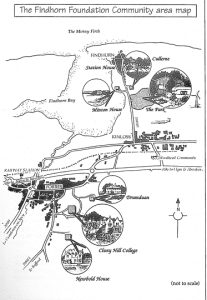
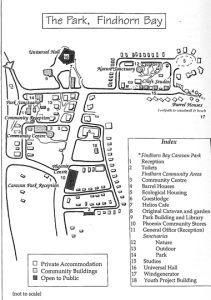
The Park
In the beginning … The Central Park
“There were about eight to ten people and there was Dorothy Maclean and Eileen Caddy and a few other middle-aged ladies wheeling these great barrows of soil around. And there was Peter Caddy exhorting them with ‘Come on! Move along! Right, you get in there and you get in there!’ When Peter saw me, he said ‘Oh, you’re just in time’ and bang, he puts this shovel in my hand and I started digging”. That was Ian Campbell’s account of joining the Community in the 1969 — it is a very different Community today. The Park has been built upon this combined surge of physical energy, Eileen’s spiritual guidance and Dorothy Maclean’s communication with Nature. There has been the transformation of a featureless sand dune and rubbish tip into a wonderful living environment. Over the intervening thirty years, through hard work, attunement to spirit and nature, love, intuition, faith and skill, The Park has become a permanent village. Today, becoming a ‘village resident’ doesn’t necessarily require living or working in the Community, although everyone seems to be swept into participating in some way or other. The original caravan and the tiny but famous garden, home to Peter, Eileen and their three sons and Dorothy between 1962 and 1967, still occupy the site where it all began (next to the General Office).
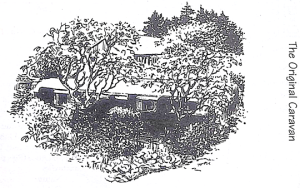
The ‘Findhorn Garden’ still produces vegetables for the kitchen and retains the feeling of being at the hub of things. Around this central area are the General Office, food and household stores, Holistic Healthcare Office, the Park Sanctuary, and the Transformation Game Office. They might look like a collection of garage buildings to some people and the truth is that they are. In the early days of the Community, Moray District Council was not too keen on anything permanent being built here. Peter convinced them that these ‘timber garages’ couldn’t possibly be regarded as permanent structures. (Happily today’s relationship with the Local Authority is more constructive and forward looking.)

The Open Air Sanctuary is sited in the Hollow adjacent to the original caravan. This was laid out by David Spangler in 1993 as a place for contemplation and inspiration. A seat is dedicated to the memory of Peter Caddy. A stone honouring the “Green Aspect of Tara” was sculpted by a refugee monk from Tibet. The Park Sanctuary was built in 1968 for the Community’s daily meditation, this is where Eileen shared the guidance she received for the Community each morning. Nowadays it is left to individuals to receive guidance for themselves. The room is furnished very simply with a circle of chairs and a bowl of flowers at the centre. On the wall is the original “Sunrise Panel” designed by the weaver Patrick Liddington. In the corner is a glass sphere symbolising the “Idea of Humanity within the Mind of God” and Humanity’s precarious connection with the Earth is symbolised in the base of green Portsoy marble which supports the sphere.
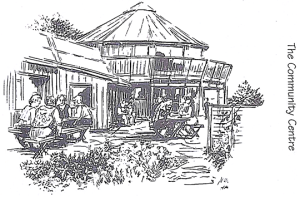
In 1970, when Eileen received guidance that the Community should build a kitchen for 200 people and a dining room to seat 70, there were actually only ten permanent members of the Community. (Up to then one of the seven cedarwood bungalows had served as the dining room). Peter enthusiastically set to and designed the Community Centre in a single evening, and soon after the timber-framed building was erected. Within twelve months the building had already become too small for the rapidly growing Community. Since then the building has been extended three times. Before the completion of the Universal Hall, the Community Centre doubled as a venue for a variety of activities including educational programmes, performances and presentations. It is still used for meetings and social occasions. The latest extension, the two-storey round house, was designed by architect Andrew Yeats and was completed in 1989. Nature is freely represented in the skillfully laid mosaic patio completed in 1988. Use of the Community Dining Room is strictly monitored and unfortunately is not open to everyone.
Performing Arts Centre … The Universal Hall
In December 1973, the Community staged a performance in the Community Centre (a quarter the size of the present area) entitled “Mass” directed by Richard Valeriano. Immediately Peter Caddy decided the time was right for the Community to have a purpose-designed hall for performances, assemblies and conferences. The garden of the Park Building was chosen because it was then the only piece of land owned by the Foundation. Architects George Ripley and Elizabeth Grindley produced a plan to fit the area between what was then the Printing House and a chicken run. The plan naturally formed itself into a pentagon. The Community had its own building team led by Lyle Schnadt. George Ripley admits that it was more intuition than conscious intention which produced his final design. Frances Ripley skillfully made a series of detailed models to communicate the complex design to the builders. Literally hundreds of people helped to build the Universal Hall — visitors, guests, members, contractors, artists and craftsmen, and it is said that the angels lent a hand too.
The external masonry might be seen as a commentary on the evolution of the Findhorn Community between 1973 and 1983. On the left-hand side of the front entrance panel is ashlar stonework cut and laid by local stone masons at a time when Community life was still quite formal and Peter expected everyone to dress for dinner. The adjacent section is random stonework laid at a time when the Community broke with its structured past and began exploring individual freedom of spirit. The third section on the left-hand side of the Helios Café was laid with great tenacity by two members over a three year period (sometimes spending a week to cut and lay just one stone): this stonework might reflect the period when the Community anguished over its future and held tight to all it owned. There is a revolutionary section on the north elevation built by Ian Turnbull — a magnificent rush of energies held together by the inspiration of the Findhorn River — this wall was created as the Community developed its independent and autonomous aspects. The fifth wall is a rendered blank surface — could this represent the idea of the potential for growth?
As the structure evolved people began to see lots of esoteric significance in the shape and proportions of the Universal Hall (described in One Earth Magazine – Winter 1978). In addition The Hall is thought to be sited at the crossing point of two ley lines and orientated towards the Moray coincidence point at Burgie three miles to the south.
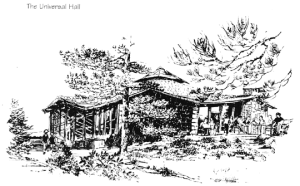
The Universal Hall is a building for the Arts and recognised as such by the Scottish Arts Council who contributed a £43,000 grant towards the construction costs. Artists have left their mark here. American architect, James Hubble, assisted by local artist Janet Banks (and others), created the swirling drama of stained glass which forms the front entrance screen. Tom Buhler from Switzerland formed the spiralling wood sculpture in the main auditorium. The sculpture is flanked by two enormous canvasses representing the moods of the Moray Firth painted by the late Haydn Stubbing. Film actor Burt Lancaster led a group in building the access ramp at the rear.
Stage and screen artists, singers, dancers, musicians, clowns, choirs, orchestras have appeared here — and still do including the annual visit of the Aberdeen International Youth Festival. There are also a host of inspiring, conferences, rituals, dances, meditations, Community gatherings, visiting speakers, and film and video presentations. The local media and Community notice boards carry details of forthcoming events. The building also serves as the Visitors Centre, café and art gallery, dance/drama studio, photographic department and recording studio. There are several forms of dance on offer varying from individual sessions to ongoing group programmes that regard dance as a structured discipline through which the creative impulse can find its freedom.
Ongoing sessions for dance and movement include Ballroom and Latin American dance, Five Rhythms, Sacred Dance and Children’s Five Rhythms. Also on offer: Yoga Classes – Story Telling – Theatre – Choir (see notice boards for details). Wednesday: 7.30 p.m. Sacred Dance evening – everyone welcome.
To the left of the Universal Hall, you will find the Park Building. This traditional house was built some three decades before The Community came into being. It was bought by Pauline Tawse who then gave it to the Community for use as a venue for educational programmes. Pauline played an essential part in the establishment the Findhorn Foundation in 1973. The Park Building houses the Library (open to visitors), a meeting room and guest accommodation.
Further East in the Park … Pineridge
In the mid-1970s, the Community began to see that children could contribute to its daily life and spirit. It was realised that being in and around the Community encourages children to form relationships with other people outside of their own immediate family in a safe and nurturing place.
With the arrival of many infants, either born on site or attached to new members, the Playhouse was created. It now provides a parents’ and children’s meeting area to support the well-being of families on all levels. The children are encouraged to learn interactive and social skills and how to be comfortable in groups.
Everyone (including visitors) is welcome to join in the school holiday pro grammes (reasonable financial contribution expected). Activities include painting, music, dance, theatre, gymnastics, pottery, swimming, outings – see announcements in Community Centre and the Playhouse, or contact the Playhouse or the Visitors Centre at the Universal Hall.
- Parents and toddlers drop-in group — guests and visitors welcome Tues day 9 a.m. to 12 noon
- The Playgroup: 2 to 4 year old (three month commitment) and ongoing groups for 8 to 12 year old girls and boys (separately) are also held at the Playhouse — see announcements in Community Centre.
In the 1970s the Findhorn Crafts area buzzed with the popular creative activities of candle-making, silk-screen printing, jewellery manufacture, silver-smithing, production pottery, weaving and so forth. That original buzz has mellowed over the years into the sound of individually crafted pottery and gentle weaving and knitting.
The Pottery — operated by Brian Nobbs (helped by his apprentice Sharona Parker) as a self-financed enterprise. Brian produces studio pottery and sculpted items. The Pottery exudes the atmosphere of long tradition, the smell and feel of the earth, the sense of it being one of humanity’s oldest crafts. There is an oil-fired kiln to transform the substance of earth into human vulnerability. The Pottery is open to everyone who wishes to learn, practice or produce, and offers pottery classes for all ages. Pottery for sale from Studio, Phoenix and Cluny Hill foyer showcase.
Weaving — operated as a Findhorn Foundation enterprise. The feeling of quiet softness seems to hang in the air when you enter the Weaving Studio; there are racks of soft, colourful bobbins with threads of silky warp on the looms. The “Sunrise” and “Star of Bethlehem” panels are produced on the 200 year old Dobby Flying Shuttle loom, donated to the Foundation by a master weaver, the late Patrick Liddington. These beautiful woven panel are available for sale. Also produced are a range of knitware and tapestries. The Studio facilities are available for individual use by arrangement.
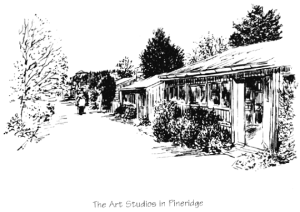
Visual Art —The Art Sanctuary is a focus for the visual arts in the Community. It is a little space for so much activity, and plans are already in hand for a brand-new purpose-made building. The Art Sanctuary is used for workshops, painting, drawing and printing classes, and children’s art. It is also available as a studio space by prior arrangement for which a small charge is made towards the cost of heating and materials. The Art Sanctuary is co ordinated by Randy Klinger.
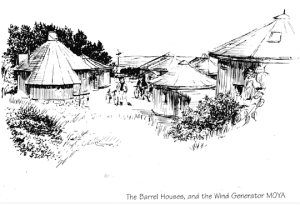
Participants who came to the 1978 “OnEarth Findhorn Conference” provided the Community with an inspiring glimpse into a new world where ecological awareness was an essential ingredient in designing buildings for everyone’s future well-being. Experiment and innovation were two of the qualities which then began to simmer away in the Community’s psyche. Upon the purchase of the Caravan Park in 1982, these qualities burst out in with a general enthusiasm to build a Planetary Village as a demonstration of the best that could be created when Nature and Humanity cooperate. For several years the Community agonised over countless plans and fantasies. Five years later in Pineridge, Ian Turnbull’s beautiful little Nature Sanctuary and Roger Doudna’s fantastic Whisky Barrel House were finished — an obvious celebration of Nature and Humanity. It was gratifying, back in the timorous days of 1985, to have Moray District Council encourage the Community to be experimental and innovative in it’s building design. Nowadays the evidence of this approach is in The Park area for everyone to see, and the dream of creating a Planetary Village has become the reality of a living Eco Village Project. It has been described as the ‘401b cabbage of the ’90s’ and has earned almost as much media attention as the original event, and has inspired many others to build with ecological awareness.
In 1990, Eileen’s house Cornerstone was built by David and Jonathan Caddy heralding the start of an intensive programme to replace the ageing caravans with housing for members and the creation of new guest accommodation. The housing at Bag End at the far end of Pineridge, the collection of whimsical Barrel Houses and the Guest Lodge on the Village Green represent a wealth of development by the Foundation and private individuals, showing that the Community’s inspiration and enthusiasm is as alive as ever.
The Findhorn Foundation’s Building School has been the main contractor supported by volunteer labour. Sponsorship has come from many of the materials suppliers. Architects Ekkerhard Weisner of the Institute of Building Biology and Ecological Design Association (experts in health aspects of building design relating to materials toxicity, ventilation and elec tromagnetic field effects) and many others have supported the project through their expertise. (The book Simply Build Green on our ecological building techniques and designs is available from the Phoenix Shop.)
The Building Department of the Foundation offers basic building instruction, accommodation, food, and participation in the Eco Village building programme. Skilled workers are also invited to participate. See the Findhorn Foundation Brochure for details.
From time to time, within The Park area, land is offered for sale for private development, subject to a feu disposition (the Scottish equivalent of “leasehold without term limit”) and right of reversion in favour of the Findhorn Foundation. This ensures that occupation is only by those who support the Foundation’s aims and objectives. In the event of the Foundation vetoing any transfer or sale, it is obliged to purchase the property from the vendor. The cost of a site is normally around two thirds of open market value.
At this time fundraising is producing the capital necessary for the purchase of building land adjacent to The Park area.
The wind turbine (named Moya) produces 75kw of electricity when the wind is blowing. During such periods of power the surplus electricity is sold to Scottish Hydro. When the wind stops blowing, electricity is bought back from them. The electricity produced meets 15% of The Park’s consumption. Moya was erected in 1989 and stands as an impressive landmark beyond the eastern perimeter of Pineridge.
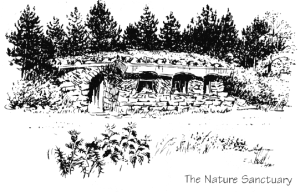
The Quiet Garden has long been considered a good place to commune with nature. It includes the Nature Sanctuary, which was built by Ian Turnbull in 1986 and dedicated to spirits of Nature. This imaginative and playful natural building uses recycled materials and cost just £1,000. (Open for individual meditation when not otherwise in use.)
Further developments … The Village Green
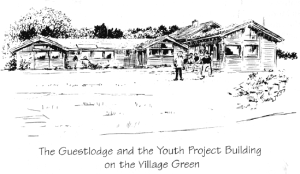
There was a time when the Community’s young people found it more comfortable to meet with their local peer group well away from the ‘exaggerated and embarrassing’ life-style of their New Age parents. Things have now changed for the better, and the young people have an on-campus meeting place of their very own. (Perhaps their parents have also changed for the better too). The Youth Project has a new purpose-made building. Members of the Project raised the funding and helped in the design and building. It has become a focal point for young people between the ages of 13 and 20 years from both the Community and the local area, and there are around 25 members of the group. The Findhorn Foundation Youth Project was born in the International Year of Youth in 1985. It organises youth programmes and initiates exchanges and link ups with young people in other parts of the world. The group runs holiday and after school activities; it is involved in work projects within the Community and also provides a support system for its members.
Also on the Village Green is the new Guestlodge. Both the Youth Project Building and the Guestlodge are crowned with a turf roof, and have been built with the Eco-Village standards.
Beyond the Park … Cullerne House and Gardens
We are told that Cullerne House on the edge of Findhorn village was originally built in 1820, nine years before the disastrous flood that wrought havoc in Moray. With predictions of a similar event occurring in the future due to the effects of global warming, perhaps Cullerne House is to be the vegeta ian Noah’s Ark of the Findhorn Community.
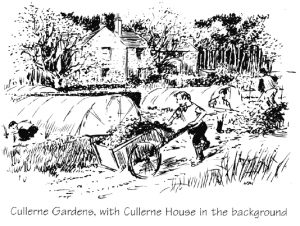
In 1979, Cullerne House and eight acres of land were purchased by the Foundation. Six of those acres have been transformed into a productive mar ket garden supplying organic fruit and vegetables for EarthShare. Hedges and trees have been planted and cultivation tunnels built to provide shelter from wind and to anchor the soil. The well outside the Universal Hall feeds the irrigation lake. There has always been a strong intention for the gardens to be used for educational programmes. It is seen as a Garden School: a place to learn prac tical gardening, and a place for individual growth through working with the Earth and attunement to Nature. The outbuildings have been renovated to provide a meeting room and library, tool store and drying loft. Visitors are welcome to spend time in the gardens.
Beyond the Park … Cluny Hill College
It took a giant leap in faith for the Community to purchase and take over the running, for one season, of Cluny Hill Hotel. Peter and Eileen Caddy had managed the place between 1957 and 1962 with Dorothy Maclean and Lena as active members of the hotel’s team.
In 1975 the Foundation was offered Cluny Hill Hotel subject to them honouring the next summer-season’s bookings of tourists. There was of course an enormous difference between informal community living in an open caravan park and operating a massive hundred bedroom hotel in the fine town of Forres with its well-established and traditional attitudes. With the community pulling together, spiritual and physical effort, and raising the purchase price of £60,000 (complete with furniture), the challenge was met, and the hotel was purchased, occupied and serviced as such for one season. By September 1976 Cluny Hill Hotel had been transformed into the Foundation’s College.
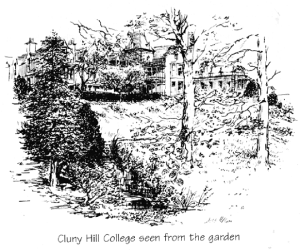
It is a rambling grey rendered building following the contour lines on the south facing slope of the hill. The building was erected in 1863 by three local business men as Clunyhill Hydropathic Establishment, since when it has been altered and extended many times.
It is the Foundation’s main campus and guest accommodation for educational programmes and conferences. It has the feeling of an intensive 24-hour-a-day lifestyle within a complete environment. The provision of food, housecare, building maintenance, transport, garden produce, meditation, sauna and healing, the educational programmes together with the general caring and spiritual nourishment for the ‘Cluny Family’ can be joyous, challenging and satisfying reality for the 40 resident members and up to 110 programme participants and long term guests. The gardens and woodland walks provide a place to get away from it all but not to be completely out of sight. Behind the open air swimming pool, a garden dedicated to Peace in the World has been created for silent meditation. The ‘Power Point’ hill behind the College is there for those who are into such things, and the view from Nelson Tower high up on the Cluny Hill above Grant Park is there as a reminder of the rest of the world.
The vegetable gardens supply a small percentage of food to the kitchen and the gardeners practise a cooperative gardening ethic. There is a fine lounge and panelled dining room, a library, shop, sauna and many meeting rooms. The Ballroom, during it’s Hotel era, was where the rich and famous danced the night away. Today it provides the ideal venue for Sacred Dancing and Group Discovery (although the Community occasionally kicks its heels up in more informal diversions).
The Meditation Sanctuary is situated within the building; it is open to all during Reception hours [please check in with the receptionist before going there]; and the rest of the time, for security reasons, it is only open to College residents and employees.
In Findhorn Village … Station House
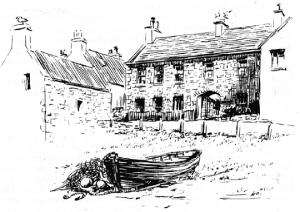
There is little to single out Station House from the rest of Findhorn Village. It has the feel of traditional stone and slate in its structure and, as a Findhorn Community residence provides more connection with the immediate neighbourhood than can ever be felt by people living at The Park or Cluny Hill.
In 1860 when Findhorn was an important trading port for the North East, a group of local businessmen and traders financed the construction of a railway from Kinloss to Findhorn Harbour, for the export of timber and wool and the import of coal and utilities. Station House was built as the terminus and engine shed with a turn table. Nine years later the venture went out of business and Station House became both residential accommodation, stables and warehouse. In 1978 it was sold to the Foundation by local Forres resident, Disney Hopkinson.
Today it is home for eight adults and three children, and a meeting room and sauna (with plunge pool) for the Community. The sauna is open each Wednesday and Saturday 5.30 – 10.00pm. (£1.50 fee)
Independent Education Projects … NewBold House
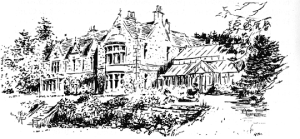
Along the road from Cluny Hill College is Newbold House, hiding away behind trees and shrubberies at the end of a rhododendron-line drive. From the outside it has the character of decorous gentility although this couldn’t, by any stretch of the imagination, describe Newbold’s more informal residents of today.
The house was built in 1893 as a private residence by Colonel and Mrs. Woodcock; their escutcheons and armorial bearings still embellish the facades. They also built two gate lodges and coach housing and established fourteen acres of formal gardens, walled vegetable gardens, shrubberies and woodland. In May 1979 the Foundation began renting Newbold as a workshop centre. Six months later, encouraged by the Foundation, the Newbold Project became the first independent, self-financing and self-governing group within the Findhorn Community.
In 1982 the Newbold Trust was founded and the house with seven acres of gardens was purchased. The Newbold group have developed their own particular ways of financing and administering the venture, and this includes a donation scheme for staying there. Membership means working with the whole project and being part of the management group. Guests can either join workshop programmes or participate with the members in the daily life of the community. A three month Short Term Membership offers an in-depth experience of community life. It is an ideal place for a regular ‘spiritual and emotional check up’. Newbold is hosting the first semester of the Findhorn College of International Education‘s programme of environmental and community studies.
Independent Education Projects … The Moray Steiner School
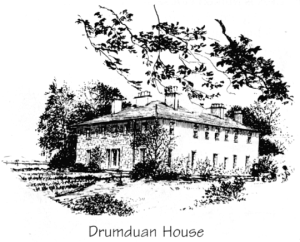
During the 1970s there was a systematic vandalisation of the empty house of Drumduan on the northern slopes of Cluny Hill. It was particularly distressing for Community members who felt that the house was destined to become part of the Foundation. After two years of pressure by the Foundation, Drumduan’s owner agreed to sell the house, and members began the grizzly task of removing all traces of the hooligan period.
The house was originally built as a single storey early Victorian villa with a raised floor and projecting gable eaves. In the late 19th century it was extended horizontally and vertically and lost much of its charm in the process. However, it does have one of the finest views in the area of Findhorn Bay and across the Moray Firth to Caithness.
After years of deliberation, a school for the Community’s children was thought a good idea, and a number of education models were considered. In 1982 it was decided that the Waldorf system of education, based upon the philosophies of Rudolf Steiner, was the most suitable and a Steiner teacher from the Netherlands began a kindergarten for preschool children in the Play House on Pineridge. It was an immediate success and by 1984 children from outside the Community were also attending. The school expanded and a year later moved to Drumduan and became the Moray Steiner School. The Steiner system encourages the participation of children, parents and teachers, which is not always as easy as it might sound, and there have been challenges to deal with over the years. The school has grown as its children have grown and now provides education up to the age of 15.
Independent Education Projects … Minton House
Catch sight of Findhorn Bay when the sun is low in the west and great clouds are bubbling upwards behind the Moray Firth: that is a good moment to see the evidence of the ‘radiant light of Findhorn’. There is a shimmer of water edged with a strip of bright sand, a white line of moored sailing craft, the silhouette of dark forest, the reflection of waterside buildings and a myriad bird wings brightly flashing against the grey cloud bank… The pink reflection in front of dark pine trees is Minton House.
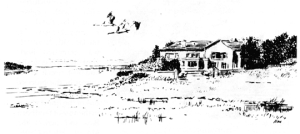
Judith Meynell (owner) established the Minton House Centre in 1984. It is a team run enterprise as well as being a retreat and conference centre embracing the spiritual traditions of Christianity, Sufism, Hinduism, and Buddhism. There are weekly Meditational Eucharist Services, Taize singing, yoga and dance, a variety of philosophical workshops and an annual Inter-Faith Conference. Guests can choose to participate in the structured programmes or design their own individual retreats. It can be a gift of time for personal contemplation and restoration. Guests can either stay on ‘full board’ or ‘bed and breakfast’.
Dances of Universal Peace – every Thurday £2.50.
Further afield
Erraid
Living on an island is often not what it might promise to be. ‘Getting away from it all’ isn’t something you can easily do on Erraid Island as anyone there will happily tell you. Certainly Erraid is a very long way from the bustle of city life and you need to have the cupboard well stocked for the times when tempests blow and spring tides are rising, but the fact is the place is alive with human and wildlife residents. Linked to the Island of Mull (at low tide you can walk across) Erraid is part of a larger local community of crofts and small farms working cooperatively, helping each other with the sheep rearing, peat digging and drying, planting and harvesting. Nature and the weather are master in this part of the world. If you want to live here joyfully, then there is little option but to accept what Nature wants to do and work with its rhythms, and in this respect the Erraid Group have found the power of meditation important.

In 1978 the owner of Erraid Island offered occupancy of the island to The Foundation for 11 months of each year. A hundred years before, another community of people had set up home there: lighthouse builders, keepers and their families. The Northern Lighthouse Company built nine stone cottages with outbuildings, and opened a stone quarry where the lighthouses were built and then dismantled to be shipped and re-erected on points around the adjacent seas. During this period, engineer George Stephenson directed operations and his son, Robert Louis, came and stayed on the island and, inspired by the landscape, developed his writing skills. (He was a great disappointment to his father.)
The legacy to the present day Erraid Community is a row of sturdy granite cottages, which they have painstakingly renovated and modernised, and five acres of productive walled gardens. They have improved the water supply and brought outbuildings back into use as cow and hen housing, workshops and a boat-house. There is also a flourishing candlemaking studio which ‘exports’ to the Phoenix Shop. From the beginning of their occupation, the Erraid Community have been encouraging the regeneration of the natural habitat. For years much of the island had been systematically denuded of trees through sheep grazing. An ongoing campaign of fencing, and wind-break and tree planting has resulted in a dramatic increase in the growth of sapling hardwood trees, wild flowers and bird life.
The major part of the Community’s income is derived from its guests. They can work alongside the members in maintaining the gardens and homes, producing the food, regenerating the landscape. It is also a beautiful place for relaxing, exploring or just being with the island. Imagine it — moorland walks, sandy coves, seals, a countless variety of sea birds, crystal clear water, and romantic views of islands and mountains. You would expect to find Heaven somewhere close by.
The Sanctuary is situated high above the cliffs and has a spectacular panoramic view of seas and islands.
Traigh Bhan
Iona is an almost “getting away from it all” island and Traigh Bhan is a three bedroom house situated on the white sandy foreshore facing the Isle of Mull. The name Traigh Bhan is Gaelic for White Strand. Iona is the last resting place of many ancient Scottish kings and other more contemporary notables.
Saint Columba came to Iona in 563 on a mission to convert the Picts to the Christian faith which then spread from the island to many parts of Scotland. The magic of Iona has drawn pilgrims seeking solace and spiritual nourishment since those early times and has strong links with Glastonbury. In 1907 the blue sapphire Glastonbury Bowl was brought to Iona and inspired the restoration of the monastic buildings and the forming of a new Iona Christian Community.
In 1923 the McDonald family built Traigh Bhan with its spiritual sanctuary. In 1953 Jessica Ferrara bought the house and seven years later Peter, Dorothy and ROC visited her there. In 1972 she gifted Traigh Bhan to the Foundation. Katherine Collis and the Iona Group are custodians on behalf of the Findhorn Foundation.
Traigh Bhan is used for retreat and spiritual renewal. During the summer months, and following their participation in a Foundation programme, guests are welcome to stay for relaxation, contemplation and personal integration. Provisions for self-catering are provided; there is a resident care taker. The Universal Sanctuary is available to the public for meditation on Wednesday at noon, please contact by telephone first.

Other Community organisations
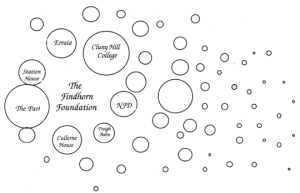
The Findhorn Foundation Community has a cellular structure and a contagious growth pattern.
One of the Universal Principles which physicists use to explain the meaning of life is: “As the Universe evolves, its structure becomes more complex” — Big Bang to Nature to Humanity to God Only Knows What. If we apply this same principle to the evolution of the Findhorn Community then no one could deny that its evolution is completely in line with this Universal Principle. Today there are ever-growing numbers of independent ventures run by Community members.
APPROPRIATE ENERGY SYSTEMS LTD (AES) (at the Park) [… in 2025 AES Solar] (partly owned by NFD) AES is in the business of designing, manufacturing and marketing solar energy panels for water and space heating. There is an ongoing research programme in cooperation with Napier University, Edinburgh, and exhibitions at external venues including the National Science Museum. A major contract in the Seychelles Islands has given the company an international profile. Contracts for supply and installation are handled by agencies throughout the UK and abroad.
EARTHSHARE Apple Core Group […] There is a spirit of mutual participation about EarthShare; there are the growers, the subscribers and the Earth itself, all participating in organic food production through the bio-dynamic method of farming. The land was already in horticultural production when it was purchased by three families (Apple Core) in the early 1990s. In 1993 the EarthShare company was founded as an independent non-profit-making venture. The participants pay an annual share subscription and assist in the production and harvest. In return they receive a weekly box of vegetables and fruit. The produce doesn’t have a set value, it is simply a share of the current season’s harvest. EarthShare also markets the produce from Cullerne gardens and cooperates in the work experience programmes for guests of the Foundation. Visitors and helpers are welcome, particularly at the times of cultivation and harvesting.
ECOCENTRICS (at the Park) […] Publishers of “Trees For Life” calendars, diaries and cards. World-wide distribution and also available through Phoenix Shop.
ECOLOGIA FOUNDATION LTD. (at the Park) […] The aim of the Foundation is to promote and foster creative change through developing connections and exchanges between people in Russia, Eastern Europe, Africa and the Western World through the themes of ecology, psychology, spiritual development, youth education and the arts.
FINDHORN BAY CARAVAN PARK (at the Park) (owned by NFD) [… in 2025 Findhorn Bay Holiday Park] In 1982 the Findhorn Foundation purchased the Findhorn Bay Caravan Park with donations received from a world-wide appeal. Up to that date there had been essentially two distinct areas (The Findhorn Foundation area and the holiday caravan park area) owned by one company landlord. Purchasing was an important step in opening up the Foundation to a less structured relationship with its membership. Today there are no obvious boundaries between the Findhorn Foundation and the Findhorn Bay Caravan Park areas, rather there is an intermingling of residents, holiday makers and businesses. The rents received from NFD and tenanted property make a considerable financial contribution to the funding of the Findhorn Foundation. There is an ongoing building programme to replace the existing residential and static holiday caravans with permanent housing in cooperation with the Eco-Village Housing Development.
FINDHORN FLOWER ESSENCES (at the Park) [… in 2025 Nature Spirits Scotland] Owned and operated by: Marion Stoker Marion produces the essences of local wild flowers, herbs and trees by sun infusion and homeopathical dilution in local water. Open to visitors by appointment. The essences are available from the Phoenix.
FINDHORN PRESS (at the Park) [… in 2025 imprint of Inner Traditions] Owned and operated by: Karin and Thierry Bogliolo. It was Peter and Dorothy printing some of Eileen’s writings on a portable duplicator that first sent the Findhorn text winging across the world. Peter soon appreciated the value of this medium of communication and quickly established Findhorn Press. Since those early days the list of published book titles has grown and grown, as has the area of distribution. Findhorn Press was purchased by NFD from the Findhorn Foundation in 1991; in 1993, Findhorn Music was incorporated into the enterprise; and in 1994, it was sold to Karin and Thierry. It now operates as an independent partnership. There appears to be a never ending source of hopeful manuscripts submitted by the Community’s “relatives and friends” to keep Findhorn Press fully occupied for many incarnations. This guidebook is published by Findhorn Press.
Book and music catalogue available; all products also sold in the Phoenix Shop.
GNOSIS (at the Park) (owned by NFD) Gaia Village Trust in Denmark provided the grant that enabled Gnosis (and the Foundation) to connect with the Internet Global Community Network. Gnosis operate a computer consultancy service for North-East Scotland and service the Foundation’s computer installations. […]
HIGHLAND RENEWAL Knockvologan, Fionnphort, Isle of Mull, Argyll Property owned by: Van de Sluis family; operated by: Carol Riddell. This is a practical project for restoring and maintaining a viable rural community on the Island of Mull – there is not a whiff of ‘alternative, spiritual community’ in any of the brochures. Highland Renewal was established as a charity in 1995 and is now receiving cooperation and assistance from many quarters including Scottish universities, the Ministry of Defence and the Forestry Commission. Carol spent many years at the Findhorn Foundation and as workshop presenter. Carol welcomes visitors and offers work experience in building, farming and land management.
- FINDHORN BAY HOLISTIC HEALTH CARE CENTRE (at the Park) […] Its main functions are:
- to put people in touch with local practitioners for individual session in therapy, massage, counselling, etc.
- to run the Health Scheme which encourages the maintenance of good health, and promotes care and well-being for individuals and families. Membership is an annual subscription.
For appointments, chat and sympathetic ear, contact Dürten Lau
- HEALTHWORKS — FORRES CENTRE FOR HOLISTIC HEALTH CARE […] The centre opened in 1994 with the aim of encouraging care for the body, mind and spirit taking into account a person’s physical and emotional environment. Healthworks also receives referrals from local NHS practices. The Centre can offer: Acupuncture, Alexander Technique, Craniosacral Therapy, Chiropody, Chiropractic Treatment, Homoeopathy, Massage, Medical consultations, Physiotherapy, Psychotherapy, Reflexology, Shiatsu. Clients pay for their treatments.
INNERLINKS UK (THE TRANSFORMATION GAME) (at the Park) [… in 2025 Transformation Game Findhorn] Observing how we interact with others, seeing what does and doesn’t serve, uncovering the qualities of intuition, love, unity and enlightenment in ourselves and those around us, finding a purpose for life, can all bring a new understanding of our true divine nature. The Game began its life one evening in 1976 on a piece of tracing paper on Joy Drake‘s bedroom floor aided by co-opted room neighbours. It has become a transformative tool and programme in a world-wide context. There are six versions of the Transformation Game, including the basic version which can be purchased from the Phoenix. Trainings available for all versions of the Transformation Game.
THE NEPAL TRUST […] After visiting Nepal in February 1993, Alan Jacobsen felt he wanted to support the Nepalese people in a constructive and tangible way and by October the same year had set up the Nepal Trust. The Trust has three aspects: medical, ecological and educational. Any scheme that the Trust supports not only raises money to build, equip and train personnel, it also works along side the Nepalese Government who are ensuring that finance continues after the Trust’s initial two year commitment.
ONE EARTH MAGAZINE LTD. (at the Park) […] The quarterly magazine of the Findhorn Community “looking in from the outside and out from the inside”. Contains articles from, and interviews with, prominent visitors as well as Community members and friends. Sold by subscription and through Phoenix Shop.
RICHARD BROCKBANK Wood Studio, […[ Cabinet-maker and artist in wood, Richard opened his Wood Studio in 1982. The natural form and flow of the wood, the bark and the knots are incorporated as features in beautifying the final item, be it a large piece of furniture or small intricately formed ornament. His studio is open to visitors. Richard also offers tuition and invites commissions.
PHOENIX COMMUNITY STORES LTD (at the Park) (partly owned by NFD) [… in 2025 The Phoenix Shop and Café] The Phoenix Community Stores began as a general grocery store in the 1960s to serve tourists and visitors to the Caravan Park. It has grown into a lively retail centre selling a wide range of merchandise including whole and organic foods, bakery, delicatessen, bulk food, organic wine and beer, crafts and gifts, recycled stationery, cards, calendars, posters, recorded music – anything from jazz to ‘New Age’, and one of the finest selections of books and magazines in the country covering topics of personal development, religion and spirituality, cooking, gardening and the environment. The buying policy, wherever possible, is directed towards locally produced items and producers whose products support the ideas of environmental and human sustainability. The Apothecary stocks herbal and homoeopathic remedies, supplements, tissue salts, flower essences, aromatherapy products, and has books on health and healing.
The Bakery is adjacent to and part of Phoenix. It bakes bread for both stores, and the Foundation dining rooms. Friday nights is the Bagel-Boys Night!
POSTHOUSE PRINTING & PUBLISHING LTD. (at the Park) [… closed in 2021] Posthouse offers a full printing service to the public: typesetting, imagesetting, design, photography, single and full colour printing, finishing, etc.
TREES FOR LIFE CO. LTD (at the Park) […] Project established in 1985 for the regeneration of the Caledonian forest of Scotland which had been destroyed through systematic industrial appropriation over the last three centuries. Trees For Life became a independent charitable trust in 1989 and is supported through grants from other trusts and the Forestry Commission. The long term aim is to restore approximately 1500 square kilometres of natural forest in the Glen Affric area to the north west of Inverness through fencing and planting. Trees for Life works alongside other groups in a combined Caledonian forest regeneration project. The Trust is also exploring an idea to re-introduce missing species of wildlife, including wolves, which used to inhabit that area.
WOODHEAD COMMUNITY Kinloss by Forres […] An intentional community living and working closely together and near the Findhorn Foundation. Through working their two acres of land, artistic expression and attunement to spirit, they seek harmony with the economic use of natural resources. They wish to expand the group (long or short term people) and also invite others to join in the cultivation of the land through Friday afternoon work projects. For visits and participation contact Hugh Andrews.
Structure of the Findhorn Foundation
The Findhorn Foundation has declared in the Registers of Scotland (no. SC007233) that it exists for charitable purposes only and its objects are the advancement of religion and religious studies, the furtherance of conservation and preservation of the natural world, the relief of poverty and distress, and any purpose which is beneficial to the general public within the United Kingdom. The trustees of the Foundation own 100% of NFD (New Findhorn Directions Ltd.)
Who’s Who
Trustees: Members of the Findhorn Foundation registered with the Scottish Charity Commissioners. On 19/5/95 they are: Judith Bone, Judy Buhler-McAllister, Sabrina Dearborn, Francois Duquense, Mary Inglis, Edward Posey, Christopher Raymont, Nicholas Rose, Michael Shaw, Lady Diana Whitmore, Alan Watson-Featherstone.
Staff Employees/Employees/Volunteers: Persons working for the Foundation full- or part-time, paid or unpaid; they have completed a graduation programme and committed themselves to working an agreed number of hours. 1995 = 80no.
Student: A participant within a Findhorn Foundation Year student pro gramme (either full- or part-time) working towards graduation. 1995 = 70no.
Open Community: A person who has a social (non-working) connection and relates through the Visitors Centre). 1995 = 120 to 130no.
Fellows: Persons nominated by The Findhorn Foundation Society of Fellows, recognised for their contribution to the area of their specific mainstream interest and having sympathetic resonance with the aims of the Findhorn Foundation. 1995 = 100no.
Stewards: Members of the world network of Stewards of the Findhorn Foundation and who support its aims. 1995 = 420no. (from 39 countries)
Guests: Resident/non-resident participants in a Findhorn Foundation programme. 1994 – 4100no. Visitors: Persons, not identified as above, who attend a Community function, performance or event, or participate in an official tour. 1994 = 9000no.
Findhorn Foundation accommodation
Residents : The Park: 95 Cluny Hill College: 40
Guest spaces: The Park: 50/55 Cluny Hill College: 60/100
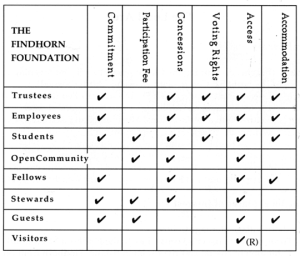
Concessions = special agreements with individual people
(R) = access restricted to public areas and events etc. through Visitors Centre
Other statistics
Average length of stay (resident staff employees):
1994 – 4 years / 1983 – 2.5 years / 1973 -10 months
Average age: 1994-40 years / 1983-33 years / 1973-26 years
Nationalities (1994):
55% GB / 16% D / ll% EU / 10% USA / 5% rest of world / 3% local
Findhorn Foundation astrological signs:
Sun = Scorpio / rising = Sagittarius / Moon = Leo
Financial information
For the financial year ending January 31,1994, the Foundation’s total income was £934,229, and its total expenditure £901,636.
The Foundation pays VAT and Local Authority rates. Employees are assessed in the normal way for local and national taxes.
The Findhorn Foundation tithes an average of £10,000 p.a. to other charities.
Local Area
Local Events
January Burghead – Burning the Clavie – Jan. 11 each year (evening).
Feb The Lecht Ski Centre – Fun weekend (third weekend).
March Lossiemouth – Spring Bulb Show and Craft Fair (third Saturday).
April Elgin – Moray Arts Exhibition of paintings (second week).
June Keith – Festival of Traditional Music and Song (second weekend). Garmouth – Maggie Fair (third Saturday).
July Forres – Highland Games (second Saturday).
August Brodie Castle – A Taste of Moray (third Saturday).
Sept. Forres – Vintage Theme Weekend (see local announcement).
Nov. Forres – Bonfire and Firework display – Nov. 5 each year (evening).
Some local places of interest
- Findhorn Village Heritage Centre
Former salmon fisher’s keeps (close to the Findhorn Yacht Club). Exhibition of coastal and river salmon fishing. Findhorn from prehistoric times to present day. Wildlife of the area.
Open Easter to September (except Tuesdays) 2 to 4.30pm July and August also 6 to 8pm. - Falconer Museum, Tolbooth Street, Forres […] Exhibition of local geological and social history. Open Monday to Saturday (also Sunday July and August). Not open Saturday from November to March. (telephone for opening times)
- Nelson Tower, Cluny Hill
Built in 1806 to commemorate Admiral Lord Nelson and the Battle of Trafalgar. Panoramic views of area from the top. Not for those who suffer from wideness of body or vertigo. Open 30 April to 25th September (not Mondays) 2 to 4pm. - Califer Hill approximately 3 miles south west of Forres
An extensive view of the Moray Firth and more. A spectacular alternative for those unable to mount the Nelson Tower (and it’s free). - Sueno Stone, east end of Forres close to the Bypass
Sculptured monolith standing 23 ft high and thought to be pre 1,000 A.D. Free viewing at all times. - Witch’s Stone, Victoria Road, Forres Thought to date from the era of the Pictish people and to have been an altar to their Sun God. It is now set into the pavement outside the Police Station and marks the place where a witch in a barrel ended her days over a couple of centuries ago.
- Cawdor Castle […]
Approximately 3 miles south east of Nairn.
The seat of the Earls of Cawdor. A fine example of Scottish mediaeval castle and steeped in history and legend. Gardens with maze, restaurant.
Open April to October 10 to 5.30pm. (last tour commences 5pm.) - Darnaway Farm Visitors Centre […]
Near Brodie, approximately 3 miles west of Forres.
Modern estate farm with audio-visual, tours, animals and museum. Open 1st May to mid September 10 to 5pm. - Darnaway Castle […] The seat of the Earls of Moray. Tours from Darnaway Farm Visitors Centre during July and August – Sun.Wed.Thurs. 1 – 3pm.
- Brodie Castle, approximately 3 miles west of Forres […]
Home of the Brodie family since 1160; now in care of the National Trust for Scotland. Shop, gardens and lake.
(Concerts and theatre out of season)
Castle open April to October (telephone for opening times) - Pluscarden Abbey, approximately 8 miles south east of Forres
Benedictine Community. The building dates back to 1230 Open daily 4.45am. to 8.45pm. Visitor can participate in the daily sacred offices (Gregorian chant). […] - The Legend, 3 High Street, Elgin […] Owned and operated by a community member, this is the shop for a magical browse through dragons and books, jewellery, gifts and Indian craft.
- Brodie Countryfare (A96) approximately 3 miles west of Forres –
The venue for well-presented Scottish gifts, apparel, produce and for hanging out in the self-service restaurant. […]

Local Walks
- Sluie Walk. On A940 Grantown on Spey road 4 miles south of Forres. Forest walks with spectacular views of the Findhorn River gorge.
- Dunearn Burn. Opposite Sluie Walk on west bank of the Findhorn near Daltulich Bridge. Viewpoint with extensive vista of surroundings and the Moray Firth.
- Randolph’s Leap. On Findhorn River 7 miles south of Forres by A940 towards Grantown on Spey, then B9007 towards Carrbridge.
- Carrbridge. Beauty spot with impressive rocky gorge.
- The Culbin forest and dunes lies on the west side of Findhorn Bay opposite Findhorn village. It is renowned for its rare species of flora. Drive west wards through Forres on A96, turn right immediately after crossing the Find horn River bridge. Park car at Cloddymoss and walk.
- Coastal paths from Kinloss via Burghead, Hopeman and Lossiemouth.
Interesting rock formations and wildlife including bottle-nosed dolphins, wide sandy beaches, small sheltered coves and deep caves. - Speyside Way. Spey Bay to Ballindalloch (30 miles) following the River Spey and with a wide variety of scenery. Access points for short walks.
- The Lairig Ghru (17 miles) – full hill walking gear must be carried. From Coylum Bridge village (2 miles south-east of Aviemore) to River Dee at Linn of Dee near Braemar. This is wilderness at its best.
For more in-depth information on the Findhorn Community
Video about the Findhorn Community
STRAIGHT FORM THE HEART (£10.99) available in PAL and NTSC
This is the latest video about the people and work of the Findhorn Foundation, the world renowned intentional community of people living, working and learning together in the north-east of Scotland. Through the voices and images of its people, the story of building community is told: working with people, education, ecological building and environmental work, global networking and infusing everyday life with spiritual values. We hope this video will touch your heart in the same way that the Community has inspired many thousands of people from all over the world. (31 minutes)
Books about the Findhorn Community
THE KINGDOM WITHIN (£8.95) isbn 0 905249 99 2
A Guide to the Spiritual Work of the Findhorn Community
Compiled and edited by Alex Walker
This collection of writings about the history, work, beliefs and practices of the Findhorn Foundation and its associated community of spiritual seekers offers a vision of hope, inspiration and encouragement. With contributions by David Spangler, William Bloom, Dorothy Maclean, Peter and Eileen Caddy amongst others, this book covers topics which include nature and ecology, the art of living in community, the relationship of ‘new age’ thought to formal religion, and co operation with the spiritual worlds. The world is hungry for the hope and inspiration this book brings — and so are you!
THE FINDHORN GARDEN (£9.95) isbn o 905249 63 1
Pioneering a New Vision of Humanity and Nature in Cooperation
by The Findhorn Community
The story of the early days of the Findhorn Community and its communications with the nature kingdoms. Peter and Eileen Caddy’s experiences as co-founders of the community, Dorothy Maclean’s contact with the devas, R. Ogilvie Crombie’s (ROC’s) meetings with Pan and the Elemental Kingdom, and the wisdom of David Spangler and others combine to give a unique perspective on the relationship between humans and nature.
THE FINDHORN COMMUNITY (£8.95) isbn o 905249 771
by Carol Riddell
The author traces the community’s development over the years and gives a clear picture of the community today and the new businesses and independent projects springing up around it. The second half of the book includes a number of intimate and revealing interviews with members, both young and old, who share their lives and experiences of living in this incredible community.
FOUNDATIONS OF A SPIRITUAL COMMUNITY (£5.95) isbn 0 905249 78 x
by Eileen Caddy
Guidance that helped a family living in a tiny caravan develop into an international spiritual community. The central principle of turning within to find the true source of faith, inspiration and love makes this book relevant not only for those building a spiritual community but also for all who live ordinary lives in our wider society.
THE SPIRIT OF FINDHORN (£5.95) isbn o 905249 97 6
by Eileen Caddy
This book offers a brief history of how Eileen gave up everything to follow her inner voice and contains much of the guidance and wisdom which supported Eileen through the early days of her spiritual transformation and the birth of the Findhorn Community.
All of the above are available from the Phoenix Shop.

Moved to Findhorn with Harley and our youngest (of four) daughters. Part of setting up Newbold House. Involved with many different educational programmes, including developing Family Experience Week.


Leave A Comment