


This article, written by Jim Donovan, was previsously published in Network News, June 1995.
lf your mission succeeds, you will not only have accomplished a personal achievement, but will have built a community health clinic that will support over 2000 people in Nepal’s most remote district – Humla – in the far Northwest bordering Tibet. More importantly you will have contributed to transforming tourism in the Third World into a pro-active force for social change.
My wife Liz and I returned to Scotland in February, from Nepal, where we were developing community-based projects. Though it was raining, windy and cold it was great to be back in Scotland. There is a timelessness and rock solidness to this land, its buildings and people. The bracing pure air and lonely landscapes that creep one way while the low grey heavens slide the other is very soothing after the conflagration of hustling humanity, poverty and foul air of Kathmandu. This past year, since Liz and I set off for Nepal, has been a montage of culture shock, risk, beauty, fear, stress, joy, adventure and persistence. In short, an exhausting and rewarding team effort, but our goal is not yet fully realised.
Alan Jacobsen, Liz and myself have learned many lessons since the Trust was established two years ago. And now, teams have formed in the Findhorn Community, Europe, North America and Nepal. The Nepali team, the Trust’s sister organisation, The Nepal Foundation, is a registered NGO in Nepal consisting of four men and two women who are committed and working for positive change in their country. Two British doctors, a husband and wife team who work in Kathmandu, are also helping the Nepal Trust. Our philosophy has been to ask the Nepalese what they need and how the Trust can work with them. Our aim is to co-create with the people of Nepal projects that are sustainable, low-cost and community-based which will hopefully lead to self-determination and the fulfilment of community aspirations.
I have travelled widely in many areas of what the wealthy nations refer to as the “Third World”. The deepest imprint and impression upon my life up to today, is witnessing and feeling the magnitude of disparity between the have and have-nots on the planet. It still is a shock to travel under the massive tangled net that ensnares the utterly dispossessed of our planet.
Twenty years ago when I first travelled to Kathmandu, it was an over-grown bustling village surrounded on three sides by two converging and swollen streams. Groups of women washed colourful garments, children played, and hippies found meaning in their self-indulgence. Today the city has become a Victorian London – choked by car exhaust, overpopulated and polluted by fumes and noise. Its two streams are no longer frayed at the edges with verdant vegetation but stagnant with modern trash and hemmed in by malignant cell-like clusters of shanty towns, where ornate temples of antiquity now crumble. In the last five years more than 400,000 people from rural Nepal have poured into the capital in search of a “better life”. The city’s infrastructure is buckling under the strain, and the countryside is losing its most valuable resource – the people.
NEPAL – THE FACTS
Nepal’s population is 20 million. It is one of the poorest countries in the world. Per capita GNP is $190, life expectancy is 54 years, and 8 million people live in absolute poverty. Adult literacy is only 25%. The rugged terrain of this landlocked country offers poor resource potential. High population growth increases pressure on the limited arable land, and forests are fast disappearing. Agriculture – much of it subsistence – accounts for 90% of employment in Nepal and over half of the GDP. Tourism and the export of garments and carpets, are the major industries, and although these pursuits bring into the country much needed foreign currency, they are also major contributors to cultural and environmental degradation.
The facts are brutal and hard. But there is a great spirit in the people of Nepal. In 25 years they have had thrown at them a condensed package of the modern era – the industrial age, technology, the information age, globalisation and the youth culture – all at odds with the old Gods. The country is really two countries – Kathmandu and outside Kathmandu.
The Nepal Trust is working with the people of both countries. The Trust’s projects are: The Durbar High School Computer Education Project, The Humla Village Health Post Project and “A Trek to Build Health and Community.”
Alan Jacobsen, 73 years young this year, long-term member of the Findhorn Foundation, founder of the Nepal Trust and former British officer who fought alongside Nepalese Gurkhas 50 years ago in the jungles of Burma during WW II, has written about his motivation for creating this initiative:
The envisioning of the Nepal Trust was the result of the coming together of a number of “strands” linking events and people in my life. It all started when I undertook an Open University course called “The Religious Quest” in 1990, and soon discovered myself staying in a Buddhist retreat centre in Spain. It was there that I learned of the great work done by Lama Yeshe, including the creation of a monastery called Kopan situated just outside Kathmandu. An inheritance I received when my mother died in 1992 enabled me to visit Nepal. Whilst at Kopan I realised I wanted to help the Nepalese people and at the same time I could repay some of the great debt we British veterans of WWII owed to the bravery and loyalty of the Gurkha troops. It also satisfied another strand, which has been my long-term need to do some hands-on practical work on behalf of the Findhorn Foundation in the Third World.
THE HEALTH HUMLA VILLAGE PROJECT
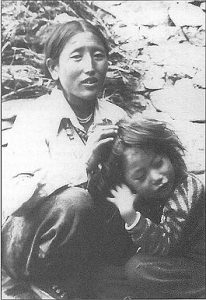
Four days walk from Tibet, at 13,000 feet in the Western Himalayas, a woman has been visited by 18 people in the storage room of the local school. The visitors have worms, burns, infections, diarrhoea, broken limbs, TB, leprosy and cataracts. Bovita Lama, a 32-year-old mother of a baby daughter, village leader and the only woman in Humla District to have a 10th grade education, is the sole health worker for the 2000 Nyimba people of the Dozom river valley. A rising school-age population and children being frightened by the sick and injured brought to the school, could force Bovita’s makeshift clinic to close this year.
The Humla Village Health Project aims to provide medicines, medical supplies, training for local women as health workers, volunteer midwives and nurses, and triage based evacuation flights for those needing urgent medical care in Nepal’s most impoverished area. The Trust is also developing an income generation project with local people and is looking for markets for handicrafts, bead jewellery, morella mushrooms and medicinal herbs produced in Humla, to support the local community and health project. We are also seeking midwives and nurses who could share their skills for periods of three to six months in Humla.
A TREK TO BUILD HEALTH AND COMMUNITY
 Giving funds alone is only part of the answer to bridging the inequalities between the rich and developing nations. But, when we work with the people of these countries, it’s different! It is truly a gift when we help people with funds, but there is also a far richer giving when we work “on site” with the people. The individuals who take up this challenge will make a difference, not only contributing with their “bucks”, but also with their backs. After a 10-day trek that passes the sacred Rara Lake, high in the Himalayas, we’ll learn from each other while building a community health post with Buddhist highlanders. The health post will save lives, heal the sick and educate people to care for themselves. At the end of this journey we will have a festival with the Humlis. Profits from the Trek will build the health post and support the Nepal Trust’s projects in Nepal. The Trust is planning several “Treks to Build” (modelled on the Findhorn Foundation’s building programmes) to construct clinics and village schools in remote areas. We believe this will help change the face of tourism into a positive force. The Trust is also looking for help in making a video documentary of the first “Trek to Build”schecluled for early October this year.
After two and a half years of challenges, putting it all together and being self-financed, the Nepal Trust now needs your support with funds, skills, equipment, encouragement. It needs your participation in the “Treks to Build Health and Community”. If you can help network some of our information – especially about the Treks-on computer nets, at universities, outdoor groups, ads in local papers or by word of mouth, please do it!
“It also satisfied another strand, which has been my long-term need to do some hands-on practical work on behalf of the Findhorn Foundation in the Third World. “
For more information and how you can
get involved, please contact the Nepal
Trust at 66 Findhorn Bay, Forres, IV36 OTZ.

Guest Authors are contributors who are not COIF members (for various reasons).



Leave A Comment