


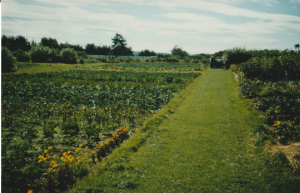
Cullerne Garden fields
I did my Experience Week in 1981 and came back many times before moving here. I did the Essence programme and was a Living in Community Guest (LCG) several times, always drawn to work in the garden, mainly in Cullerne but also experiencing the Cluny and the Park Gardens.
In 1986 I moved to the Community and did the Orientation Programme, with one of my focalisers, Linda Parker, being the ‘lady of the trees’ who was responsible for the tree nursery in Cullerne. At the end of my Orientation I decided to work in Cullerne Garden, narrowly missing becoming the Focaliser of Park Reception by encouraging Maggie Isaksen (now India) to take it on!
In those days, the garden still felt quite separate from the rest of the Foundation – there was a lingering question in the Community: “Is Cullerne actually part of the Foundation?”
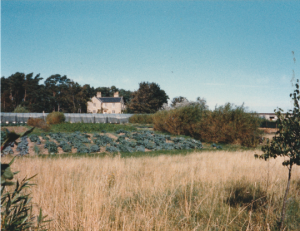
Cullerne House and Garden
There was still quite a bit of letting go to do from Project Cullerne, and a re-orientation of the work. For instance the tree nursery was slowly being released and I remember the asparagus bed was overrun with couch grass and sadly dug up. From then on our asparagus harvest was dependent on a few plants in Fred Barton‘s little tunnel, enough for the gardeners to have maybe one each in the occasional meal we had together in Cullerne House. Cullerne House and Garden were quite integrated; the residents being mainly gardeners and long term guests in the garden. It housed our office, library and attunements and it was the responsibilities of the residents to look after the house. I remember Marty painting the window frames and the warmth of the big range in the kitchen where we’d cook together – often using the produce which wasn’t sufficient in number to send to the kitchens, like the asparagus and Bodil’s attempt at growing celeriac , one of her favourites, which didn’t like the sandy soil and grew lots of roots.
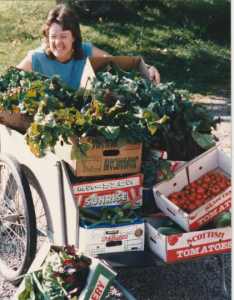
Cullerne Garden produce
In 1987, I started out as the “tunnel person”, working in Filclair, tending to tomatoes and peppers and introducing basil, as I had come to Findhorn after a year in Rome where fresh basil was a must. Back then, Alexander Heybroek was the focaliser and Fred Barton was the head gardener. Everything was beautifully casual. We’d harvest what was available and the Cluny van would swing by twice a week to pick up what we had, and a large cart was used to transport veggies to the Park. It wasn’t until Fred insisted we start weighing the produce and keeping records that we began to feel like a “serious” production garden.
I also remember times when the Park Garden and Cluny Garden were also producing veggies and we would get very upset if our produce wasn’t used and ended up back in our compost. We had interesting conversations with the cooks at times learning to understand what was difficult for them and what worked well. Lots of ongoing learning for everyone, in good “Findhorn” style.
In 1988, everything changed. Alexander decided to leave, and the personnel department asked me to take over as focaliser. It was a bit absurd, I was a teacher by trade and a novice in gardening, but as a dutiful student of the Foundation, I said “yes” to service.
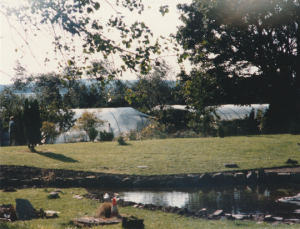
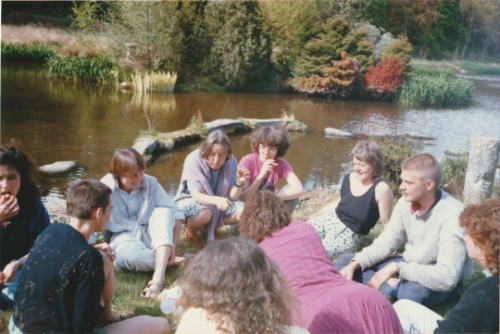
Fred’s pond is taking shape
That role taught me more about people than plants. Fred was my rock; while I managed the team’s dynamics, he held the vision for the land and supported all our learning. For his last few years in the garden, he focused on creating the beautiful pond which was a vision he’d held for a long time.
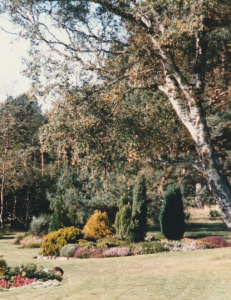
Fred’s pond
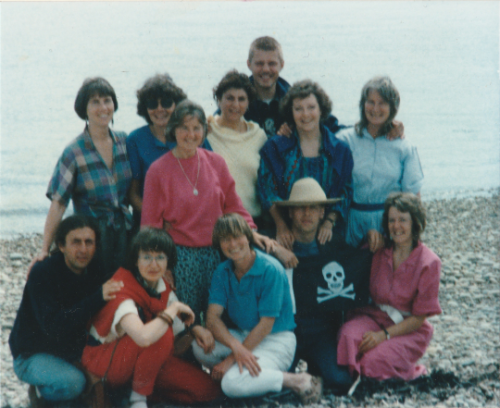
We were a team of ten or eleven, a mix of members and guests, all navigating the balance between gardening and personal growth.
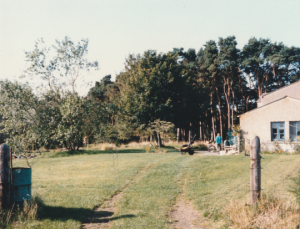
Cullerne garage
We cleared out the space above the garage to hang dried flowers for tea, a project run by Verena Bauer, which she made into teas and wreaths. These were for sale. I still laugh remembering our stall at the Brodie Fair, where we were positioned in the “Spirit Tent,” sandwiched between the local distillery and the local wines.
Slowly, the feeling of isolation faded. We began meeting with the Park and Cluny gardeners, integrating our work into the wider Foundation. We experimented with permaculture and Perelandra, though we always struggled to scale those ideas to our large fields.
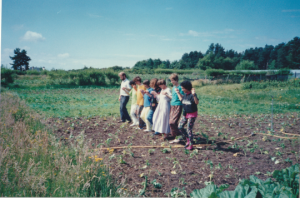
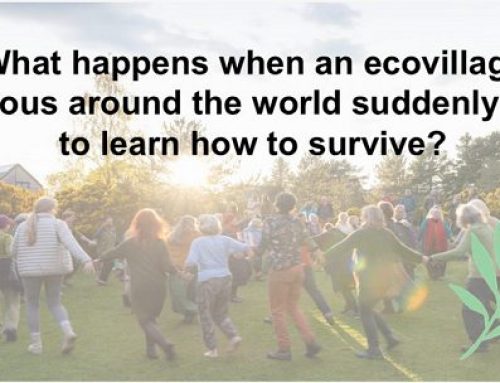
Cullerne Sacred Dance in the field
Cullerne House now had resident members who were not all Cullerne Gardners, the house being used as a workshop space for Foundation programmes such as an esoteric retreat, focalised by Vita de Waal and Ian McPherson, and massage trainings run by Isobel Lamont and Dorothy Noble. It was a lot to juggle, as at times this could create difficult dynamics for those living in the house. At one time we had an architect living in the house who made up plans to create staff housing above the garden garage. Also a group of members went a long way to planning staff housing in the north east corner of the garden.
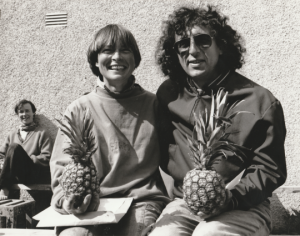
Judith Bone and Fabien Barouch with Chantal Kickx in the background
By the Foundation’s 30th birthday in 1992, Cullerne felt very much part of the Community. We hosted a massive brunch on the lawn, serving piles of zucchini frittatas to guests and residents alike.
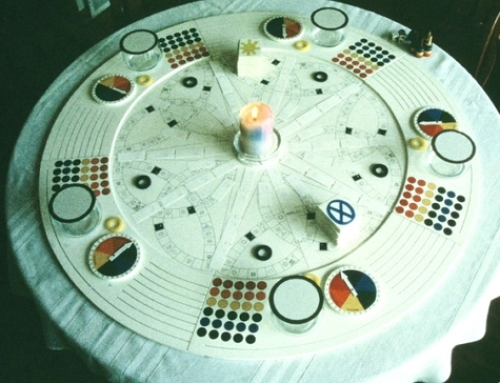
By then, my own journey was pulling me toward running workshops, particularly with the Game of Transformation and Sacred Dance, and I handed focalisation on to Sharon Took-Zozaya.
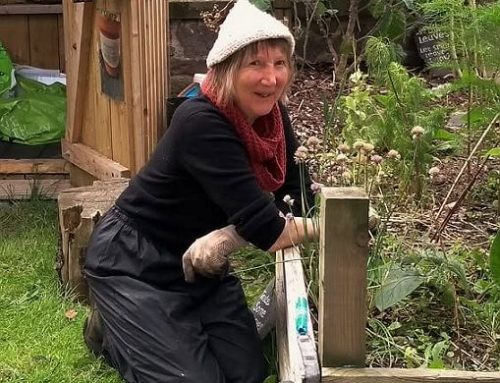
From Northeast England, trained as teacher in Cambridge, taught for 1 year, then off to Germany teaching English as foreign language. ’77 backpacked in Asia, Experience Week ’81. Life-long educator.
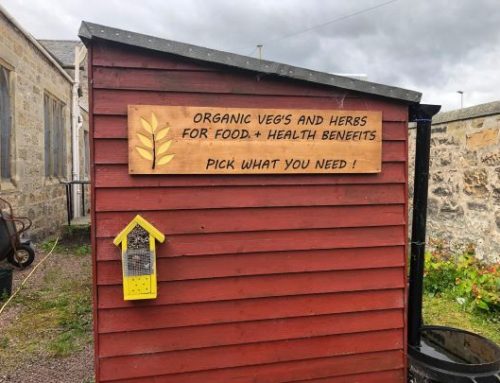


Some of my favorite times was when I worked in Cullerne. I learned a deep lesson in how to be of service by rescuing a bird from netting. I could feel its panic and I started to become upset. Then I stopped, breathed, centered, and calmed down. I was able to free the bird. It was important to not get drawn into distress, and focus on solutions and helping.