


Expanding Light
It is the American Southwest; again, the lake forests of Scandinavia; pampas grasslands of Equador (where the bobolink winters); meadows of a Sicilian spring; reflections, at high tide and white mist, of a “Holy Isle” half a mile offshore: — homelands, promised lands.
In the shadows of reeds bullfrogs thread crickets’ sound with their rich call. The sky — white — lies reflected on the lake; the lake, still, does reverence to the sky. The dark shape of the hill — silhouette of a stand of spruce and white pine — recalls a planting calendar of the plains, whose profile of the land set landmarks for equinox and rain.
I stand shoulder to shoulder with a crowd of people as I survey these outlooks on the world. I see no faces, but share the view. I feel them breathe beside me and see the steam of their breath in the cool air. A family gathers on the shore, bare feet in white sand, where they speak quietly of common things, share a silence — laughter of geese flying east . . .
There are old wise faces in these paintings, faces so familiar I’m content to just watch with them without a word. Snow falls on the sand of a beach. It is a place we have walked, it keeps the memory of our feet. . .
*
Clay, wood and knife, palette and brush are a practical aid to the exercise of seeing. Delacroix called drawing from life saying his prayers. What is the color of that sky — gray or blue — what kind of blue? In the stillness of mind and peace of spirit that spontaneously come in the devoted effort to match one’s being with that of the world, recognition dawns that things cannot be seen, heard, tasted with any finality. The world itself shifts, changes . . .
For ten thousands of years vertebrate life on earth crawled on the earth. Then there came a moment — not one single historic instant, but a cluster of experiences — when the hominid, dimly dreaming of the creatures she or he would someday be, lifted up off forearms and stood erect. For the first time she saw the horizon. Under the jutting bone of the brow her eyes looked and lingered, and something there began to stir and brighten.
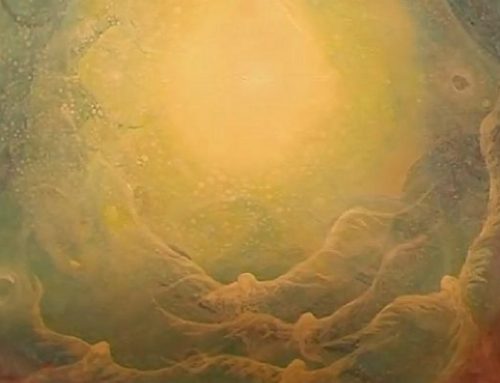
When I stand before a canvas of Haydn Stubbing I faintly remember something from not just my life, but from the species life . . . something ancient. It is a landscape but it is not; it is earth but it somewhere else; it is familiar and also new. From end to end the horizon vibrates, sings, even roars with all the force of an harmonic tone: a music of the earth, the first of the spheres for humankind. Somewhere in me something turns and wakens–an inkling I am witness to an event I will never in one lifetime fully understand. The light as it appears rises, quickens, increases, expands and takes the viewer out into the world.
Sunrise . . . the return of light. In midwinter, huddled in chilled forests, our ancestors gathered in the back of a small temple built of flat stones in hollowed-out earth. The first light of solstice day streamed through the post and lintel door into their waiting eyes, to affirm that summer would return.
*
Haydn Stubbing’s early training found him on his back in Spain’s early neolithic caves. Later he was among those in France who experimented with “action painting” in the use of the whole hand on the canvas instead of a brush. His mature subjects–a bird spotted on the fountain; the wingspread of an owl in flight, the pattern of the eye’s iris.
If anyone were to orchestrate music to a documentary Haydn Stubbing would assent to “two notes of the conch.” The conch–used for millennia in India, Asia, Africa, to announce the first festival chants.
“The titles are not important,” he says, “because the original subject means nothing to someone who has never heard of it. In painting I have to take that sight and transpose it to another level where everyone can recognize it.” It is depiction of the very life of an experience, the “soul” of a sunrise.
If these paintings have a title it is, “Good Morning!”
Frederick E Steinway
For more information about the murals please see Haydn Stubbing’s Murals in the Universal Hall
We thank Mark Richard of Aurora Imaging for the use of the featured image.

Guest Authors are contributors who are not COIF members (for various reasons).



Leave A Comment