

In 1974, living on-shore in Findhorn Village while working off-shore on a North Sea oil rig aged twenty-six, I met and befriended some of the younger members of the “Trust” community who ventured down into the local pubs – around the pool table in the Kimberley Inn or the weekly folk nights in the Crown (no Anchor in those days). I took to walking my dog around the Park campus, chatting to the gardeners and other folk, who were often laughing and singing. There was an atmosphere of unfettered happiness, in marked contrast to the oppressive institutions of my own culture. I was attracted to the music, humour and fun in the community, particularly the regular shows in the tiny Lollipop Theatre (now La Boheme) focalised by Michael and Simone (now Anniese) Worth, also to the book shop. The village folk had a generally ambivalent, in some cases, hostile attitude to the “Trust”, or “Caddy’s mob”, as it was often known as. I never imagined for a moment that I might one day be part of it.
A year or so later, when the seriously rough darker winter weather started up again on the North Sea, I quit my job on the rig. I was working in the woods on my uncle’s farm in Mull, when I received a bolt-of-lightening, out-of-the-blue startling intuition – a voice from somewhere which said: “Go and live in that Community near Findhorn”. In among much surprise and apprehension, was a clarity that this was my next step in my life
I packed my rucksack in early January 1976 and embarked on a journey half a mile down the road to join the by-now thirteen year old spiritual community. I had previously presented myself at the reception desk and enquired: “What do I have to do to join this community.” A strange thing happened in that moment – an elegant couple – Frank Stong and Gillian Lubach – entered the office and requested for a radio to be switched on by Anna Barton, from behind the desk. Frank was Guest Department focaliser. A voice came out of the radio answering the very question that I had just asked. The voice was unmistakably the perfect received pronunciation of Peter Caddy in a recorded interview being broadcast on BBC Scotland. Anna relayed my question to Frank, who responded: ”Well, does that answer your question?” It did – straight from the horse’s mouth, so to speak.
The Caddys were away touring for three months – much to my relief – as I was convinced that they would take one look at this rather dishevelled young hippie from the village and declare me unsuitable material for the spiritual community which they had co-founded with Dorothy Maclean.
After I arrived for my “Guest Week”, I made my way to the Community Centre for “Guest Tea”. To my left an elderly gentleman called Ross Stewart extolled the wonders community life, “group consciousness” and “cellular evolution”, as we sipped herbal tea and ate delicious freshly baked sunflower “cookies” sweetened with honey. Ross was a retired naval Captain who had served aboard the battle cruiser HMS Invincible at the Battle of the Falklands in 1914, and miraculously survived as he was away on shore leave when the ship was sunk. He was now Chairman of the Trustees of the Findhorn Foundation Trust. The gentleman to my right, another trustee, was a tall, dark, handsome retired tank regiment commander called Tom Welch, after whom a community bus was quite recently named. Both of these retired military men were not what I had expected to meet in this community of spiritual seekers. Their Britishness, and presence were strangely reassuring to me.
By the time I arrived, the community was an education centre teaching about cooperation with nature, building spiritual community in a new age of Global cooperation and synthesis. My first job was preparing timber for the roof structure of the foyer in the Universal Hall, as well as cleaning the Community Centre, including the toilets, on a Saturday morning with two other men.
Three months passed before Peter and Eileen Caddy returned from a tour of North America. Peter strode and crunched purposefully along the gravel paths dressed in a check jacket and cavalry twill trousers – in marked contrast to most of us in our casual gear – with an air of focussed intent – his pinkish or orange shirt often matching his tanned skin and glistening balding head. He was a strikingly handsome man. Initially his imposing, slightly military appearance struck fear into my body as it was reminiscent of the beaks and totally dominant male authority figures of my childhood. But there was a clear, benign light, clarity and charity about him.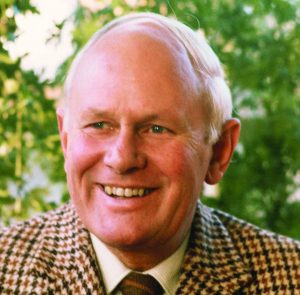
At first I did my best remain to be invisible when the Caddys were around.
A Welcome from Eileen
I arrived late for dinner one evening and there was one empty seat in a packed dining room – directly opposite Eileen Caddy. I slipped in gingerly, and hoped invisibly, on to the bench opposite her. There she was – beautifully dressed in a fine frock, made up and decked with jewellery and twinkling sapphire eyes, a palpably dazzling aura of light around her, chatting with friends – Ross Stewart and his wife Aileen Ross Stewart. After dinner, the friends left, and Eileen turned to face me. She said in her soothing yet sincere voice: “Why don’t we go out for a walk?”
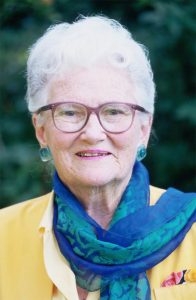
As we strolled through the gardens, shimmering with life on many levels, Eileen gestured with a wide sweep of her right arm: “What I love about this place is that it belongs to no one . . . only to God.” I understood that she was saying telling me that we all had an equal right to be there. I relaxed a bit. Then she rested her hand on my arm and looked into my eyes: “I am so glad that you have come to live in our community.”
Dominic Stuart

I come from a Moray family, although I grew up primarily in England and North Wales. I first came to Findhorn in 1951 and it has been a constant in my life ever since. I love Findhorn, in all its many facets. I joined the Foundation community in January 1976, and left to live in London in July 1979. I worked in business in London. mostly green businesses, and later as a green financial adviser. I burnt out with ME in 2002. Since then I have been involved in writing, and trauma healing, initially for myself, and later with others.




Leave A Comment