


This is the story of Matthew Ingram’s visit to the Ecovillage Findhorn in 2023. He came to do research for his latest book The Garden: Visionary Growers and Farmers of the Counterculture which chronicles how a generation influenced by psychedelics, Eastern philosophy, and reactions to Vietnam, the Oil Shocks, and DDT became interested in sustainable growing and farming. The book contains a chapter about what happened when the hippies came to Findhorn.
***

In August 2023, by train, plane, then taxi, I fulfilled a long-cherished ambition in taking the pilgrimage to Findhorn. Arriving in the middle of a rainstorm in the darkness, I gingerly let myself into “Genesis” the chalet that had once been the home of Eileen and Peter Caddy and their family. What had brought me to this enchanted site nestled on the dunes at Findhorn Bay in the North of Scotland?
I first heard about the intentional community at Findhorn when researching my previous book “Retreat: How the Counterculture invented Wellness”. It had been mentioned by one of my interviewees, pioneer of Holotropic Breathwork, Stanislav Grof. Grof had run a number of workshops at Findhorn and had a similar relationship with it to that he had forged with the Esalen Institute in California; the establishment of both, perhaps not coincidentally, was in 1962.

That previous book had looked at different techniques of healing against the backdrop of the hippie movement. There were a surprising number of candidates: Macrobiotic food, Transcendental meditation, LSD Psychiatry, Transactional analysis, and Esalen’s Gestalt Practice. But what I was unprepared for was the manner in which these were all tied into spirituality, and especially Eastern philosophy. That wasn’t the book I had set out to write! However, I ended up being fascinated by the holistic ideas of the Vedas, Buddhism, and Taoism.
Certainly, healing and its relationship to spirituality is a central motif of the community’s mission. It’s arguable that this need for revival was brought about by the trauma of the two world wars. Peter Caddy and Findhorn associate Richard St. Barbe Baker had both been in active service. With regards to the connection to Eastern philosophy, through the influence of Madame Blavatsky’s Theosophy, Peter Caddy had been transfixed by the spiritual culture of Tibet. Caddy was fortunate to travel there in 1945 just before the Chinese occupation. However, tellingly, he concluded of the experience that, “many of the people had become crystallised in their thinking and customs.”
It was, however, none of this that had brought me to Findhorn. In spite of Eileen Caddy’s view that the primary mission of the community was connected to her experience of the voice of god, “the still, small voice” and insistence that “the garden came second”, it will be eternally associated in the popular imagination with Peter Caddy’s giant vegetables. My latest book “The Garden: Visionary Growers and Farmers of the Counterculture” looks at the connections between the hippies and growing. It takes in forebears like Rudolf Steiner and the UK’s organic movement (Lady Eve Balfour herself no stranger to the community), Self-sufficiency, the back-to-the-land movement, Masanobu Fukuoka’s Natural farming, Permaculture, and much else besides.

Given that the “hippie farmer” is one of the best-loved and durable figures in society, a trope even, it is a wonder that such a book hadn’t been written before. Oh certainly, Tompkins and Bird’s “The Secret Life of Plants” (1973) was the foundational book of the plant-consciousness counterculture, but it didn’t discuss the hippies themselves – only their putative influences. Peter Tompkins can be seen talking to journalist and television presenter Magnus Magnusson in a wonderful BBC TV special on Findhorn from 1973.
The book’s final chapter concerned the community at Findhorn. Reading extracts from it published in Harper’s Magazine, as he sat in his cluttered and shabby warehouse in the old industrial section of Boston, Paul Hawken, author of the subsequent “The Magic of Findhorn” (1975) was rendered “psychologically flatfooted and analytically agape” – and set off on his own pilgrimage to visit.

The world of the founders of the spiritual community at Findhorn is referred to by Celebrating One Incredible Family chronicler Cornelia Featherstone as one of “tweed” but my book concerns the counterculture, that intense revolt of the youth against straight society that peaked in 1968-69 with The Beatles “White Album”, the Parisian student riots, Woodstock, and the back-to-the-land movement.
As Cornelia puts it, the original founders were at work in a field that was, “very specific and quite esoteric in the true sense of the word, ‘Not seen’.” Arguably, it wasn’t until the small community’s discovery by the hippie movement that it became what it remains to this day. Right at the heart of its visionary offering, setting it a decade ahead of other early intentional communities, was Peter Caddy’s vegetables. I had the good fortune to be able to talk to some of those original hippie visitors, briefly with Paul Hawken (now the world’s leading sustainability guru), with another key American émigré from that era, the sparkling Roger Doudna, who still lives in the dunes, and with Leonard, one of the original gardening “gnomes” who arrived as a gang from Blackpool in 1971.

Living Machine
Being guided around the site by the delightfully bossy Caroline Shaw, I was able to see firsthand the ways in which growing food and working with plants is still central to the Ecovillage Findhorn community. Caroline let us into the magnificent water purification plant, set up in collaboration with expertise from Cape Cod’s New Alchemy Institute (featured in another chapter of my book), where reeds are used to convert grey water till it’s clean enough for goldfish to happily live in it.

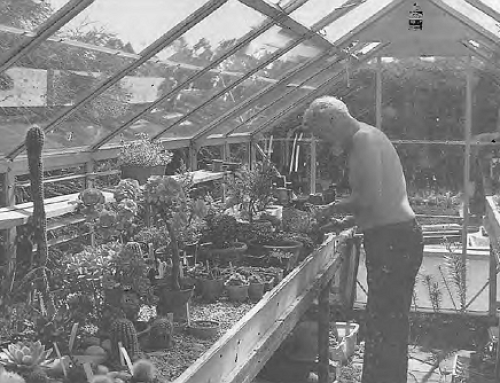
Cornelia’s greenhouse
Cornelia Featherstone showed me around her magnificent vegetable garden which has already, thanks to a lovely film by internet gardening sensation Huw Richards, attracted worldwide attention with half a million views. Cornelia’s garden was, in the true ‘spirit of Findhorn’ like Peter Caddy’s before her, growing biologically without chemicals; that’s to say in accordance with nature. This choice of growing methods, and indeed the whole organic movement, were closely followed by the countercultural generation.
-

- Michael
-

- Soillse Garden
Michael Shaw led me around the Community Supported Agriculture garden on the site, which was being tended by WWOOFer Veronica Caldwell, returning from Australia to Findhorn where she grew up, and now a highly-skilled grower.
-

- Raised Beds
-

- Composting Hot Bins
-

- Park Garden cold frames
But even this abundance of gardening was not all at the ecovillage! There are raised beds, composting hot bins, and cold frames in the community “streets”.

Massive rosehips
On a walk into Findhorn itself I was delighted to encounter some actual massive fruit. In this case rose hips reaping the benefit of a whole summer of long days. There has been much speculation over the years as to the causes of Peter Caddy’s forty-pound cabbages. Was it the devas? Without wanting to spoil anything, this matter is explored in the book with some interesting new material which came to light in my research. In strictly literal and ecological terms though, the real miracle is how a vibrant topsoil has been created upon such unpromising land. Ecovillage Findhorn, long may she grow!

“The Garden: Visionary Growers and Farmers of the Counterculture” by Matthew Ingram will be published on April 8th 2025 – but is available as a pre-order.

Guest Authors are contributors who are not COIF members (for various reasons).




Leave A Comment