


July 2025 musings on The Findhorn Foundation Tree Chronicle (1984).
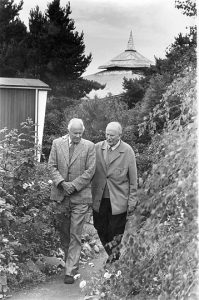
Peter Caddy & Richard St. Barbe Baker photo Findhorn Foundation
Richard St Barbe Baker – the ‘Man of the Tees’ – was a (mostly) annual visitor to the Foundation. I first met him in 1975, and Peter Caddy (who adored St Barbe) ‘handed him over’ to me to hang out and be with him for the few days he’d stay with us … and this continued on all of his subsequent, annual visits.
He also visited with Leona Graham and Jeremy (Bradford) in those days, one reason for which was that Jeremy had forestry training and background … and of course, Leona was/is Leona! A related and memorable event 🡪 during a damp late winter visit, St Barbe was cold and Jeremy enthusiastically gave him his own (gorgeous) full length, forest green, pure wool Danish forester’s coat. St Barbe loved it…and kept it!
Though a man of classical forestry training and with a colonial background (forest officer in numerous African colonies), St Barbe was entirely comfortable with the spiritual side of life and nature. As we spent time together, and with trees already having played a significant role (relational and professional) in my life for many years, I was able to soak up St Barbe’s energy and read all his books. In the process, an inner portal opened for me, and I could further expand my own understanding through some direct experiences with a cosmic presence who assisted my learning about the energetic, non-physical role of trees on Earth.
In this process, I was gradually prompted to “do something about it.” I felt that it needed to be mostly growing our own trees from seed, then filling out the community grounds with increased shelter belts in the caravan park, and throughout the still sparsely-planted Pineridge gardens — basically everywhere that needed them including other local places in the wider community, as the opportunity arose. One of St Barbe’s rallying cries was, “Plant Trees for your Life,” and that slipped very easily into a name for the programme, Trees for Life.
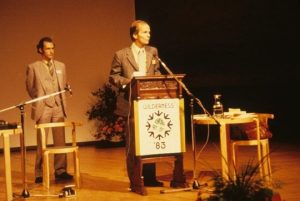
World Wilderness Congress 1983 photo Findhorn Foundation
Through St Barbe I met Dr Alan Grainger in 1979 – now Dr Anna Grainger, a professor at Leeds – and invited him to Findhorn. We partnered-up and together conducted a workshop tour I arranged in Eastern Australia in 1980, on the way to the 2nd World Wilderness Congress (WWC) in Cairns, Queensland. During these workshops and on site-visits to forest projects, Alan presented the ecological importance of trees and I presented the practical and spiritual dimension. I also secured a plenary speaking spot for Alan at the 2nd WWC, and I served as the aide-de-camp for Congress Chairman Wally O’Grady and Ian Player of South Africa, founder of the WWC. Subsequently, I co-edited (with Mary Inglis) the 2nd WWC proceedings published by Findhorn Press, and then as Executive Director of the 3rd WWC in Inverness and Findhorn (and subsequent editor of the proceedings published by Lorian Press). What originally initiated this life-stream of events, eventually leading me to leave Findhorn and return to the US, create the WILD Foundation and conduct, inter alia over 40 years, the next 9 Congresses, is another story altogether.
Alan was both the first editor of the Journal of Agroforestry, and also at that time the first acknowledged expert on rainforest ecology and the dangers of its destruction (the news of which had barely arisen in the news of the day). Teddy Goldsmith (brother of Sir James Goldsmith and uncle to the current UK politician and former Minister, Zac Goldsmith and his brother Ben, noted environmentalist financier), the pioneering environmentalist financier and founder editor of The Ecologist magazine, heard of Alan’s work. He was so impressed with this tall, thin, 28 year-old academic that he asked him to be the editor of the Jan/Feb 1980 edition that focused on tropical rainforest destruction and a plan to save them.
Through St Barbe I also became a friend and colleague of, and introduced to Findhorn, the very talented and nature-committed Hugh Locke, a close collaborator of St Barbe’s, engaged in the UN and various international relief efforts. He subsequently was very active in Haiti, in particular, starting the Smallholder Farmer’s Alliance (using an innovative tree finance model to help renew this tragic island nation). As compiler of St Barbe’s archives, Hugh collaborated with Paul Hanley in the 2018 publication of Man of the Trees: Richard St. Barbe Baker, the First Global Conservationist, with Foreword by HRH Prince Charles and Introduction by Dr Jane Goodall.
I note these people and others in this document who were not resident in the Community to indicate that Trees for Life opened the Foundation to the mainstream global and UK forestry and environmental sector.
 By 1980, with the advent of Cullerne Gardens, Dick Barton (first focaliser of Cullerne Gardens) readily agreed to my request to build a fabulous tree nursery. It was hexagonal, with each of the six sections composed of an outside ring of a small poly-tunnel for germinating and potting, and within that was an inner triangular section, an uncovered area with gravel bedding and wooden sides that was the standing-out ground. We started the seeds in flats – after proper preparation such as scarification, soaking, whatever each type of seed needed – and, after sprouting, pricked them out into black poly bags and put them into the tunnels … by the thousand! After a year or so, they were well-established, they were transferred to the standing-out ground so they would be hardy. I think we limited the species to about 10 or 12, concentrating on the normal ones (birch, oak, alder, ash, rowan, etc)…and… dabbled in some suitable exotics such as one of my personal favorites, pinus aristata, the bristlecone pine (arguably the oldest surviving trees, found in the western US).
There were numerous other and varied aspects of the early Tree Programme. For example, to name just a few of them:
- On a visit to the US, I purchased several bundles of cuttings of the fast-growing, hybrid poplars in order to start a wood lot to provide part of the fuel for the growing number of wood stoves in the community. I covertly brought them through UK customs, and we planted these cuttings at the far south end of Cullerne. I don’t think the fuel supply aspect ever really happened, but most of those poplars are still there.
- The Foundation acquired Drumduan House during this time, and I asked St Barbe to plant a holm oak (Quercus ilex) in front of the house and to lead a Blessing of the Trees for that property.
- We planned a newsletter, and actually published the first one, a copy of which is in the attached Chronicle.
- Shortly after our son, Farren, was born in 1977, I left for 3 months to manage the first Findhorn World Tour that Peter had asked me to arrange. When I returned in 1978, Kate, Farren and I moved into a bungalow (at that time called McPherson Green’s) immediately adjacent to the centre of Pineridge Gardens, in the creation of which I was a full and enthusiastic participant as (Garden Focaliser) with Fred Barton (Head Gardener) and many others in the Garden Group. We finished the dry stone wall structure of the gardens on what we called “The Mound” (just a sand dune at that time), with a sparse planting of some shrubs left over from propagation done by the previous garden team, the Blackpool group. In the middle was a circular structure called The Well, where Kate and I were previously married by Peter Caddy in 1977.
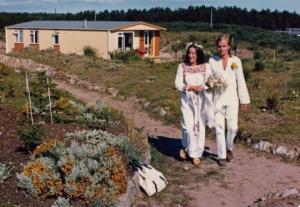
Kate and Vance Martin wedding
When we moved into the bungalow in Pineridge I planted an English oak (Quercus robur) in the centre of The Well, and gave our son the middle name of Drew, after the Druids, the ancient priests of the oak groves. It stands today, a strong and proud oak. When Felicia was born 18 months later, I planted an ash (Fraxinus excelsior) in the centre of the second Well (on the west side of ‘The Mound’ and the eventual site of Ian Turnbull’s fabulous Nature Sanctuary), to complete the ages-old saying to foretell of seasonal rainfall: “If ash flowers before oak, a real good soak; if oak before ash, just a splash.” Several years later the ash was moved to the outer edge of the Well, so that the Sacred Dance Group could practice outside. I’m unsure if it survived.
• I wanted to plant a demonstration wood at the end of Pineridge, dubbed “St Barbe’s Wood.” The first tree was a copper beech (Fagus sylvatica purpurea) planted by St Barbe in 1980-81. We subsequently planted several others – too close together I might add. A brief, humorous aside 🡪 I was talking to St Barbe a year or so after he planted the copper beech and asked him if there were any trees he particularly did not like. He answered readily. “Yes, two. The Monkey-Puzzle tree (Araucaria araucana, the very singular, tall, evergreen native to the southern hemisphere) that sheds those horrible scales everywhere. You see them planted in front of every Welsh coal-miner’s cottage! And the other is the copper beech…those dark leaves don’t reflect light…too gloomy!”
In 1981, St Barbe made his annual visit to Findhorn. We were together for a few days, and of course as this tall, classical-looking, elderly gentleman walked around he would greet people with a hug, often surprising those that did not know that he had accepted the Bahai faith many decades previously and thus swore always to hug, and never to merely shake hands. We discovered that we were both due to be in Australia six weeks from then, and so we made plans to meet in Sydney.
When I arrived in Sydney, I heard that St Barbe had been in an automobile accident in Kenya and had to be hospitalized…apparently the early generation of seat belt (while it likely saved his life) had left him with some internal injuries. I went to a park in Sydney on the appointed day to meet St Barbe, and saw him seated on a low stone wall, slumped-over, head down. I was alarmed. The head of the Australian branch of Men of the Tees (a woman :-)) was hovering around him, and a camera crew from ABC was setting up for an interview.
I greeted St Barbe and asked how he was. He stood up wearily, embraced me and said: “Oh Vance … thank God, so glad you are here. I had a crash in Kenya. They made me spend a fortnight in hospital. Those two weeks almost killed me!” The camera crew signalled it was ready to roll, and St Barbe straightened right up into a commanding stance. The interviewer asked him the lead question and he was off and running, speaking clearly and with presence about the great role of trees to save humanity on earth …”Plant trees for your life!” Interview over, he again slumped and asked for a cup of tea. We parted, promising to see each other the next year, not-knowing that he would pass-over in June 1982 in Canada, an early stop on his annual world tour.
As mentioned earlier, with the Tree Programme stabilized I was drawn into work more specifically-focused on global wilderness, bringing the 3rd WWC to Findhorn in 1983 as the first congress in the officially-permitted (24 hours before the opening session!) and completed Universal Hall. This process led me to agree with Ian Player that I would return to the US and set up the WILD Foundation, and so on.
Before I left, we began to plant the initial shelter belt around the caravan park. Subsequently, many more thousands of trees needed to be planted out, and Jonathan Caddy (who, of course, grew up in The Park in what would become the Findhorn Foundation), led the effort that planted many of them all around The Park and in Pineridge.
With many more trees remaining, Craig Gibsone (long time and much-respected community resident), offered them to John Christy at Black Hills, a good friend, ally and steward (after his father, Sylvester, passed) of our favorite wild garden, the bewitching and dazzling Black Hills. John readily agreed as he needed a large shelter belt on the north side of his estate. Craig mobilized community members and guests, and the results of that effort stand today as a mature, wide, shelter belt of many species, guarding the fields against the often strong and biting north winds.
As I left in July 1984:
- Alan Featherstone Watson was solo-pioneering a unique, visionary rewilding project in Glen Affric, that was eventually to become a globally recognized initiative. He asked me, since I was leaving, if he could assume the name Trees for Life for his project. I readily agreed and the rest is rewilding history.
- I documented the The Findhorn Foundation Tree Chronicle.
- The Tree Programme continued with a team that included community members Linda Parker (former backcountry ranger in the US Forest Service); Jonathan Caddy; Annie Blampied; Paul Hice; and others such as Craig Gibsone, who characteristically kept his eye on things.
Where did we get the funds to do all this? It was my first foray into fundraising, and bits and pieces came from all over … people liked trees, and many community members gave UK £5, £25, (and one man gave £1000!), plus modest grants from a few philanthropic groups such as The Doughnuts and the Threshold Foundation in the US …it was the response to a clear, loving, and needed proposal. I remember with humour the first official “fundraising meeting” I had with a person outside the community, who lived across the road at the side of the Bay. He founded and led the Glasgow-based global banana importing business … was it Fyfe’s? In any case, we had tea and I pitched him on the trees and on the 3rd World Wilderness Congress. He gave me a box of bananas!
I brought the box of bananas back to the bungalow in Pineridge. Kate remarked with a laugh that I had a dubious future in fundraising, saying, “Some people bring home the bacon; you bring home the bananas!” Little did I realize at that time that the fundraising experience started at Findhorn would be my daily duty for the next 40 years as I created and built-out the global work of the WILD Foundation with the help of many people, which included Leona at numerous critical and often perilous moments.
I think I’ve got most of this right … or close to it. Of course, many other people were involved. Any omissions and errors are my own.

Working for wild nature, wild people, wild planet


Leave A Comment