


“This generation may either be the last to exist in any semblance of a civilised world or it will be the first to have the vision, the bearing and the greatness to say “I will have nothing to do with this destruction of life, I will play no part in this devastation of the Land, I am determined to live and work for a peaceful construction, for I am morally responsible for the world of today and the generations of tomorrow.””
Richard St Barbe Baker.
I hadn’t realised how dire things had become, till awoken by the environmental activism that began to find a voice in the ’70s, highlighting the many abuses by mankind, of the natural world.
ROC would sometimes address the community, giving talks about his encounters with the Nature Kingdom and sharing insights. On some occasions, he said we mustn’t ever underestimate the power of evil at work in the world; I think he was concerned the community was overly idealistic and a bit lopsided. He didn’t go into details on this subject, it was more of a gentle reminder, there were no conspiracy theories or demonising of science, technology, government or corporations and with Peter’s positivity and the focusing of attention on creating “The New”, such considerations were not given energy; neither was there a sense of a ‘crusade’ but a seeking to create a place of demonstration, where simple, often well tested principles were being put into practice. Peter encouraged focussing on the new but also maintained that much could be built on the best of ‘the old’. The philosophy of Mahatma Gandhi of ‘ahimsa’ – harmlessness and “think globally, act locally” was very much in evidence as well as the simplicity of a Buddhist style economy which was already well in place before we arrived “think – less is more”. Before the concept of ‘carbon footprints’ had been conceived, the community’s would have been well within the limits of sustainability.

There were the obvious virtues of self-sufficiency and organic husbandry, with regards to the garden and crops, as well as looking to Spirit and the overlighting intelligence of the Natural World that Dorothy and Eileen inspired in us all, for nourishment clarity and inspiration on all levels; acknowledgement of the invisible realms with gratitude. This ethos was of a collective nature and an intention we sought to live by, day by day. Peter and Eileen’s take on this was to “seek first the kingdom of heaven” or for those whose buttons get pressed by ‘christian speak’, putting first things first and seeking to live in a more transcendent way, with appreciation, less dependent on a sense of so called security (stuff) without fears of scarcity but having faith in life’s abundance – glass half full rather than half empty.
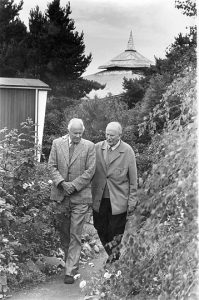
Peter Caddy & Richard St. Barbe Baker photo Findhorn Foundation
Many luminaries in the area of environmental awareness passed through the community in the ’70s, to visit and to participate in the early conferences, sharing their knowledge and concerns, hopefully encouraged in some way by the work of this place. There was Richard St Barbe Baker “Man of the Trees”, a big congenial person with a peaceful demeanour and a ready smile, who had spent his entire life working with trees, seeking to re-forest what had become desert areas of the world and ‘founding’ the British Forestry Commission in the 1920’s. It was he who had advised Peter and the gardeners on the planting and care of the young trees in the early gardens of the community. I listened to a talk he gave and was moved by the inspiring and enthusiastic way he shared his wisdom and love of trees; one of his dearest visions was to see the planet reforested as much as is possible. Perceiving trees as the skin of the Earth and he spoke about how mature trees help to ‘ground’ a most transcendent energy and must be reverenced and preserved as sacred places… (this knowledge known by indigenous people all but forgotten by our cultures, obsessed with the growth of greed.)
Fritz Schumacher also came. It may have been one of the first conferences that was held in the community and he had just published his ground breaking book “Small is Beautiful”, helping, as it did, to present a vision of a holistic worldview, via the new economics, intermediate technology, environmental awareness and the case for increasing de-centralisation in governmental structures.

Michael as Moses
For me, it was in the mid-60s that I began to see changes in the countryside I had grown up in, riding on Jo’s motorbike and on trains between London and the Kent coast. Thrilled to have left the bomb blasted environs of South London shortly after my tenth birthday, I found myself in a heaven of lush landscapes away from the coastal resorts, where I would roam, sometimes with Dad in one of his old Ford dormobiles, exploring the diversity of ancient farmlands, the many kinds of orchards, wild flower meadows, fallow fields and small mixed woodlands, brooks, streams and the perennial village ponds, complete with ducks; the lay and tilt of the land, a delight at every turn of the hoary hedgerows, the atmosphere full of rich diverse aliveness. Traditional farming methods were still honoured and many people from the small villages, worked the land as their ancestors had, growing the hops, barley, fruit and vegetables that Kent was famous for and had been for centuries.
Years later, I’d see the regular spraying with insecticides, the spreading of chemical fertiliser, where before there had been the good smell of animal manure laying down and enriching the top soil; once too, there had been the knowledge of mixed, planting and crop rotation in order to deter pests (pests that had fed a varied and diverse bird population). There had been knowledge that life was a web and the health and richness of the few inches of top soil had to be ‘living earth’ if our food was to nourish us with the necessary nutrients and mineral content needed to maintain good health.
The gradual degradation of the land by mono cultivation became all too apparent in a very short time as farmers ‘grubbed up’ literally thousands of miles of hedgerows, a lot of it dating back hundreds of years, enfolding small fields and pastures – in keeping with the dimensions of this small island – preventing erosion and flood and acting – as it did- as a ‘womb’ for the varied wild life that once existed in glorious profusion and had kept this land magical, a wonder of biodiversity.
The fields became prairies, the top soil degraded, losing its natural vitality, no longer protected from the increasingly strong winds and storms. Ponds, brooks and woodlands were filled in and removed, in order to mount this devastation and all for what? To create a few more hectares for growing cash crops? To make things easier for all the new mechanisation? To receive the large and ill thought out subsidies from the government coffers? In order to create butter, cheese and grain mountains? An excess of unusable crops, creating an overload of cheap foods, guaranteed to eventually lead whole populations into poor health, obesity and much else besides, as well as destabilising and compromising markets worldwide; undermining the small and unique, the market gardeners, the small holding that help to diversify the choice of foods we eat; yes, “small is beautiful”.
Industrial farming releases vast amounts of carbon dioxide, in fact it’s the second greatest cause of climate change after fossil fuel combustion; conversely, sustainable organic farming not only enriches the environment, supporting pollinators and wildlife, it also stores carbon in the soil.
The dismantling of the working communities of small village life never made any news headlines, it was a gradual decline, eliminating the human diversity, the old knowledge as farming became more mechanised. I didn’t know it then, as I rode pillion on Jo’s motorbike, but I was witnessing the beginning of the “great unravelling”.
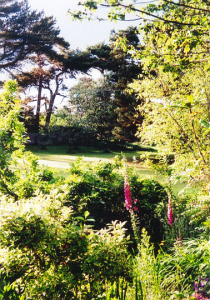
In many respects the community became a seed bed for ecological ideas and innovation, that would bear fruit over the following decades. The ‘Living Machine’, a natural process of cleansing (grey) water with the use of plants, fish and simple hydrology, was installed by a small group of pioneers in the eighties. Later, the community had several turbines installed, generating its own electricity on this very windy peninsula.
During the 90s an eco-housing development got underway, based on sustainable, often recycled materials – energy saving designs using solar and photovoltaic sources.
Craig Gibsone, a forthright and likeable Australian, a long term member from the early ’70s who had been Peter’s right hand man, pioneered the successful United Nations’ supported ecovillage workshops that have been running now at Findhorn for two decades bringing people together from all over the world, mostly from rural situations. The concept of a “web” where everything is connected is a central idea, using permaculture techniques, intermediate technology as well as the best of traditional methods to live as harmoniously and harmlessly on the Planet as possible including as well successful community-based principles and ethics to solve problems of a practical and sometimes political nature. All these aspects, ‘a drop in the ocean’ but (along with the many who are creating transformation) filtering through the collective consciousness to create the changes needed if we are to endure as a species and prosper along with our world of which we are a small part; small but not yet beautiful! while the ‘egoic’ mind is in control, collectively speaking, squandering our creative ability to evolve in our obsessions with power, greed, hatred and fear.
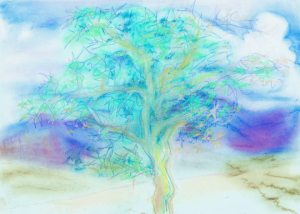
Story Tree pastel by Anniese Giuntini Worth
With the gift of intelligence vested in us by life, we are capable of both destroying or cherishing this fragile and wondrous world. In the words of Eckhart Tolle: “The foundations for a New Earth, is a new Heaven, the ‘awakened’ consciousness.”
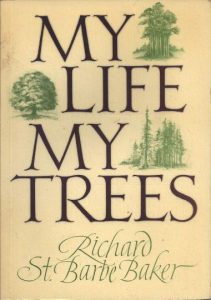 I end this chapter with some further quotes by Richard St Barbe Baker, taken from one of his books “My life – My trees” published by Findhorn Press, (1979). No one has done more for the preservation of ancient forests and the reforestation across the world. A man of extraordinary spiritual stature who devoted his life to this herculean task.
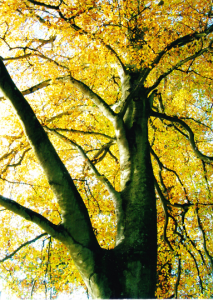
“The ancients believed that the earth was a sentient being and responded to the behaviour of man upon it. As we have no scientific proof to the contrary, should we not accept this point of view and behave accordingly?”
“I look at it like this: if a man loses one third of his skin he dies; the plastic surgeons say “He’s had it”. If a tree loses one third of its bark it dies. This has been scientifically proven by botanists and dendrologists. Would it not be reasonable to suggest that if the Earth loses one third of its green mantle and tree cover, it would assuredly die? The water table will sink beyond recall and life will become impossible.”
“Water must be a basic consideration in everything: forestry, agriculture and industry. The forest is the mother of the rivers. First, we must restore the tree cover to fix the soil prevent too quick a run-off and steady springs, streams and rivers. We must restore the natural motion of our rivers and, in doing so, we shall restore their vitalising functions. A river flowing naturally, with its bends, broads and narrows, has the motion of the blood in our arteries, with its inward rotation, tension and relaxation. Picture a river which has risen from a mountain spring in a well – treed water shed; trees of mixed species and different shaped roots; the spear – shaped roots; the heart – shaped roots and flat roots – fixing the soil at different levels and reducing competition for food and water. The leaf – fall and humus on the floor of the forest will act as a sponge to retard quick run-off after a storm. Water will sink through to porous soil and form myriads of springs which will feed the land and rivers during the drier months of the year. Mountains and high ground should be covered with protective forests up to the snow line: In high country, fields should be kept small and carved out of the forest and always be tree surrounded.”
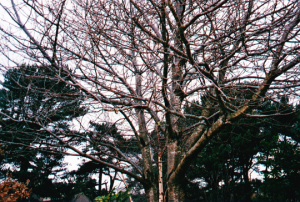
“How strange it is that communities fail to realise the importance of preserving tree cover on tree slopes. Man has a bad record as a forest destroyer, cutting and burning greedily and recklessly, destroying the built-up fertility that has accumulated through the centuries. He has been skinning the earth alive in his greed and folly and to satisfy the unnatural appetite for the flesh of his fellow creatures’.
‘In some countries, such as the U.S.A., up to three quarters of the land has been degraded to the use of growing crops to feed animals, which they kill to feed themselves. Surely a round about way of getting food, when it is possible to get food for ourselves direct from the earth through fresh vegetables, fruit and nut bearing trees.”
“Under existing systems food looms large and there is a constant threat of famine over wide areas, but if we treat reafforestation as seriously as we do national defence, and turn from an animal economy to a sylvan one, we shall be able to look forward confidently to the time when food will worry us as little as the air we breathe.”
***
About the photos: A big Thank You to my grandson Ziggy for enhancing the appearance of many of my somewhat battered and ancient photos from the ’70s.

I live very simply in this land I love. On returning to the area with my daughter Jade, I found joy in volunteering in the life of the Community; until Covid, then everything changed.



Leave A Comment