

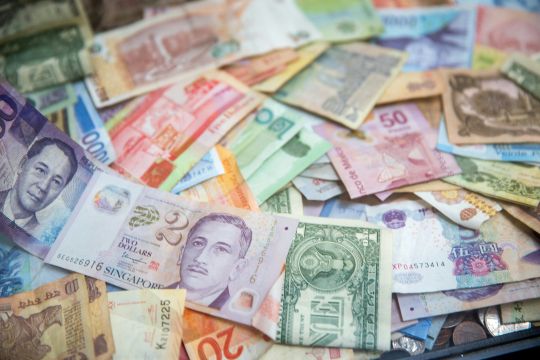
When I arrived at the Findhorn Foundation back in 1977, ignorant as I was of esoterics, I frequently found myself sitting at the feet of Stephen Field. Stephen was a trustee at the time, but long before he came Findhorn, he had served as an army chaplain – a brigadier in the Korean War. Through that intense experience, he had discovered the profound power of group cohesion under the extreme fear of death. He saw how a small group of men were willing to set all ego stuff aside for the common good. That lived experience reinforced his deep understanding of what a focused, spiritually orientated group could achieve.
Stephen introduced me to the Alice Bailey material, particularly her perspectives on money. He gave me a transmission from Master Djwal Kuhl (DK) – the Tibetan source Alice channeled. I’ve carried an adapted version in the front of my notebook ever since:
Need, love and magnetic power are the three things which – consciously or unconsciously – attract money. They will do so when people are animated by a spirit of unconditional love. Often the need is felt rather than real, comes out of glamour and illusion, and is for things material which are not necessary to health or happiness. Often the love is selfish and conditional. And often the magnetic power is wrongly motivated. These distortions, prevalent over centuries, have led to the present dire financial situation in the world.
Money is the manifestation of energy. It can be selfishly or unselfishly used. Creative thought determines the magnetic power of any individual, group, or organisation. Determine your motive. See that your group ideal and group love are dominant! Use skill in action! This will involve preliminary meditation and correct thinking, and that which you truly need in order to fulfill your real purpose will be forthcoming.”
This text opened my eyes to World Goodwill and the Lucis Trust, founded by Alice and her husband in 1920. Their core thesis framing money not as a mere economic tool, but as “crystallised” or “concretised” divine energy, completely transformed my perspective. Humanity’s core failing was hoarding rather than sharing. The work called for reorienting money from personal accumulation toward world need, seeing it as an etheric energy to be redirected by right-minded people of Goodwill. [1]
The Money Game – how it started and where it went
Around 1979, a cloud of negativity regarding debt and finances settled over the Community. Seeing this, Daniel Ofman composed and performed a song at a Friday evening sharing to directly confront these hang-ups. Then followed his conception of the Money Game – an immersive, real-time exercise (not a simulation) using real cash to help participants explore their deep emotional responses as money changes hands. It lets participants experiment with behaviour that may run counter to their habitual pattern — for instance, someone who habitually gave might practise receiving, or someone who always kept score might practise generosity without keeping track.
Recent informal research showed that the Money Game has been gone out into the world, yet most resources trace it back to the ‘early 1980s at Findhorn’. It was offered not only by Daniel Ofman through his own consultancy and network in the Netherlands but also by Peter Koenig in Switzerland and in some other collectives. We even found a reference for an online version offered from 2017. This was confirmed by one of our Community members who had played that version a few years ago as part of an online training.
Closer to home and from my personal experience
Over the years I have facilitated many Money Game workshops with my wife Clare, both at Findhorn and in the South of England. Richard Coates did many sessions as part of Findhorn Foundation educational programmes. William Bloom was teaching widely on money, prosperity consciousness, including at Findhorn and in the Alternatives programme at St James’s Church, Piccadilly. He has written extensively on money and consciousness, including the book Money, Heart and Mind, which explores psychological, historical and “metaphysical” dimensions of money. Lisette Schuitemaker, long-term Findhorn Foundation chair of trustees, has also trained as Money Game facilitator.
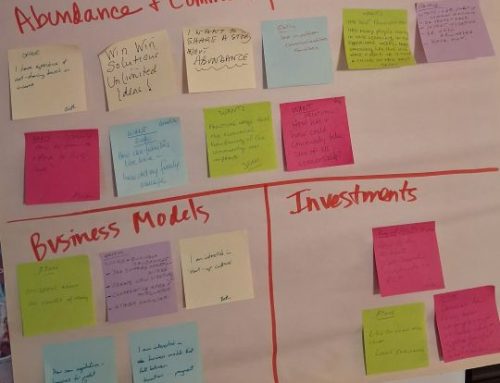
All of this was quite a while ago and I haven’t heard much about the Money Game for years until it resurfaced recently. I was thrilled to learn that the Money Game had been remembered in one of the Your Community Your Story workshops. A participant in the Ecology module recalled a Money game workshop with William Bloom in the 1980s in Oxford as a powerful, challenging and transformative experience. And it resurfaced again – as these things do when there is ‘Angel business’ going on – at the end of a heated discussion in the Education Circle around programme fees. Some folk were upset by what they considered unaffordable prices, whilst others spoke for a need to cater for the whole spectrum – including high-end corporate trainings bringing people to the Park Ecovillage who wouldn’t otherwise come here. The Money Game was mentioned again and it was agreed to run a pilot to assess whether the tool still has any relevance in the 2020s. I was asked to support this endeavour by sharing the format we’d used for the workshop which I was delighted to do. The pilot was run on 22nd July 2026. There was a strong sense that this is a tool which will be relevant for the Community going forward. The following module was on Economy – and I was pleased to hear that the importance of the Money Game was reaffirmed.
The Money Game Structure
Preparation is essential
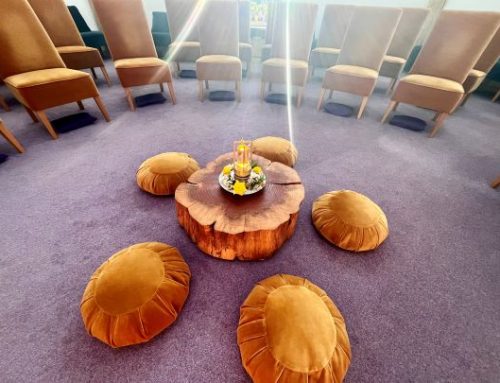
 Participants are asked in advance to bring a sum of money that represented a genuine ‘edge’ for them – enough that winning or losing it would be felt. It is essential that it REAL so it best ‘played’ with real money, as that is a more visceral experience than using tokens. They are also asked to bring a written intention for the session to read out in the introduction round, and a bowl for their cash, a notebook and pen for their reflections.
The core aim is to maintain acute awareness of feelings, physical sensations etc. throughout.
The process is structured into three rounds, every individual transaction has to be distinct, followed by returning back to the seat and allowing a pause for sensing of what’s happening inside. Each round is followed by a period of reflection and journaling.
Round 1: The Taking Round (in silence)
This is a silent phase where participants may take money from others. Each movement of money must be a distinct transaction—traveling from one’s own space to another’s to move the funds. After a facilitator-led interval—typically between five and ten minutes—the game pauses, and participants write down their feelings about their gains, losses, and the experience of the transactions.
 Round 2: The Giving Round (in silence)
Also performed in silence, this round shifts the focus to the act of giving. Participants take money from their bowl and give it to others in distinct transactions. The goal is to observe the emotional impact of giving away money and receiving it from others. Participants again conclude the round by reflecting on their final balance compared to their starting amount and recording their thoughts.
Round 3: The Negotiation Round (some verbal exchange)
Unlike the first two, this round is vocal. Every transaction must be negotiated between two people. A participant might offer money in support of another’s work or request funds for a specific purpose, while the other party may accept or decline. Participants may choose to discuss real-life needs or hypothetical scenarios; regardless, the focus remains on the emotional dynamics of the negotiation itself.
The game concludes with a sharing session, where participants reflect on their experiences, often beginning with conversations in pairs or small groups to process the internal shifts they observed during the rounds.
As far as I am concerned, this Money Game concept is open source, but I would suggest that anyone facilitating it is fully transparent about the amount and nature of experience they have of participating in or facilitating the Money Game. That could be a significant part of the opening session of the workshop.
I’d love to hear about your personal experiences with the Money Game, so please share them in the Comments below.
***
[1] In my filing cabinet, I still have the following 30-page compilation of passages drawn from the books of Alice A. Bailey:Money — The Medium of Loving Distribution, published by World Goodwill/Lucis Trust (London, New York, Geneva)
Click here for the document which is available as PDF from their website.
***
Photo Credits: on the top from Unsplash free – Thank you Jason Leung.
Money Game photos Cornelia Featherstone

Philosophy, Economics and Business studies (5yrs). Corporate finance (7yrs). Harvard Advisory Gp. Indonesia (2yrs). Boat building (2yrs). Findhorn Community (6yrs). Independent SRI Advisor (37yrs)




Leave A Comment