

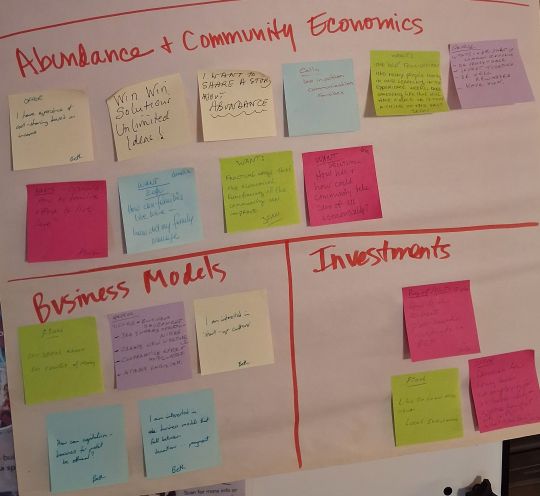
This report of the workshop held on 6th August 2026 in the Park Ecovillage Findhorn gives a summary, themes and next steps as well as details of the sharings and discussions for those who want to delve in more.
Summary
The event brought together fourteen citizen-historians for a four-hour workshop exploring the Community’s relationship to money, business, and financial sustainability. The session moved from an Introduction Round, through parallel breakout conversations, to a plenary Closing Round.
Introduction Round
Participants grappled with what replaces the Foundation’s historic ‘ashram economy’ — free or subsidised living in exchange for volunteer labour. The organisational landscape and circumstances have changed dramatically, including UK employment law, all resulting in a need for conventional income, pensions, and hard currency. Mixed-tenure housing projects like Duneridge, and ideas ranging from volunteer-hour discounts to a local currency (Ekos), surfaced as partial answers, without consensus.
A strong spiritual reframing of money ran through nearly every conversation: money as energy, intention, and a tool rather than an object to hoard or fear, including a fascinating discussion of debt as privilege rather than danger. Participants repeatedly traced their personal attitudes to money back to family scarcity or abundance in childhood and connected these patterns to community-level decisions about risk and investment.
The report also surfaces a more candid, less-often-discussed thread: the real financial cost of long-term community living, including pension gaps and a researcher-quoted pattern of residents “getting poorer” the longer they stay — met so far only by informal, ad hoc community generosity such as a COVID-era emergency fund.
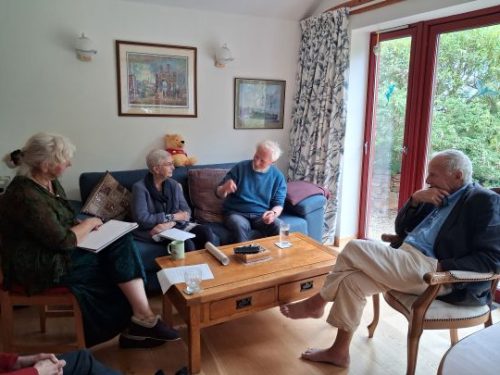
-
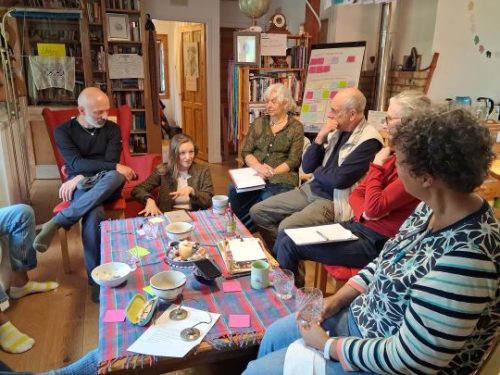
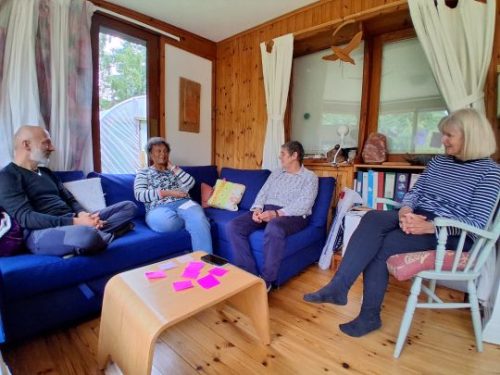
- breakout groups
The Themes
Six themes recurred across the Introduction Round, all four breakout groups, and the Closing Round. Click on the arrow on the left to expand the text.
From Ashram Economy to Mixed Economy
The Foundation’s historic model — free or subsidised accommodation, food, and pocket money in exchange for volunteer labour — has ended, and no single replacement has taken its place. Participants circled repeatedly around what should fill the gap: paid coordination roles, volunteer incentives, a barter or local currency (Ekos), or simply accepting that residents now need conventional jobs and hard currency income. Mixed-tenure housing projects like Duneridge, with subsidy designed to persist across resales, were the clearest concrete example of a hybrid model in progress.
Money as Energy, Not Object
Across nearly every conversation, participants reached for the same reframe: money is energy, intention, or a tool rather than a possession to hoard or an object of shame. This underpinned the debt-as-privilege discussion, the description of money as “a colour” with as many qualities as intentions behind it, and the Community’s growing comfort with the idea that money can be a force for good rather than something incompatible with spiritual values.
Scarcity and Abundance as Inherited Patterns
Many participants traced their present-day relationship with money directly back to childhood — a mother’s compulsive shopping, Depression-era parental fears, growing up working-class or genuinely poor, or, conversely, a family for whom money was simply never a live concern. The group repeatedly recognised that these inherited patterns shape not just individual choices but collective debates, including the willingness to take financial risk on shared community assets.
Business as a Vehicle for Values
From the Enterprise Fair to the regenerative investment movement to the historic tension between the Foundation’s educational mission and its business survival, participants kept returning to the question of how commercial activity can serve, rather than compromise, community values — and how easily that balance tips, as in the Education Circle’s debate over a high-priced programme, or the Foundation’s decision to undercut incubated businesses rather than stay in partnership with them.
Visibility and the Stone-Soup Catalyst
The day’s opening metaphor — a stranger’s stone that catalyses a whole community’s generosity — recurred as a lens for the Enterprise Fair, for external validation (the Oxford-linked researcher’s findings), and for the broader idea that documenting and making visible what already exists (73 businesses, six decades of surviving founding principles) is itself a form of economic and cultural work.
Personal Cost and Collective Responsibility
Beneath the more abstract discussion sat a frank acknowledgement that long-term community life has carried real financial cost for some residents — pension gaps, lost savings, and a documented pattern of people getting poorer the longer they stay. The Community’s response so far has been informal and ad hoc: individual acts of generosity, an emergency COVID fund, and “heavy lifter” investors absorbing disproportionate risk on shared assets like Cullerne House. Several participants named this as unfinished business for the Community to address more structurally.

Roses teaching abundance
Notable Threads for Follow-Up
- Revival of the Money Game — a facilitator has volunteered to co-host a session, writing up the story of the Money Game
- Duneridge’s mixed-income housing model is roughly three months into an early-stage process, with no conclusions yet to report.
- The Oxford-linked AI analysis of Foundation organisational history is an ongoing piece of external research worth tracking as later versions become available.
- Interest was expressed in Ecovillage Findhorn hosting a regenerative investment conference, building on GEN International’s connection such as the Latin American Regenerative Investment Society (LARIS2026).
- A request was made for updated front-entrance signage naming the Community’s three founding practices.
Outcomes and links to stories created around this workshop:
This Funny Thing Called Money by Robyn Gaston
Abundance Consciousness by Dorota Owen
Navigating Money, Fear and Abundance by Cally Fulton and Dorota Owen
My Involvement with the Money Game by Giles Chitty
The workshop in detail
Session Overview
Sylvia, our storyteller, shared the wisdom tale of the Soup Stone. The theme rippled through the Introduction Round in which each of the 14 participants shared what drew them to the theme of economy and what they hoped to explore. Followed by Open Space with a series of breakout conversations where ‘butterflies and bumblebees’ addressed the issues brainstormed after the introduction round.
Several voices and threads recur across more than one section of this report — most notably the question of what replaces the Foundation’s historic historic ‘ashram economy’, and the recurring reframing of money as energy rather than as an object to be hoarded or feared. The workshop completed with a “show and tell” Closing Round.
Introduction Round: Voices and Perspectives
Fourteen people introduced themselves and their relationship to the theme of economy, prompted by the Stone-soup story about a stranger who created community around a ‘magical’ stone. Several people picked up the stone directly as a metaphor for community economy; others spoke from very different life histories — of poverty, wealth, entrepreneurship, and inherited attitudes to money.
Visibility and the Enterprise Fair
One sharing relayed years of frustrated attempts to document the Community’s economic life on film. They described the Foundation’s public profile as “a blue lid” that hid the diversity of businesses underneath it from outsiders and insiders alike and traced efforts over several years — through cancelled camera shoots, a crashed hard drive, and finally three Enterprise Fairs — to make that diversity visible. They noted that the Ekopia website now shows 73 distinct businesses and enterprises in the Enterprise Directory with more being added every year.
“I felt the Foundation’s presence on the internet was like a lid… nobody on the outside could see the diversity of the economy because it was covered by that blue lid.”
The origin story of the Enterprise Fair itself was shared: an image received during a meditation of all the Community’s AGMs (Annual General Meeting) combining into one “MGM” — a Members General Meeting — so organisations could conduct the formal legal business in front of everyone. As harmonising financial year ends made a true MGM impractical in the short-term, the underlying “visibility thing” became the first Enterprise Fair in 2024. It is now in its third year.
Scarcity, Abundance, and Inherited Attitudes to Money
A strong thread ran through several introductions: the imprint that family background leaves on a person’s relationship to money. Someone described growing up in poverty and later working for billionaires, observing that “need doesn’t get you to happiness” and asking what changes when a community organises around opportunity rather than scarcity. Another participant named a family history of poverty and scarcity-consciousness a generation back. They came to Findhorn wanting to learn a more exchange-based, less fear-driven way of relating to money. Someone else traced a lifelong discomfort with her mother’s consumption habits and described building a life of second-hand and hand-me-down resourcefulness instead.
Others described economy as simply not a central driver of their life choices. One grew up poor and working from age 13, but said scarcity was never really an experienced driver for them: “I have never worked for money; I have always worked, and the money came along.” Another, by contrast, named themselves “fiercely commercial” from childhood, running a schoolyard punishment-writing business before decades of commercial life, and arrived at Findhorn drawn by the sheer density of opportunity.
New Lenses on Economy
Several participants brought professional or intellectual frameworks to the theme. Marilyn described founding Integral City, a social enterprise. In applying biomimicry — specifically, the model of a honeybee colony — to human settlements, she posed the question of what a community’s “double sustainability loop” would look like: what sustains it this year, and what regenerates conditions for the community and its wider eco-region next year. Another participant works professionally helping wealthy individuals shift from maximising returns toward place-based and community investment and named this a major emerging global trend of which Ecovillage Findhorn could be an early example.
Two long-term perspectives raised practical questions the day would return to repeatedly. Someone who first lived at Findhorn in the 1970s and again in the 1980s, asked plainly how families afford to live in the Community today, and pressed the group on why the model doesn’t extend further into Forres and the wider district. Another, a business owner turned observer, praised the Community’s values but questioned its operational efficiency.
Breakout Groups
Supporting Community Activities & Infrastructure
This group opened on the practical question of who currently coordinates volunteer-dependent activities — community meals, conference catering, Experience Week — now that the Foundation no longer employs people to run them centrally. Participants agreed that coordination currently rests informally on a small number of individuals (one person, Dorota, was named as currently holding conference catering together through personal persuasion), and that this is not sustainable.
The conversation moved through several possible incentive structures: a discount at the Phoenix shop for logged volunteer hours, barter, or the local-currency system Ekos and the more provocative idea of expecting every resident to contribute a baseline of volunteer work. Several participants pushed back that this generation of residents — with families, jobs, and no free or heavily subsidised accommodation — cannot replicate the informal, all-hands culture of the Foundation’s early decades, when hardship itself created cohesion.
“The Foundation had taken on a kind of parental role, and so now the Community has to learn again how to be adults and take care of themselves collectively.”
The group linked this directly to physical infrastructure: renewable retrofits (heat pumps, solar panels) are expensive and disruptive to install in existing houses, and community-generated wind power still needs maintaining and eventually replacing.
Duneridge was raised as a live example of a mixed-tenure model — 16 new houses, six subsidised at roughly 50% through the Scottish Government’s Rural Housing Fund, with the subsidy designed to stay in perpetuity rather than being lost at first resale (unlike some Field of Dreams initial ‘lower cost’ homes, which were sold on at market rate).
The group closed without a settled answer, agreeing only that some ongoing hard-currency income has to underwrite community infrastructure and paid coordination roles even where volunteer culture is strong.
Spirituality, Money, and Community
This group began with the meaning of spirituality itself — an inclusive definition covering everything not directly touched, seen, or grasped — before turning to how Ecovillage Findhorn communicates its spiritual identity in a world where meditation, ecovillage living, and “spiritual” branding have all become far more mainstream than they were in the 1960s. Several participants noted that ‘spiritual education’ content is now widely available online, raising the question of what makes physical presence at Ecovillage Findhorn distinctive today.
A candid exchange followed about whether the Community actually has a happier atmosphere than elsewhere. One long-time member described the early, almost tangible sense of recognising “the God within” in every stranger’s face as having visibly withdrawn over the years, replaced by more ordinary daily greetings. Newer members disagreed, describing consistent warmth, safety, and openness compared with cities they had lived in, while a very long-term resident described an ongoing, unresolved pull between the sense of home at Findhorn and a competing sense of belonging in London.
“I used to look at somebody and there would just be this kind of knowing… That magic withdrew a lot in comparison. Whether it’s mirroring — perhaps it’s something from me. I don’t know, but it’s different.”
Shifting Focus: Village Life, Community, and the Economics of Spirituality
The conversation broadened into a comparison between village and city life. One participant contrasted a brother’s life in Aberdeen — a social circle chosen by shared profession and income level — with the Community’s village structure, where neighbours of very different means and outlooks are simply part of daily life, producing what they described as greater tolerance and less resentment of difference. A related exchange compared the ease of starting a business inside the Community’s existing network of relationships against a sibling’s experience starting a business from scratch abroad, while noting that the local region provides smaller market which is a real limitation.
The group returned explicitly to money, naming the Community’s historic discomfort with the subject — “money was bad, money was not spiritual” — and the emerging sense that money can be a spiritual force for good rather than something to be shunned. This opened into an extended, largely metaphorical discussion of money as energy: money as “a colour,” as something that lives inside a person rather than in a banker’s safe, and as an entity that circulates rather than accumulates. Concrete Community examples followed, including the recent capital raise that kept Cullerne House in community ownership, a comparison between share purchases and outright donations at Cullerne Gardens, and reflections on early investments in the Field of Dreams and the Findhorn Wind Park.
“The stake needs to feel proportionate so that I don’t start getting resentful.”
This section closed on an open question about how much of a financial stake in a shared community asset should be equal across investors versus proportionate to what each person can contribute — with reference back to the historic “Money Game” exercise as a tool for surfacing exactly this discomfort.
Foundation Legacy, Business Models, and the “Money Game”
This group examined why the Foundation’s donation-dependent business model contributed to its financial difficulties, and what a healthier structure might look like going forward. One participant relayed feedback from an outside researcher (using AI analysis of Foundation organisational history) who concluded that the trust repeatedly “sold the family silver” to stay afloat, and who argued the Foundation incubated successful community businesses without ever taking a stake or ongoing benefit from their later success — then undercut some of those same businesses by replicating their services internally at lower cost rather than staying in partnership.
“Everyone must take a vow: that any business that’s undertaken will have a business plan where revenues and expenses will be accounted for, and we will never sell the family silver.”
A personal account followed from someone who joined the Foundation staff in 1995 and watched education gradually become subordinate to the need to fund the wider organisation — relayed that it had been described as a “Hungry Ghost” for an institution whose overhead outran its educational mission. The group discussed a recent, unresolved debate within the Education Circle over a £5,000 programme fee that some felt in conflict with the Community’s affordability values, even as others argued that the programme was accessible to the specific audience it was designed for.
The conversation closed on the historic Money Game, an experiential exercise (originally developed by Daniel Ofman in the 1980s and more recently facilitated using Giles Chitty’s script) in which participants bring a ‘stake’ in real money, an amount they would genuinely feel the loss of, and risk leaving at the end with less. Recently revived after decades of dormancy, the group discussed logistics for running it again, with participants volunteering to co-host a future session.
Personal Financial Sustainability and Foundation Legacy
This group addressed a more private and, for some, difficult subject: what long-term community living has actually cost people financially, particularly those who lived within the Foundation’s historic ‘ashram economy’ without paying National Insurance. One participant, previously quoted in an academic anthropology paper on capitalism’s presence within ecovillages, restated the claim directly: most people get poorer, financially, the longer they live at Findhorn — a pattern felt most acutely by long-term residents now without pension or savings.
“Most people get poorer financially when being here.”
Others in the group compared their own financial trajectories in detail — pension contribution gaps left by years as unpaid or under-threshold Foundation staff, savings used to top up National Insurance retroactively, and one participant’s frank account of an inheritance that changed their financial picture substantially. The group also discussed an emergency fund set up during COVID-era redundancies: an initial personal donation of £5,000 grew, once matched by wider community giving, to roughly £11,000–£12,000, distributed to staff who had exhausted their resources trying to stay in the Findhorn Foundation and complete training programmes.
Closing Round: Show and Tell
The full group reconvened for a popcorn-style sharing round. Several threads from the breakout groups were picked up and extended here, alongside a few that emerged fresh in the plenary setting.
The Three Core Practices, and Money as a Force for Good
One participant relayed a striking find from the same outside Oxford-linked researcher mentioned earlier: that the Community’s three founding principles — inner listening, love in action, and co-creation with the intelligence of nature — have survived over 60 years, and that the researcher could not find a single long-term community member who didn’t know them. This sparked a practical aside about the front entrance signage, currently missing a clear reference to the three practices.
This connected directly to a recurring theme of the day — that the Community historically treated money-talk as incompatible with its values (“money was bad, money was not spiritual”) — with the group affirming that the idea of money as a force for good is now becoming genuinely acceptable within the Community’s culture, which several people named as a significant shift.
Debt Reframed
The longest single contribution of the closing round came from a participant who described debt not as a danger but as a privileged tool available to relatively few people in the world, illustrated with several personal examples: writing a cheque they couldn’t yet cover to help a stranger start a house-building project, and structuring roughly £17,000 of personal debt against a steady rental income stream. They connected this to the historic meaning of paper money itself as a promise or IOU, arguing that debt used consciously and with a repayment structure is not something to fear.
“Money is energy. It’s an amazing tool… we’re simply people that are using the energy around these numbers and figures to create something with our lives and with our community.”
Several participants pushed back with their own inherited relationships to debt — one describing a childhood shaped by Depression-era parents’ fear of losing everything, another naming a business nearly destroyed by a 20% interest rate — while acknowledging real admiration for the reframe. This dovetailed with the Duneridge project (described again here as a live example of intentionally mixed-income community housing, six of 16 homes government-subsidised) and a comparison to Los Portales, an ecovillage in Spain whose members openly acknowledge differing needs and hold the difference communally rather than dividing residents into categories of need.
Circulation, Regeneration, and the Wider World
Other sharings moved outward, connecting Ecovillage Findhorn’s internal economic conversation to wider movements. One participant described the emerging regenerative investment movement — including a recent Latin American Regenerative Investment Society (LARIS) conference in Colombia — and floated the idea of Ecovillage Findhorn hosting a regenerative investment conference of its own, on the basis that the Community already has enough well-run businesses to be a credible destination for investors actively looking to give money to good projects. Measuring social impact convincingly enough to satisfy funders was named as the persistent difficulty.
Another participant connected this to a set of novellas they had written about fictional “regenerators” building regeneration hubs from scratch, inspired partly by David Spangler’s “Islands of Calm” teaching that a single grounded person can influence a thousand others — reframing the Community’s economic role as something exported through people rather than confined to a postcode. A further contribution described funding solar power and electric bikes for a village in India as a direct, personal expression of the day’s recurring idea that money’s value lies in the intention behind its movement.
The group returned once more to circulation as a core value — the etymology of “currency” itself, and a comparison to Switzerland’s negative-interest banking, where holding large sums costs money rather than earning it, actively discouraging accumulation. The closing contribution was a personal, ancestral story: a participant traced their family from sheep-stealing on the Isle of Lewis to a great-grandfather’s success founding an insurance company in Montreal and giving back to his home community — framed as a personal touchstone for the day’s central idea that what is given returns.

Inspired by CommUnity, a group of NFA volunteers, manages this website. Hearing each others stories, and learning about the history of this community can help us all to find more cohesion and a sense of belonging. Read more.<




A rich and comprehensive summary of the day’s emergent learnings! Thank you .