


A story about the Ecovillage Findhorn Edible Woodland Garden
One radiant morning in early spring 2026, I encountered the focaliser of the Woodland Garden, Draeyk van der Horn, preparing to plant a plum tree at the head of the pond. Part of a farming family, and a keen gardener since the age of eight, Draeyk is a passionate advocate for the environment, for food security, and for the creation of resilient communities. The plum tree was a replacement for an original tree blown down in a storm last year. Soon, I thought, the plum tree will blossom alongside the abundance of this enchanting garden and I wondered how such an oasis had come into being.
The designer and driving force behind this innovative project was Ariane Burgess, an active volunteer member of the Findhorn Hinterland Trust. Ariane’s reputation for imaginative land design and her participation in the New York Community Gardens movement preceded her arrival in Findhorn in 2011. She had designed and constructed labyrinths in the City from a variety of materials, including cobblestones, paint, and logs. A notable commission came from The Battery Park Conservancy, New York, in 2001. Ariane was invited to construct a memorial labyrinth in Battery Park which was close to the site of the Twin Towers disaster, a place sought out to this day by people seeking peace and contemplation.
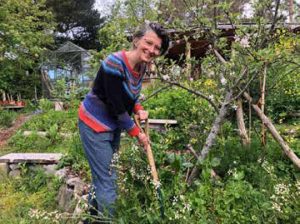 Given her affinity for repurposing land, it was not surprising that Ariane began to consider the possibility of transforming a parcel of degenerate woodland near the Barrel Houses into a garden capable of producing food for both humans and wildlife: an Edible Woodland Garden. Such a garden would be an ambitious venture, in effect a microcosm of the macrocosm of the Findhorn Ecovillage, that would mirror the Community’s aspirations to live sustainably and spiritually in harmony with nature. Utilising the principles of permaculture, the garden would demonstrate perennial horticulture as well as offering a sanctuary for peace and meditation.
She shared her idea with Jonathan Caddy, the then Chair of the Hinterland Trust which stewards the land to the north of The Park Ecovillage. He proposed the garden’s current site at the south-west corner of Wilkes Wood where the sandy land was unproductive apart from scrubby bushes and lodgepole pines. There, a number of precarious storm-blown lodgepole pines needed to be felled and Jonathan suggested that the trees could be incorporated into the proposed garden.
Ariane consulted nearby residents for their views on her proposal, and after important constraints had been considered, such as an income stream for the project and viable sources of materials, she set about mapping the land and developing drawings of the proposed woodland garden. Unsurprisingly, her drawings depicted curving terraces and pathways that reflected her previous labyrinth designs.
In 2013 work began in earnest with a team of enthusiastic volunteers. The land was cleared of precarious fallen pines whose sturdy trunks were sawn down to edge the terracing that would capture rainwater runoff and fix nutrients. The site was dug over and the terraces backfilled with compost gifted by Park Garden then subsequently planted with fruit bearing shrubs, trees, and all manner of perennial edible plants including ground cover and green manures to build organic matter.
Numerous volunteer work parties created the garden, from laying out the terraces to planting the fruit trees. It was a learning experience for high school students too, who, among other tasks, helped to plant the shelter belt hedging the perimeter of the garden. The terraces were filled with compost, mulched, then covered with cardboard salvaged from the Phoenix shop and AES Solar, and a layer of straw. The paths between the terraces were covered with wood chips.
Next the ‘understorey’ of the garden was planted with a shrub layer: fruit bushes including elderberry, raspberry, logan berry, currants – black, red and rose – and a variety of succulent gooseberries. In the first year the ground was planted with nutrient giving plants including phacelia which were later mulched into the ground to provide organic matter. The top canopy layer included a nearby, well established lime tree (whose delicious spring salad leaves were appreciated by volunteers), a whitebeam, and an alder sent to Ariane as a gift from Tombreck Farm, a permaculture project on the shores of Loch Tay.
Writing this account, assisted by Ariane’s extensive archive of the project, it is simple enough to list in a few words the genesis of the woodland garden. The reality however was hours of work by a committed group and various visiting volunteers over a number of years, and plenty of coffee, tea and biscuits. Supervising the work was only one of Ariane’s unpaid tasks; she also became the fixer of numerous challenges, and the organiser of visiting school and education groups.
By 2015, the terraces were ready for the ‘middle storey’: fruit trees including apple, pear, cherry and plum. The pond was installed to encourage wildlife, such as frogs and toads, dragonflies and damsel flies. Ariane worked with a member of the Biomatrix Water team to install a water recycling system that would deliver additional water to the otherwise rather dry site. This involved harnessing grey water from the nearby Soillse laundry’s washing machines, as well as rainwater from the building’s roof.
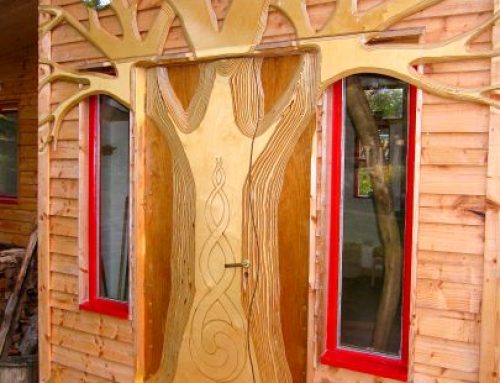
It had become clear that a garden shelter would benefit individuals and groups working and learning and meandering in the garden. Around the same time that Ariane was developing ideas and raising funds for such a structure, Jonathan Caddy met Henry Fosbrooke who was known for his skill in building round timber framed structures. They invited him to construct the frame for what became known as the Outdoor Learning Centre. Together Ariane and Henry selected trees from the surrounding woodland which the Woodcutters Collective felled for the construction of the new shelter.
This project offered many learning opportunities and proved to be popular with people keen to learn new skills. For example, Henry set up a pop-up shelter in the nearby Wilkies Wood where he taught volunteers how to strip the bark off pine trees, turn some of them into planks, chisel mortise and tenon joints, and fashion oak pins that would hold various structures together.
When the Outdoor Learning Centre was completed, it was immediately put to use. It became a special gathering place for groups which had direct involvement with the garden, as well as for individuals experiencing Ariane’s intention for the garden also to be a sanctuary.
During this period, the garden had revealed an abundance of spring blossoms, and in summer and autumn a glorious harvest of apples, pears, plums, raspberries, redcurrants and gooseberries. The pond came to life with amphibians, as well as warblers, tits, blackbirds and thrushes, sipping at its margins.
In 2019 Ariane was selected as a Scottish Green party candidate in the 2021 Scottish Parliamentary elections. She was living in Forres at the time and having to focus on making a living and building the election campaign but she continued to champion the Edible Woodland Garden by working through the process of design implementation and external evaluation which she had initiated in 2013. In April 2020 the Edible Woodland Garden of the Findhorn Hinterland Trust was recognised as a learning and demonstration centre within the UK Permaculture Association LAND Project.
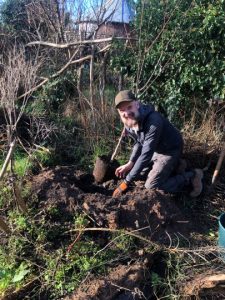 The Edible Woodland Garden now suffered from the absence of its hands-on focaliser, but a new phase began when Draeyk van der Horn set up home in The Park in 2021. From the moment Draeyk stepped into the garden, he was seduced by its potential.
Draeyk threw himself into focalising the taxing work of the restoration and renewal of the garden with the help of the Hinterland Trust and Community volunteers. With his knowledge of permaculture and how perennial plants and other systems are affected by the challenges of climate change, the soil, and lack of water on the site, he carried on the educational intentions for the garden.
One day when winter 2025 was receding, I came across Draeyk clearing a terrace of weeds and augmenting the topsoil. I had come to ask him if I might ‘adopt-a-plot’. On this deceptively warm sunny morning, shining globules of toad and frog spawn were visible in a corner of the pond and closer inspection revealed several amphibian eyes holding mine in a frozen moment of interspecies communication. Frost had been forecast for the following days, and whilst we spoke Draeyk unwound the hose to top up the pool and prevent the spawn from freezing. A memorable demonstration of work as love in action, I thought, as he pointed out a selection of terraces that might fit my aspiration to have a plot to care for within the garden.
Stewardship of the garden with little support, apart from the monthly Findhorn Hinterland Group work party and the occasional volunteer, was becoming too demanding of his time and expertise, Draeyk told me. And unsupervised well-meaning volunteers could be more of a hindrance than a help. One day a shamefaced volunteer dug up treasured young foxglove plants, mistaking them for the undesirable weed, alkanet. Another time, after he had protected the fruit of a gooseberry bush from devouring birds by covering it with twigs, he discovered they had been removed by an otherwise valued helper who failed to comprehend his intention.
Nevertheless, volunteers will always be essential to the maintenance of the garden. In consultation with the Findhorn Hinterland Trust, in 2025 Draeyk instigated the Adopt-a-Plot scheme in which Community volunteers are offered a designated terraced area to grow perennials and benefit from his expertise. Several plots were adopted in that first year, and some are still available.
Whilst we chatted, Draeyk explained that now he has become a Green Party local councillor as well as managing an art gallery in Forres, the time he has to work in the garden is limited. The garden needs more help, and one solution, he says, would be for him to mentor someone, or possibly a committed group, to take on a focalising role under his supervision.
Given Draeyk’s extensive knowledge, his offer constitutes an exciting opportunity to learn about permaculture and how perennial plants and other systems operate. Anyone who takes up the offer would not only demonstrate work as love in action for the benefit of the wider community but also play a significant role in the preservation of this productive garden, educational hub, and beloved sanctuary.

I am a published Author and live in Edinburgh these days with my partner, the artist Geoff MacEwan


Leave A Comment