


Synopsis
On 23rd Aug 2026, this workshop brought together 11 participants whose collective experience of the Community Centre spanned almost fifty years, from the early days in 1974 through to its destruction in 2021 — with every intervening decade represented in the room.
The Introduction Round alone surfaced a remarkable range of memory: first arrivals straight off the train into a “warm, cosy and inviting” space; years spent as Park Kitchen buyers and cooks; weddings celebrated there; a boyfriend once turned away at the door for not being on a programme; and, not least, an encounter at the 2014 New Story Summit that changed the course of one participant’s life entirely — including the legend of the accidentally salted 300-person cake, quietly never mentioned again.
In the Open Space two conversations took place: The CC Through the Years, and The Gritty Bits.
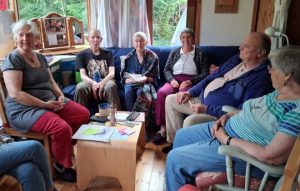 The CC Through the Years conversations traced the building’s physical and cultural evolution — from its 1969 origins and various extensions, through the ritual of dressed-up Friday night dinners with their bar and playful send-ups of Peter Caddy, to a strongly-held sense of the Community’s identity as a welcoming place, tempered by some instances of ‘them-and-us’ experiences. The conversation carried through to the present day, ending with the unresolved question — whether today’s Ecovillage Findhorn has fragmented into semi-isolated “wedges” of people, and whether that is a problem to solve or simply how the Community now works. This led to the practical, unanswered question of who would actually own a rebuilt Community Centre — a question Marilyn traced back to her own attempt to survey what people wanted after the 2021 fires, an effort stalled from the start by overlapping claims of ownership over the CC’s many functions. The group reflected that since the fire, catering and socialising had become dispersed across half a dozen other venues making the case even more complex as the sustainability of those venues is taken into account.
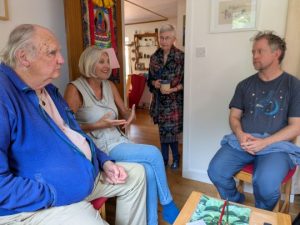 The Gritty Bits (or warts-and-all) conversations addressed the more challenging issues: the decades-long, still-tender pattern of who was and wasn’t allowed to eat in the CC; the Community’s uneasy, often invisible relationship with money; the everyday friction of an, at times, boundaryless culture; and, at the centre of it all, the 2021 fire — recounted through genuinely different, equally valid first-hand experiences, and through an unresolved, wide spectrum of feeling toward the person responsible. No single account emerged, and none was expected to; what did emerge was a shared recognition that this unspoken material may itself have been slowing the Community’s ability to plan a new CC, along with a concrete, cautiously-held proposal to treat 2027 as a bounded “year of healing”.
The Closing Round drew both threads together. There was clear agreement that restorative work needs real time and cannot be rushed to make way for rebuilding — but equally, that healing need not stop forward motion. A hopeful, practical note entered too: the possibility of the Moray Art Centre serving as “more than a Community Centre and more than an art centre”. Participants differed on whether splitting into two parallel conversations helped or cost them, but the smaller-group format itself was seen as a useful, generative preparation for the CHI’26 Storyfest — the natural next step for this work.
***
In Detail
Please click on the arrow on the left to expand the sections.
Introduction Round
This round made clear that there was a broad representation of years – experiences of the Community Centre (CC) from 1974 to 2023 – with each decade represented in the group. The sharings offered vivid accounts of the many different facets of the CC.
- “I first visited the Park during an Experience Week at Cluny in 2023 and noticed the absence of a Community Centre. When I was in the Park, I was wandering around. Where do I go? There’s nowhere to go. It was only this week that I finally saw pictures of the CC and realised that it must have been like my experience of eating in the Dining Room in Cluny. I am glad that I now have that connection.”
- “I remember being taken straight off the train directly to the Community Centre upon arrival in 1974. My very first impression of the community was that the space felt warm, cosy, and inviting.”
- “I arrived in 2003 and spent a lot of time in the Community Centre. As I was living in Forres, it felt like a home base. Now that it is gone, I feel like a refugee at the Park. I am actively looking for a new place to nest, I therefore strongly support the creation of a new Community Centre.”
- “I have been part of the Community since 1987. Right at the beginning I picked up some ambivalence around the CC, as I heard from some folk, who called themselves ‘independent members’ that they felt aggrieved as they were no longer able to eat in the CC. Entering the Findhorn Foundation, I was fully ‘inside’ but still felt the sadness that some felt ‘left out’. That eased to some degree over the years and I have many wonderful memories of special events, including celebrating our wedding in 1995.”
- “I have several distinct experiences with the CC: I first arrived in 2017 and ate in the CC as part of the “eldest daughter effect” workshop group. When I moved to the Community in 2018 I became the “pudding queen for brunch” within my first year and enjoyed that very much. I used to eat Sunday brunch on the singles table, and when that wasn’t possible due to Lockdown, we created Zrunch (meeting on Zoom whilst eating brunch) which now is Phrunch in the Phoenix Café. Between 2018 and Lockdown, I also used the workshop space of the Upper CC to deliver my first Integral City Training here.”
- “I first came in 1975 and had frequent visits until 1977. Thereafter I returned every two to five years. Each return brought a unique experience at the CC with mostly positive memories, reflecting the changes in Community friendliness and activities over time.”
- “I arrived in 1974, and my very first job was working in the Park kitchen. Having never cooked for more than 10 or 15 people in my life, I was plunged into this extraordinary experience.”
- “I was also plunged into interesting experiences in the kitchen after arriving in 2012. I first came for Eco Experience Week and my arrival at the CC was a bit ‘traumatic’ as my boyfriend who wasn’t on a programme wasn’t allowed to eat in the CC. Two years later I was a Foundation co-worker, and spent about two years working in Park Kitchen, I am not sure why I was put there, probably because I am Italian. I have fond memories, especially Sunday Taizé in the Upper CC and brunch afterwards, and of course Friday night dinners that always felt like a party.”
- “I am an occasional visitor, I came first for the New Story Summit in 2014. During that event I had a transformative one-and-a-half-minute interaction that led me to manage a property in the U.S. for seven or eight years. It completely changed the course of my life.” At the end of the round we were treated to the ‘CC magic’ story mentioned – click here to read the story.
- “I have to chip in with a legendary story of a giant cake baked for over 300 people at the end of the New Story Summit: the cook accidentally mixed up sugar and salt, making the massive cake entirely salty. Because everyone was so happy, nobody said anything, and there was an implicit agreement to not mention it.”
- “I first came to the community in 2005 for a workshop, having my first experience of the CC during lunch one day. I came to live in the ecovillage in 2017 and experienced the CC for just a few years before it got destroyed.”
The Open Space
Several options were on offer:
- The CC Through the Years
- Daily activities in the CC
- Events in the CC
- The Gritty Bits (or warts-and-all)
In the end it was two spaces that attracted participants to share in depth.
The CC Through the Years
The original CC building dates back to 1969. Click here to read about the building in the words of the founders.
When Roger arrived in November 1974, a first extension was already present. The second extension happened in 1987, designed by Jochen Burger Jr., featuring a circular layout and telephone poles as primary supports that cost £10 each.
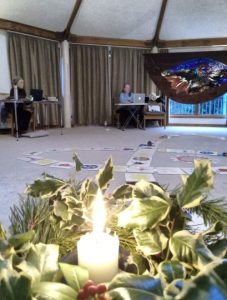 The upstairs of the round building was initially a half-floor, but was later filled in to create a wonderful space with great acoustics, perfect for small meetings and singing times (such as Taize Singing). The balcony allowed people to watch goings-on in the CC garden, survey the Ecovillage from higher up or observe skyscapes and weather changes.
Participants recalled that in the early days everyone was encouraged to dress up for Friday night dinners. There would be volunteer waiters who dressed up, and would playfully ask diners whether they wanted small or medium portions. Friday night dinners included a bar where people could buy wine or beer by the bottle, mingle freely between tables, and welcome international workshop guests.
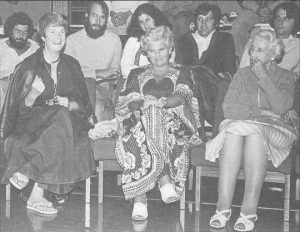 Also mentioned were the Friday night sharings from the 1970s which started as fun nights where people gathered, but evolved into events of remarkable vibration and quality. Almost every joke or skit affectionately targeted Peter Caddy, who loved the send-ups as a demonstration of esprit de corps.
People would share their personal stories and why they came to Findhorn during these gatherings, which acted as an emotional glue for the Community.
A recurring and strongly-held theme was the Community’s identity as a welcoming place. Multiple participants affirmed that new visitors consistently report feeling welcomed, and several felt this quality was central to the Community’s character and worth actively protecting.
One participant shared their first encounter as they walked into the CC: a member came up to them and said “Welcome, I’m so glad you’re here — we’ve been waiting for you.” This moment left a lasting impression, so much so that the participant now uses the same phrase when leading tours.
For many, the CC was “heaven” — a place of radical openness where visitors and residents could sit anywhere, engage in juicy conversations across tables without pretension, and never feel lonely. Conversely, other members who arrived later (such as in 2018) experienced the space as cliquish, noting that certain “old-timers” had set tables, making newcomers feel unwelcome to move around freely. One participant recalls losing her temper with friends who brought their own food and always sat with the exact same people, reminding them it was a community center, not a private club. Several participants shared personal stories both amusing and dramatic.
Present day
The conversation moved to the present day. A central question raised during the conversation was: “Who is the Community?” Several participants observed that Community life currently feels segmented into distinct, semi-isolated subgroups — described in the conversation as “little wedges of people” — which may rarely interact with one another. This raised a further question the group sat with rather than resolve: if this fragmentation is how the Community is naturally evolving, is that actually a problem — or simply a natural pattern to accept?
The discussion arose about the desire for a new Community Centre and the question “Who would actually own the Community Centre?” was addressed. After the 2021 fires, Marilyn was asked to survey what people wanted from a rebuilt Sanctuary and CC. The Sanctuary was straightforward and got built. The CC survey never happened — and still hasn’t — because too many different groups felt some sense of ownership over it (kitchen use, meals, teas, weddings, birthdays, workshops, even a short-lived bar) even though the Findhorn Foundation technically owned it. Nobody could agree what a survey should even ask.
The bigger open questions raised were: what’s actually needed more — a rebuilt CC or housing/accommodation for volunteers and young people? and, what is the vision for a CC now, given the Community itself is more spread out and wealthier than it was?
The Gritty Bits (or warts-and-all)
This conversation invited some of the challenging, perhaps unresolved, experiences and memories about the ‘old Community Centre’ (CC). The group acknowledged that some of these difficult threads may be quietly sabotaging the Community’s ability to imagine and thereafter build something new. As there were ‘bumblebees and butterflies’ participants the conversation kept circling around similar issues. This report endeavours to collate the main themes, drawing out the areas of agreement, the areas of live disagreement, and the practical suggestions that emerged for how the Community might carry this work forward.
1. Who is In and Who is Out
A recurring and clearly still-tender thread concerned who was, and was not, allowed to eat in the Community Centre at different points in its history. The CC was built when everything was ‘one’ but by the early 1980s different relationships with the Findhorn Foundation made it more complex and there was a dichotomy between the name and the organisational facts.
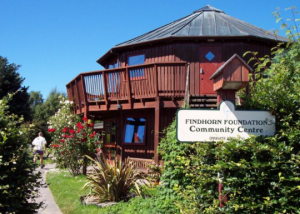 This was made explicit by a sign at the entrance from the Runway in the 2000s:
Findhorn Foundation
Community Centre
Private Facility
Multiple participants recalled being turned away or challenged, some as visitors, others as ‘independent members’. They recounted being told outright, at various points throughout the 1980s and beyond, that they could not eat there because they were not members/co-workers of the Foundation. The notion “There are some people who are not allowed to eat in the CC” persisted, demonstrated by the sharings of several experiences which took place decades apart. The group agreed that these experiences reinforced an underlying ‘them and us’ pattern that is real, long-standing, and not unique but perhaps felt more acutely in the context of the spiritual community, where it ‘should be different’.
Over time the issue was addressed to some degree and members of the NFA could enjoy meals in the CC through a volunteer-voucher system, or by booking and paying for individual meals.
2. Money Issues
Both people who worked in the Park Kitchen, as well as others with the privilege to pay for meals, acknowledged that the prices charged historically didn’t cover the real cost of the food, labour and kitchen infrastructure. They felt that this reflected the attitude around money in the ‘Ashram Economy’ where real costs were often not visible, and subsidies were taken for granted. The group recognised that this had a significant impact on the kitchen’s ability to buy organic or varied ingredients and created a shortfall which led to tensions and a sense of lack of sustainability and fairness.
Two stories, four decades apart illustrated this. A Park Kitchen member holding the role as buyer in 1974, recalled never once seeing an invoice or a price list, buying bulk nuts and big buckets of honey on faith that ‘only the best is good enough for God’. This was contrasted with the near-collapse of the Foundation in the late 1970s/early 1980s, when half the membership left, and the Community lived on kale through a hard winter. Another remembered that in the 2010s the Park Kitchen team was labouring with the incongruence between the values of local and organic food and with the reality of what they could afford to buy.
3. Niggles in the daily experience
Several participants described the Community Centre as a place where the Community’s culture of boundarylessness played out in daily life. Meals were remembered as sometimes being ‘hijacked’, being interrupted by work related questions or other unwelcome ‘urgent’ business.
The noise levels could make it difficult for some families, particularly those with young or neurodiverse children, to eat there at all.
This was framed not as a criticism of community life itself — the same openness was recognised as exactly what made the Community Centre special — but as a genuine cost that fell unevenly on some people more than others. A practical fix was tried and, participants agreed, worked; a quiet area was introduced, and the CC Extension eventually became a recognised quiet space for meals.
4. The 2021 Fire: More Than One True Story
-

- Community Centre (CC)
-

- Stairs to the Upper CC
As expected, the big issue was the fire that destroyed the Community Centre and Sanctuary in the early hours of 12 April 2021.
This was the topic which the conversation looped back to several times. Even after more than five years, there was a strong emotional content in the accounts of the discovery of the fire and the evacuation of the people sleeping in the nearby bungalows.
Two markedly different first-hand experiences were shared side by side. One person described the shock and grief of arriving at the smouldering ruins that morning. Another described arriving to a spontaneous, unplanned circle of singing at the site — a moment they experienced as beautiful rather than traumatic, shaped in part by an early, practical recognition (given the known asbestos in the old building) that the fire, while shocking, was not without a silver lining for the site’s future. Both experiences were held as equally valid readings of the same event.
The identity and motive of the person raising the fire — a long-serving Foundation co-worker recently made redundant, who had been in charge of both the Community Centre and the Sanctuary — generated the most sustained and unresolved discussion of the session. Responses in the room spanned a wide spectrum. One participant described writing to him in prison offering forgiveness and an open invitation, and described a warm reconciliation on meeting him later on in the street. Another stated plainly that they have not forgiven him and do not expect to until he acknowledges what he did directly; someone else described an encounter outside a supermarket with the person who started the fire where they realised that they carried the fear that harm could happen again. Participants agreed this spread of feeling — rather than a single settled Community view — is itself part of what remains unresolved, and that voicing it in a held space, as happened here, has real value on its own.
The financial aftermath was also raised as a ‘gritty bit’ in its own right: the insurance payout, at roughly £900,000, was described by one participant as having effectively kept the Findhorn Foundation solvent — a story of blessing that they felt had been overshadowed by a persistent, more resentful narrative that the Foundation had not invested the money in a new building.

CC fire aftermath 20210412 photo Lorenz Gramann
A seven-minute film documenting the night, made by Lorenz Gramann, a filmmaker who was one of the 12 who had to be evacuated, was mentioned. He shares that it was offered repeatedly as a restorative tool with skilled facilitation. This was declined by leadership on the grounds that it risked re-traumatising the community. Participants saw this as evidence that there was still ‘unfinished business’.
The conversation turned to a recurring Community pattern which was dubbed ‘holy war’, periodic, highly charged collective conflicts that leave the social fabric measurably torn. One participant, with forty years’ experience of the community, described this as close to a structural feature. They said, the Community is always in some kind of crisis, and while it is not always skilful in handling the nuance of individual conflicts, it has nonetheless proved consistently able to come through transformation and keep growing.
The ensuing discussion took stock of the Community’s current capacity to hold these kinds of processes. A proposal emerged: to treat 2027 — marking six years since the fire — as an intentional ‘year of healing’, giving the Community a bounded but not falsely final container for this work, potentially building towards some form of collective honouring around April 2027. One participant cautioned that this kind of healing more realistically takes a decade, and the group agreed both things can be true: naming a year helps those who need to feel movement, while accepting the deeper work will continue well beyond it. It was noted that this is not a new idea — the collective autobiography project itself started six weeks after the fire in 2021 as an attempt to find a way to tell these harder stories.
A further suggestion, offered as an alternative or complement to an ‘organised’ process design, was that the Community build its own shared facilitation muscle over time — for instance by routinely naming, at the end of any meeting, what was learned about facilitating well — rather than relying on individuals’ separate professional training or one-off external methods that later go unused.
In Conclusion
No single, agreed account of the fire, or of the Community’s history around ‘them and us’ emerged from this conversation — and participants did not express that expectation. What did emerge was a shared sense that the Community’s planning for a new Community Centre has been genuinely hampered by leaving this material unspoken, and a cautious, still-forming consensus that a facilitated, time-bounded process — potentially anchored around 2027 — offers a way to hold both the people who are ready to move forward and those who are not yet ready, without asking either group to pretend the other doesn’t exist.
Closing Round
This was the final go-round after the workshop’s two parallel sessions — the “gritty bits” restorative-focus conversation and the CC Through the Years group. Participants spoke in turn about their overall takeaways.
Shared threads:
Acknowledged need to do restorative work properly with agreement that genuine healing — particularly around the fire — needs real time (several said “a year or so,” not a quick fix) via something like restorative circles, and that this needs to happen before or alongside the discussions to rebuild. Affirming that this was not either/or, indeed that it is important that the restorative work doesn’t block forward motion.
A recurring, hopeful note around the Moray Art Centre as a possible community hub — some enthusiasm about its potential ‘more than a community centre and more than an art centre’.
There were differing views about the two parallel conversations wanting more time to go deeper into one or the other rather than dividing attention finding the split itself valuable — personal/emotional material in one room, infrastructure/ownership/community-structure material in the other — seeing both as necessary halves of the same conversation. One voiced they’d found it hard to sit with the more negative, gritty material, and didn’t find it constructive
The “who owns the CC” discussion was framed as a natural precursor to the upcoming CHI’26 Storyfest. The experience of this workshop with a smaller group size was seen as a good preview of what the planned CHI’26 Storyfest could look like.
The question “what would Peter Caddy do?” was offered to encourage trusting attunement and momentum rather than over-planning.
The following stories were generated in and around the workshop:
The Community Centre Beginnings by Eileen and Peter Caddy and Dorothy Maclean
Forty Words in the CC by Donnie Maclurcan
The Phrunch Story by Marilyn Hamilton
Findhorn Reflections – Community Meals (2015) by Graham Meltzer
Click here for Upcoming COIF Events.

Inspired by CommUnity, a group of NFA volunteers, manages this website. Hearing each others stories, and learning about the history of this community can help us all to find more cohesion and a sense of belonging. Read more.<


Leave A Comment