

This article was previously published in Network News 26 Spring 2001.
***
A year or so ago, the Findhorn Foundation sponsored a conference on angels. Originally, I was scheduled to speak at that event, but at the last moment, the unexpected arrival of two kidney stones sent me to a hospital instead. So whatever remarks I might have made were left unsaid and unheard, even by me. Now Michael Hawkins has kindly invited me to revisit that lost moment and discover whatever thoughts I might have had on the topic of angels in the 21st century.
The title is misleading. For those who don’t believe in angels, the answer to the question it poses would be “No!” while for those who do believe in angels, the answer would probably be “Of course! Angels are timeless, so it doesn’t matter to them what century it is!” Perhaps the question should be, “How should we imagine angels in the 21st century?”
There are different ways of answering this question. I could, for instance, explore with you thoughts about a class of newly appearing inner beings who seem adapted to and engaged with technology; angels of machinery or of electromagnetism, for example. It is not at all far-fetched to me to assume that as we create increasingly more complex fields of energy and information there will be forms of consciousness and intelligence that can use those fields for their manifestation and incarnation. I believe I have even run into some of these “techno-angels” in recent years in my inner work.
But there is a deeper issue even than this regarding our relationship to angels and to other non-physical beings, for that matter. And this is the issue of how we gather these beings into our expectations and imaginations, how we think of them, and therefore by extension, how we think of ourselves. Let me tell a story. My eldest son, John-Michael, works as a volunteer in the raptor centre of the Seattle zoo. Raptors, of course, are birds of prey like eagles, hawks, owls, and vultures, who kill with their talons as well as their beaks. His job ranges from mucking out the birds’ living quarters to taking one of the raptors on his arm and walking through the zoo giving little educational talks about the bird to the visitors. As a young man who would not have minded being a bird himself, he loves it.
One of the birds at the raptor centre is a turkey vulture named Modok. Like many of the birds there, Modok was raised by humans and then given to the zoo when its original owners could no longer care for it or got tired of it. Some of these birds can be rehabilitated to return to the wild, but this is not the case with Modok. He is too imprinted with human contact ever to survive on his own.
At some time in his youth, Modok learned to untie shoelaces and pick pockets. Once he was inadvertently released by zoo keepers who mistook him for another turkey vulture that had been rehabilitated. A day later the zoo received a frantic phone call from a mother who said this large bird had flown down in front of her young son and begun to untie his shoes. Needless to say, Modok was quickly returned to the zoo. One can understand the mother’s consternation. Raptors are predators, after all, and their beaks and talons are dangerous. Seeing a two-foot tall turkey vulture with a six-foot wing span descending towards my child would send me into a state of alarm, too. Knowing that this bird was only interested in my child’s shoes, not her flesh, would not be wholly reassuring either, what with the price of kids’ footwear these days.
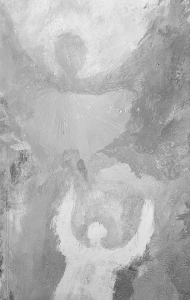
from original artwork by Barbara Thomas
The humour of this story lies in the incongruity of a bird of prey performing so domestic and trivial a task. Yet, as an image it is suggestive of a certain modern imagination of angels as well. Now I’ve never heard of an angel who liked to swoop down and untie shoelaces, though that would surely be a sight to give one pause. However, one does not have to read a great deal of new age literature on angels to realise that our imagination of these beings has something in common with Modok. No longer the fiery, awe-inspiring, and sometimes fearful beings of ancient religious traditions, they begin to seem something akin to a combination of a private spiritual concierge, personal trainer, emergency rescuer, guardian, and self-help guide, there to ensure our lives run smoothly and that we feel loved and cared for. We begin to imagine angels as PAAs, Personal Angelic Assistants, not unlike the PDAs or Personal Digital Assistants we run on our computers.
There is something unnatural about the image of a wild turkey vulture spending its time untying shoelaces. Something is missing in this picture. Something is lacking. Likewise, there is something lacking in imagining angels domesticated to provide for our human needs and concerns. Not that angels do not assist us or care for our wellbeing, but is that the best way in which to think of them? Might we not be taming in our expectations what should not and cannot be tamed?
To reduce an angel to the compass of an imagination shaped by our everyday needs, vulnerabilities and desires is like making a raptor a pet. Neither one naturally inhabits human worlds of thought and feeling. Neither is designed for domestication. We may want angels to be our friends and helpers, much like good neighbours and loving parents. What they want and what they are may be something different.
There is something undeniably attractive about wild animals, and the thought of having an eagle or a hawk, a lion or a tiger, a wolf or a bear as a friend appeals to me a great deal. Who wouldn’t want such a powerful ally? And there is also an ego charge thinking of such a being acting as a companion, accepting me as its friend. But as our indigenous ancestors knew, alliance with such a being demands something from me as well. We must meet at a boundary between their world and mine, and each of us must sacrifice something of our natural state to accommodate the other. We do not become pets for each other. I must honour their wildness, their otherness, their nonhumanness. They do not come to me to untie my shoelaces.
This is how I think of angels. My experience of them is of powerful beings who are only partly connected to the human world (I do not think of deceased humans or non-physical masters as angels). They and their world are very different, and to understand them, as much as a human can understand them, we must go in imagination beyond the boundaries of our perspectives. One gets a lovely sense of this in Stephen Mitchell’s book Meetings with an Archangel.
Perhaps the first step, then, is to consider angels as wild creatures, just as we might consider an eagle or a lion. Like a raptor, an angel is dangerous. Not that angelic talons will rip into my flesh or soul, but they are a presence of otherness that can disrupt my normal human perceptions. They are a presence of light so penetrating as to make the Sahara seem an oasis of shade; they are a presence of joy as painful as the sharp, cold air in our lungs on a winter’s day on the slopes of Everest. They are an embodiment of freedom that comes from a total absence of deception, a presence of truth as bearable as a vivisector’s knife. They are a manifestation of passion and play that can turn our everyday pleasures into ashes. And they are a grace that cloaks themselves lest we become lost in the wilderness of their love. And at the same time, they view us as beautiful and worthy beyond all measure, which may in the end be the hardest of all to bear, so little do we know about who we are and our own true measure.
When we picture them in wildness and strangeness, walking like sleek panthers through the midst of our concerns, then we can ask ourselves, “In the presence of such beings, what do I want to offer? What part of myself shall I bring to this encounter? Can I find a strength to match their own, a pride of humanness, a grace of personhood, an honouring of self and life to stand with them in companionship? Can I respect them not to ask them to do for me what I can do for myself, but to ask instead what we can do for each other and for the world? Oh, they may be more than willing to tie or untie my shoelaces, but is that the relationship I want with them when I can bend down and do it myself?”
The challenge is to imagine these beings as partners, not as helpers. Of course, partners help each other. But when I think of an angel ally, am I really thinking of a co-creative alliance or am I looking for an assistant? An assistant becomes part of my world, while an ally remains sovereign and centred in his own, requiring me to change and adapt to meet him halfway.
In this context, how we imagine angels, that is the forms and appearances we give to them, is less important than how we imagine ourselves in a relationship with angels. Why do we want this contact anyway? What are our motives? What do we want from the angels that we cannot do or get for ourselves? Is it companionship? A sense of being with someone powerful? A feeling of protection? But these can be compensations for unexamined feelings of powerlessness and unworthiness. Having an angel ally doesn’t prove anything. It does not make us any more spiritual than we were before. Such a contact is not a status symbol the way some Texas millionaires keep tigers as pets.
Over the years, I have had my share of encounters with what I understand to be angelic beings. I doubt that I could ever write about these encounters since I’m not sure I could find the words to properly describe them. If I failed, I would only simplify and humanise them. But one thing I have learned is that angels come to us not simply or even primarily to help but to form co-creative partnerships, and they do so not out of need but out of the joy that such alliances and co-creativity can bring, because they are embodied creativity themselves and they see ourselves in the same way. They come to us precisely because we are creative and different and thus can offer something which they do not. When we respond out of our needs, seeing them as helpers and protectors, they will do what they can, but we are limiting the possibilities of the relationship. We are in effect asking them to untie our shoelaces when they are offering us a chance to fly with them.
So perhaps one step in dealing with angels in the 21st century is not to imagine them as human or as present to meet human needs, even though they can and do help us in many ways. In this sense, the ancient ways of seeing angels may be more accurate than the images conveyed in new age angel books. What is really changing is not the angels but our sense of ourselves. We can imagine ourselves rich with the possibility of meeting them as partners and co-creators. At Findhorn, partnership with angels is one of the founding principles, particularly embodied in the work of Dorothy Maclean. As one of Dorothy’s initial angelic contacts said to her at the beginning of their work together, “You must come to us in power.” This was the angels’ gift, not the information they could give about horticulture or their help with energies in the garden, but their perspective of human possibility and their calling forth of our own creative power to match and engage their own.
In the 21st century, I imagine angels will by and large be what they have always been, but it is we who will be different. To see ourselves as angels see us, as fellow creative beings and potential partners, is a liberating gift and a challenge to our own self-images. From the depth of their own wildness, they are inviting us to experience our wildness, too, the power of our spirit that is greater than any single image we may hold of ourselves. Then we can fly together and keep our shoelaces tied as well.
***
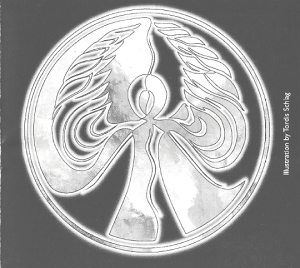
Angel illustration by Tordis Schlag incorporating the original drawing by Barbara Thomas
An Exercise to Help You Come to Angels in Your Power
In seeking contact with an angelic force, it is best if you have the following attitudes within yourself:
-
A sense of your own personal spiritual power and integrity, as well as an awareness that all your needs are being met by virtue of who and what you are (this is so you do not go into the process in a needy way);
-
A sense of what an angel is or means to you, the nature of your imagination of an angel (which is important as a starting point for contact and as clarification of your own expectations and preconceptions; it may also give the angel a point of imaginal contact with your consciousness);
-
A sense of what you can and will bring as a creative contribution to the contact and any alliance that may form out of it;
-
A willingness to release expectations about the contact so that it may take whatever form best suits both you and the angel.
In effect, you want to go out of the house of your imagination to a place where the angel can approach you from the wild, so to speak, and engage with you out of the deep integrity and character of its unique nature as well as in honour of your own. You want the angel to have a chance to be itself, and not have to fit your preconceptions, images, needs, or desires. And it wants you to be free to perceive and accept new conceptions about yourself.
Exercise
In whatever way you do so, become comfortable and enter an inner space of openness and expectation.
Remember a particular incident in your life which filled you with a sense of accomplishment, a recognition of your own goodness and power as a person, a feeling of pride and trust in yourself. Let yourself sink into the sensation and upliftment of that moment. Feel the energy of that incident fill you.
Using that energy, remember other similar moments. Flood yourself with an awareness of your successes and accomplishments as an ordinary person, the little things you do and have done that reflect well upon you, that show kindness to others, that bring you happiness, that manifest your indwelling spirit. Feel pride and love for yourself. Bask in your integrity. Honour your goodness.
When you feel sufficiently marinated in your virtues so that you can meet any other spiritual being with a sense of your own worth, integrity, power, and spiritual presence, let your mind and heart focus on the nature of angelic presence. Allow an image to arise that represents an angel to you. Let the specificity of this image, its concreteness and form, anchor the sense of “angelness” into the moment for you.
Now step into that image and go as deeply into and beyond it as you can. Ask yourself why you have chosen this image, not as a topic to be analysed in any rational way, but as a question for which you would like insight and as a way of releasing this image as you realise there is something more and deeper beyond it. Allow any sense of angelic presence and being beyond the scope of this image arise within you.
Prepare to enter a space that is hospitable and welcoming both to you and an angelic presence. What gifts, contributions, or power of spirit do you naturally bring to this space? What can you do to create it and hold it? What kind of ally can you be or will you be to an angelic presence?
As you sense this, go into this space without expectation, open to what might emerge, but holding clear your invocation of angelic presence and the invocation of your own spiritual presence and strength. Be in this expectant, emergent space for as long as feels comfortable.
Be aware of any sensations, images, feelings, thoughts, words, and the like that may arise for you. Allow any interested angelic presence to enfold and connect with you to share this space with you in whatever way it wishes, however ambiguous or nebulous this may seem to your human awareness. At the least, seeds are being planted and insights will blossom later.
When you feel done or restless, give thanks, offer your blessings to this space and whoever shared it with you, and allow yourself to sink for a moment into calm, into peacefulness, into grace. Then open your eyes and centre yourself in your everyday world. Record anything you experienced in any way you wish. If you have had a definite sense of contact, do not try immediately to define or name it except in ways that arise naturally and without effort in your mind. Allow it to remain plastic and somewhat unformed, but cherish the presence and energy. Then use it as a guiding vibration the next time you do this exercise. Over time a clear sense of angelic presence or alliance may then build for you, defining for you in a unique way the nature of your own angelic contact.

I have been a teacher of subtle realities for sixty years. I am married with four children, all of whom live in the Pacific Northwest. I have a granddaughter and a grandson.




Leave A Comment