

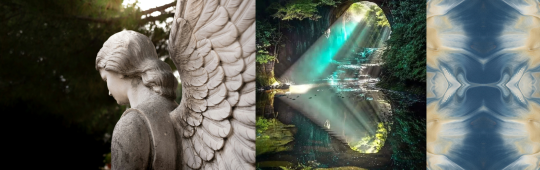
The COIF team asked if I would like to contribute something to the new Topic of “The Angel of Findhorn*).” At first, I thought that I had little new to offer beyond what I wrote in 2024 about the Findhorn Angel as a “planetary angel.” I don’t have a day-to-day engagement with the Angel as I might if I were living in the community, and my news of the Community at Findhorn mainly comes these days through the monthly newsletter.
However, as I sat here writing, I got a nudge that there was something I could share and would I please do so. Upon reflection, I realised it had to do with the different ways the Angel could manifest. At the least, I think of these as three “faces” of the Angel, or three levels of engagement—and there could well be more.
First, it’s important to emphasise that an angel—and in particular, a being like the Findhorn Angel—is unlike any organism we might find here in the physical realm. This seems obvious, but it’s still a tendency in the human imagination to visualise non-physical beings as if they were three-dimensional entities like we are. That is, we see angels as persons, and they are thus represented in much of our popular art and religious iconography. Look at the angels on the Angel Cards, for example, and you can see that they are portrayed as cute robed people with wings.
Most angels in my experience have the capacity to take any shape that facilitates their work, especially in contact with human beings. It stands to reason that they may appear humanoid to us as that form is what we’re familiar with and is one to which we can relate. But the body of an angel manifests through more than three dimensions (including more than one dimension of time) in a way that is challenging for a human mind, raised in and with three dimensions of space and one of time, to grasp and comprehend. These are complex organisms of will, intelligence, energy, and most of all, love.
I write this in the hope that you, dear reader, will not seize upon a particular image that I offer and say, “This is the Angel of Findhorn!” Let your imagination remain fluid and your heart open to what may seem like “shaped shapelessness” or “indeterminate determination.” In other words, open to paradox!
When I attune to the Angel of Findhorn, I am aware that I could engage with one of three possible modes of consciousness (or with some combination of these three, including all three at once). I think of these three as Personal, Place, and Planetary. Depending on which of these I engage, the “shape” of the Angel can be different.

laura-espana-zCd8LGK92Hw-unsplash
PERSONAL: Each person who is part of the overall energy field and purpose—the collective life—of Findhorn has a personal relationship with the Angel of Findhorn. Here, the Angel is most likely to appear as a human being, male or female, though I would emphasise again that appearance is dictated by the nature of the relationship, expectations, and what facilitates the connection. If I’m more comfortable relating to a cloud of Light, than the Angel may appear as such rather than as a person.
The point is that at this level of consciousness, will, focus, and engagement, the Angel is sensitive to and concerned with the nature of the relationship the individual has as a unique person to the energy field of Findhorn. You could say this is the Findhorn Angel personalised for and configuring itself to each person who aligns with and becomes part of its life and mission. In this role, it can function as something akin to (though not exactly the same as) a person’s Guardian Angel, and it can be a conduit for blessing, learning, and nurturing in a person’s life.
One does not have to live in the Community to have a personal relationship with the Findhorn Angel. However, having daily interaction with the life and energy of the Community helps give this relationship substance.
To a person experiencing the Angel of Findhorn in this way, the presence of the Angel can feel concrete and immediate. The sense of being in touch with another being can be strong as the shape the Angel takes can be definite and well-defined by the parameters and nature of the relationship. This specificity is as much a function of the specific nature of the individual as of the angel itself.

jessica-anderson-w1OvSwkgtIE-unsplash
PLACE: Findhorn is a particular place within a larger ecosystem. It is defined geographically by various elements in the environment, such as the Moray Firth, Findhorn Bay, the sand dunes, the local hills, the presence of various human villages and towns, and so forth. Findhorn is not the same as Inverness, or Elgin, or London, or Rome. It has its own unique ecological identity.
In this mode, the Angel of Findhorn is similar to the being Dorothy Maclean called the Landscape Angel or the local Deva overlighting the area. Their functions can overlap in mutually supportive ways and can at times, to a human’s eye, be interchangeable and indistinguishable. The Findhorn Angel definitely cooperates with the local Devas, nature spirits, elementals, and so forth. It may even appear as if it were a Deva.
However, the main concern of the Findhorn Angel at this level is the development of Findhorn as a place. When Eileen Caddy had a vision of Findhorn growing from a caravan park to a community, then to a village, a town, and later a “city of Light,” it’s this development that is held and fostered by the Angel of Findhorn in its Place function. (Note that I’m not saying that the Findhorn Ecovillage should become a “town” or a “city of Light,” only that it is the relationship of the human beings and their activities and enterprises—such as building—with the local ecology of nature that is the concern of the Angel of Findhorn.)
Physical places are always conduits of non-physical energy—the qi of Gaia, the planet—and some places carry more of this earth energy than others. Hence the idea of ley lines and power points in the earth. The Place of Findhorn lies near certain powerful power points and is at a convergence of various lines of subtle energy (some pre-existing the caravan park and some created deliberately by Findhorn’s Founders). As such, as a Place, it is a generative node of spiritual energy, and it is this that falls under the supervision or overlighting of the Angel of Findhorn.
Put another way, there are subtle energies that are only or mainly accessible at the physical location of Findhorn–though from the Angel’s point of view, that physical location is larger than just the caravan park, Pineridge, or the dunes. I do not know just where the boundaries are, as the Findhorn Angel draws on the energy of a variety of places in the general Elgin-Forres-Findhorn vicinity. This is an area where exploration and experimentation on the part of those living at Findhorn could be useful.
Note that a person can be outside the boundary of the Findhorn Angel as Place but still be within the field or reach of the Findhorn Angel as Personal and Planetary.

susan-wilkinson-e_JRmzNucWw-unsplash
PLANET: This is the aspect of the Findhorn Angel with which I am most familiar and which I engage frequently. I wrote about this in 2024, a document that is available here in the COIF archives. This aspect of the Angel deals with the relationship of humanity to the larger planetary ecology of the subtle dimensions and the spiritual lifeforms that inhabit that ecology in service to Gaia. It also joins with other Angels and Devas and human beings in helping humanity through this time of transition as the Earth goes through various changes. Here one is more likely to experience the Angel as a Field of Light rather than as a person, but again, I want to stress that this is up to the individual. I enjoy working with Fields of Light with which I can blend, but someone else may find it easier to relate to what appears as another person.
These three modes—Personal, Place, and Planet—are aspects of one multi-dimensional being, one bringing love into action on various levels of activity and outreach and one that seeks human partnership and collaboration. Whatever level one feels there is a connection with the Findhorn Angel, whether personally, locally, or planetarily, it is a contribution to the whole. There is no special merit to attuning to the Planet aspect over the Personal or Place aspects. What is important is the quality of relationship one feels with the Angel at whatever level or combination of levels one feels called.
What is important is to realise and appreciate that the Angel is not simply an idea or a metaphor or a fantasy. It is an objective, very real, complex organism and consciousness whose modes of being can bedevil a human mind that wants it to be one thing and one thing only. Behind all the apparent complexity, though, there is love. It is through love that we make the fullest connection.
***
*) Editor’s note: The term ‘Findhorn’ used in this post relates not only to the locality but also to the community which grew in and around the Findhorn Foundation, and the concept it represents to many. This is not to be confused with the village of Findhorn.

I have been a teacher of subtle realities for sixty years. I am married with four children, all of whom live in the Pacific Northwest. I have a granddaughter and a grandson.



Leave A Comment