


Click to view e-book
In the summer of 1993 David Spangler and Craig Gibsone came together to present a Christ and Buddha Nature workshop after years of thinking it would be a good idea to explore these two roots together. Craig’s background includes a long-standing interest in Buddhism and David’s background includes an interest in esoteric Christianity. Departing from the established routine of other workshops where a small group gathers together for a week and focuses mainly on themselves and their subject, this workshop gathered each evening in the Universal Hall to open itself to the Findhorn Community as a whole. This paper is the transcript of one of those evenings.
First published as David Spangler; Christ and Buddha Nature; One Earth Magazine, Winter 1993, Issue No 12. Reprinted with permission. Further edited by David Spangler for this chapter in The Kingdom Within.
* * * * *
I’d like us to think for a moment of what it is that precedes our image of Buddha and the Christ. And while you’re thinking of that, I want to harken back for a moment to the beginning of the Findhorn Community. In many ways this Community has incorporated into its teaching and into its life an image of the Christ—the Christ energy, Christ consciousness, or the Cosmic Christ—and some of that incorporation evolved out of the work I did here some 20 plus years ago. But before the Community was talking about Christ consciousness, its initial impulse was one of attunement to the sacred or to God, going directly to the source without intermediaries. The Community was built on Eileen and her hearing of the ‘still small voice’, upon Dorothy and her hearing of the ‘still small voice’ and then Peter’s willingness to execute the guidance and information that came out of the respective attunements of these two women.
Even though the Community became famous because of its garden, and because of the idea of co-operation with nature which was the image that went out into the world and attracted people who came here to see this marvellous garden and to explore further the dimension of co-operation and interaction with invisible kingdoms, the real message of the Findhorn Community—what Peter and Eileen and Dorothy themselves thought of as the basic message—was attunement to the sacred and obedience to what came out of that attunement. This is a very mystical approach.
All of the great religious traditions, in one way or another, invite us into a relationship with the ultimate, a relationship with the ground of being that is the answer to our most pressing existential questions: “Why am I here?” “Why is there life?” “Where are we going?” Different peoples in different times have experienced a connection with a source that has offered them what they have felt were the answers. Some people looked at the ultimate through one lens and some looked at it through another and out of those respective visions grew traditions, just as here in this Community traditions grow and spring up and thrive.
Going back to my original question about what it is that comes before the Christ or the Buddha, we come to this condition of of attunement and relationship to the sacred or what many Native American have called the ‘Holy Mysterious’. I think this is an important place to start because there is already an immense amount of material — discussions, probings, insights, questions—that has emerged out of the Buddhist/Christian dialogue. What I want to do is to use the images of Christ and Buddha to enliven within us a sense of what is our most basic relationship to the sacred, because that is the defining, formative impulse for this Community.
In doing this, it is important that we also realise that we are taking a journey into imagination and that Christ and Buddha, to some extent, exist for us as images in our imagination.
Over the past 30 years, for most of the Community’s existence, the image of the Christ has played an important role in the spirituality of the Community. It is an image, however, drawn mainly from the mystical side of Christianity and, as well, from that inner tradition that could be called esoteric Christianity. What distinguishes a mystical or esoteric image of the Christ from an exoteric one is that the Christ is seen not simply as a being outside of us and separate from us but as a presence that is at the heart of our souls’ existence. It is a state of being that we can share and in which we can participate.
The interesting thing about this image of the Christ is that it has much in common with the Buddhist concept of the Buddha nature. I can bring the spirit and life of Christ to birth in me, just as in Buddhism I can unfold the Buddha nature and become Buddha. In fact, I already am Buddha—we are all Buddha—it’s just that we don’t realise it, and that’s the problem. But the moment we awaken to that fact and realise it, then we just are what we have always been anyway, and the illusion of separation and of self falls away.
In a similar way, in esoteric Christianity we all are the Christ; we are that principle of Logos, that presence of love, and our task is to awaken to that reality. Different schools or traditions have different processes for how that awakening takes place, exactly as in Buddhism there are different schools and traditions that give different techniques and processes for how the awakening into Buddhahood or enlightenment takes place. What I am particularly interested in is the way these figures live in us as powerful spiritual images and help to take us to our own experience of the sacred.
Looking at Christ and Buddha imaginally, the task is to go into those figures and through them and out the other side. There is a well known statement in Zen Buddhism that if you meet the Buddha on the road you must kill him, because in Zen the object is to go direct to truth and truth is beyond form. So if Buddha appears it is just another form and it’s just another illusion that you want to cut through. It would, however, be very unusual to find a similar statement in the Christian tradition—“If you meet Jesus on the road, kill him!”—because in Christianity the form of things is often considered important, and Jesus is the most important form of all, being the incarnation of the sacred into a form. But our task is to use the form, the image, to go more deeply into the spirit that may lie behind it.
If we want to encounter the essence of Christ and Buddha, which may not be identical and may be two very different qualities, we come to that essence not by looking to those individual figures, but by going through them to that which existed before they did, and then coming back and asking the question: What is it about soul life, about human life, about planetary life that made it necessary for such figures to be evoked in the collective imagination—both as real figures, historical figures, and as images that have grown and been elaborated upon through history?
The figure of Jesus is not set; when I say ‘Jesus’ not everyone agrees about exactly who I’m talking about. In the two thousand years of Christian history the image of Jesus has changed dramatically, almost once per century, and the image we have of Jesus now is not identical to the one that was held in the first century after his death and resurrection. It is not the same as was held five hundred years ago. There is a process of imaginal development or change as each period of history and each culture reinterprets this individual and the spirit he represents. But why do we reinterpret? What is it about these figures that we can’t allow them to be set in concrete? Instead, they have a dynamic life, a transforming life of their own that acts almost mirror-like to the changes and evolutions of our culture. This is because our own soul life is changing in relationship to the sacred. Just as we grow to understand the nature of physical reality more deeply and clearly, so we grow to understand the mystery of the sacred more deeply. And as we do, those images that mediate that mystery to us change as well.
In a sense, the Findhorn Community reflects the current historical collective process in which a new image of the sacred is seeking to emerge. It is for that reason that I want to bring our attention back to the founding impulse of this centre, which was attunement to the sacred: attunement to the ‘still small voice’ of God, however one defines and experiences that.
This Community was founded on a process of attunement to the sacred within. This specifically manifested here through the guidance that Eileen Caddy received for Peter and the Community. However, one day Eileen was instructed no longer to get guidance for the Community because increasingly the act of getting guidance was being confused with the principle of attunement to the inner divinity or ground of being. Her specific way of getting guidance and her way of perceiving God was beginning to crystallise as ‘the way’ to do it in the Community, which was not what the Findhorn Community was about. It was not for all of us to learn to stay up late at night and receive guidance; this was Eileen’s way. However, what Eileen was in touch with, the mystery of the sacred within us, was what we were all asked to be in touch with.
For the Findhorn Community to become a Christian centre, or even an esoteric Christian centre, or a Buddhist centre, or an Islamic centre, or a Human Potential centre or anything quite so specific, I think, is to miss the nature of the mirror that this place is called to hold up. In a way we are where St. Paul was when he went to the Greek world and said, “I bring you teachings of your unknown God.” Of course for Paul, Jesus Christ was the face of the unknown God. But there is a part of God that is always unknown. That is an esoteric teaching. So every age confronts its own unknown God and then forces arise to bring a new knowing out of that mystery. But it will never be a final knowing. The moment a new aspect of the sacred emerges, a new unknown God emerges too! But, it is important that in moments such as these, when human culture undergoes such a deep shift as it is attempting to do now, that our ability to name ourselves and to name the sacred makes a commensurate shift.
That shift is that we, each in our own way and collectively in our own way, can hear the ‘still small voice’. That to me is the Findhorn Community’s task, and it mirrors the task that Peter and Dorothy and Eileen had when they arrived. But what is this still small voice? What is the sacred as it seeks to live in our time? Is it the Christ? Is it the Buddha Nature? Let us look further at these images.
Christ
The word Christ comes from the Greek word Christos which is a version of the Hebraic Messiah. It means ‘the anointed one’. There is a significant difference between imaging someone who is anointed and imaging someone who is awakened (the Buddha is the awakened one). We all know what awakening is like because we do it every morning, more or less. At some point in our lives we have all had an experience of awakening from something but we may not feel we have ever had an experience of being anointed. Anointing is an act in which something is transferred, bestowed and confirmed upon someone else and it can be thought of as an act of giving. In the New Testament, in the Gospel of John, it says that God so loved the world that he gave his only begotten son. He didn’t loan, sell or barter—he gave him as a gift.
In that notion of giving we have a vision of a way of interaction that runs as a theme throughout the New Testament and describes the Kingdom of God. One of the qualities of this state of being is that it is not transactional: it doesn’t have a debit sheet, it doesn’t keep accounts—I give and I do not give with the expectation of return. So in this idea of the Christ as the anointed one, or the gift, is a sense of liberation and freedom from reckoning and keeping tabs, a freedom from all the kinds of internal accounting. In a sense it is a liberating openness to new possibility.
Giving and being a gift has a transformative and uplifting effect and this is one traditional way to describe what we experience as the Christ. It is the message of Jesus throughout the New Testament: Watch what I’m doing and do likewise, be a giver too.
There is another side to the image of the Messiah that is more problematic because the image of the Christ enters into our history through a particular cultural heritage that is looking for a warrior hero—a priest king that would come and be a saviour to a specific people. The image of the Messiah in that context is that of a leader, someone who stands at the pinnacle of government and at the pinnacle of the people.
Certainly over the past two thousand years the image of the Christ as mediated by various church institutions has often been presented to us as a kind of kingly lord who one day will rule the world and who is the summit of human aspiration. In Revelations, John says, “When he comes again he will come in a cloud garbed in power and majesty,” which is an interesting image when contrasted to Jesus’s own words when he said, “I come as a thief in the night,” secretly and quietly. This image of Christ as a symbol of power makes it more challenging for us to receive the Christ and find our own anointing in the ordinary surrounds of our daily life because most of us do not live wrapped in clouds of majesty and glory.
In those quiet, intimate and ordinary moments of our lives when nothing particularly spectacular is going on we may not recognise that the Christ can be there and this is because we are trained to look for something very much like an earthly king, a kind of esoteric master or a God-realised individual that stands out from the ordinary. I feel we place a tremendous burden on ourselves by thinking we are not worthy or kingly or queenly enough to experience the Christ. While we are watching a sunset or listening to a piece of music or having a good meal or working in the garden, if for some reason we have the immanence of the Christ break in upon our consciousness and we feel a sense of oceanic love and oneness and delight and pleasure and ecstasy, then it is easy to come up with all kinds of excuses about why we shouldn’t be feeling it. It is easy to deny it or on the other hand to think that since we are feeling this, therefore we must be a great realised master or a king or a queen. Instead, we could be feeling that this is an experience of the most ordinary and natural state for a human being.
There will always be moments when we touch the Christ in an extraordinary way and we are taken beyond ourselves, but most of the time we can find the Christ in the very non-Messianic moments of our lives when we are with other people, eating, drinking, cleaning our houses and doing all the hundred and one things with a good heart, good intelligence and with skill of body.
There is a famous document of Christian mysticism called Practising the Presence in which a monk would experience his union with the Christ in doing very simple things—baking bread, washing dishes, cleaning the floor and so on. In new age circles this sometimes gets misinterpreted in the assumption that it is the act itself that is the practising of the presence—my practice is baking bread, my practice is sweeping the floor, and so forth. These can be good things to do in a skilful way, but what makes something a practice is not just the ordinary doing of it, it is the sense that in this moment we are giving ourselves, in love, to the universe through this action. I’m not in any way struggling with it—if I am washing this dish, I wash it with the sense that I am caressing the consciousness of a multitude of beings and asking that my touch may be a gifting touch, bringing love and a sense that I am touching my beloved.
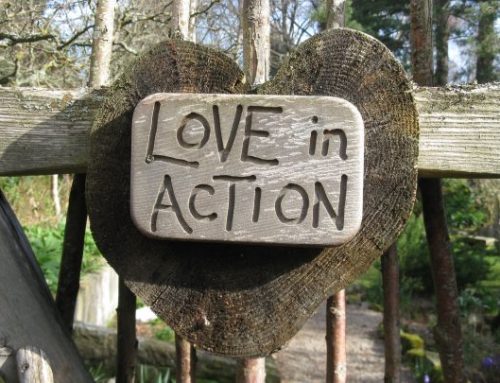
In this sense, we annoint the moment with our love and with our attunement to the sacred. We make that moment a messiah, a liberator, a revelator in our lives. We redeem that moment from being trivialized and contained and open it out to be a sacrament of communion with our Beloved. This is very much part of Findhorn’s spiritual teaching: work is love in action; love whom you’re with, where you are, what you do. Then the still small voice comes alive in that moment, and its message is the love that spreads out from your mindfulness and attunement.
Buddha
Although this Community uses the language of Christianity to talk about itself and its mission, it is in some ways a Buddhist centre and this can be illustrated through the image of community.
When this was a small gathering of people it was very easy for us to experience community here; everyone worked with everybody else, we knew everyone’s first name, we were together through the day and we had sanctuary all together. As the Community grew, jobs became more specialised and people worked further afield, and being together with everyone else became more difficult. Then the quality that makes community had to arise from something more than just physical proximity and daily encounter.
Some years ago, a friend of mine, David White, gave a talk on Celtic history and Christianity. He said that the best way to think of the Celts is that they were a ‘community of the imagination’. I have been using a similar image for a number of years and have talked about the ‘community of consciousness’, a phrase that originated here. Community is not something that is created when people come together and live together, rather it is something that is pre-existent and we can awaken to it. There is never a time when we are not in community, but there are many times when we don’t feel ourselves to be in community, and our practice is to awaken to that experience of communion.
When I meet you, though I don’t know your name, though we do not work together, though you may have just newly arrived and I have been here for many years or vice versa, I can immediately see and experience you as part of my communion. Community is for me something like the Buddha nature—always present, always infusing what we come out of and what we are immersed in, but I need to awaken to it.
One of my friends was a Tibetan Buddhist monk and is now a professor of Tibetan Buddhist studies at Columbia University, and he gave a talk once in which he discussed a set of practices for enlightenment that had seven steps, six steps of meditation leading to a seventh step of realisation. The first step was to meditate on the realisation that all beings are our mothers—in the countless millennia of time in which we have lived countless millions of lives, every being has probably been our mother. And we honour our mothers and we recognise that our mothers nurture us and give us life and birth. The second step is just to remember the kindnesses that have been paid to us by our mothers. The third step is to meditate on the desire to repay all that kindness—every molecule, every star, every world, every being anywhere in the vast extensions of the cosmos is looked upon with a remembrance of tenderness of the gift of love they have given to us and we want to repay that. The fourth step flows out from that; it is to meditate on that feeling of great love that is invoked by that remembrance. The fifth step is to meditate upon the compassion that that love ignites. And the sixth step flows out of that compassion, love and remembrance and it is pledging ourselves in service.
All those meditations together lead to the seventh step which is the will to achieve enlightenment because the way in which we may give service, express compassion, give love and repay tenderness to all beings, is to become enlightened—not for ourselves, but on behalf of all sentient beings. That is the meaning of the Buddhist Bodhisattva vows.
Bodhisattvas exist in a wide continuum from baby Bodhisattvas who have only been Bodhisattvas for a couple of hours to cosmic Bodhisattvas who have been Bodhisattvas for three uncountable aeons of time and are right now trembling on the brink of Buddhahood.
The wonderful thing about this image is that you never know, just by looking, who is a Bodhisattva. But we do know that all of us at some point need to become Bodhisattvas because the deepest task of life is to serve other life in becoming enlightened and liberated—in being at one with all other things. But how do I awaken to that oneness? The world is full of practices, but we can use community as a mirror in which, by encountering each other, the other, we can awaken to that deeper communion. This is the practice of community.
The practice of Buddhism enjoins me to go out into the world and see all other beings wherever I may be as part of my being, as part of Buddha nature, sharing that great community of existence. However feebly I can attempt it, my task is to act for the well-being of all these others in my great community. Maybe in the beginning my actions can only be feeble, tentative or half-hearted; I’m so filled with myself that I can’t do more than make a half-hearted gesture towards someone else’s well-being. In the Bodhisattva tradition it takes a long haul to become a Buddha and that is a way of saying that we should be prepared to be gentle with ourselves but also make consistent effort.
Here in this Community the intent is to inspire a practice where I would not think of myself as a ‘Findhornian’, but instead think of myself as a member of a community of consciousness, and my community is the world. In community I can learn to be a baby Bodhisattva. If all the structure of the Findhorn Community fell away and all the buildings disappeared, you could still look at each other and say, “I know you – we’re in community together.” We can hear the still small voice of communion that links us as one.
In this awakening to the “enlightenment” of community and the anointing of each moment with our awareness and our love that redeems that moment from triviality and makes it sing with presence, we use the images of Buddha and of Christ to find the deeper strata of living the sacred in the midst of the ordinary. That is what Findhorn is about to me, to live the ordinary as if it were sacred, and the sacred as if it were ordinary. In this lies for me an emerging image of the sacred for our time, one that weaves Christ and Buddha in a new dance but that remembers the Holy Mystery that is at the dance’s centre.

I have been a teacher of subtle realities for sixty years. I am married with four children, all of whom live in the Pacific Northwest. I have a granddaughter and a grandson.



Leave A Comment