

This article was published in Anthropology of Consciousness, 2025; 0:e70019 1 of 10
by Kelsey D. Grubbs
Department of Social Anthropology, School of Social and Political Science, University of Edinburgh, Edinburgh, UK
Correspondence: Kelsey D. Grubbs (k.d.grubbs@sms.ed.ac.uk)
Received: 1 November 2024 | Revised: 28 July 2025 | Accepted: 2 October 2025
Keywords: capitalism | ecovillage | hauntology | Scotland | specters
ABSTRACT
The Ecovillage Findhorn Community (EFC) in Northeast Scotland seeks to live in harmony with nature. How the community has done this over its 60-plus years has changed from social communalism, where residents lived in cheap caravans, to now mostly privately-owned expensive ‘eco’ houses with green technology. Embedded in this historical-present transition is a troubled tension of both resisting and perpetuating capitalism—the malevolent specter fueling genocide and ecocide. However, there is an ‘eco’ paradox of “cruel optimism” here, whereby paying for expensive ‘eco’ housing and green technology infrastructure to mitigate capitalism’s specters inherently fuels capitalism, which created the need for ‘sustainable’ solutions in the first place.
This paper attends to how EFC residents, human and other-than- human, grapple with capitalism’s spectral entanglement with affective infrastructures.
“Everyone gets poorer living here”, Margot exhaled. Twenty-four other Ecovillage Findhorn Community (EFC) residents sat around the table nodding in agreement. We were in the upstairs area of the Phoenix Café in EFC. These ‘Sunday Conversations’ were weekly round-table informal discussions for community residents, and today the topic was money and home ownership. “This is because we have a cultural problem of giving too much freely”, Sundar added, nodding to how people in EFC became increasingly poor because residents had been conditioned to live in poverty through volunteering for the Findhorn Foundation (FF)—the community’s former educational, administrative, and financial arm—in exchange for communal housing in a dingy caravan, a weekly stipend, and food from the garden. Since the community’s founding in 1962, the goal wasn’t to earn money, but rather to ‘live in harmony with nature’1 through egalitarian living and varying spiritual practices. The community became famous for telepathically communicating with nature spirits, and with their help grow ‘big veg’ in the garden (Findhorn Community 1976; Maclean 1981; Crombie 2018). Yet what I witnessed in my 13 months of ethnographic residency during 2023–2024 was that EFC transitioned from being a communal ‘spiritual community’ supported by FF to being a private estate ‘ecovillage’ of about 300 residents where 70% of housing is privately owned, fitted with expensive green technologies, and limited communal food growing. And for people like Sundar, this past ethos of giving too much freely needed to change because it was unsustainable in a community that was no longer held by a communal-focused FF and was increasingly infiltrated by capitalism. As illustrated below, ecohouses and green infrastructure have good intentions of seeking to live sustainably and in harmony with nature to mitigate capitalism’s crises of ecocide, yet financially and socially marginalized some humans and other-than- humans to perpetuate capitalism’s crises of poverty and alienation. For many humans and other-than- humans, this infrastructure haunted by capitalism was very painful and frustrating.
Marx proposed that specters of communism haunt Europe and instill fear in the ruling elite (Marx et al. 2012). Jacques Derrida followed from this to argue that post-Cold War, communism was, contrary to popular belief, alive and needed more than ever (Derrida 2006). I transpose this framework to look at how capitalism haunts EFC’s founding ethos of egalitarian communalism through affective infrastructure. Hauntology in anthropology has looked at affective structures (Chiovenda 2019; Good Byron et al. 2008) primarily in “post-trauma societies” (Fischer 1999, 455) and “the haunting remains of empire, colonial violence, and proxy wars” (Good et al. 2022, 442). While EFC does not at first appear to fit this description of post-trauma society, EFC is embedded in a historical-present trauma of globalized capitalism. Very few places (if any) on Earth are untouched in some way by capitalism (Wainwright 2024; Tsing 2015, 3). Capitalism gives the perception that “Nature is external and may be coded, quantified, and rationalized to serve economic growth, social development, or some other higher good” (Moore 2015, 2). Through this “rational” separation and alienation from nature and amongst humans, capitalism propels competition and hierarchy (Baker 2013, 287). A minority leadership makes decisions for a majority to follow which “generates conflict and provokes antagonism” and acts of resistance (287). This then leads to capitalism’s own undoing and eventual collapse. However, this paper isn’t necessarily about denouncing capitalism in favor of communism, which can be just as corrupt and inefficient as capitalism (Chang 2009, 104). In most countries today, there is a mixture of capitalism and private ownership with state intervention–ownership (116).
Capitalism, when de-essentialised, manifests uniquely across spatiotemporalities and political imaginaries (Knox 2020, 369). It has multiple meanings and lives in spatiotemporal and political contexts, “roaming in the space of possibilities” (Das 2021, 104). Capitalism is a heterogeneous chimera taking many forms (Baumol et al. 2007) with emergent “multiple histories” (Roitman 2005, 3). Capitalism as conceptual specters is, as Derrida argued, malevolent, haunting “Things”, “animated by a spirit” and possessing a sensorial body (Derrida 2006, 4, 6, 189). As such, capitalism is a nonlinear historical and affective process clothed as a socioeconomic system (Moore 2015, 6). With a world-ecology approach, “‘The economy’ and ‘the environment’ are not independent of each other. Capitalism is not an economic system; it is not a social system; it is a way of organizing nature… humans make environments and environments make humans – and human organization” (Moore 2015, 2–3, emphasis in original).
In EFC, humans have organized and made their environment into an ecovillage. What it means to be an ecovillage varies, but generally they aim to maximize quality of life, happiness, and wellbeing (Hall 2015, 30) through “a strong ecocentric spirituality of interconnectedness” (LeVasseur et al. 2013, 253–254) and egalitarian compassion (33–34). Acquiring needs locally and communally was “a way to leave the ‘rat race’” and reject it (Hall 2015, 33–34; Grinde 2009). Ecovillages emerged in the Global North from the 1970s ‘green movement’ based on socialist-hippie principles to oppose neoliberal capitalism’s role in social division, climate change, and biodiversity loss (Jonathan Dawson 2006, 9–10; Jonathan Dawson 2013, 217–222). Today, about 6000 ecovillages worldwide are part of the Global Ecovillage Network (GEN), of which EFC is a founding member. GEN defines an ecovillage as an “intentional, traditional or urban community that is consciously designed through locally owned participatory processes in all four dimensions of sustainability (social, culture, ecology and economy) to regenerate social and natural environments” (East 2018; Papenfuss and Merritt 2019). These culminate in an Integral Design of “whole systems thinking” and being “aware of privilege and use it for the benefit of all” (GEN 2025).
The process of EFC becoming an ecovillage started in the 1980s when FF staff were inspired by the green movement and ‘planetary villages’.2 They wanted to replace the dilapidated 1950s caravans with ‘green’ energy efficient ecohouses. To put a complicated history simply, this propelled FF to purchase the caravan site (1983) and adjacent agricultural land (1995—now called The Field of Dreams). But FF did not have the funds to replace or build homes themselves. After careful consideration, FF sold land plots to residents who then built and paid for their own homes. In 1997, a handful of residents formed Duneland Ltd. to purchase an adjacent estate of 300-plus acres. About 275 acres were gifted to two nonprofits under the condition that the land would be kept in perpetuity as a nature reserve. The remaining acres were kept aside by Duneland Ltd. for ecohousing development and wind turbines.
Infrastructure is generally thought to be “architecture of circulation” (Larkin 2013) that enables “things to happen” at greater spatiotemporal scales (Boyer 2017, 174). In the social sciences, infrastructure conceptually and empirically shifts (Harvey et al. 2017, 88, 157–158) from taking a Marxist approach to social and material political consequences in urban studies (Durkheim, David Harvey), and co-opting Foucault’s biopolitics as “energopolitics” in sustainable energy (Boyer 2014), to a more Boasian approach elucidating how meaning and affect are constructed in culture-energy- infrastructure entanglements with other-than-humans (Jensen and Morita 2015; Watts 2018; Maguire and Winthereik 2017; Weszkalnys 2013). While slightly different, what these approaches have in common is viewing infrastructures as “dynamic and emergent” relational possibilities (Harvey et al. 2017, 6). In an attempt to combine these disparate infrastructure frameworks, Knox (2020) examined the Iquitos-Nauta road project in Northeast Peru as affective infrastructure. Here, affect such as “surprise” from potholes or “frustration” from roadblocks exposed “the concatenation of forces that ebb and flow and manifest in and between bodies” and “embodied material interaction” (375–376). Materials are not just “substrate on which social life proceeds”, but are assemblages (Latour 2005) or intra-actions (Barad 2007) in “embodied, affective relationship[s]” (366). They reveal “the unstable or uneven quality of politics”, and agentive stories that demand “a response from the powers that be” (369). This enables “material diagnostics: a kind of questioning, interrogating, tracing, supposing, linking, storytelling, and demonstrating, which is formed in… infrastructural affect” (369).
Applying this in EFC, residents have expectations of how ‘ecovillage’ should function to reduce carbon footprint and environmental impact while also fostering social equality and financial sustainability. However, when the material relations
do not function as expected (e.g., wind turbines or tarmac roads), the failure “allows us to begin to understand how material relations might be participating in the production of political modes of engagement” and “embodied or affective response[s]” (Knox 2020, 376–377). As illustrated below, re-tarmacking a road and receiving high energy bills caused EFC residents to question how ‘eco’ the ‘ecovillage’ really was, the political processes behind decisions about ‘community ownership’, and the shared ‘pain’ when unable to live up to the ‘ecovillage’ ideal. In EFC, humans both resist and perpetuate capitalism to survive, often with practices that compromise an idealized theory of egalitarian living in harmony with nature. In effect, EFC is symptomatic of “cruel optimism” – “when something you desire is actually an obstacle to your flourishing such as ‘a fantasy of the good life’” (Berlant 2011, 1). On the one hand, ‘ecovillage’ is a fantasy, a striving towards ‘the good life’ as an alternative to and escape from capitalism. This attachment to the ecovillage fantasy creates the “affective structure”, the embodied and material performing of ‘ecovillage’ that (hopefully) inspires a better way for the world to work (2, 16). Yet ‘ecovillage’ is precarious. In attaching to an ecovillage idea with environmentally sustainable ‘ecohouses’ and green infrastructure, EFC residents reproduce that which it seeks to resist—capitalism—through participating in capital ownership and wealth accumulation. This ‘structural contingency’ creates ‘crisis situations in ordinary existence’ whereby low-income
and young people are unable to participate in the ecovillage ‘good life’ fantasy (11). Capitalist logics are mutually exclusive with environmental and social sustainability (Greenleaf 2024, 2). As I illustrate below, when people are unable to live up to the imagined fantasy of ‘the good ecovillage life,’ the onus is placed on individuals with “poverty consciousness” rather than capitalism’s infrastructural violence. The affective infrastructure is the pain, ugliness, and discomfort of EFC humans and other-than-humans.
While there are many other-than-human residents in EFC, this paper centers on nature spirits. Nature spirits are seen and experienced differently across contexts. In EFC, nature spirits are mostly fairies, elves, gnomes, angels, and what co-founder
Dorothy Maclean called plant devas, which appropriated from Hindu Vedic literature means “shining ones” (Maclean 1981). In communicating with nature spirits, some residents likened this to ‘attunement’ or tuning into different radio stations. One
person may tune into the nature spirit Pan on one wavelength, while others converse with tree beings on another. ‘Shona’ was able to ‘tune in’ to many different spirits. I took her workshop on connecting with nature spirits in EFC. We walked around the edges of the Community Center Garden, stopping when nature spirits wanted to interact. A gnome was stuck in the Earth. He told Shona he was traveling around EFC and got trapped in a spot of grief, anger, and fear, or what Shona called mind energy—human fixations on trauma and drama that get caught in the energetic field. Shona explained that nature spirits cannot live in these negative energetic spaces and can even die. They need places in nature that have limited human interference or have regenerated from human ruins. One of these healing places for nature spirits in EFC was called ‘The Magic Triangle’. Although this was a brown site during WWII filled with RAF waste and gravel, it was left fallow for 40 years and regenerated with rare lichens, fungi, trees, and gorse. The Magic Triangle became a place where children had treehouses and fairy friends, and adults performed fire and dance rituals. However, in the early 2000s, after community consultations with an ecologist and other ‘experts’, ecohouses were built creating The Whins. Shona and other sensitive interlocutors said many nature spirits left, became ill, or died because this space had been destroyed.
This paper asks, how does capitalism haunt EFC humans and other-than-humans? How do they grapple with haunted affective infrastructures? And how can EFC highlight ways to take responsibility for specters? I explore these questions with ecohousing, wind turbines and solar panels, tarmac, and nature spirits. Elucidating capitalism’s specters in EFC can perhaps inspire creative and generous justice.
1 Ecohouses
‘Toby’ was the project director for the community’s ecohousing development projects. Although he moved away in 2006, he still owns a house in EFC and visits often. In the late 1970s, Toby said residents “were living in tin boxes in the north of Scotland. It was freezing. It was moldy, unhealthy, ridiculously expensive to heat 10 months of the year, and nowhere near what our aspirations were which was to be in harmony with nature”. For Toby, back then the community was doing well in spiritually living in harmony with nature and having “psychic experiences” with nature spirits, but residents needed to do this on a material-physical level through green building and energy technologies, starting with ecohouses. Using natural and sustainable materials allayed “sick building syndrome” – the use of cheap chemicals and toxins in buildings linked to fatal diseases like cancer. Building ecohouses would be a win-win for healthier environments and humans.
For Toby, the ecovillage movement “trains us to become indigenous peoples again where we are spiritually, physically and mentally connected to the rest of the world and its sentient intelligent presence”. Yet this theory was troubled in practice. Toby explained some residents were “very interested in the concept that land should not be owned by human beings.
Philosophically, absolutely, it’s a stupid idea. For any indigenous culture, the idea that you own the Earth, are you kidding me? Ridiculous”. With this in mind, initially, the community came up with an idea whereby FF would own the land and houses but loan them to the occupants. However, this showed up as debt on FF’s accounting books, which the accountants did not like, especially after FF’s bankruptcy scare in the early 1980s. So, “after five years or more of very intense research, thinking, and attunement,” occupants purchased the land from FF and built their own homes. The EFC neighborhood ‘Field of Dreams’ got the nickname ‘Field of Screams’ because large houses up to two-and-a-half stories high were built next to 20-meter-square dilapidated caravans. While Toby and the Park Planning Group (PPG) initially had planning application approval for 45 houses on 33 plots, thinking people would go in to buy a lot together and build a duplex, “that just never happened. People bought individual lots and built individual houses, with a few exceptions”. There were four lots leftover where Toby and his partner built ‘affordable’ terraced houses (called the Centinis). A one-bedroom was £60 000 and two bedrooms were £75 000. ‘At the time they were affordable, but now they’re more expensive, but so is everything else.’ Cost of living increased across Scotland and the UK in the last 25 years, yet home prices in EFC tend to be more expensive than neighboring villages and even certain areas of Edinburgh (Scottish Housing News 2025). For example, a two-bedroom home in West Whins EFC was recently listed for £420 000 (Zoopla 2025).
Homes can provide a sense of social, material, and ontological security, “allowing one to flourish in life” (Lancione 2023, 5). Yet this is troubled by a global housing crisis with “massive displacement, gentrification, and uneven development” (Lancione 2023, 7). This has been linked to economic gobalization, migration, and climate change (Ley et al. 2020, 25), and a decrease in state housing with an increase in neoliberal policies “designed to create stronger and larger market-based housing finance models” (Rolnik 2013, 1058). While “housing is recognized as a basic human right and is essential for human development” (Ley et al. 2020, 26), commodifying homes shifted their value from a “social good” to “a means to wealth” and “appreciation” (Rolnik 2013, 1059). Homes become socially violent through privileging homeowners with access to capital and fiscal services, and excluding others “into precarious living conditions” (McCarthy 2025, 1). Economic markets are unable “to provide adequate and affordable housing for all” (Rolnik 2013, 1064), which can be seen in EFC.
Private home ownership in a neoliberal real estate market turned EFC into what many interlocutors called “a retirement village for rich people”. The majority of people who could afford to purchase a home in EFC were older with established careers or substantial retirement savings. In the 1960s–1970s, the average age of residents was 20s–30s. In the late 1980s, the average crept up to 40–50s. Now, the average age is 60s–70s. While ecohouses were built with good intentions of environmental sustainability, the effect has created marginalized low-income and young people, troubling GEN’s Integral Design principle of being “aware of privilege and us[ing] it for the benefit of all” (GEN 2025).
While most residents are aware of privilege, how it benefits “all” and who is included in “all” is questionable, particularly when it comes to ‘affordable’ housing. As of May 2024, there were 26 affordable housing units in the Whins of EFC. However, there were several reasons why these houses were unattainable and unaffordable. As ‘Bob’, part of Duneland Ltd., shared with me, they made an arrangement with Moray Council where, in exchange for Duneland not receiving subsidy money from the council, Duneland, not the Council, could decide who got to live in the affordable housing. This was important for Bob, who had been on affordable housing boards in other areas before, and observed “nice affordable housing communities” very quickly turn decrepit. He attributed this to council-assigned affordable housing usually going to those most in need first – “uneducated helpless people with drug problems and mental health issues” who ruined the “nice” communities. Bob was pleased that Duneland could selectively choose “educated community members” instead.
Yet even for many “educated” residents it was unaffordable. For example, ‘Sebastian’, his wife, and two-year- old daughter rented an affordable housing flat in East Whins. He formerly worked in tech services in Germany where he made a “good living”, but after moving to EFC started freelance work in IT and HR services. However, as a living example of Margot’s opening sentence above, Sebastian has become increasingly poorer since moving to EFC. Local businesses did not see the value in his work or could not pay him anywhere near the rate he received in other cities, despite the cost of living in EFC being similar to these cities.
He opened his laptop and showed me an incredibly detailed and color-coded Excel sheet of his finances. On average, he barely broke even each month. His basic living expenses came to an average of £2100/month. In this section, he pointed to his council tax of £180/mo. His unit should have been in council tax band A with a significantly lower rate, but Moray Council put the affordable units in council tax band C based on the £1 million total cost of six units. Sebastian and his neighbors were in the midst of a lengthy process of petitioning the council to put them in band A. And in addition to paying 20% income tax, at the end of the year he also had to pay £680 in self-employment taxes, “which altogether is as much tax as people who earn twice as much as me”. This was not affordable. “If someone works 35-hours a week for £15/hour [just above Scotland’s minimum wage of £12.21/hour], that means they earn £2,100/month before taxes. With £2,100/month of living expenses, that means you’re in the red each month”. Sebastian was seriously contemplating leaving EFC because it was fiscally unsustainable.
Duneland built additional ‘affordable houses’ in the North Whins. Instead of renting these out, Duneland built these to sell. Bob explained, “you get more bang for your affordable housing buck. So, we could have had two houses for rent or six for sale”. Yet the challenge here is that “you had to put money down now to build the house, and you won’t be able to move in for three years. So, that’s a really hard sell, especially for young people”. Jimmy, a young person in his 30s and born and raised in EFC, was one of these young people who wanted to purchase an affordable unit in North Whins. But because he was self-employed with various and inconsistent income streams, banks would not give him a mortgage.
‘Ted’ further highlighted how affordable housing can be inequitable for young people. Ted, an energetic man of retirement age, lives in a two-bedroom affordable flat in EFC. When I asked him what challenges the community faced as an ‘ecovillage’,
Ted immediately said “this house is an ecohouse and uses as many sustainable resources as possible.” But there is an issue
of housing fairness. “My neighbors are a family of four living in the same size space [two-bedrooms] I’m living in on my own.
There’s some guy who bought a five-bedroom house on the Field [of Dreams], and he lives there on his own. Are we actually courageous enough to address the whole issue of what is fair, what is appropriate?”
These examples show that despite trying to live more environmentally sustainably through ecohouses, private ownership embedded in capitalism perpetuates privilege and social inequality. Cruel optimism ensues whereby low-income young people desperately try to live the ‘ecovillage’ good life that increasingly becomes unattainable.
2 Poverty Consciousness
While the above examples illustrate capitalism’s specters infiltrating affordable living and home ownership, some residents
blamed “poverty consciousness” stemming from FF’s programming. As ‘Teresa’ explained, “there’s a lot of nostalgia here. And it was fabulous in those early days. Everything was free, everybody did stuff for free, but that was [then]. We can’t do that now. We have to embrace that”. This affirmed Sundar’s comment above about EFC having “a cultural problem of giving too much freely”. Toby also echoed these sentiments to me. He laughingly (and lovingly) called FF staff “temple slaves” because “people were giving their all but without being recompensed or taken care of. People were exploited and spent decades working for a non-living wage”.
‘Emile’, who was previous FF staff, said FF created an energy field of “there’s not enough” because FF was frequently on the verge of bankruptcy. This then led to normalizing being poor for the communal good, and creating what ‘Daniel’ called “poverty consciousness, the idea that there’s something sacred or holy about being poor”. Daniel, like many young(er) people in EFC, changed homes frequently in the area as rent prices and availability precariously changed. Yet he blamed himself, not capitalism: “I still have an anarchist slightly conspiratorial fundamentalist view there’s something wrong with money, and as a consequence I’m constantly sabotaging the opportunities when they come up that would help me get out of a dire financial state. Had that not been part of my program for so much of my life, maybe I’d be buying one of these houses right now”. Here, the victim blames themselves and is caught up in the cruel optimism of capitalism’s specters.
Toby gave his own personal account of being a ‘temple slave’. While he “never regretted any of it”, after earning £8/week for 10 years with huge responsibilities as the ecovillage project director, he “was exhausted, burnt out, and broke.” Reflecting on GEN’s four quadrants, he felt the community did really well in all of them except being sustainable economically. So, he made the decision “to leave the Foundation but not leave the community” and started his own consultancy business. “I charged a whacking £12 an hour for my engineering expertise which people were outraged by at the beginning. And suddenly in a couple years I was able to have some savings and start building my own house. I hired my friends to help me build it. Paid them really crap wages but they were grateful because that’s what was going at the time”. Getting paid “crap wages” was normalized by FF. For Toby, shifting out of poverty consciousness recognizes “there’s nothing wrong with money. It’s just energy. And it’s really about creativity and not being held back by your own limiting beliefs. Ask the universe to support you”.
Teresa had also been a ‘temple slave’ and shifted out of poverty consciousness: “I want to have enough money to be comfortable, and there’s nothing wrong with having money. It’s how I make the money, which is my business. It’s each to our own conscience. And it’s very much about self-worth. I am worth way more than £5 an hour. But at the same time, I’m not defined how much money I make. The two things are true next to each other”. For Teresa and Toby, having money is tied to a consciousness state—if you view money as a good thing and have enough self-worth to charge more for services, then you will attract and earn more money.
But Toby also recognized that what was once ‘affordable’ is no longer affordable due to inflation, cost of living increases, and
wealthier retired people with financial means moving to EFC and driving up costs. “If you want to live here, it’s not cheap. That’s something we need to wrestle with. We need to build more affordable housing”. They had 50 applicants for the eight affordable housing units in the West Whins of EFC. Yet, as we’ve seen above, affordable housing does not necessarily equate to affordable and equitable living. Furthermore, blaming low-income individuals for not being able to participate in the ecovillage good life fantasy because they have “poverty consciousness” enables capitalism’s specters to hide in the shadows blameless. And in putting the onus on the individual to become fiscally adept abrogates EFC from its GEN obligation to address power relations and inequalities as a community.
3 Wind Turbines
One of GEN’s guidelines for ecovillages is to have “locally owned, participatory processes” (GEN 2025). Previously, FF owned the assets and facilitated community meetings with group consensus. However, as more private houses were built and local businesses formed outside FF’s purview, this principle wavered. For example, EFC advertises their wind turbines as ‘community owned’, yet, as illustrated below, community ownership is a gray area here.
Across Scotland, community-owned wind turbines are becoming an increasingly popular way for communities to empower themselves through providing their own electricity and exporting to the national grid for profits to then reinvest into the community. Yet despite seeing other community-owned wind turbines have lucrative profits (cf. Beinn Ghrideag in the Hebrides or Neilston Community Wind Farm) (Local Energy Scotland 2025), several EFC interlocutors were perplexed as to why their electricity bills from their community-owned wind turbines were as high (sometimes higher) than if they lived in neighboring towns. On EFC’s Facebook group, Jimmy posed the question to the community: “We seem to get super high energy prices for our ‘community-owned’ windfarm? Am I missing something?”
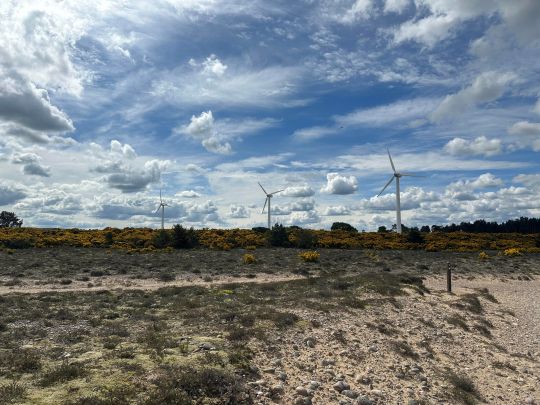
In actuality, the wind turbines are owned and maintained by Findhorn Wind Project (FWP) Ltd. According to its government registration (GOV.UK 2025), FWP Ltd. is a ‘private company’ with ‘persons with significant control’ (ownership of shares and voting rights) by three companies: 1. Baywind Energy Co-Operative Ltd., based in England; 2. Ekopia Resource Exchange Ltd., a ‘co-operative’ organization based in EFC that raises funds “to support local community social enterprises’ and currently ‘manages assets of circa £2.4 million’” (Ekopia Website 2025); 3. New Findhorn Directions Ltd., which FWP lists as “the Findhorn Foundation’s wholly-owned trading subsidiary” (Findhorn Wind Park 2025). While some individual EFC residents are listed under ‘Directors’ and provide input, FWP Ltd. is ultimately owned and operated by three shareholder organizations. Reading through the 25 responses to Jimmy’s post, ‘Resident A’ commented: “there isn’t community oversight or ownership. It is decided by the current board, but they are probably doing their very best to do what’s right for the community, yet keep some financial stability for the company…It’s one of those semi-community owned things we have here. It all depends on the definition”. The definition of “community owned” according to GEN is that it includes “participatory processes”. While there were individuals from the community who acted as ‘directors’, the community as a whole did not participate in decision-making processes, and for many interlocutors, like Jimmy, there was a lack of transparency and confusion in how FWP operated. Furthermore, because ultimately shareholder organizations made the decisions and were fiscally responsible, using the word ‘community’ in FWP’s descriptor of ownership was misleading. Similarly, Watts (2018) also found the word community controversial with “community” wind turbines in Orkney. One of her interlocutors preferred the term “local shareholder owned” wind turbine in recognizing the nebulous inclusivity of “community” infrastructure (172).
I sat down with Bob who, in addition to Duneland Ltd., also worked for FWP Ltd. Bob said FWP was formed in 2006 to manage this “big new project” of three wind turbines able to reach 750-kW total, generating 90%–95% of the community’s electricity needs. However, “only half of it is used on site because when it’s a warm day, people use solar energy [from solar panels on private houses], so we export it.” They currently did not have a sufficient battery storage system, so when the wind wasn’t blowing and the sun wasn’t out, then they had to import energy from the national grid. As Bob iterated, “We’re not quite self-sufficient”.
I shared with Bob that a few interlocutors didn’t understand why their electricity bills were the same and sometimes even higher than neighboring towns, especially when they saw other “community-owned” wind turbines in Scotland making huge profits. Bob explained that FWP and NFD — the community’s trading subsidiary which issues the electricity bills to EFC residents — set the cost of electricity in EFC ‘roughly equivalent to what you would be paying in [neighboring town]’ to be able to pay continual investments and repair costs. In 2006, FWP needed partners to loan the project £600 000 in start-up osts. ‘For the first 10 years, the project was profitable enough to repay the loans. That was good, but we weren’t generating anything extra above that. And then shortly after there were extremely expensive repairs. So, for the next couple of years, we didn’t really generate profitability. But in the three or four years since then we’ve done really well. And we’ve replaced all the cells, which are the square boxes on the top of the towers which turn the actual turbines. That cost £300,000, and we’ve already paid off that loan.’ However, the set cost of electricity didn’t come down after the loans were paid off because NFD was about to upgrade the ecovillage grid system, which will cost between £80 000 and £100 000 over the next 3 years.
Another reason energy bills were high for residents was that FWP chose to import green energy rather than fossil fuel energy from the national grid. Green energy is more expensive than fossil fuel energy, and it’s also difficult to negotiate fair contracts with national energy companies that operate on neoliberal principles. As Bob explained, the price per kilowatt FWP paid for national grid imported electricity was far more expensive than the income revenue FWP received for wind turbine exported energy to the national grid. So, to answer Jimmy’s question about why residents have high electricity bills despite having ‘community owned’ wind turbines, FWP/NFD charge residents market rates for electricity to pay for and maintain costly infrastructure embedded in neoliberal energy markets.
As Bob added, “there are major forces in the world we’re dealing with that are not being very helpful”. While Bob didn’t clarify what he meant by “major forces”, his account points to capitalism. In particular, we see “splintering effects” (Graham and Marvin 2001) whereby energy infrastructures “that were once shaped and held together by elected public authorities deploying funds from taxation are now distributed amongst many different owners and property regimes, deploying funds that derive from diverse charges to users. Civic infrastructural systems are increasingly managed by public authorities in partnership with private capital and shaped by a politics of decentralization that encourages the monetization of component networks in line with neoliberal agendas focusing on the out-sourcing of service provision” (Harvey et al. 2017, 9). This then results in inequal access to infrastructure and fiscal services, and “patchy efforts at regulation, monitoring, and control” (9). In EFC, FWP is part of the splintering effect that decentralizes participatory processes of EFC residents and removes their decision-making and fiscal-making agency.
Wind turbines and solar panels are often marketed as a “win–win–win of green capitalism – profit, environmental protection, and improved human well-being” (Greenleaf 2024, 25), relying on technology to save us before we reach a fast-approaching extinction (Klein 2014; Ashley Dawson 2016). Yet green technology often perpetuates capitalism’s oppression (Lennon 2025, 8). While theoretically solar and wind technologies can empower communities to become independent of and resist capitalism’s networks, what’s often ignored are the exploitative circumstances behind the technology’s resource extraction. Myles Lennon calls attention to this in his book Subjects of the Sun (Lennon 2025): “Solar technology is made from toxic materials mined from the earth; manufactured with the physical labor of precarious people of color; transported transnationally with fossil-fueled ships; installed by exploited, low-wage workers; and could potentially become a significant e-waste problem in marginalized communities throughout the world” (9). As resources are traded and exchange hands across commodity chains, ‘dematerialization’ ensues—a lack of knowledge or awareness of where commodities come from, which are often from “shadow places” and “sacrifice zones” of capitalism fueled by colonialism, racism, and classism (Lerner 2012; Plumwood 2008). In EFC, while residents want to ‘live in harmony with nature’ through implementing green technology to save environments and lives, this form of green capitalism implicates EFC in capitalism’s ecocide and genocide.
4 Tarmac
For Jimmy, EFC does not meet much of GEN’s ‘ecovillage’ criteria, particularly around infrastructure. Jimmy shared an example of EFC recently re-tarmacking the roads. As a brief background, the ecohousing developments were built without individual driveways to encourage households to use public transport, bicycles, and car shares. But the logistical feasibility of owning a car in EFC outweighed lowering their environmental impact. Now, most residents own petrol cars attributed to a number of factors: elderly and disabled people needed accessible transport; resident trade workers (carpenters, plumbers, etc.) needed large vans to haul equipment; public transportation options were poor (the unreliable and expensive bus service
was officially canceled in August 2024); and the community car share business went under in early 2024 because the insurance company raised their rates by 600%. Now, the parking lots are overflowing.
Jimmy said a team of consultants was hired by FF to evaluate how to ‘green the roads’ in EFC. Some ecologically friendly solutions propositioned by the consultants included replacing the tarmacked roads with gravel and putting in raised wooden walkways instead of pavement, so that plants and soil could integrate into a nature causeway and ‘breathe’ (tarmac suffocates the soil). Yet, as Jimmy said, many people in the community have been “saying for ages many of the same solutions, and have been getting ignored about greening the roads.” Despite these consultations, the main thoroughfare road called ‘the runway’ was re-tarmacked in autumn 2023 by “people in charge.” Jimmy shared his frustration, “Some people feel safer with the tarmac and go-kart white lines. But that’s not what we’re here for. We’re not here to be safer. We’re here to be fucking weird.”
Before meeting with Jimmy, I just so happened to have interviewed the ‘person in charge’ of re-tarmacking the runway. ‘Samantha’ is of retirement age and owns/lives in a West Whins house. She initially came to live in EFC in the 1980s for 15 years, but then left to live in a New Zealand ecovillage. Samantha recently came back to EFC and is the Chair of EFC’s Title Holder’s Association (THA), which is responsible for maintaining the commons infrastructure such as roads, sewage, and lights. Because EFC is registered as a ‘private estate’, Moray Council does not pay for or maintain EFC’s infrastructure. Anyone who owns or rents a home in EFC pays a monthly ‘Hoco’ tax to the THA.
She shared incredible stories of ‘cocreating with nature’ when she lived on the West Coast of Scotland and New Zealand such as communicating with birch trees and cows. She took great pride in how she and her late husband built their ecohouse in New Zealand using mud bricks they made themselves, ‘3500 of them, one on top of the other’. They were completely “off the grid, producing our own electricity from solar and wind” and collected rain water. They supplied almost all their own food from chickens, two cows, hunted wild pigs and birds, and had a garden for fruits and vegetables. “Apart from wheat, sugar, salt, tea and coffee, we were self-sufficient… We totally 100% lived the dream. And it really was amazing”.
However, here in EFC, she said it’s “less vivid” and “the capacity for working with nature feels so much more limited. I’m not creating anything new. I’m having to work with what’s there already, and it’s ugly and horrible. You’re tapping into something painful here. The runway is ugly and the caravans are ugly. The new houses are beautiful. But I’m in charge of resurfacing the runway next week, dealing with potholes, white lines, traffic signs. Four people have fallen and had accidents in the last two months. We’ve got to get the tarmac down because people are hurting themselves”. For Samantha, retarmacking the runway was an answered prayer. After trying to get the runway re-tarmacked for 2 years facing challenges of finding the right people, scheduling, and funds, she phoned Greenleaf construction company, who were getting ready to tarmac the newly constructed North Whins site. Greenleaf agreed to tarmac the runway after North Whins. “But I’m not cocreating with nature at all in this project. I’m not feeling the spirit of nature dancing here. I will really sit with this.”
Samantha’s words highlight this struggle of finding balance between living up to the ‘ecovillage’ label and satisfying requirements of health and safety, taxes, and comfort. While ecovillages strive to be socially equitable and environmentally sustainable, they are still situated in a political economy with taxes, planning regulations, and capital accumulation (Jonathan Dawson 2013, 227). Diana Leafe Christian’s book Creating a Life Together: Practical Tools to Grow Ecovillages and Intentional Communities (Christian 2003) deduced that 90% of ecovillages fail because founders did not set up organizational structures to endure “major variables” that “are not in the founders’ control-land value and availability, banks’ lending policies, and city or county zoning regulations” (Christian 2003, 17 quoted in Baker 2013, 293, emphasis in original). It is easy to blame the “victims” and their internal power dynamics for failing when in reality capitalism, supported by state policies, is at the root cause of “structural” conflict (Baker 2013, 293). As illustrated above with tarmac, while residents want to create beautiful eco solutions, EFC is haunted by capitalism with state-mandated ‘health and safety’ regulations.
5 Nature Spirits
For co-founder Dorothy Maclean, love disintegrates capitalism’s illusion of separation between humans and other-than-humans (Maclean 1981, 125). Love is a ‘force of nature’ and our common language to enable communication with nature spirits (95–99). One-ness with nature through love is an expansion of human consciousness beyond modernity’s purification of physical reality (Buhner 2004, 13; cf. Latour 1993). Yet this was troubled in practice. In this section, I provide ethnographic accounts between humans and nature spirits to expand beyond the human (cf. Archambault 2016; Salas Carreño 2017; Candea 2010; Erazo and Jarrett 2018; Tsing 2015; Hartigan 2017; Hartigan 2021; Kopenawa and Albert 2013). While there were accounts of positive relationships between humans and nature spirits in EFC during my fieldwork, most were precarious. Here, I illustrate how affective infrastructure can create collateral damage for nature spirits.
In his book, resident Graham Meltzer includes a letter sent out by the Park Garden team to the community explaining they “held an attunement to inform the nature kingdoms” about digging a trench along the runway to bury a new electricity cable (Meltzer 2015, 38). “We walked down the route, looking at all the plants and deciding what was best for them will work with NFD to minimize the impact” (38, emphasis mine). Nature spirits weren’t asked for their permission or advice, but merely informed. How did this happen? Shona explained to me that humans can develop unhealthy relationships whereby nature spirits serve humans through manipulation and exploitation of their desire to foster one-ness. “If we create this awful contact with them, they become like the unhappy house elves in Harry Potter.” Co-founder ROC had a similar experience with elves on the Black Isle. He went to a Faerie Glen that “was completely neglected” and “even the air seemed oppressive” (Crombie 2018, 52). Two elves drew bows and arrows, ordering him out (53). He “realized their hostility was born of a deep grief at what man had done here” (53). Although the fairy king agreed “elves would not hurt mankind…they were entitled to play tricks on humans when they come to places where they were not welcome, or if they sought to destroy” (55).
‘Anabel’ also explained how humans can harm nature spirits. Humans tend to prioritize themselves over other-than-humans when facing “root chakra issues of security and survival, problems with people and property owning.” Annabel moved to EFC in 2023 and was flabbergasted that, despite EFC’s history, nature was really suffering here. For months she meditated in the garden, building relationships with the nature spirits there. One morning, approaching the garden, she felt anger—something was wrong. The nature beings were nowhere to be seen. Two trees had been felled. A big one had blown over in a storm, but why the little one? The trees’ branches and mangled body were scattered on the ground along with a broken fairy chime. Annabel later found out it was done by a volunteer who apparently had too much to do and ran out of time to give proper care and respect. The perfectly healthy little tree had been cut down out of convenience to reach the big one. Over the next few days, Annabel sat in the garden, singing and offering loving companionship. Eventually, the nature spirits came outagain, and the gardener said they would be more ‘mindful’.
Annabel wasn’t the only person who mentioned time. ‘Katie’ mentioned this to me as well. Katie moved to EFC in 1977 and telepathically communicates with nature spirits. For Katie, cocreating with nature is a daily relationship and ‘not about just going when you need something’. It’s about taking the time to “walk across the land with that sense of gratitude and loving kindness…to put myself in a position where I am in an equal partnership.” In this way, humans and nature beings learn from each other. Yet Katie observed in EFC this has “fallen to the wayside because life is too busy…And it’s not instant, and that goes against so much of the milieu of the world today.” Most people don’t collaborate with nature beings, but rather they make human plans and say “we’ll try to be sensitive to nature.” Whether people in EFC are walking their talk of “true cooperation” with nature is questionable. Particularly, said Katie, when the community keeps building on a “fragile” desert ecosystem peninsula surrounded by rising sea levels.
Commoditized time like what we see in these examples is a tool of capitalism’s specters. Capitalism requires we give our time as labor to accumulate wealth and ameliorate ‘root chakra’ issues. Linear social clocks and calendars govern bodies into an assimilated low-wage workforce (Munn 1992, 109–110). Time becomes a “Chronocracy”—“asymmetrical relationships of exclusion and domination” between humans, nonhumans, and ecologies (Kirtsoglou and Simpson 2020; Bear 2014). Value is displaced from connecting with nature as this time cannot be commoditized. Commoditized time “penetrates the body and with it all the meticulous controls of power” (Foucault 1979, 152). It quickens our heartbeats and increases our stress levels to keep up in the ‘rat race’ of capitalism’s cruel optimism.
6 Responsibility
For some residents like ‘Omid’, the community is first a ‘spiritual community’. Living by these spiritual roots means having a “generosity of spirit” whereby residents nurture each other socially, fiscally, creatively, and spiritually. Yet as Sundar said in the opening comments, this generosity of “giving too much freely” was increasingly unsustainable as an ‘ecovillage’ haunted by capitalism. Here, residents—human and nonhuman— experience “slow death, the attrition of subjects by the situation in which capital determines value” (Berlant 2011, 38) instead of social good determining value (Matthews 1991). In this haunted thinking, the value of low-income humans and nature spirits drops because they do not accumulate wealth. As illustrated above, the ramification for nature spirits is illness and even death. For low-income humans, in just trying to afford “ordinary” everyday ecovillage lives, they are worn out by continuously both resisting and perpetuating capitalism’s demands (95, 102). This tiredness leads to attrition, demographic homogeneity (“retirement village”), and lack of innovation. As Omid put it, “If we don’t have the freedom, how can we create?” Freedom to create requires supportive community infrastructure, a “generosity of spirit” to ameliorate power and capital inequalities.
While EFC community organizations implemented many green/sustainable buildings and technology through the early 2000s, for the last 19 years, not much innovation has happened other than building privately-owned ecohouses. As Jimmy said, “fundamental to living in an ecovillage is experimenting and exploring and living on the edge, because that’s what nature is always doing. It’s never staying still. Of course, it’s fucking terrifying. But that’s what nature is. You got to take some risks”. Some residents blame the lack of innovation on “poverty consciousness”, or lack of time, or retired people who don’t want to experiment and take risks. Yet the root of these problems (capitalism) effervescently pervades EFC’s affective infrastructure.
Jimmy admitted that it’s hard to refer to the community as an ecovillage because “there’s a few quite important things missing” as discussed above. But some, like Jimmy, didn’t want to drop the ‘ecovillage’ label because “maybe we just need to use it as something to live up to.” Perhaps being an ecovillage, as an experiment, is “a process [not] a product” (Greenberg 2013, 270). As Ted said, “Over the years there’s been so much willingness of people to try new technologies, new ways of building, and we have collectively made loads and loads of mistakes. So, this is a tremendous resource for Scotland and the western world to come and find out as much what not to do as what to do.” EFC is learning to “live with ghosts” (Good et al. 2022, 448). But before EFC can be a shining example for how to ‘live in harmony with nature’ with socially and ecologically equitable relations for humans and other-than-humans, residents first need, as Derrida deduced (Derrida 2006, xviii), to seek justice and take responsibility for capitalism’s specters haunting EFC infrastructures. Then, perhaps, generosity of spirit can replace capitalism to become the dominant and innovative spectral affect in EFC’s infrastructure.
Acknowledgements
I am very grateful to my interlocutors for sharing their time, knowledge, and care. Thank you, Dr. Courtney Stafford-Walter, for your careful and keen comments on the revised draft, and to the editors and peer reviewers for your insightful guidance on the initial draft.
Endnotes
1) The community’s three founding principles that contribute to ‘living in harmony with nature’ are inner-listening, cocreating with the intelligences of nature, and love is work in action.
2) Planetary Village was the forerunner name for ‘ecovillage’ in EFC. The planetary village principles inspired GEN’s.
References
Archambault, J. S. 2016. “Taking Love Seriously IN Human-Plant Relations in Mozambique: Toward an Anthropology of Affective Encounters.” Cultural Anthropology 31, no. 2: 244–271. https://doi.org/10.14506/ca31.2.05
Baker, T. 2013. “Chapter Sixteen. Ecovillages and Capitalism: Creating Sustainable Communities Within an Unsustainable Context.” In Environmental Anthropology Engaging Ecotopia: Bioregionalism, Permaculture, and Ecovillages, edited by J. Lockyer and J. R. Veteto, 285–300. Berghahn Books.
Barad, K. 2007. Meeting the Universe Halfway: Quantum Physics and the Entanglement of Matter and Meaning. Duke University Press.
Baumol, W. J., R. E. Litan, and C. J. Schramm. 2007. Good Capitalism, Bad Capitalism, and the Economics of Growth and Prosperity. Yale University Press.
Bear, L. 2014. “Introduction: Doubt, Conflict, Mediation: The Anthropology of Modern Time.” Journal of the Royal Anthropological Institute 20: 3–30.
Berlant, L. G. 2011. Cruel Optimism. Duke University Press.
Boyer, D. 2014. “Energopower: An Introduction.” Anthropological Quarterly 87, no. 2: 309–333. https://doi.org/10.1353/anq.2014.0020
Boyer, D. 2017. “Revolutionary Infrastructure.” In Infrastructures and Social Complexity, edited by A. Morita, C. Jensen, and P. Harvey, 192–204. Routledge.
Buhner, S. H. 2004. The Secret Teachings of Plants: The Intelligence of the Heart in the Direct Perception of Nature. Bear & Company.
Candea, M. 2010. “‘I Fell in Love With Carlos the Meerkat’: Engagement and Detachment in Human-Animal Relations.” American Ethnologist 37, no. 2: 241–258. https://doi.org/10.1111/j.1548-1425.2010.01253.x
Chang, H.-J. 2009. Bad Samaritans: The Myth of Free Trade and the Secret History of Capitalism. Paperback edition. Bloomsbury Press.
Chiovenda, A. 2019. “From Metaphor to Interpretation: ‘Haunting’ as Diagnostic of Dissociative Processes.” Ethos (Berkeley, Calif) 47, no. 4:489–500. https://doi.org/10.1111/etho.12257
Christian, D. L. 2003. Creating a Life Together: Practical Tools to Grow Ecovillages and Intentional Communities. 1st ed. New Society Publishers.
Crombie, R. O. 2018. Encounters With Nature Spirits: Co-Creating With the Elemental Kingdom. Findhorn Classics.
Das, V. 2021. “Crisscrossing Concepts: Anthropology and Knowledge-Making.” In Living With Concepts: Anthropology in the Grip of Reality, edited by A. Brandel and M. Motta, 73–109. Fordham University Press.
Dawson, A. 2016. Extinction: A Radical History. Or Books.
Dawson, J. 2006. Ecovillages: New Frontiers for Sustainability. Published on behalf of the Schumacher Society by Chelsea Green Pub. Co.
Dawson, J. 2013. “From Islands to Networks: The History and Future of the Ecovillage Movement.” In Environmental Anthropology Engaging Ecotopia: Bioregionalism, Permaculture, and Ecovillages, edited by J. Lockyer and J. R. Veteto, 217–34. Berghahn Books.
Derrida, J. 2006. Specters of Marx. Routledge.
East, M. 2018. “Current Thinking on Sustainable Human Habitat: The Findhorn Ecovillage Case.” Ecocycles 4, no. 1: 68–72. https://doi.org/10.19040/ecocycles.v4i1.107.
Ekopia Website. 2025. “A Community-Based Social Enterprise.” https://www.ekopia.org.uk.
Erazo, J., and C. Jarrett. 2018. “Managing Alterity From Within: The Ontological Turn in Anthropology and Indigenous Efforts to Shape Shamanism.” Journal of the Royal Anthropological Institute 24, no. 1:145–163. https://doi.org/10.1111/1467-9655.12756
Findhorn Community. 1976. The Findhorn Garden. Findhorn Press.
Findhorn Wind Park. 2025. “Community Owned Renewable Electricity.” https://findhornwind.co.uk/
Fischer, M. M. J. 1999. “Emergent Forms of Life: Anthropologies of Late or Postmodernities.” Annual Review of Anthropology 28, no. 1: 455–478. https://doi.org/10.1146/annurev.anthro.28.1.455
Foucault, M. 1979. Discipline and Punish: The Birth of the Prison. Penguin.
GEN. 2025. “GEN Concepts.” https://ecovillage.org/about/about-gen/concepts/ .
Good, B. J., A. Chiovenda, and S. Rahimi. 2022. “The Anthropology of Being Haunted: On the Emergence of an Anthropological Hauntology.” Annual Review of Anthropology 51, no. 1: 437–453. https://doi.org/10.1146/annurev-anthro-01819-110224
Good Byron, J., M.-J. D. V. Good, S. T. Hyde, et al. 2008. “Postcolonial Disorders: Reflections on Subjectivity in the Contemporary World.” In Postcolonial Disorders, 1st ed. University of California Press.
GOV.UK. 2025. “Findhorn Wind Park Limited.” https:// find-and-update.company-information.service.gov.uk/company/SC231 587?fbclid=IwY2xjawLQ –1leHRuA2FlbQIxMABicmlkETBWZ0dCaDh4OU1Oc21rVFNWAR406koNmtnYl8ujesYLK4PiaSatr9R7yQH9n2doVcd4txL9gFVKYLEQq-qXgA_aem_ zO9DZmgqs4CJ60879XdUJw
Graham, S., and S. Marvin. 2001. Splintering Urbanism: Networked Infrastructures, Technological Mobilities and the Urban Condition. Routledge.
Greenberg, D. 2013. “Academia’s Hidden Curriculum and Ecovillages as Campuses for Sustainability Education.” In Environmental Anthropology Engaging Ecotopia, edited by J. Lockyer and J. R. Veteto, 1st ed., 269. Berghahn Books.
Greenleaf, M. E. 2024. Forest Lost: Producing Green Capitalism in the Brazilian Amazon. 1st ed. Duke University Press.
Grinde, B. 2009. “An Evolutionary Perspective on the Importance of Community Relations for Quality of Life.” Scientific World Journal 9:588–605.
Hall, R. 2015. “The Ecovillage Experience as an Evidence Base for National Wellbeing Strategies.” Intelektinė Ekonomika 9, no. 1: 30–42. https://doi.org/10.1016/j.intele.2015.07.001
Hartigan, J. 2017. Care of the Species: Races of Corn and the Science of Plant Biodiversity. University of Minnesota Press.
Hartigan, J. 2021. “Knowing Animals: Multispecies Ethnography and the Scope of Anthropology.” American Anthropologist 123, no. 4: 846–860. https://doi.org/10.1111/aman.13631 .
Harvey, P., C. B. Jensen, A. Morita, Economic and Social Research Council, University of Manchester, and Centre for Research on Socio Cultural Change. 2017. Infrastructures and Social Complexity: A Companion, edited by P. Harvey, C. B. Jensen, and A. Morita. Routledge, Taylor & Francis Group.
Jensen, C. B., and A. Morita. 2015. “Infrastructures as Ontological Experiments.” Engaging Science, Technology, and Society 1: 81–87. https://doi.org/10.17351/ests2015.21
Kirtsoglou, E., and B. Simpson. 2020. The Time of Anthropology: Studies of Contemporary Chronopolitics. 1st ed. Routledge.
Klein, N. 2014. This Changes Everything: Capitalism vs. the Climate. Allen Lane.
Knox, H. 2020. Thinking Like a Climate: Governing a City in Times of Environmental Change. 1st ed. Duke University Press.
Kopenawa, D., and B. Albert. 2013. The Falling Sky: Words of a Yanomami Shaman. Harvard University Press.
Lancione, M. 2023. For a Liberatory Politics of Home. Duke University Press.
Larkin, B. 2013. “The Politics and Poetics of Infrastructure.” Annual Review of Anthropology 42, no. 1: 327–343. https://doi.org/10.1146/annurev-anthro-092412-155522
Latour, B. 1993. We Have Never Been Modern. Translated by Porter, Catherine. Harvard University Press.
Latour, B. 2005. Reassembling the Social: An Introduction to Actor-Network-Theory. Oxford University Press.
Lennon, M. 2025. Subjects of the Sun: Solar Energy in the Shadows of Racial Capitalism. Duke University Press.
Lerner, S. 2012. Sacrifice Zones: The Front Lines of Toxic Chemical Exposure in the United States. MIT Press.
LeVasseur, T., J. Lockyer, and J. R. Veteto. 2013. “Globalizing the Ecovillage Ideal: Networks of Empowerment, Seeds of Hope.” In Environmental Anthropology Engaging Ecotopia, 1st ed., 251. Berghahn Books.
Ley, A., J. Fokdal, and M. A. U. Rahman, eds. 2020. Housing and Human Settlements in a World of Change. 1st ed. transcript.
Local Energy Scotland. 2025. “Neilston Community Wind Farm.” https://localenergy.scot/casestudy/neilston-community-wind-farm/#:~: text=The%20four%20turbine%2010MW%20windfarm,contribution%20to%20the%20joint%20venture.
Maclean, D. 1981. To Hear the Angels Sing: An Odyssey of co-Creation With the Devic Kingdom. Findhorn.
Maguire, J., and B. R. Winthereik. 2017. “Living With the Earth: More-Than-Human Arrangements in Seismic Landscapes.” In Infrastructures and Social Complexity, edited by A. Morita, C. Jensen, and P. Harvey, 179–191. Routledge. https://doi.org/10.4324/9781315622880-25
Marx, K., F. Engels, J. C. Isaac, et al. 2012. The Communist Manifesto, edited by J. C. Isaac, 1st ed. Yale University Press. https://doi.org/10.12987/9780300163209
Matthews, F. 1991. “Value in Nature and Meaning in Life.” In The Ecological Self, 94–127. Routledge. https://doi.org/10.4324/9780203009741-11
McCarthy, L. 2025. “For a Liberatory Politics of Home: By Michele Lancione, Durham, NC, Duke University Press, 2023, 304 Pp., £24.99 (Pbk), ISBN: 978-1-4780-2052-3.” Housing Studies 40: 1–2.
Meltzer, G. 2015. Findhorn Reflections: A Very Personal Take on Life Inside the Famous Spiritual Community and Ecovillage. Graham Meltzer.
Moore, J. W. 2015. Capitalism in the Web of Life: Ecology and the Accumulation of Capital. Verso.
Munn, N. D. 1992. “The Cultural Anthropology of Time: A Critical Essay.” Annual Review of Anthropology 21, no. 1: 93–123. https://doi.org/10.1146/annurev.an.21.100192.000521
Papenfuss, J., and E. Merritt. 2019. “Pedagogical Laboratories: A Case Study of Transformative Sustainability Education in an Ecovillage Context.” Sustainability 11, no. 14: 3880. https://doi.org/10.3390/su11143880
Plumwood, V. 2008. “Shadow Places and the Politics of Dwelling:[Paper in: Eco-Humanities Corner. Rose, Deborah (Ed.)].” Australian Humanities Review 44: 139–150.
Roitman, J. L. 2005. Fiscal Disobedience: An Anthropology of Economic Regulation in Central Africa. Princeton University Press.
Rolnik, R. 2013. “Late Neoliberalism: The Financialization of Homeownership and Housing Rights.” International Journal of Urban and Regional Research 37, no. 3: 1058–1066. https://doi.org/10.1111/1468-2427.12062
Salas Carreño, G. 2017. “Mining and the Living Materiality of Mountains in Andean Societies.” Journal of Material Culture 22, no. 2: 133–150. https://doi.org/10.1177/1359183516679439
Scottish Housing News. 2025. “ESPC: Average Selling Prices Rise Across Majority of Regions, 2025.” https://www.scottishhousingnews.com/articles/espc-average-selling-prices-rise-across-majority-of-regions#:~:text=“Edinburgh%20remains%20the%20most%20expensive,%2C%20Stockbridge%2C%20and%20Comely%20Bank.
Tsing, A. L. 2015. The Mushroom at the End of the World: On the Possibility of Life in Capitalist Ruins. Princeton University Press.
Wainwright, J. 2024. “Capitalism Qua Development in an Era of Planetary Crisis.” Area Development and Policy 9, no. 3:407–427. https://doi.org/10.1080/23792949.2024.2311897
Watts, L. 2018. Energy at the End of the World: An Orkney Islands Saga. MIT Press.
Weszkalnys, G. 2013. “Oil’s Magic: Contestation and Materiality.” In Cultures of Energy, edited by S. Rupp, S. Strauss, and T. Love, 1st ed., 267–283. Routledge. https://doi.org/10.4324/9781315430850-24
Zoopla. 2025. “Properties for Sale in Field of Dreams, the Park, Findhorn, Forres IV36.” https://www.zoopla.co.uk/for-sale/property/findhorn/the-park/field-of-dreams/

I am a PhD candidate in social anthropology at the University of Edinburgh, documentary filmmaker, medicinal aromatherapist and sound bath practitioner.





Leave A Comment