


I first arrived in Findhorn in 2005 for the GEN+10 conference. I was on a ‘grand tour’ of intentional communities, seeking one to join. After the conference I stayed on for Experience Week, during which, as I was walking back from the Park to Cluny late one brightly starlit night, I was strongly ‘guided’ to move here. But before I could do that, I had to go back to Australia (where I had lived for 30 years and had family) to apply for a visa. Fortunately, because I’d had a grandfather born in Newcastle, I was entitled to an Ancestry Visa and UK residency.
I got back in early 2006, in time for the start of the Foundation Programme (FP) which ran for three months with Jörn and Adele as focalisers and about 15 participants. At the end of FP, most of the participants stayed on in LEAP (the Living Education Apprenticeship Programme) and I was all prepared to do that. However, towards the end of FP, a difficult situation arose in the FF involving a proposal to build a new conference centre. As my background was in architecture, the Asset Manager at the time, Patrick Lewington, asked me to assess the plans. This led to the project being halted, although not without significant financial loss, sadly. Through this process I had developed a close working relationship with Patrick, so he invited me to stay on in the Asset Development Group (ADG) which meant that I joined the FF straight away rather than first going through LEAP.
I served in ADG for many years, initially with Patrick and Bruno Rossi, then later with Paul Johnson, doing whatever was required in the realm of design, construction and project management of buildings and infrastructure. The transformation of the Universal Hall roof was one of the first projects to come up, in 2007. It had become urgent, as there were leaks around the edge of the roof, which had been known about for some time, but were rapidly getting worse. Water was coming through the ceiling of the small western porch facing the Park Building, resulting in significant damage to the plywood sheeting. After further investigation it became apparent that several of the roof’s downpipes were obstructed and that the one above the porch fully blocked and overflowing. The cause was difficult to investigate as they were buried inside the stone walls, but we concluded that the blockages were caused by the crushed quartz that underlay the stones on the roof being washed down into the gutters and then into the downpipes.
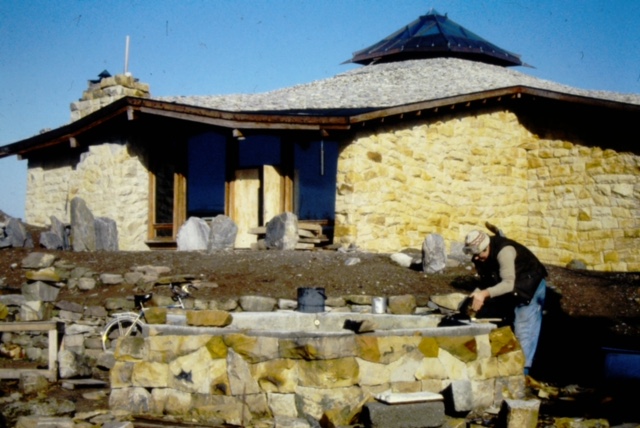
Original Hall roof photo Michael Davidson
It was clear that we had to strip the roof completely of the crushed quartz because it was the root cause of the problem, but in any case, the whole system of layers was badly compromised, with many of the stones dislodged and much of the quartz washed away. But to remove the quartz, we had to first lift off the iconic beach and river stones. So then we started wondering whether we really want to put the stones back, or might there be a better alternative? I personally wanted to reinstate the stones as they had significant symbolic value – representing many wonderful stories about how they were originally sourced from the beach and then from the river. But bedding them in crushed quartz again, or soil perhaps, was not an option. Anything like that would eventually suffer the same fate.
We talked to the FF trustees and were encouraged to look at alternatives to reusing the stones. At the time sedum roofs were all the rage, and with good reason. There’s a lot to be said for a green roof – a growing, living roof – not least because the roots of the plants bind the substrate and prevent it from being washed away. I did further research and put together a proposal for the trustees with photo-montages showing how a sedum roof might look. They decided to go ahead with the project, which I was asked to oversee. I needed an offsider to work with so asked Paul Muircroft, a local builder, to join the project. Paul was very skilled and easy to work with; we made a great team.
It was going to take a huge effort to clear the roof. We had to manually pick-up and place the stones into crates and then have a hire-crane lift the crates from the roof. Then we had to do the same with the crushed quartz – shovel it by hand into crates and have those lifted off. As this was going to require a lot of person-power, we manifested a community project, a bit like the original building of the Hall. But of course, we needed to be very health and safety conscious around volunteers being on the roof, in a way that it seems they weren’t back in the ‘70s when the Hall was built. So the first thing Paul and I did was build a safety rail around the perimeter of the roof. From the tops of ladders, we fixed timbers to the rafters supporting the eaves, then added uprights and props and finally, a triple rail all the way round. That alone, took several weeks. But only then could we call for volunteers.
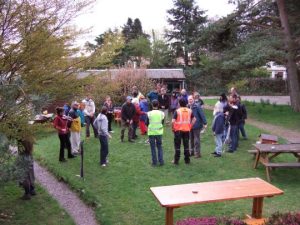
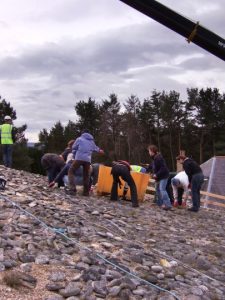
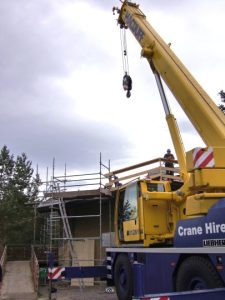
About 20 community members at a time came up onto the roof to lift the stones and shovel the quartz into crates. As we’d hoped, the camaraderie was palpable and the spirit, engaged and joyful, but also focused, as it needed to be in order to prevent accidents. I recall that attunements at the beginning of each shift were key to ensuring mindfulness. A crane was parked between the Park Building and the Hall to lift the crates. The stones and quartz were stockpiled in the turning circle behind the Park Building and eventually distributed.
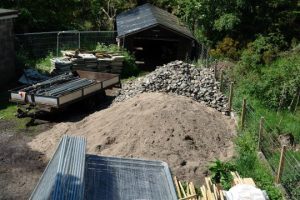
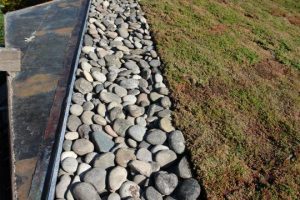
Once that phase was complete, we brought in contractors to lay the new roof. They first overlaid the old bitumen-based membrane, which was anyway badly deteriorated in places, with a new EPDM (rubber) membrane. Over the top of that, they laid about 100 millimetres of soil, well-retained at the edges, and then laid pre-grown sedum mats on top. They did a good job and in the end the result was very pleasing. Hundreds of the stones were laid in the gutter around the edge of the Hall roof, both for practical reasons and also to honour their heritage value. The remainder eventually ended up on the roof of Robin and Kosha’s Roundhouse, where they look grand, I believe.
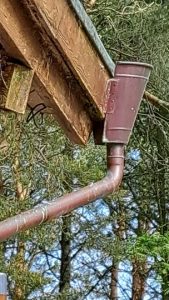
copper downpipes
We needed to add a few finishing touches. The blocked downpipe on the western corner was replaced by a new chain and stone soak-away. And we created two new copper downpipes to go on the eastern side, which I think are an attractive adornment. Sadly, the sedum never really thrived in the way that I had imagined it would. The ongoing maintenance required to prevent weeds growing was not carried out. Sedum doesn’t necessarily need irrigation; it is very hardy and can live with very little rain. But it does need to be weeded every now and again. As a famous American, Norman R. Augustine, once said, “Regulations grow at the same rate as weeds.” That can certainly be said of Health and Safety regs in recent decades, which is said has been the main reason for maintenance of the Hall roof being curtailed. Hopefully, as the community takes more responsibility for The Park and for the Hall, we will re-establish a regular maintenance regime.
To finish as I began, on a more personal note…some months prior, my mother living in Australia had decided to get married at about the same time – mid-May, 2007. For various reasons, not least that it fell in the middle of the re-roofing project, I had decided not to go to the wedding. But as her big day came closer, I felt increasingly drawn to being there. And so, at the last minute, I decided to go unannounced; it felt like the best possible surprise wedding present. I knew it would make Mum’s day. However, as I was supervising the project, I could only go for the shortest possible time. Hence, I flew from Inverness on a Friday, arriving early on the Sunday for the wedding, and flew back again the following day, arriving in Findhorn on the Tuesday. The turnaround was so quick, I completely avoided any jet-lag!
***
Photo credits: photos by Peter Vallance, except the Original Hall roof (by Michael Davidson), copper downpipes (Graham Meltzer)

Graham spent much of his life living in intentional communities, including kibbutz, hippie communes, cohousing and now Findhorn. In a past life he was an builder, photographer, academic and architect.


Fantastic catch-up story Graham (speaking as one who worked on the Hall in the 70’s)