


“Non violent communication” grew from my attempt to understand the concept of love and how to manifest it, how to do it. I had come to the conclusion that love is not just something we feel, but something we do, something we have, love is something we give; we give of ourselves in particular ways. It’s a gift when you reveal yourself nakedly and honestly at any given moment for no other purpose than to reveal what’s alive in you. Not to blame, criticise, or punish, just “here I am and here is what I would like, this is my vulnerability at this moment”. To me, that ‘giving’ is a manifestation of love.”
Marshall B Rosenberg, PhD.

When Ruby was four and Amber approaching two, I realised how inadequate I sometimes felt, as a mother and the irony of our so called ‘education system’ in offering zero education, in that area. Probably the most important task any of us can undertake and all we have at our disposal, to accommodate our children’s growing needs for sensitive non-invasive communication, is what we inherited from our parents, the good, the bad and the ugly. The ‘good’ I’d inherited from my mother had occurred so early, when she was still a whole person, that I had no conscious knowledge of it; I was virtually a Motherless Mother. Sometimes, under stress in power struggles, and alone with the girls, I’d open my mouth and it was my mother, shouting, playing victim, blaming, ordering, scolding, it was awful. Mostly though, I was a natural mother knowing intuitively how to handle most things – and there were gaps in my knowledge – of how to implement what later became known as ‘non-violent’ communication; the work pioneered by Marshal Rosenburg.
One of the mothers suggested I read the “Parent Effectiveness Handbook” Parent Effectiveness Training just about saved my sanity, helping me practice good – effective! – principles of communicating with small unreasonable people with strong wills.
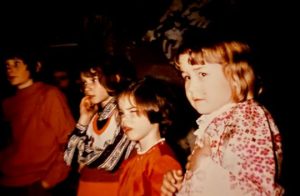
Christmas Show Ruby, India and friends
Many of us young parents were struggling and in our play group attunements it was often a relief to be able to talk about the challenges. The balance between being overly permissive and overly controlling, of finding new ways of doing things, after all, wasn’t this what the New Age was about, finding new more creative ways of dealing with the relentless demands of child raising along with everything else?
We were no longer content to live with the pain of conflict, which in a ‘Light Centre’ where we were seeking to be more conscious about everything was even more apparent, the pain more excruciating when withholding love and dishing out judgement or any other kind of ‘old age’ punishing behaviour.
David Spangler spoke about the challenges facing humankind in his talks to the community and how in the maturing and developing of the ‘emotional body’ – collectively speaking – we were only at the adolescent stage. Which is why, looking around at the many troubles in the world, it would appear that things are being run by a lot of very badly behaved and angry teenagers, for the most part. This sounds very simplistic and David didn’t put it that way, the point being, we all have a great deal to learn on the emotional level and the area where the greatest self knowledge can be harvested is in relationships and particularly with one’s children and families – as for loving relationships of the more romantic kind – a journey equivalent to taking a PhD.
It does of course go a long way to treat our children as equals, with love and respect, though the fact remains they function with scant knowledge of the realities, dangers and challenges of the world around them and until a certain age – around seven, – are unable to conceptualise or ‘reason’ as they operate on a very ‘elemental’ level.
-

- Ruby
-

- Amber
The non-violence of P.E.T. cuts through a lot of dross and from what I can recall, lists the twelve baddies of ‘old age’ invasive ways of getting our kids to do what we want and seeks to replace them with positive solutions of empathy and listening and being willing to step into the power of ‘Now’ to create mutual solutions that honour and acknowledge the needs of this small person. Some of the ‘baddies’ are – ordering, mocking, shaming, blaming, blackmailing, shouting, manipulating, judging, scolding and the ugly list goes on, and on, making us, as parents, into monsters and helping us to create psychopathic offspring (bit extreme – but true.)
I learned that in terms of ‘good’ communication skills the ‘I’ message is central. So, for example, rather than saying “You’re making a mess/noise”, etc etc (blaming) you change this to: “I’d like it if you could be quieter, tidier, I’m tired of cleaning up all the time” and “I love it when you help me put the toys away” so always affirming the positive rather than the negative.
In head on collisions involving a battle of wills I began to find that it was possible to be subtle, distracting, using humour and tact to diffuse a situation rather than the often-ugly adult approach of “I’m bigger and smarter than you so do as you’re told” (ordering). No one likes to be commanded it doesn’t help a child to build self-esteem and confidence and all trauma of an emotional nature, where a loved one ‘verbally beats you up’ is seen by children and probably all of us, as almost life threatening, leaving a residue of pain, anxiety and an inability to trust others or trust in love, that can follow us for the rest of our lives and/ ‘or at least, into therapy.
In India, the path of the Householder parents, is seen as sacred and a constant opportunity every day, for enlightenment; when we are willing to meet the moment in love and humility with our child/ren we grow in patience, understanding and wisdom, raising our own emotional intelligence and hopefully, that of the whole.
At the end of a difficult day when the children were small, I would simply have to cry and I knew I wasn’t alone in this as I heard the same from my friends; I would look back over the day and see how I didn’t meet the moment but put the transient needs of the material world, above theirs. I’d feel disappointment in myself and vow to do better tomorrow, that’s all we can do – and I’d think – “tomorrow I will look into their eyes, knowing their small young needs will not be with me for long (even if it doesn’t always feel that way!) and how I respond to them, will help to define who they are and how they conduct their lives later on. So, may I respond with the very best of who I am. The dirty dishes will always be there as will the everyday messy considerations of domestic family life, but their small, upturned faces, looking for fun, love, games, connection, will not”.
-

- Peter as Santa with Ruby, Gillian and family
-

- Michael, Amber and Peter as Santa, Crispin, Millenko
Perhaps there is no other learning curve so steep, as good parenting, except perhaps when we know we are going to die of something terminal quite soon! The learning with our children is about learning to live, as fully as possible and in the present, surrendering the rest, what could be closer to a path of awakening?
We had some visits from the family. Carl and Edie came just after Amber was born, staying in a local B&B and enjoying the beauty of this place and the warm summer we were having, delighted to meet their new granddaughter, but supremely puzzled by the community, though willing to hear about the gardens and their lineage as they too were keen gardeners. Dad was the same and couldn’t understand why we had come so far from home to what he described as “this God forsaken place”! (The weather was not good on Dad’s visit).
As more people arrived to live, the area at Pineridge became more populous and as the girls grew and made new friends, the more freedom they had to roam within this area. This kind of freedom would have been unthinkable in a normal urban situation, here was a safe space that featured only one small road with very slow-moving cars and bikes. Apart from the arrival of some new bungalows (mobile homes) and caravans it was all green space.


A delightful family, Ann and Dick Barton came to live and put down roots at Pineridge bringing their children and grandparents. Dick was ex R.A.F. and the adults were all skilled gardeners. With great enthusiasm they began to create some lovely extensive gardens and what had been only sand and maram grass, with ambitious landscaping the planting of many native trees and plants this significant area of land was gradually transformed into very lovely gardens.
Peter often spoke of the importance of ‘sounding a clear note’ in order to attract what was needed in any given situation; the necessity for clarity of thought and intention, trusting that the universe will respond – rather than using manipulation – and this was something I witnessed time and again during those years, as small groups of people with passion and a vision came together, seeking to implement these principles.
The Publications Department was a good example. Starting out as a small hand cranked printing press operated by two people in the back of the office/reception, printing the early booklets of Eileen’s guidance and Dorothy’s Devic messages, the original garden story, and David’s early transmissions from limitless love and truth, over the course of a few years, expanding into a substantial well equipped building with a team of talented printers and graphic designers, photographers, editors and journalists, the publishing side of the community became an inspired and entrepreneurial success. This seemed to be the pattern with most areas in the community’s life.
In those early years there was a sense of sharing in everything and giving, without compartmentalisation or over specialisation, though these elements existed in most areas; it’s as though we had the wisdom to know that such elements caused energy to back up and suffocate the process of flow – people didn’t say – “I can’t do that, it’s not my department”. It was all hands-on deck and when one area needed extra help, then the community responded willingly and was there for itself. One great example of this was the first steps in materialising the Universal Hall. Everyone who was fit and able, carried the materials onto the site, as well as helping with the digging and laying of the foundations, it was a huge, group undertaking, done in the altruistic spirit of the American barn raising tradition. It was wonderful, things worked well and people were drawn to stay and assist on the strength of the joy and fulfilment of sharing in a sense of fruition and of course things had to be paid for, costs had to be covered, it had little to do with making a profit and everything to do with sharing inspiration, – there were no wages in those days, people did things for the love of it.
Its true what Ed had said, all the archetypes were showing up and they brought the necessary skills for further growth and expansion; we must have been ‘sounding’ a clear note or perhaps, blowing our horns! and those who were attuned were finding ‘Findhorn’ without too much trouble.
Margaret came for a visit, Michael’s sister, an astute woman who had worked in education all her life; she was interested and found the place stimulating, her ‘take’ on it at that time was that everyone was bright, intelligent and mostly white and middle class, a sweeping generalisation that wasn’t entirely true. Many of us came from working class backgrounds, a good few were upper class, a tiny handful were super rich, there was even a sprinkle of aristocracy. Quite a few came from more exotic climes, rarely staying for long periods because our climate was too harsh, on the same meridian as Moscow, Peter liked to tell the guests when they grumbled on the variability of the weather, sometimes four seasons in one day.
Peter saw the community as a place where ‘unity in diversity’ could flourish along democratic lines, that were open and flexible to change. Nothing was written in stone except everyone’s intention, to come from a place of good will, seeking to share their best. Although there were some real professionals from different fields of endeavour many people were doing things they had never done before but always wanted to, which is where flexibility came in and the apprentice – mentoring factor, that made the workings of community life, rich and interesting. Also, there was the growth consideration of stepping out of one’s comfort zone to try something new, learning to be vulnerable and cultivate ‘beginners mind’. No one said “You can’t do that, you’re not trained in that area, you don’t have the qualifications”. Somehow the rarefied atmosphere of that time assisted this process, plus the very real support of a caring community.
There were some highly skilled individuals willing to share their gifts of ‘know how’ with others; Lyle Schnadt was outstanding in this respect; a housebuilder/carpenter, familiar with all aspects of construction work, he later became a foreman extraordinaire in the building of the Universal Hall at Findhorn.
Lyle’s first project on arrival from the States was the expansion of the Community Centre, bursting at the seams now there were so many of us, we were often eating in shifts.
Lyle passed on his knowledge in the practical application of everyday labour, never lacking in patience and the ability to mentor.
Although co-operation was a byword in all areas, there was also a healthy sense of competition in the sense of seeking excellence in one’s area of expression. I experienced a sort of epiphany when Peter had showed us the new C.C. Kitchen, pointing out the state of the art equipment, the stainless steel pots and pans, saying how important it was to expect the best and aspire for the best (not 2nd best) as the universe would respond in kind to our aspirations and thoughts, it was a spiritual law; something ignited inside me whenever Peter spoke this way and I decided that “the best” was what I would aspire to, in every way.
***
About the photos: A big Thank You to my grandson Ziggy for enhancing the appearance of many of my somewhat battered and ancient photos from the ’70s.

I live very simply in this land I love. On returning to the area with my daughter Jade, I found joy in volunteering in the life of the Community; until Covid, then everything changed.




Leave A Comment