


Click to view eBook
Editor’s Note: This chapter is based on a Foundation Early Study Paper which was also printed in New Age Journal and United Focus Journal. It was also reprinted in a slightly amended form in The Kingdom Within (click here to read that version).
In the book, Myrtle’s writing is interspersed with quotes by community members and photographs (see the eBook for acknowledgements). We’ve tried to replicate this in the post as closely as possible.
***
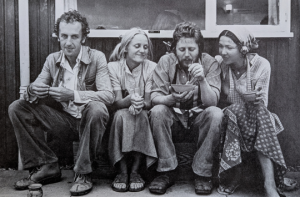
Michael W.: In a community where one’s work is so closely linked with other people’s, if one is out of sorts it’s soon going to affect everyone else. The state of my relationship with anyone is the clearest reflection of the state of my consciousness. There is no escape. Any attempt to escape is bound to intensify the situation.
Over the past few years, my co-worker David Spangler and I have been contacted by several persons who have felt that Findhorn was losing its direction or was becoming imbalanced in some way. We have also heard from people who had gone to the community in response to something they had read or heard, only to discover that its reality was not what they had expected. Most of these reports indicated a disappointment that, in the minds of these people, Findhorn was not living up to the beautiful ideals which it proclaimed.
This concerns me, for I have a deep personal interest in Findhorn’s well-being and a love for the people who are trying to make it a success. My work there put me in touch with every facet of the community life and gave me opportunity to experience firsthand the challenges in building and running a place like Findhorn. These were not only the normal human relationship problems brought about by the presence of many strong and different personalities or by the community’s small living area and limited accommodations which caused everyone to live in constant, close contact. There were also problems arising from the subtle but highly stimulating and transformative spiritual and psychological forces at work there.
This experience gave me a perspective on Findhorn’s strengths and weaknesses, as well as an appreciation of the immense amount of commitment and care it takes just to make it work at all. It is important to remember that Findhorn does work, although not always to everyone’s expectations. The experiences of Findhorn are not unique to that center either; I have found similar mixtures of positive and negative elements in every group or enterprise I have ever encountered. And just as the truth of an individual does not lie in his extremes, so it is true of Findhorn. Its reality lies neither in the glamorous image of a heaven on earth, nor in a picture equally negative. Rather, Findhorn is on a path of transformation, and we need to understand that path more clearly, for it is all of ours as well.
The most intense criticisms of Findhorn have come, as one would expect, from the people most involved with the community. I remember one young man who had come from London to live at Findhorn. He discovered, as do most who join the community, that Findhorn is no refuge from the problems of society. To the extent that these problems are inner, created through our own personal imbalances, we bring them with us wherever we go; and at Findhorn our inner contradictions are brought to the surface with uncomfortable intensity. This young man kept alternating between staying in London and living at Findhorn. Finally, despairing of his ability to adapt to Findhorn, he told us that emotionally it was a worse jungle than London.
Why should a spiritual center, based on ideas of love, service and wholeness, create such problems? Why should Findhorn be a jungle as well as a garden? One answer comes from the process of growth itself; another from the nature of the community and the people living there.
As a counsellor, I have found that the meaning of growth is frequently misunderstood. Many people seem to see it as a process of addition: the acquiring of new skills, knowledge, and images of self. To me, growth is a more profound activity than just acquisition. It is a deepening into the wholeness of life, like the spreading of roots to nourish and support the visible structures of stem, leaves, and blossoms.
***
Mary: We now use several personal growth techniques to assist us when we get stuck, co-counselling, psychosynthesis, rebirthing and different forms of meditation. Yet the techniques are not ends in themselves -they are a means of enabling people to look at and take responsibility for the whole of themselves, to transform elements within themselves that hold them in old patterns. All the techniques, in one way or another, acknowledge a higher vision of humanity and are working to bring it about.
Kay: Floyd and I have been married 36 years, and we went through a lot of pain for years before we came here, working on our emotional attachments. If we’d come to Findhorn any earlier we wouldn’t have been able to give much to the community. We would have been struggling with, “Is this person going to satisfy my needs, and if not, well, I’ll try this person or I’ll try this group or I’ll be celibate for six months and see if that takes care of it.” We reached the point where we both decided to retire from our respective careers, and we come to Findhorn having discovered through a long process of trial and error that no matter what you try, no technique, group or person is going to make you whole. Integration has to come from within.
***
It is a greater openness to life and its dynamic qualities. Growth can be joyous and exhilarating, a fulfilment of all that is most human within us. However, if we are unwilling to release our desires about how we should grow, if we shrink from confronting the deeper truths of our nature, then growth can be a challenging, frightening, and even a negative experience.
Within us is a mixture of characteristics, some of which we are happy with and some of which we aren’t. These characteristics are the seeds we have sown over the years-our karma, if you like or the tendencies we have built through our own habits. When we open ourselves to the forces of growth it is like exposing a garden to the sun and rain. Whatever seeds are there will sprout and reveal their nature, whether we want them to or not. This means we may find ourselves confronting unpleasant and undesirable elements within our nature. Also, for plants to emerge the soil must be broken up and the seeds themselves must disintegrate to give birth to new forms. Creativity often involves prior destruction and growth involves a giving up or a “destructuring” of familiar patterns to make room for new ones to appear. This process can produce imbalance in our lives. During growth periods, therefore, we are more vulnerable than usual, and more likely to experience negativity in our relationships with life.
The young man from London called Findhorn a jungle. Yet, a jungle is a place where the growth forces are strong and life is abundant. This is the nature of Findhorn: it is a place where the forces generated by the pioneering dynamics of life in its deeper aspects are exceptionally strong and concentrated, a tropical zone of the spirit.
Although its climate does not suit everyone, a jungle cannot be blamed for being what it is. Unfortunately, however, people coming to the community are sometimes unprepared for the intensity and swiftness with which inner pressures of change begin to manifest. While at Findhorn I observed that there were those who came expecting a garden of Eden, a community of loving souls where the problems of life would somehow resolve themselves. They came with definite preconceptions about both the community and their own growth. It was painful to watch the crises these people went through as their dreams ran up against the reality not only of Findhorn but of their own natures as well. Many people were able to readjust their expectations, but there were still those who refused to change or to give of themselves except in the manner that they wanted. These were the ones who eventually left the community with bitterness at what they saw as Findhorn’s failure to adapt to their needs and desires.
Certain characteristics of Findhorn stand out as being most important to the understanding of the pressures of growth there. Primarily, Findhorn is a spiritual center, based on guidance from higher levels and on esoteric teachings. It has a deliberate focus on transformation and on exploring the frontier of a new consciousness as part of a greater planetary unfoldment. A creative relationship with invisible forces is an accepted and intricate part of the community’s consciousness. The members identify their task as finding the blend between divinity and humanity, between a person and the whole of the universe, and all community activities relate to that task in some manner. And because we don’t really know just what the nature of that blend will be, Findhorn tries to allow room for experimentation. As a center for exploration of the new, there is a real sense of pioneering and, consequently, very few rules of conduct, one looks to guidance through attunement to higher levels rather than to a code of laws. This openness to inspiration creates the sense that one needs to live in the moment, to be flexible and open to sudden change.
***
 Kay: At Findhorn we choose to be together with the whole idea of becoming one to serve God, to serve something greater than ourselves as individuals, couples or groups. We’re still struggling with that process of surrender. By surrender I don’t mean compromise, and I don’t mean giving up individuality. I mean yielding attachments and personal desires in order to give as a team.
Leona: I’ve heard a lot about the New Age being an Age of Woman. What I think that means is that it is an age of the rebirth of the feminine principle to blend with the masculine principle which has been dominating most societies for thousands of years. It’s not a return to the matriarchy of old that is needed, but a blending of the Yin-Yang principles in every aspect of our culture.
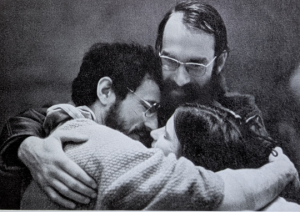 Alice: If our foundations as a couple had been weak, then they’d have been shattered by the extra load of community life. But if the foundations are strong, then the community is a great place to build on them. Coming here we found our lives much fuller; we share our meals with many other people, there’s lots of questioning and discussion, and so much diverse activity that we almost have to make appointments to see each other! But it hasn’t shaken our roots at all. It’s given us that much more to come home to and share with each other. And I think that our marriage has improved because now we’re taking the love that we’ re generating as a couple and we’re doing something with it, which makes it even stronger. ln a sense, joining the community as a couple can be like deciding to have a baby. Having a baby can fulfil a good relationship, but it may even help to destroy one that’s seeking a fulfilment it isn’t prepared for.
***
Findhorn exploded in growth and activity in the early 1970’s, growing from a small group to a community of over a hundred. With this rapid expansion other pressures came to bear, with more jobs to be done than people to do them, and a sense of urgency to serve the rapidly expanding community. This high activity level, as well as the sense of experimentation and the strong spiritual focus, were the result of powerful growth forces invoked into the community life, and they fostered transformation in the lives of the members. At the same time, paradoxically, this same intensity made it difficult to deal with the consequences of that growth.
As imbalance and negative states of thought and emotion can be temporary by-products of growth efforts, the appearance of these states at Findhorn was intensified. Also, the spiritual nature of the community caused difficulty in dealing with negativity because it clashed with the community’s high ideals and its emphasis on positive thinking. To give vent to negative pressures was to risk being seen as a disruptive element in the community’s life. This was particularly true with respect to the community’s general understanding of the Laws of Manifestation, through which Findhorn could attract to itself what it needed to grow and survive. Positive thought and emotion were seen as the fuel that made these laws work, whereas negativity was a neutralizing force that could block manifestation and thus threaten the
community. Consequently there was a tendency to ignore the personality level, with its inherent conflicts, and concentrate on higher, more esoteric levels.
For many within esoteric disciplines the personality is seen as a “lower self”, a source of distortion and error, something not to be understood but rather to be overcome, gone beyond, or transmuted. Because these methods are often not well understood, the practical effect of this approach can simply be to ignore the personality, hoping that by concentrating on a spiritual vision it will just go away somehow. Of course, it doesn’t go away; it remains, untended and unintegrated, to be a source of continuing problems of relationship and communication on all levels. This way of thinking, though not extreme at Findhorn, tended to prevent some people from seeking help in dealing creatively with personality problems.
Added to this pattern was the tendency to find esoteric or spiritual explanations for almost everything that happened. This attitude diverted attention from inner causes of the problem and turned it outward, dispersing the sense of personal responsibility. It also tended to increase the repression of negative emotion and to make people feel guilty when these emotions surfaced. At Findhorn we faced a problem where the very nature of the place stimulated the appearance of negative emotional states as part of a natural growth process, while it also tended to deny an acceptable outlet to these feelings because they conflicted with spiritual ideals.
Despite these problems, the tendency to be critical of negativity within the community was offset by a generally good community perspective, a high level of humor and a great deal of love and caring.
***

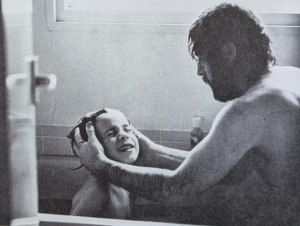
Michael W: The other day I was struck by the situation in the lunch room. There is no question that the presence of children adds something vital to the environment. At the same time, I noticed that there was a lot of tension and mess around the tables where the children were. We occasionally have people saying that we should find separate facilities for the children, which is obviously ridiculous. Yet I could see how someone coming in from a hard morning’s work, feeling up to here with all the pressures of the community, at least wants to be able to eat in peace. From a child’s perspective, however, as you walk into the Community Center you see a lot of personal worlds battling for privacy. And the kids join right in to break down the walls, because they want communication, they want to feel acknowledged. So they make a noise until they are acknowledged.
 The paradox is that as soon as children know that you’re willing to give them all your attention they don’t need to demand it incessantly. Now I think that a good percentage of the community is becoming more and more available to giving the children the attention they need, because they’re aware of the paradox that the more one is open and ready to give one’s whole self to each little situation, the less one need fear being drained. The more responsive one is, the less friction one creates.
Michael W: I think that children are a beautiful example of how you can have your spiritual path staring you right in the face and yet not recognize it. It’s so easy to feel that the kids are an interference, holding you up or preventing you from getting on with what you should be doing, because they’re demanding everything of you. But that’s all there is to the spiritual life learning to give everything; children are a constant reminder of that.
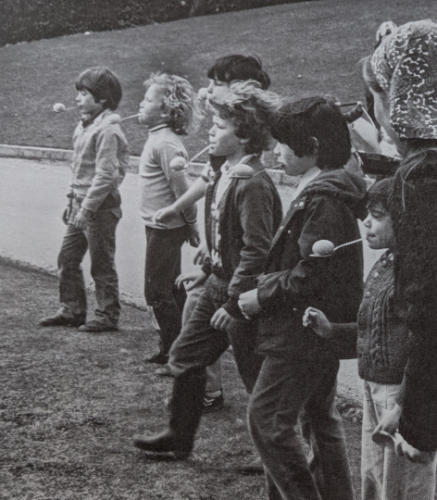
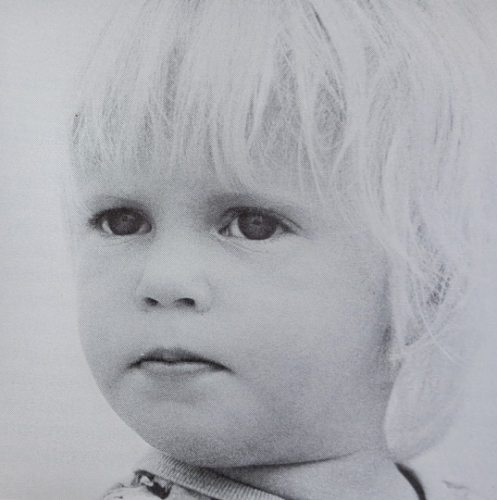
Clare: I remember Milenko once telling us something that expresses ideally my vision of parenthood. When Cathi was pregnant, Milenko was once meditating and he felt the sou[ of their unborn child communicating with him and saying: ”I’m choosing you to be my parents because I know that I’m going to go through all kinds of experiences in my life that will put me in danger of forgetting my true identity, and I’m choosing you to be my parents because I know that you will always remind me who I really am.”
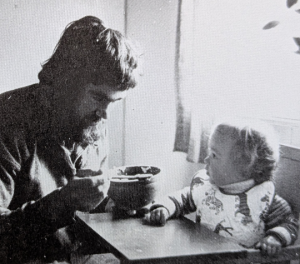
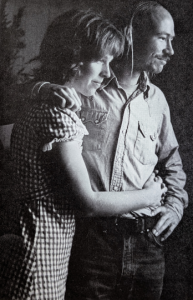 Irmeli: The night before Debbie’s wedding she had a party for her women friends in the community. It was like a tribal gathering. There were about thirty of us, all sitting around in a circle. Debbie’s mother and sister were there, too. I sat with my head in the lap of a pregnant friend and felt warm and relaxed. There was such a nourishing, feminine, present energy in that small room.
People were sharing their experiences of love and marriage. I was struck by the power of the sharing and people’s openness about things that aren’t usually easy to talk about: their intimate feelings and fears and expectations about sexuality and marriage, and their disappointments as well.
Everybody shared about all kinds of relationships, from life-long partnerships to lovers that had been gone the next morning. When my turn came, I was a bit inhibited at first, but then I felt that what we were doing was offering our own special wedding gifts to Debbie. I wanted to be as honest and open for her as possible because I felt that she was very young and excited about getting married, and she was very willing to listen and learn from other women’s experiences. It felt like giving her something that she was ready to receive. ln that sense it was as though we were participating in an ancient ritual in a spontaneous reawakened form.
The whole evening was very revitalizing. It was like wiping the dust off the mirror of our relationships and seeing them, and seeing our images in them, more clearly. There was a sense of affirmation, not just for our present relationships, but for the past ones, too. The whole ritual was like a blessing of those past experiences and an integrating of them into our present. It was a harvesting and a blessing of all our shared experiences.
***
Experimentation and the high activity level in the community added the element of instability to the pressure of growth at Findhorn. Growth is a process of deepening, not just activity, in the direction of newness and change, and because it can create its own temporary experience of instability, it is good if growth can be nourished by a stable environment. The constant intense activity within the community, though not in itself a bad thing, did, however, further complicate the process, substituting a sense of motion and change for a slower, more gradual deepening.
All these factors detracted from the overall stability of the community and so also had their effect on family life. The demand of the community for the greater part of an individual’s time and energy had a dispersing effect on families that came to live at Findhorn as well, bringing into conflict the allegiance of husband and wife to each other and to their children with their new allegiance to the community.
Families have never had an easy time of it at Findhorn, and some have been broken up. However, I observed that in every case where a family broke up in the community, the seeds of that separation were already there before the couple came to Findhorn. The community simply intensified and speeded up their confrontation with the realities of their relationship. Also, the glamor of growth, of moving into a New Age and leaving the past behind, tended to devalue that which was familiar and ordinary, such as day to day chores of home building and parenting. Instead it gave a lustre to that which was new and different and seemingly more significant. Thus, working in the community, building a New Age, grappling with metaphysical problems, seemed more exciting and more meaningful than the chores and duties of the householder. All of this, as well as individual internal growth pressures, put strain on relationships and family life.
Life at Findhorn was further intensified by there being few rules, placing a premium on self discipline. But self-discipline is also a matter of training and can be difficult to develop in the vulnerability of an intense growth process. As a consequence, Findhorn can appear as an emotional jungle where people are left exposed to the heat of the sun and unprotected from the ravages of their own contradictions and those of the community. The fact remains, however, that Findhorn has been meeting its problems and continuing to grow. Findhorn does have its jungle aspect, but it is learning to deal with it in creative ways. Today the focus is still on expanding beyond personal concerns to contribute to the larger whole, but within that focus more flexibility has been created for the necessary personality work to be done.
People look to Findhorn seeking a garden rather than another jungle. Most people feel they already live in a jungle in modem society and long for inspiration and for a piece of heaven on earth. But, because Findhorn is a physical place, its concreteness can obscure its vision. People hear of it, and rather than see its reality within their own lives and environments, want to travel to Scotland.
We see and hear what we wish. We create our dream worlds and try to project them into reality. We desire a heaven on earth. We can have such a heaven if we are willing to create it in our own lives and where we are, which means confronting the challenges of growth. This is all they are doing at Findhorn. The problems that arise are human problems; the triumphs are born out of the spiritual potentials and realities within all human beings everywhere.
***

Wedding Celebration
Babs: Three of us went to visit Alan in the hospital the day he died. We knew he was in intensive care, but none of us knew he was dying until a doctor came and spoke to us in the waiting room. Then we had to wait a long time before a nurse came to get us. We talked about death, and our experiences and fear of it, and we had a quiet time together. As we were walking down the corridor towards Alan’s room, I suddenly felt such a rush of joy that it was hard to contain it. I couldn’t understand it because when I’d been a nurse before coming to Findhorn I’d been with many people who’d died, and my memories were not very pleasant. When we went into the room the nurse, to my surprise, left us behind the curtains by ourselves. Alan was lying there, totally unconscious, on a monitor. We stood still for a few moments, then we decided to attune, holding hands with Alan, around his bed. Again this rush of joy came, and when I opened my eyes I saw the monitor needle had stopped pulsing. He actually had died while we were meditating with him. Afterwards we drove home and I felt so inexplicably happy that I couldn’t sleep that night.
Three days later Alan was buried in the cemetery behind Cluny Hill. It was a glorious day. There were about thirty of us there, and we carried the coffin and lowered it into the grave ourselves. Then we meditated and sang together, and I almost felt like dancing. Afterwards, on the way home to Cluny we passed a newborn foal struggling onto its legs. I suddenly realized what a change of perspective I’d been through. I’d glimpsed that life and death are indivisible, and that death is a process of transformation and not of loss.
Bart: The energy at my daughter’s birth held my attention so strongly that I couldn’t talk. It was a constant meditation. When the head actually started to crown and I could see a little patch of hair, a wave of gratitude and joy and a feeling of specialness at being present at this birth just washed over me. The birth was happening to me too, and I was so grateful that I started crying what could have become uncontrollable tears, and I would have missed it all. I just let the feeling fill my whole body, and stayed aware of what was happening. When the head came out, I wondered what the difference is between life and death. It was strange to see this creature that was moving and kicking but was not breathing. It wasn’t alive, yet it was. It was alive on some other plane of existence. It was mysterious and kind of grey, like a stone; it wasn’t human-being-colored yet. When it came out it made a little crying noise as it took its first breath. Nobody said a word. We just listened. We were listening and watching, hearing her gentle breathing, and seeing the snow falling gently outside. That was when I began to love her, when she first breathed. I still couldn’t talk. Then I picked her up, and she opened her eyes. Everything was so peaceful. She looked at me with this ancient look of wisdom, checking me out. Then there was a feeling of oneness … letting her know I was there … that this is a safe place to be … that she had come from one womb into a larger womb. I never felt love like that for anything or anybody. I watched her change color from grey to pink; I watched the life come into her.


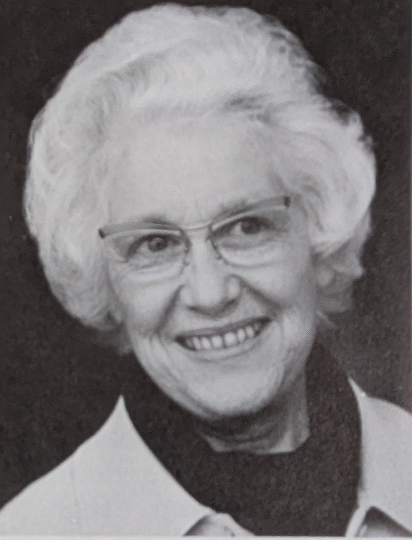
Born in Utah, USA in 1908. Mother of 4. Human relations and marriage counsellor and teacher, co-founder of the Interstate College of Personology. From 1965 worked closely with David Spangler. Died in 1987.




Leave A Comment