


Author’s note: I undertook this research into the history of Station House in 1987.
The earliest records indicate that a feu was granted over “that part and portion of the Town and Lands of Findhorn whereon James Hoyes sometime Cooper in Findhorn, his house, shops and cellars and others were built”. [2],[3],[4] etc. Unfortunately it is not clear at what date this was given.
James Hoyes is recorded as owing money to a local farmer called James Milne [14] (who was perhaps an ancestor of the 20th Century merchant who donated the money for the present village hall) as early as 1758. If he was by this time the owner of property in the village the feu must have been granted by Hugh Rose of Kilravock who did not sell the Barony of Muirton to Col. Hector Munro of Navarre (ancestor of the current superiors who own Novar estates) until 1766. [15]
Nor is it clear which, if any, of the original buildings still remain, but without doubt, sometime in the Eighteenth century the land that is now Station House was first developed.
According to one of the oldest documents still in existence [2] James Hoyes’ only son and heir James duly inherited the property. He is described as a “Cooper In London”, but evidently he found himself in some legal trouble [2] and “John Reidhead Cooper and Merchant in Findhorn upon the eighteen the day of July Seventeen hundred and seventy one years obtained Decree and Sentence of adjudication at his instance Before the Lords of Council and Session against John Hoyes”. Reidhead then became owner of the land and buildings.
There is no reason to suppose that John Reidhead was anything other than a Scottish craftsman and merchant, but his only surviving son David begins an American connection with the house for he is described as “late of Salin (i.e. Salem) in the County of Rockingham, New Hampshire and presently of Findhorn House and Ships Carpenters” [2] . We might have expected David to inherit the property in his turn but for some reason the property goes to old John’s grandson, (and David’s nephew), another John Reidhead.
In December 1817 this younger John is described as “late of Castine near Boston North America, presently residing in Findhorn”. [1] However, in the document that describes him as such he goes on to say that “Considering that my affairs require my going abroad where I may be detained for some considerable time”, he has decided to appoint a “proper person for the management of my affairs in this Country during my absence.” This person was Alexander Gerrie, a “Cooper and Salmon Boiler in Findhorn”.
Whatever these affairs that detained young John were they seem to have taken him to London, and thence to the “Island of Jamaica” [14] and may have required some financing for only three months after his departure in March1818 his uncle David and his appointed factor Alexander Gerrie sold the House to George Wood, a ship owner of Findhorn, and George McHendry a “Farmer in Middleton of Langcot now in Whiteinch” [4] At this time the property is described as being 21 ells in breadth and 51 ells in length (i.e. about 20.5 metres by 59 metres) “all lying within the Barony of Muirton regality and Barony of Kinloss and Sherrifdom of Elgin and Forres.” [2]
These gentlemen held the property until 14th July 1838 when they sold it to David Clark a sometime merchant in Elgin, and afterward a “merchant and shoemaker in Findhorn”. He held the property until June 1855 when it was sold to another merchant of Findhorn, James Calder. [5] At this time the land is sold “together with the whole wooden sheds and erections belonging to me thereon and also the weighing machine and weights thereto attached.” [6]
Through various vicissitudes the Calder family held the land until May 1891, and this is the period of the short-lived Findhorn railway [17] from which the house takes its present name, but there is no mention of this anywhere in the records that I have seen. What the precise relationship of the house was to the railway is not at all clear, but the implication of the written records is that it was used as storeroom for goods transported by railway, which terminated near the entrance to the courtyard, but that there was never any formal connection between the two.
James Calder died at Edgehill Forres in October 1869 [7] and when his son George who was then a banking clerk in Kapunda, South Australia (but who later became an accountant in Broken Hill, New South Wales [8] ) finally sold the house it was to William Brown via the Trusteeship of his mother Matilda. There is little record of Brown’s affairs but when he sold the house after only six years he was living at a fashionable address in Dundee where he employed at least two servants, so he may have been somewhat of an absentee landlord.
The Bisset family were the next owners. John Bisset bought the property in two stages. In 1893 he acquired the “ground flat of the tenement of houses….and also the piece of garden ground lying between the said ground flat and the public road… and free right of access at all times by a passage from the said public road through the courtyard to the said flat”. [5] Four years later he became the owner of the entire lot. John Bisset died in July 1905, and his eldest son Alexander had already died without issue earlier in the year, yet John is unlikely to have been an old man for his wife Elsie survived until May 1940.
Whatever his age John Bisset certainly left debts which his wife’s family had to help her pay off so that she could retain the property [9] . In particular John Bisset took out one security for £300 via Allan and Black solicitors of Elgin [10], and another of £450 in favour of John William Thomson which was paid off in instalments, the last of which was not made until 1942!
During the time of the Bisset’s occupancy an insurance premium was taken out on the “building of two story dwelling houses and Post Office and on the building of Mission Hall and Granary all adjoining and communicating by roof… all brick or stone” [1] . The premium in 1906 was 10 shillings (50p), and the value of the building £500. By 1943 the amounts had increased to 17 shillings and £1,000 respectively. A memo to the premium notes that “said Granary is used for storing corn and fishing nets, and it is warranted that no scenic representations or dramatic performances involving the use of scenery may be given in said Hall.” It also seems that the Bissets had tenants staying in all or part of the House. [10]
When Elsie died in 1940 her son John Anderson Bisset inherited the property, but as he was by then living in Merrylands, Sydney, Australia. Trustees from the immediate family were assigned to dispose of the estate.
Thus the house was sold again in 1944 to Lt. Col. John Hopkinson and his wife Aileen Disney Willoughby Hopkinson for £700. Four minor points about this transfer may be made.
First of all, for the first time the property is not defined by the long-winded repetition of the original eighteen century description about “that part and portion of the Town and Lands of Findhorn whereon James Hoyes sometime Cooper in Findhorn, his house, shops and cellars and others were”. Instead, it is described in terms of the sale to the Bissets.
Secondly, the size of property is not in terms of ells, but of 38 poles and 19 square yards, a description that still stood in 1979. Thirdly, this is the only document in the titles to which a sketch map is attached showing the outline of the land and buildings and the immediate neighbours.
Fourthly, there is a burden on the land imposed in a Memorandum of agreement dated 1930 between Novar Estates and the Bissets’ Elgin solicitors, Allan and Black. This increased the annual feu duty to the superior from 16 shillings and 8 pence by a further 11 shillings and 7 pence, giving a grand total of £1 8s 3d (or about £1.41p). [3]
Unfortunately the Colonel did not enjoy his tenancy for long for he died in March 1949, but it was not until thirty years later that his wife Disney sold up. In between times a 1959 inventory of writs describes the property as being “Houses, Stores, Tearoom and Workshop” [1]
During this time the legal profession were attempting to sort out the medieval system of Scottish land tenure and remove the concept of Feu duties. Thus Mrs. Willoughby paid the superiors of Novar Estate £16.95, who still owned the superior more than two hundred years after buying the land from Hugh Rose, “in redemption for all time from Whitsunday 1970 of the feu duty of £1.41 (except for a feu duty of a penny a year if asked only)” [13] , a burden which exists to this day.
Nine years later the “whole buildings now known as Station House, Forty-Six Findhorn and the whole other erections thereon: TOGETHER ALSO WITH the parts, privileges and pendicles, the whole fittings and fixtures” were disposed of to Joan Hartnell Beavis, Captain Robert Ross Stewart, Sir George Trevelyan, the Reverend Stephen Field, James Michael Shaw, Thomas Welch Lt. Col retired, and Nicholas Rose as Trustees of the Findhorn Foundation, “with Entry and vacant possession as at the First Day of September Nineteen Hundred and Seventy Nine.” [1]
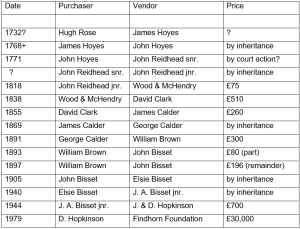
Dispositions and Finances
Buildings
It is not at all clear from the deeds when the current buildings were erected. Some of the deeds of 1818 refer to James Hoyes buildings in the present tense, and the huge increase in value from 1818 to 1838 indicate that George Wood and John McHendry may have considerably improved the land. However, there is then a dramatic fall in price by 1855, and the value remains relatively constant with inflation to the present day. The question this leaves us with is – was David Clark the purchaser of new buildings which he allowed to fall into disrepair, or was he simply a bad judge of business opportunities who paid over the odds for the land, and then sold it at a loss?
The oldest extant map of Findhorn [16] is George Brown’s “Plan of the Town of Findhorn” dated 1816, and this lends credence to the idea that it was Wood and McHendry who erected the current buildings. The original Hoyes feu is marked “T”: on this map, and a building is shown in the north west corner where Tower View and No. 2 Cottage now stand. There is however nothing shown anywhere else on the property. By 1870 the current building was in place. [16]
Whatever happened in the nineteenth century it is certain that there were buildings on the land by the middle of the eighteenth century, and it is possible that some of them remain in part at least. It is tempting to believe that the lintel above a back window of No.2 Cottage with the inscription “IH MR 1732”; is a remnant of the original owner (a member of the Hoyes family?), with “MR” possibly having been the builder of the “houses, shops and cellars and others”.
Full description of the Property from one of the earliest extant documents – the “Disposition and Assignation. Alexander Gerrie and David Reidhead In Favour of George Wood and John McHendry 1818”.
“that portion of the town and lands of Findhorn whereon the said James Hoyes his house Shops and Cellars and others are built and more particularly bounded in manner
underwritten viz. From the back of John Smith, Smith in Findhorn his house at the south and on the Northside from the Entry to the house possessed By Robert Ducat Shipmaster in Findhorn and Jane Fordyce his Spouse in breadth twenty one Ells and extending in length from the high way leading to the said Town of Findhorn at the west down opposite to the house presently possessed by William Muirison Fisher in Findhorn at the North fifty one Ells in length from thence southeast to the back of Peter Wright fisher in Findhorn his house twenty one Ells in breadth from thence South East to west at the back of the houses presently possessed by Donald Fowler, Margaret MacPherson and the said John Smith, Smith in Findhorn fifty one Ells in length all lying within the Barony of Muirton regality and Barony of Kinloss and Sherriffdom of Elgin and Forres.”
***
Footnotes
1 Factory Commission by John Reidhead in Favour of Alexander Gerrie 17.12.1817.
2 Deposition and Assignation. Alexander Gerrie and David Reidhead in favour of George Wood and John McHendry 6.03.1818. This document (and item 14) take considerable pains to repeat a long list of James Hoyes debts, and the legal action carried out by John Reidhead snr. against John Hoyes. The last
date shown for one of Hoyes snr.’s debts is 1769 and the date of the legal action is 1771, so it is likely that James Hoyes died leaving debts which his son could only meet by selling off the property. It is possible that these are recorded because Riedhead was obliged to pay the debts when he bought the land, but the language and style of this, and indeed most of the early eighteenth century documents is both obscure and repetitious. Apparently the legal profession was paid by the written folio so this obfuscation was in their interests.
3 Memorandum of agreement between Novar Estates Limited and Willam Rose Black 1930, noting increase of feu duty.
4 Instrument of Sasine in favour of Mr. David Clark etc. 1838. The description of McHendry means that he farmed first in Langcot – now part of RAF Kinloss – and then afterwards in Whiteinch which is immediately to the west of Kinloss itself.
5 Disposition by William Andrew Brown in favour of John Bisset 2.04.1897.
6 Instrument of Sasine in favour of Mr. James Calder.
7 Special Service: George Wilson Calder to his Father James Calder 1878.
8 Disposition By Misses Matilda and Isabella Calder and George Wilson Calder in favour of William Andrew Brown.
9 Disposition by James Bisset and others as Trustees in favour of Hopkinson 1944.
10 Back Letter by Allan and Black to John Bisset 1903.
11 Royal Insurance Company Policy No 7997239 1906.
12 Inventory of Writs of Station House etc. 1959.
13 Disposition by Mrs Aileen Disney Willoughby Hopkinson in favour of the Trustees of the Findhorn Foundation 1979.
14 Charter of Adjudication. M.A. Johnstone Munro of Novar Esquire to John Reidhead 5.02.1822.
15 Shaw’s “History of the Province of Moray”. The barony was owned by Sir Robert Innes in 1656 and sold to James Calder in 1710. Calder left debts in excess of the value of his property and his heirs had great financial difficulties after his death when the land was sold to Hugh Rose. It is possible that one of the 19th Century Calders who owned Station House was a descendant of this ill-fated family.
16 This map is hanging in the reception of R.&R. Urquhart’s office at 121 High Street, Forres.
There is an older map dating from 1765 (No. RHP 10) which is held in the Elgin library, but it is not detailed enough to be revealing. The same is true of John Leslie’s 1858 map which is largely conjectural, in so far as the village is concerned. RHP 13211, an 1891 line drawing of the bay has no land detail at all.
The only other 19th Century map I am aware of is the OS map of 1870 which shows the house as it presently stands, but with an extension running from No. 2 Cottage all the way along to the north east wall. This is perhaps the location of David Clark’s “wooden sheds and erections” of 1855.
There were titles belonging to the Findhorn railway company held by the Davidson family who owned land in Findhorn in the early 19th century. These were gifted to the Elgin records library but apparently later thrown away due to lack of space. The only other untapped source of material is Novar Estates.
17 According to the “Findhorn: A Scottish Village” booklet the railway was opened in 1860 and closed on 1st January 1869.
Sources
Title deeds etc. as researched by Alex Walker in 1987.




Great research work, Alex!
Tom W and I had tea with Disney at her gracious house up above St Leonard’s Road, roughly opposite Cluny Bank to clinch the deal I recall a charming old lady, lace doilies and Worcester china tea service. Tom believed her late husband had reached the rank of General and applied his own military background and his charm to good effect. I was the Aide de Camp in this situation, naturally!