


From 1991 – 1998 there was a dedicated holistic health centre in The Park located in Meridian, one of the eco-houses in Bagend.
It also had a small office next to the General Office in the Original Garden area for several years.
-

- Bag End Cluster photo Findhorn Foundation
-

- FBHHC Meridian office practitioner booking room – Sabine Hildebrandt Katie Lloyd
-
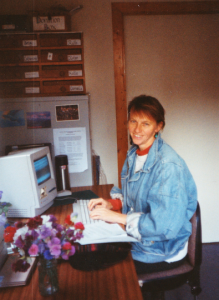
- FBHHC Katie in the office next to the General Office
The Findhorn Bay Holistic Health Centre (FBHHC) offered a wide range of services in traditional and complementary medicine with a strong emphasis on preventative care.
The practitioners offering those services formed a dynamic peer group for professional support. This resulted in a Code of Ethics and Practice offering a complaints procedure for clients.
FBHHC provided hands-on care in community, and from 1996 held an Elders fund to be able to support this care financially. It organised an educational programme and international conferences; it also engaged in research. To create financial sustainability, it experimented with an innovative subscription-based Community Health Scheme.
For a chronological view please see Timeline for Health and Wholeness in the Community.
***
The vision
The article A Vision of Holistc Health in the OneEarth magazine by Cornelia Fellner (now Featherstone) described the beginnings of the FBHHC.
“The Holistic Health Centre will provide professional health care for the Community and for the people in the local area. A team of practitioners (doctors, acupuncturists, physiotherapists, homeopaths, psychotherapists, etc.) will work within the new Health Centre offering traditional and complementary medicine merged with spiritual awareness.”
This vision was not new, it has been around since the 1970s, as described by Mary Inglis in Healing at Findhorn in the 1981 Health and Wholeness issue of OneEarth. which shows the range of healing modalities at the time. What was new was the people who embarked on this journey together, and for a time manifested that vision in The Park, before things changed again.
The Team
In June 1990 the two Health and Wholeness focalisers in the Findhorn Foundation, Dorothy Noble in The Park and Cornelia, in Cluny, decided to join forces and create one Holistic Health Department (HHD). HHD benefited from the services of several professional practitioners in a wide range of therapies (including osteopathy, acupuncture, psychotherapy, massage, orthodox medicine, naturopathy). Soon thereafter the team grew with some dedicated volunteers and later part-time staff to anchor the vision and create the different aspects of the services.
The facilities
In our post From Merlin to Meridian, Cornelia reflects on the manifestation of the treatment centre in one of the first eco-houses built in the Bagend Cluster, a residential area of The Park. So in August 1991, the Findhorn Bay Holistic Health Centre was born.
-
- FBHHC Meridian office practitioner booking room – Sabine Hildebrandt Katie Lloyd
-
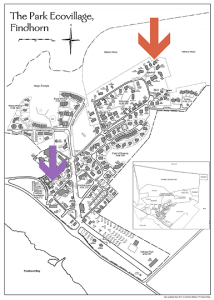
- FBHHC office and Meridian on Park Map
-
- FBHHC Katie in the office next to the General Office
As this was not easily accessible, the FBHHC reception was moved to a central location of The Park in 1994, where staff was on hand every weekday morning for drop-in chats, for practitioners to book treatment rooms, for clients to make appointments for treatments/consultations, and for members to book educational workshops. The Holistic Health Education, the conferences and much more were organised in that little office.
As we were aware that the far corner of Bagend was not very accessible to the general public given the largely sceptical view of the Community locally, we started to look at more easily accessible sites for a purpose-built holistic health centre.
Minton House, a beautiful big mansion just across the road from The Park, had been operating as a healing and workshop centre for years. The owner, Judith Meynell, was inspired by the vision and plans took shape to build the new health centre in the grounds. Katie Lloyd reported about this in the One Earth Magazine no 06 in Spring 1992: A Vision of Holistic Health: Grounded and Growing.
However this sadly triggered the ire of a close neighbour and started him on a campaign to ensure that the Findhorn Foundation and the ecovillage (he considered them one and the same) would not expand. This caused a lot of problems for various organisations and conflict in the local area. Thus the attempt to build in Minton grounds had to be abandoned, as it was paradoxical for a healing centre to contribute to strife with the neighbours.
In late 1993 doors opened for another possibility, even more accessible. It was premises with an established successful osteopathy practice in 5 Bank Lane in the centre of Forres. Katie Lloyd who was working for FBHHC at the time wrote Healthworks Goes to Town in the OneEarth Magazine no 15 Autum 1994.
For the collective autobiography we created a more detailed summary in the post Healthworks Holistic Health Centre: 30 years of Resilience and Service in Forres.
The concept and services
It was our mission to provide health care integrated in the fabric of community life in as many aspects as possible. The concept evolved through collaborative explorations amongst the many health care practitioners living and working in the Community, as well as through international conferences that brought visionaries and pioneers together.
Over the years the evolving concept has been described in several publications which we have been able to offer on this website:
- A Vision of Holistic Health (1990) by Cornelia Featherstone
- A Vision of Holistic Health: Grounded and Growing (1992) by Katie Lloyd
- HealthWorks Goes to Town (1994) by Katie Lloyd
- The Healing Potential of Community conference report (1995) by Holistic Health Care
- Medical Marriage: The New Partnership Between Orthodox and Complementary Medicine – various authors (conference report, articles, book chapters)
- Healthcare: integrated in the fabric of life (2000) by Cornelia Featherstone
- A Healthy Community (2001) by Cornelia Featherstone
- Complementary Health Services and Care in the Community (2002) by Cornelia Featherstone
- Healthy Living in Community (2008) by Cornelia Featherstone
In the seven years that the FBHHC was operating it provided a wide range of services.
Complementary therapies:
A large number of health care practitioners (complementary and orthodox) lived in the Community and the surrounding area and provided treatments and therapy in Meridian, the Bodhi Room in Cluny and other treatment spaces.
Supporting self-care
Holistic health care of course starts with each one. Our approach emphasised self-responsibility and co-caring.

The-model-of-integrated-healthcare – wellness
To support that the FBHHC provided a comprehensive workshop programme in two terms (Spring and Autumn) to give access to education in self-care techniques such as Touch for Health, Co-Counselling, stress management and others were an essential part of community education throughout.
Community Health Scheme
A subscription health scheme was started in 1991. For £5 per month, a member was entitled to choose one taster treatment every month, one health workshop in the Holistic Health Education programme, and an annual health overhaul by Cornelia Fellner (later Featherstone, a qualified GP) for free. The taster treatments were gifted by the complementary practitioners associated with the FBHHC. More more information please click here.
Practitioners Group
Another aspect of the work of FBHHC was coordinating complementary practitioners. In 1991, a small number of complementary therapists were inspired to develop a Code of Ethics and Practice to safeguard high standards of care and safety for their clients. Practitioners signed up to that code were listed in a complementary Practitioners Directory, this has evolved into the Moray Complementary Therapies group which is still serving the whole population today.
Code of Ethics and Practice
From 1991 practitioners were meeting to support each other in their professional practices. In that context awareness grew that some were registered with professional bodies in the UK that offered clients the safeguarding of a complaints procedure, whereas others weren’t. Some of those were from overseas and their qualifications did not translate to UK professional qualification, others were in the UK for too short a time to warrant the application expense and effort. Courtenay Young and others formulated the idea of safeguarding clients and the group set out to formulate the Code of Ethics and Practice which has been reviewed over time and is still in place.
The Code Of Ethics Of The Complementary Health Practitioners In The Findhorn & Forres Area
(revised version June 2017) – please click the arrow to the left to expand the text
This group is also a member of the New Findhorn Association’s Forum of Organisations and adheres to their Ethical Principles. See findhorn.cc for details.
Aim:
The aim of this code is to serve the best interests of clients, practitioners and the community. Its purpose is to bring clarity and awareness into our complementary health and healing services.
In case of illness we strongly recommend that you see your doctor first before making arrangements with any other practitioner.
Complementary Health Practitioners:
Practitioners from many different backgrounds are gathered with the common purpose of ensuring quality of health and healing services.
Some of the practitioners have completed a professional training in the area of services offered and maintain a professional practice. They usually
a) are registered members of a professional body
b) have access to on-going professional support and supervision
c) have professional indemnity insurance.
They are committed to discussing their training and professional background (incl. insurance and supervision) openly and at anytime it is requested.
Others are lay practitioners with a reasonable degree of experience yet who may or may not have trained extensively in the area of service they provide. They offer the service of nourishment and relaxation as a measure of health maintenance. This is an important part of the local culture and a positive way of maintaining health and offering care and support within the community. Their services should not include any medical treatment, diagnosis, any administration of drugs or remedies (allopathic, homeopathic or herbal) – with the exception of the external application of commonly used preparations for massage and flower essences etc. They should not include deep emotional work as the main focus of their practice. These healing services are not considered as a professional practice. The lay practitioners are committed to discussing their training and experience openly and at anytime it is requested. The information supplied in the directories and entries on our web site www.findhornpractitioners.co.uk should be sufficient to determine the levels of a practitioner’s experience and training.
We strongly advise clients to seek all the information they need to make a responsible choice for their needs regarding the service offered and the practitioner’s skill and experience, as well as taking responsibility during any treatment to make sure that they are completely satisfied with the service received.
The Code:
The Code of Ethics describes the basic ethical principles that all the members of the Complementary Health Practitioners group agree to and commit themselves to. It offers the inspiration of a joint commitment to excellence as well as the security of a complaints procedure to the client. The multi-disciplinary group monitors the Code of Ethics. These principles still apply if we are offering training, supervision or support, in groups or individually.
The individual practitioner’s Code of Ethics supersedes the Code of Ethics of this practitioners group. For example in the case of body based therapies the Code of Ethics of the professional body the practitioner is registered with, will inform the way in which touch is directed in a session.
Ethical Principles:
The Therapeutic Relationship Between Practitioner and Client:
1. We acknowledge that the relationship between practitioner and client is a special one and must serve the best interests of the client. A good working relationship is an essential part of effective treatment. The practitioner carries certain responsibilities and any exploitation of this position or oppression of the client is unethical. Sexual activity between practitioner and client within this relationship is totally inappropriate and unethical. Affectionate gestures, such as hugging, may be used in a sensitive way and only when acceptable to both parties. We will ensure that satisfaction of our emotional needs does not intrude on the relationship.
2. The clients dignity and integrity must be respected at all times. We affirm the client’s right of self-determination. One goal of our work is to enhance his or her progress in the direction of self-responsibility. The client always has the right to refuse or terminate anything proposed or undertaken by the practitioner. We make this explicit at the beginning of the relationship.
3. The practitioner and client make a mutually acceptable clear contract which addresses precisely and openly the questions of fees, time involved, frequency and number of sessions, technique of treatment, limits and ground rules, confidentiality, availability of follow-up, referrals etc, as appropriate. We make available to the client the Codes of Ethics and Practice we work under. The same applies to the contract between teacher and student for those practitioners also offering workshops and training.
4. We recognise that there can be a duality of roles wherein a possible conflict of interests may occur. Wherever this is applicable it will be discussed openly before any treatment starts. It is our responsibility to make boundaries explicit and clear. We retain the right not to work with certain people but not in a way that results in unfair discrimination.
Confidentiality and Records:
5. The relationship and all knowledge of the client is treated as confidential by the practitioner and may only be disclosed with the client’s specific consent or – if there is a clear evidence of probable serious danger – to the client or others. For supervision, research, teaching and publication purposes the identity of the client must be concealed.
6. We keep records of the sessions in a confidential and appropriate way and our records about the client should be available for their inspection.
Practitioner’s Support and Further Education:
7. Each practitioner carefully monitors the limits of their own competence and confines their work within these limits. We commit to getting extra support and supervision as required.
8. We commit ourselves to:
a) maintain and extend our knowledge and skills appropriate to our practice;
b) getting extra support and supervision as required.
c) pursue our personal growth, spiritual practice and the fulfilment of our personal needs outside our complementary health practice.
Advertising:
9. Advertising will be confined to descriptive statements about services available and details of methods and qualifications, without comparative evaluation or extravagant claims about the efficacy of our practise method.
Hands-on care
Responding to individuals in need, FBHHC staff and volunteers expanded their capacity to provide effective support.In the early 1990 a culture shift took place gradually from a ‘working community’, where those who couldn’t ‘pull their weight’ would leave to avoid being a burden to a ‘cradle to grave’ community. The appreciation grew of the gifts of olders, or elderberries as we like to say, bring to the wholeness of life. And whilst still today some people worry about being a burden as they grow more dependent, many have experienced the joy of helping others, so that they can surrender to accepting help when they need it.
“What’s the bravest thing you ever said?” asked the boy.
“Help” said the horse.
“Asking for help isn’t giving up,” said the horse,
“it’s refusing to give up.”
from The Boy, The Mole, The Fox and The Horse by Charlie Mackesy
One focus was on enhancing the sense of neighbourhood and friends’ networks for support to become part of the ‘natural’ social environment. That way allows for co-caring which validates the contribution of everyone however big or small, softening the dynamics of giving and receiving, making it more of a two-way flow. The approachability of the FBHHC office each workday morning was a great way to created safety netting. This was also supported by a dedicated group of volunteers called the People Care Circle.
People Care Circle
Through knowing those Community members who had some aspect of need, the volunteers in the People Care Circle, could gently affect changes, lend a helping hand, or even step in a more upfront way to try an avoid crisis situations. The group regularly met, and we called it ‘lovingly gossiping’ when we shared about concerns and strategies to care. This continued well beyond the closure of the FBHHC and into the Caring Community Circle until 2020 when another culture shift occurred. Throughout the proceeding years the People Care Circle functioned on the strength of the personal relationships and the professional standing of the volunteers, many were practising or retired healthcare professionals. As the Community grew, and that first generation dwindled either through death or ill health, a new generation of volunteers was concerned that the practice of ‘loving gossip’ contravened the Common Ground and the right to privacy. The People Care Circle was replaced by the CCC Taskforce, and the CCCoordinator always gets written permission before any details are shared with the volunteers.
Eldersfund
This financial safety netting was set up by Eileen Caddy and Barbara Faro (now Vincent) in 1996 when Joanie Hartnell-Beavis required nursing care. Barbara tells the story of that fund, it initiation and long-term service in the post entitled Care in Community – Funding. The aims of the fund are to support care in the community, both financially where statutory support is not available, and also in ‘infrastructure’ (such as equipment, and by supporting the Community Care Flats through a loan).
Education
Learning on all levels is a central aspect in our concept of holistic health care. For the individual education can help to meet life’s challenges in ways that help them to grow. Through the journey of the conferences we evolved our definition of health:
Health is the ability to respond to all life situations in a way that increases
capability, responsibility, autonomy, spontaneity and joy.
(adapted from the Peckham Experiment)
For practitioners learning is also essential to support them to evolve their practice, to stay current and grow personally and professionally. That way they can be nourished by their work as they serve their clients and the population. The Findhorn Bay Holistic Health Centre wanted to learn from and with the clients, practitioners and other inspiring projects in the field of holistic health care all around the world.
Therefore we developed an education programme here at Findhorn and helped organise international conferences throughout the 1990s. We also took part in several research projects.
Workshops
Katie Lloyd developed a comprehensive programme of workshops in two terms – Spring and Autumn:
– Local practitioners offered introductions to their modalities.
– Trainers came to provide introductions and professional trainings in different complementary approaches
– Self-care through meditation, exercise, and also a lot of fun
International conferences
 We wanted to learn from other visionaries and practitioners in holistic health care as well as provide a nurturing environment for those professionals to learn from and with each other. The first conference we held was in 1992 Holistic Health Care for the 21st Century. Our dream to co-create a concept for an inclusive model of care came to fruition through a series of Medical Marriage conferences (1994, and 1996).
 The conferences fed into a textbook for healthcare professionals by Findhorn Press in 1997. Medical Marriage – The New Partnership between Orthodox and Complementary Medicine by Cornelia Featherstone and Lori Forsyth.
 The Healing Power of Community conference in 1995 brought us in touch with many other projects. One of the most impactful influences came from the learnings about the Peckham Experiment – a very inspiring concept from the 1920s and 30s in London which put health at the centre of care, rather than disease. This concept was actually on the table for the British Health Minister, Aneurin Bevan, to consider in the mid 1940s. Sadly he plumbed for a service that focused on disease care, and so, what we now know as the NHS came into being. We can but dream what the state of health of the population would be if the concepts of the Peckham Experiment had been implemented.
In 1998 many of FBHHC staff and volunteers were involved in the conference entitled Conscious Living Conscious Dying.
Research
The FBHHC was very keen to develop their services in close contact with the Community, both practitioners as well as ‘client’. Much reflection occurred informal meetings in different group settings in a culture of cyclical planning-implementation-review processes.
Two more formal surveys were undertaken:
– in 1996 a medical student, David Ponka, from McGill University, Montreal, Canada stayed for 2 months to conduct A Survey of Attitudes towards Health and the Community Health Scheme within the Findhorn Foundation.
– In 1997 we surveyed the olders/elderberries – this resulted in the publication of a paper The health needs of elders within an intentional community – by Cornelia Featherstone and Peter Michael Forster in Community, Work & Family Vol. 3, No. 1, 2000
Organisational structure and finance
From Findhorn Foundation work department to charity
The early days of working in the FF Health and Wholeness department are described in the story From Merlin to Meridian.
In 1992 the FF went through a restructuring process and asked several departments to ‘go independent’, the Holistic Health Department was one of them. We collaborated with others who were ‘going independent’ and came up with the legal structure of a company limited by guarantee with charitable status. Holistic Health Care Ltd. was incorporated on 25th February 1993. The first board of directors was: Alan Gerald Jacobsen as chair, Ronan Tyer, company secretary, and FBHHC staff/volunteers Cornelia Juliane Fellner, Dürten Inge Lau, Kathryn Margaret Lloyd and Ruth Pfitzenmaier.

HHC Ltd founder directors 1993: Ronan Tyer, Cornelia Featherstone, Ruth Pfitzenmaier, Alan Jacobsen (back), Dürten Lau, Katie Lloyd (front)
-

- Setting up HHC Ltd Ronan Tyer, Jerry our accountant, Cornelia in Meridian photo HHC Ltd
-

- HHC Ltd chair of the board Alan Jacobsen
The history of the charity is summarised in our post Healthworks Holistic Health Centre: 30 years of Resilience and Service in Forres.
Findhorn Bay Holistic Health Centre finances
As FF work department Health and Wholeness was supported through the provision of treatment facilities (at Cluny and in The Park) and a small allowance for the staff members working in the department. Treatments were offered for free or by donation, treatment rooms were available for hire by practitioners. Any income was FF income, some of it – by negotiation – was set aside for improvements of the departments in Cluny and at The Park (from 1990 one joint department). This principle stayed even when the names changed – to Holistic Health Department and then Findhorn Bay Holistic Health Centre.
When the transition into ‘independence’ was requested by the FF, the Community Health Scheme was already under way. The FF Management Group chose to take out a ‘bulk subscription’ for FF members as a mechanism to ensure that the services previously provided continued to be available for staff and guests from the new charity Holistic Health Care Ltd.. This gave FF members access to the benefits of the scheme.
Over the next couple of years the FF first reduced and then ceased that payment and prioritised providing the services in-house. This created a two-tier provision of care which persisted throughout the years. It left the new charity in a vulnerable financial position. The FF continued to support the office by allowing us to use it rent-free.
The Community Health Scheme, supported by the practitioners volunteering their service, plateaued at about 130 individuals making the provision of the scheme marginal. The vision that the Community would carry the healthcare provision as part of a caring community culture did not come about.
The treatment rooms at Meridian brought a steady basic income. Educational Programme and conferences covered their cost but did not contribute reliably to the overheads.
The overheads were substantial. Despite Patricia Sankey’s generosity to allow FBHHC the use of the ground floor of Meridian rent-free, we still needed to cover energy and other costs. The staff was working for very little money, at a time before minimum wage, but nonetheless this was a regular significant cost.
In the end it was the income from the private medical practice of Cornelia Featherstone, who was (low) paid staff, which was essential for financial survival.
The end
Several converging factors led to the winding down of the Findhorn Bay Holistic Health Centre in 1998.
Key personnel changes included Katie’s relocation to Erraid, necessitating the sale of her share in Meridian. Additionally, Patricia needed her capital returned, prompting the sale of her portion of the house. Dürten’s transition to a staff role at the Findhorn Foundation. Cornelia was embarking on a sabbatical with her family, and felt ready for something new to come back to (she went on to working as GP in the NHS in 1999).
Furthermore, the growing trend of practitioners working from home and the presence of HealthWorks in Forres lessened the need for the dedicated treatment rooms.
We released the Findhorn Bay Holistic Health Centre in a beautiful ceremony and moved on.
-

- FBHHC closure ceremony 1998
-

- FBHHC closure Dürten Cornelia Katie
The little office next to the General Office became the Park Campus Office of the Findhorn Foundation and Dürten returned there when she was Park Focaliser. The quality of ‘drop-in’, care and awareness remained as part of the fabric until its closure in 2023.

photo Adriana Sjan Bijman
***
Photos: Holistic Health Care Ltd unless stated otherwise.

Established in 1993 – supporting holistic health care through a treatment centre, education as well as choice and financial support.



Leave A Comment