


This tribute was previously published in One Earth magazine, Issue 9, Spring 1993.
***
One year ago, on March 1, 1992, long-time member of the Findhorn Foundation Fred Barton died at the age of 86. He came to the Foundation in 1976 with his wife Rowena, his son Dick, daughter-in-law Anna, and four grandchildren. Officially “retired,” he focalized the Park garden, landscaped the quiet gardens in Pineridge, and joined Dick at Cullerne Garden in 1978. In 1983 he married his second wife, Lynn, and together they worked at Cullerne until his death.
You were 76 when we met. I missed most of your life. We shared eleven out of your 86 years. Those eleven years were a wonderful gift. You gave me so much: the knowledge that I could really love and that I was deeply loved and cherished; a sense of complete at-homeness with another person; real intimacy, emotional and physical; the sharing of interests—gardening, travel, books, crafts, nature, humour, and food.
You were my husband, teacher, lover, friend, and child. We were in the centre of each other’s lives and perhaps it was all possible because we knew it wasn’t forever—not forever in this life.
You were loved and respected by many people who came in contact with you in the Foundation’s gardens. They appreciated your knowledge and love of plants, gardens, and nature. They told me in cards and letters after your death how they saw you as an example of love in action in the natural world.
Your eyes were always sharp, your interest in nature keen. You noticed when next year’s buds formed on the trees, where the wagtails made their nest, the exact furthest point where the sun rose in mid-winter before beginning its journey south.
Gardening and the land were in your blood. You were proud of being the fifth generation of Bartons who were gardeners or countrymen. You knew the Latin names of most plants and taught me patiently, making it a game. Then you began to forget them. That bothered you more than forgetting a person’s name.
You were not sentimental about nature. You cut down trees when they grew too large. You pruned vigorously when necessary. You pulled out bedding plants when the tulip bulbs needed to be planted in the autumn. You crushed greenfly with your thumb. But when the blackbird nested in the greenhouse jasmine, you made sure the door was always open a crack so she could get in and out. Your touch with seedlings was always delicate and loving. After brunch on Sundays you liked to walk around the Park garden. You always stopped in front of Ross Stewart’s bungalow and said, “Those trees were only that high,” holding your hands three feet apart, “when I planted them.” Recently one of those trees was cut down. You would have approved; the time had come.
People remember you as a patient teacher. You were a Scorpio with a sting in your tail and your patience had its limits. Anyone who really wanted to learn could have unlimited amounts of your time and attention. Having your advice ignored hurt and angered you. It was only in the last few years that you learned to shrug and not take it personally when someone chose to do something different.
People probably remember you most at Cullerne. Each spring you sowed thousands of seeds in the greenhouse. In late summer you cut the long grass with a scythe so rickety that it fell apart if anyone else touched it, but you used it so skillfully that we paused to watch and listen to the gentle swishing of the blade through the grass. Much of your last summer you spent working on the water garden—your last big project. You laid the heavy stone edging. You waded in the pool fishing out sycamore and poplar leaves and launched baskets of waterlilies in the deep end.
You were a proud man; rightly proud that you could compensate for waning strength with skill and knowledge and a careful pacing of yourself. “It’s no use getting old, if you don’t get artful,” you said.
People remember your jokes, although your wit was so dry it was often taken seriously, even by me. “Pull her leg and it comes off in your hand,” you said. In the early days of the garden school, you led the garden students in the Hall for a Friday night sharing, wearing a kilt and swinging a large cabbage mounted on a stick, like a sergeant major at the head of the troops. Bagpipe music issued from a cassette player which you wore like a sporran. You liked to recite Stanley Holloway’s monologues—Brown Boots and Albert and the Lion—and sing music hall songs with innumerable verses and questionable taste—Our Poor Pussycat Died Last Night and The Rotten Egg Song.
You were always unpredictable and never boring. When we went grocery shopping it was your job to push the cart while I rushed ahead serious about shopping. Sometimes you followed sedately. Other times I turned around to find you pushing the cart sideways or waltzing to the store’s muzak.
We had bad times as well as good—a serious car accident, the caravan burning down, troubles at Cullerne, your diabetes and circulation problems, and having to put down our little dog Bryn.
You were never philosophical about winter. You hated the cold and the damp that swelled your fingers with chilblains. The grey rains of November depressed you. But you always rallied and took out your watercolours, pen, ink, or pastels. You borrowed books from the library, studied seed catalogues, and went out faithfully to check the greenhouses and attend planning meetings at Cullerne. We escaped to Florida whenever we could, where in your eighties you tasted shrimp creole, lazed in a jacuzzi, slept on a waterbed, rode a three-wheel bike, and saw an alligator—all for the first time. You danced to the big band sound and exposed your knees to the sun.
You were always interested in life. You lived fully, with humour and grace. Your dying of leukaemia was not easy, but you prevailed. You were always strong-willed. Six weeks in hospital was more than you could stand—losing charge of your life, cut off from nature, no fresh air. In the end, you refused food, water, and medication. You pulled out your saline drip. Finally, in words, you told them what I knew by your actions: “No more.” In those last three days family and friends came to Aberdeen to be with you—Anna, Tracey and Craig, Dick and Marnie, and friends from the Foundation. There was a meditation held for you in the Park Sanctuary. You were surrounded by the Light. The doctors stayed away. The nurses moved gently in and out of the room. One of us was always with you.
Your dying was hard physical work, but not, I think, painful. It was as though you were digging over a very large plot of garden. You were barely conscious, your breathing laboured and heavy, almost mechanical. You worked away for many hours, then suddenly your breath became soft and natural. I was holding your hand leaning toward you. You opened your eyes and as I said, “Yes—go, go,” you went. In that moment something very special happened, another gift from you to me.
There was a memorial service for you in the Sanctuary a week later. You were very loved and honoured, and we were all very proud of you.
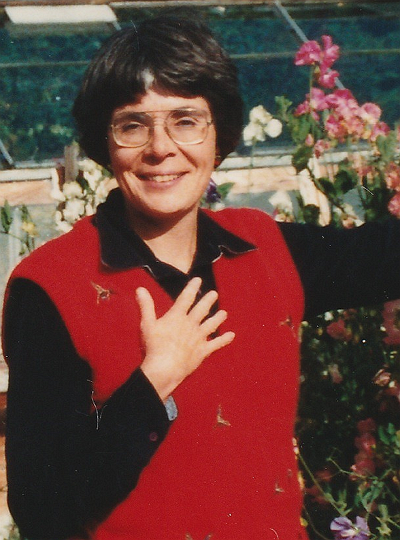
Grew up in Michigan, BA English & MS Library Science University of Michigan. 1983 married Fred Barton. Since 2004, BA Fine Arts Moray College, very engaged with painting,


I came to Cullerne Gardens knowing so little about raising food and gardening in general. I learned a great deal. Once, when I’d mixed up what type of tomato seedlings I’d repotted, I asked Fred if there was a way to figure out what was what. He stated, with a straight face, look at the fruit.