


(Editor’s note: We offer this manuscript in it original as a flipbook as well as below in sections – to read each section please click on the arrow on the left to expand the text. We have added some images from the archive to enliven the tour for our readers.)
EARLY DAYS: PRELUDE TO COMMUNITY
Peter Caddy, looking for work, decided in 1956 that he could manage a hotel, since he had been a commissary officer in the RAF over 250 catering officers and ultimately a quarter of a million men. He and Eileen were looking at what they could do with their lives together as spiritual partners. They had come together, Eileen had left her former marriage, and they were trying to feel their way as to what God wanted them to do.
So Peter went to a hotel chain owner, and basically talked his way into managing a hotel. The woman owner of the chain said, ‘That’s all well and good, sir, about your philosophy. But we’re in business to make money.’ And Peter right from the start talked himself up and said ‘Dear madam, there’s absolutely no reason why you can’t make money being spiritual. I will prove it to you.’ And he did. He was already working with the power of positive thinking; that was his spiritual training — Rosicrucian training.
So, the hotel chain decided to give Peter a chance, and the place they decided to send him was, accidentally, Cluny Hill, up in Forres, in Scotland. Peter sold brushes door to door in Glasgow that winter to make a little money before he and Eileen started their managership. He loves to regale people with how difficult that was, let alone thinking of managing a big hotel. Peter and Eileen came up to Cluny in the spring of 1957, walked into the building, and were shown their quarters: insignificant little quarters. Peter said, ‘No, we want the best rooms in the building.’ They decided that if they were going to work with perfection and with the best, they wanted to embody that in their vibrations and approach to life. That was the beginning with difficulties with the hotel chain ownership about managing the hotel.
-

- The Caddy family at Cluny Hill Hotel ©Findhorn Foundation
-
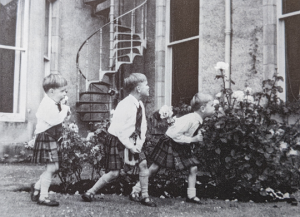
- Christopher, Jonathan, David Caddy at Cluny photo Findhorn Foundation
-
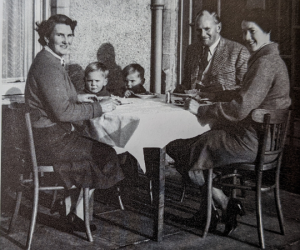
- Peter, Eileen, Dorothy and the 3 boys photo Findhorn Foundation
Peter and Eileen really tried to turn this place into something; in the five years from ’57 to ’62 they raised it from three-star to four-star rating, and trebled the takings within three years. They were very successful. They worked with the same principles that they later told the community about: how to live together; work is love in action; perfection in all things. That was how they wanted to live their lives. Use only the best — of materials, of attitude with people — and you will get only the best. They didn’t want anybody working here who was just working here for the money. They wanted a staff who would feel a loving connection with their guests — treat them like guests in a home. They established a great rapport with their staff, so for example every year in the springtime after the hotel had been closed over the winter, they would put flowers in the staff rooms. They would redecorate the staff quarters, paint them. So that when the staff came back it was, ‘Oh great, here we go again with Cluny’.
So things were going beautifully; they were making money and they were living a very fine life. Peter had bluffed his way into operating the hotel. He didn’t have a clue what to pay the staff. He asked Eileen all the basic questions, and she would get the answers from her guidance. There are many stories over the years about running Cluny on Eileen’s guidance.
One story: The head chef was something of an alcoholic, liked the bar. Some big night, I believe a Saturday night dinner — consternation. Somebody comes up to Peter; trouble in the kitchen. He goes into the kitchen. Head chef won’t put the meal out. He wants some whisky. Peter can’t get him to reason. There are guests waiting. Peter goes to Eileen: ‘What do I do?’ Eileen goes off to get guidance. Comes back and says, ‘Give him the whisky’. Peter gave him the whisky; the meal got out, right on time; everything went smoothly.
So the spiritual guidance that Eileen got had a double side to it. On one side it was really very practical, and the other side were the basic spiritual principles. Peter was fully trusting that Eileen’s guidance was of the highest, that her guidance was what they were supposed to be running their lives by, and that it was God’s word to them for whatever they had to do on the planet. And right now, within that time period from 1957 to 1962 it was, for whatever reasons, for operating the hotel. As we look back on it, and as they would look back on it, they would realise that this was preparation for community: working with a group of people, and looking at personality issues. Managing Cluny was like a mini experience of a community — a first step.
Then, to speed the story up a little, around ’60 to ’61, the hotel chain asked them to move to another hotel in their chain, the Trossachs, down in the Midlands, which was a more prestigious hotel, much more expensive; pony trekking and speedboat racing on the lake, and so forth. Wanted them to do the same magic down there that they had done here because the Trossachs was running into difficulty. But by then Peter and Eileen (and Dorothy Maclean who had joined them) were aware that there was something special about Cluny, that it was no accident that they had been led up here. They were aware of Cluny as a power point, and that there was something special about this place. They began to realise that it had something to do with their purposes in life, beyond the fact that they were demonstrating spiritual principles: running their lives, and the hotel, based on Eileen’s guidance. They felt a real draw to be here rather than any place else. So they didn’t want to go to the Trossachs, but they finally decided that, ‘Well, let’s give it a go. If we can bring the light out of Cluny, we can do it anywhere, and it would be a good experience.’
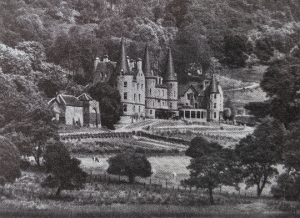
Trossachs Hotel 1962 photo Findhorn Foundation
They packed up and went down with some of the staff to the Trossachs. To make a long story short, they hit a black wall. They felt they had dropped into a black hole. The head chef said, ‘There is evil in these walls.’ It was as if they had been thrown into darkness; everything went wrong. The energy of the staff; the vibrations that they’d created as a team; problems with drugs and alcoholism. Peter and Eileen told the hotel chain, ‘This is wrong. Please put us where we’re supposed to be,’ and they basically insisted on coming back to Cluny.
That was part of the beginning of the end. When they didn’t do what the hotel chain wanted them to do, that also fed into the fact that by then Peter and the hotel chain owner had had quite a bit of a personality run-in over the years. As we all know, Peter is a man with a strong will and he always wanted things his way. There were instances like Peter ordering stainless steel gravy boats — new ones for the hotel. And he was sent porcelain gravy boats. He opened the boxes and saw what was in them and started breaking them one by one and said, ‘I wanted only the best, I will accept only the best.’
So for reasons like that, very bluntly they were fired, thrown out, had to be out by the end of the year. That was 1962. Stunned, they didn’t know what to do. But at least they did have by then a caravan, down at Findhorn village. So on November 17th, 1962 Peter, Eileen and Dorothy pulled their caravan up to the Findhorn Bay Caravan Park, and were given a dumpy old corner for it. They thought they were only going to be there for a few weeks, until the hotel chain owners came to their senses and realized how successful they’d been at Cluny and want them back. But they weren’t asked back. That’s a whole other story. The point is that they then had to re-establish their lives.
THE RETURN TO CLUNY
Thirteen years passed during which the community starts. People being drawn without the intention of starting a community, but in response to the principles that Peter, Eileen and Dorothy were using in growing their own food and making contact with the devic world. Seemingly all of a sudden Peter and Eileen realise that they’re involved with a community. Only afterwards did Eileen’s guidance confirm that ‘Yes, this is all a part of My plan, that you are creating a garden community on its way to becoming a village, on its way to becoming a city of light for the planet.’ Whatever all that meant they didn’t know, but they had to concentrate it there.
Every once in a while in those years Peter and Eileen would ask about Cluny. They were wondering about Cluny, because it was such a vital part of their experience. They knew they had something to do here, because Peter had been told: he was the caretaker of Cluny. They just knew that it was significant. Eileen would often get in guidance things like, ‘All is very well, you will return to Cluny soon.’ And, ‘Cluny will go down and down and down until it hits bottom.’ That’s basically what happened.
By 1975 the community was flourishing, with over 150 members. A PR man for an American woman guru came here, looked around, saw what was going on, asked to speak to core group. He said, ‘I don’t think you people realise what’s happening here. Paul Hawken’s book The Magic of Findhorn is coming out in paperback this year. You’re going to be inundated with thousands upon thousands of people coming here who’ve never heard of all this. You got a whole new clientele out there. What are you going to do? You have no place to put them.’
Peter thought about that, realised that it was true, and said, ‘Why don’t we check with the hotel chain and see if they might be interested in selling Cluny. It would be perfect for our needs.’ And of course privately he felt, ‘Wait a minute, is this the time for Cluny?’ So core group agreed, and they had the community’s solicitor call the solicitor of the hotel chain the next day and inquire if they might possibly be interested in selling Cluny. A pause at the end of the line, and the solicitor says, ‘Either you have a spy on our board of directors or you’re psychic, because we just this morning decided to sell.’ The reason was because Cluny had been going down, down, down, over the years. Until finally that year the thing that broke their backs was that there were new fire regulations for hotels. It would have cost them about £25,000 more in major renovation work, and they decided that with everything considered, it was too much; they wanted out. They made the decision, and somebody calls them up the next morning and wants to buy. They almost gave it away. There was no quibbling. For a place that we then had appraised for £1,500,000, complete with everything –grand piano, ban marie, table cloths, the whole thing — they were willing to sell for £60,000. And Peter, and Eileen too, then knew that this was it, this was part of the picture.
They had to convince the community about it. The community at that time was divided down the middle about that move. Making that decision was really the next major step in the growth of the community. ‘Do we jeapordise the quality of life we’ve got as this nice little family in the caravan park, all living together, all sharing with each other, creating a real family, to split and take on this huge project of running a hotel five miles away?’ What’s that going to do to the quality of life in the community?’ It was a major decision.
Peter and Eileen of course were strongly clear that it was supposed to happen. So Peter would bring community members over here, a dozen at a time and take them up to the power point and have them do a little meditation. And then walk them around to get the feel of the place. He wanted them to come to it from the inside, the way that he and Eileen had. This helped some, but still there was a feeling of, ‘That’s too much; who’s going to run it? How are we going to raise the money? What will having that debt do to us?’
This process went on and on, while Peter and Eileen went off to Australia on tour. Eventually the hotel chain said, ‘Put up or shut up. We have to move on this. We have to have an agreement or we’re going to put it back on the market and release our offer.’ A lot of hemming and hawing, a lot of meditating, and finally, ‘Let’s go for it.’ Some people said, ‘I don’t know that we can do it, but it feels that’s what we’ve got to do.’ Because others were saying, ‘Folks, we either grow or we die.’ There was something new being asked of the community. The way to grow was to have accommodation space for more guests and members. After an all day meditation, attunement and discussion core group finally made the decision to buy on November 17, 1975, thirteen years later, to the day, from Peter and Eileen’s move to the caravan park.
We took a loan from the Bank of Scotland, who knew by then that they could trust us. And we repaid it within seven years. Cluny paid for itself. It was one of those perfect timing things that the Findhorn story is full of. We had some individual financial help as well. A very good friend of the community who used a private suite upstairs for a while paid for renovation of the entranceway.
-
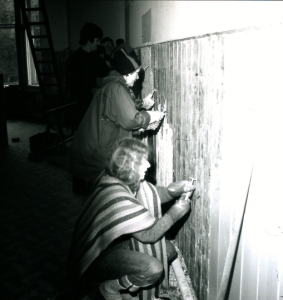
- scarping sanctuary panelling 1976 photo Findhorn Foundation
-
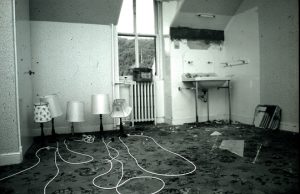
- old lamps at Cluny photo Findhorn Foundation
-
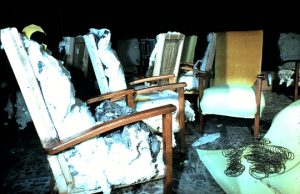
- refurbishing chairs Cluny photo Findhorn Foundation
With the decision made, renovating began that winter. We spent the first three months of 1976 on major renovation, coming over here to Cluny from the caravan park in the dead of winter. The place was a filthy mess. There was absolutely no reason to doubt why it had been going down, down. No energy in the place. The staff quarters downstairs were a trash, a total trash. And the kitchen, every place; it was just dead in the water. We came in here with crews of people every day, 15 to 35 people, attuning out on the parking lot in front. We hit the building: major repair on plumbing, putting in an extra boiler for being able to run year round, because we would have to operate year round; they had been geared only to run the normal season and then close in the winter. New linoleum going down in the loos, new hardboard and carpeting for the offices. Painting all over the place, everything had to be painted. The floors stripped down, and the wood brought back up with polish. Major furniture repair, especially for the staff quarters. On and on, a major repair. I came in mid-February, and became a part of the team repairing Cluny.
Come 1st April we opened. Part of the contract around our buying Cluny was that we had to honour the agreements already made by the hotel chain for the operations of 1976, which were to have coach parties coming through here. That’s how the hotel had made its money. A coach party will stay at different hotels touring around Scotland for 7 days, or 10 days, or two weeks. We weren’t sure as a community that we wanted to do that, but we had to agree when we made our decision that we would also run the hotel besides doing our own programmes that first year.
-
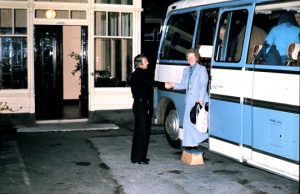
- Guest arriving at Cluny 1976 photo Findhorn Foundation
-
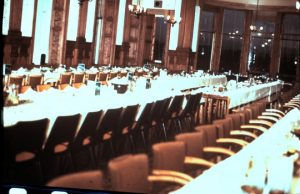
- Dining Room formal seating photo Findhorn Foundation
-

- Cluny Bar photo Findhorn Foundation
So from 1st April to the end of September we ran coach parties through here, giving them four-star hotel service. And was that wild, it was great. Peter asked me to be night porter, and I soon learned what that meant: getting up early in the morning and doing early morning teas and early morning wake up calls. We had to get the guests into their rooms with their luggage, and get them down into the lounge, and get them their meals. We served their meals four-star hotel style; three members to every table, holding the goodies and going around. Then clearing the dining room, and serving our vegetarian meals for the community.
For breakfast a three-man team would come over from the Park early in the morning and cook, because they liked the fact that they could eat the extra kippered herrings, and the bangers and the fried eggs. They would give the guests their breakfast and clean the whole place up. And then have our community breakfast — muesli and so forth. We were a bunch of amateurs, although a few knew something. Maggie and Ike had run a restaurant, and Ike was focalising the kitchen. We had one fellow who had worked in a restaurant and who was focalising the dining room. That was about it in terms of experienced help. The community was fantastic. People would come over from the Park and help serve sherry in the lounge for the coach party people. It was beautiful. It was one of those things where when you have to produce, you do. Some parties stayed one night, so it was just one dinner and breakfast; sometimes it was two days. Every once in a while there was a five day one. The people would go out every day and tour the area and then come back in the evening; it was that kind of rhythm.
We were flat out that summer. We had our programmes going on the same time that we catered for the hotel guests. We got a lot of good reports about that. I used to be on reception sometimes, and I would talk with the coach drivers. A driver would come back next time around and say that at the end of their tour quite often people would say that the best part of the tour was that ‘interesting hotel in Forres’. A number of times the people would be interested enough in what was going on that they would talk their drivers into taking them by the caravan park to see the community before they left the area.
CLUNY’S HISTORY
The hotel was known as the Cluny Hydro. They used to do water treatments here. It was not special spring water, but it was using water with high pressure hoses, baths, showers, and so forth. The Cluny Hydro was a healing place. It’s been used in the past during the wartime period as a hospice for soldiers. Parts have been added to it over the years.
The property also used to include the golf course. This was part of the hey day of people enjoying going to a really nice prestigious hotel for a holiday, including features like a golf course. But very early on the golf course was split off and became private.
-
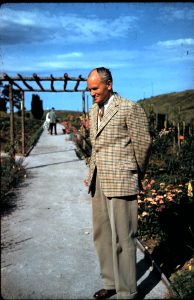
- Peter Caddy in Cluny Garden photo Findhorn Foundation
-
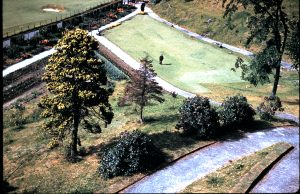
- Cluny view over lawn photo Findhorn Foundation
-
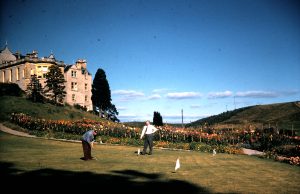
- Cluny putting on lawn photo Findhorn Foundation
The garden was beautiful, but very traditional. When we arrived we were faced with questions like, ‘Do we cut the espaliered apple trees loose from their traditional growing so that they can be more free?’ Over the years we’ve adapted the garden to our attempts at cooperation with nature. Not a lot of major changes have been made in the gardens from that time; it’s been kept pretty much the way it was.
A few years after we came here, during a spring festival, the gardeners spent three or four days quietly uncovering a former spiral walkway up to the power point, doing it in gentleness and peace, feeling their way, and ultimately uncovering the walkway. At the end of that spring festival, as a community we went up to the power point in silence and had an attunement.
We don’t really know when the spiral path was originally made; there are all kinds of sensitives’ comments about Cluny. Some people say this area is Druidic, of the pre-Christian era. The walkway of the trees in Cluny woods is said to be a Druid walkway. There are rumours that Cluny Hill was also visited by Jesus and Joseph of Arimathea at the time when Jesus was brought by Joseph to Glastonbury, that led to the establishment of the Christian church in the United Kingdom. The purpose for this we don’t know; some people say Jesus’ energy has been brought to this place, perhaps to reactivate it for this stage. It could be intuitive.
We also have the traditional story of the Viking ghost in Cluny. There can be some truth to that; this coastline was raided quite often in the past. There was a feeling that this Viking contact at Cluny had to be exorcised — the ghost of Cluny sent on his way towards the light. We’ve done little ceremonies to help him find the light, find his next step. As far as I know we have no ghosts in this day and age.
A TOUR THROUGH THE BUILDING
This is the main lounge. This is where the coach party people used to hang out in 1976, in the good old days, filling it with cigarette smoke and card playing and newspaper reading and window peering. They would peer out the windows at all the strange things going on in the halls: people hugging each other, laughing and so forth; wondering what these other people in their hotel were all about. It was really very funny. It was amusing to look in here and see them in their little life, living their life totally oblivious, some of them, to anything else, and some of them on the edges of it, beginning to be aware of strange things going on in the building, other than themselves. But their life was from the lounge, to the dining room, back to the lounge for tea afterwards, to their rooms; that was pretty much it. In those days, the community used the upstairs lounge, that later became the Beech Tree Room. The main lounge was strictly for the coach parties until the end of September 1976, when we reverted to community use of Cluny. Incidentally, the reason why things worked out so well about the cost of this place, is because since we are not open to the public, we are not a hotel falling under the same category as the new fire regulations for hotels. We didn’t have to do all the £25,000 worth of renovations that the hotel would have had to. We have in any case upgraded our fire facilities quite a bit, but have not needed to do the major renovation work, such as putting stairs outside the building.
We’re badly in need of a carpet in here. Quite often the guests are the ones who have given us the where-with-all to take the next steps in our renovations. They really love to help do something specific: ‘I gave that to Findhorn.’

Cluny Dining Room photo Findhorn Foundation
The major change in the dining room since ‘76 when we came in is the new tables. There used to be round tables; Joannie found these fantastic tables for us that now fit so perfectly in the dining room. This is a new carpet; and new covering on the chairs from the earliest days. The dining room can seat 150 people, and it can expand to be more. We often have the whole community over here for special events; with a lot of lubrication, 220 people will fit in.
The most dramatic event in here was the Cluny fire in August of 1982. To make a long story short: a fire was started in the dining room, in the main hallway, and in the Sanctuary. Even though it was caught in time by the valiant work of Eric Franciscus, there was terrific smoke damage. The whole room was black. The night after the fire, members and some guests stayed up all night to move everything out of the dining room into the ballroom, which we set up for meals.

Cluny dining room – cleaning the ceiling after the fire 1982 photo Findhorn Foundation
I had come back to the community after a year away, and this was what I was greeted with. I helped take over the reincarnation of the Cluny dining room. It was a great experience. We had to get it ready for October conferences, so had six weeks to clean the dining room and the main hallway; we had to release the Sanctuary restoration for later on. We got in here and did a huge scrub job. We repainted it and put up new plaster — a whole section had to be replastered, because it had been all torn down. At the end, we had outside contract help finish our plastering to give it a chance to dry before we had to open up. It worked out beautifully. It was a chance to reconnect with the building, with the dining room; to re-appreciate it. I used to start with sacred dances in here before we’d start work both morning and afternoon. Quite often other people in the building would come and join us. It was real high energies, a lovely feeling. A lot of the members came in at the end and helped do the final painting. That was their chance to break off from their own work departments and help with it. Up to that point it had been primarily a lot of guest help. Eric Franciscus, who valiantly put out the fire, then valiantly recovered all our chairs for us with the new blue covers. We barely finished; it was Friday afternoon, five o’clock, the day before everyone was to arrive for the Conference.
The fire destroyed a section of the wood around two of the windows, which was charred beyond keeping. Two sections were re-made by a local joiner in Elgin. He obtained the actual same type of wood, copied our old forms and just did a beautiful job. We were very lucky.
This is our stillroom. There’s a question about why it’s called the stillroom. Technically, my understanding is that because the company who manufactures this water heating equipment is Still & Sons, rooms like this are known as stillrooms. But I’m also told that there’s another more romantic reason. In palatial homes in the past there was a room where they did things kind of like Bach flower remedies for the lovely lady of the house. It was a gentle, peaceful place, and therefore called a stillroom. So for whatever reason, this is our ‘gentle, peaceful place’. It has been quite extensively renovated since our coming here. In the spring and early summer of 1983 we did a major renovation that sent Big Bertha, our dishwasher, to pasture and replaced her with Carl. The sprout section became much more extensive and the corner sprout cabinet was put in. And new cabinets, new floor, a new hot water still setup replaced the old one that used to leak constantly. This is where we have our late teas and fill our hot water bottles.
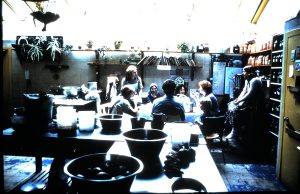
Cluny Kitchen attunement photo Findhorn Foundation
We are in the kitchen. When we came in here, in that winter of ‘75-‘76, it took us the better part of a week to steam clean all of the old grease and dirt and grime from all of the years of cooking fats and meats and so forth. Cleaning the walls, the ceiling, the floors — it was just one huge steam room for a while. Some renovation has been done since then. New tables, steamer. Our pizza oven has been a beautiful addition to life at Cluny. We can have our own bread and biscuits and croissants. The new floor was put in last year. We’ve been upgrading our kitchen facilities from the beginning. It’s of a size that’s served our needs well. Over the years we’ve been able to handle events that have cooked for as many as 250 people.
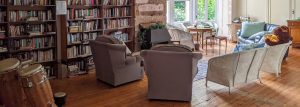
Cluny Family Room photo Cornelia Featherstone
This is the family room, downstairs in the basement level. There used to be a partition dividing the room. It was two rooms before with glass in between. Then somebody discovered that the fireplace was behind the wall. He spent some time uncovering the fireplace, and in so doing we ended up taking the wall out that used to be here. One side used to be the TV room, and the other room was mostly for family meetings, social events, and so forth. We decided from the very beginning to create space for the family living at Cluny — to give them their own space away from the guests, for relating to each other as family. It’s had various identities over the years: it has been a sewing room, and an art room. It never has totally taken on its full use. It’s often used for parties now, which were enhanced by the little family kitchen next door to it that we built when we came in in ’76. We thought it would be a good idea to have space where the Cluny family could have their own opportunity to have little dinners with each other and cook their own dishes, including meat dishes if they wanted to, leaving the main kitchen strictly vegetarian cooking. That was our choice as a community. If people wanted to host a private dinner down here, this would allow them to live in Cluny and feel that it was a home rather than a hotel.
Most of the stained glass that we have now was made by a member some years ago who lived here, and who was one of the first people in the community who helped us to look at, how we can be here in independent ways rather than just spending all our time in work departments. Could we do that? Could we support people to do the creative work? This person — Ione — chose to go independent, and try to make her own income and pay for her being here by selling her stained glass.
The famous Cluny boutique has beautiful stuff given to it. It enables the members to be able to afford to live in a community like this, and also lets guests and members find clothes for work and so forth. It’s very much a ‘put something in for people, and take something out for yourself that you need.’ Really works beautifully; it’s a good system. One night the night porter on his rounds found out that two people discovered where they could find some privacy in Cluny to carry on an intersocial relationship. And the poor night porter very gently came up the next day to somebody and said, ‘I’m not too sure what to do about a situation; what do you think I should have done.’ And I think he was pretty much advised by everybody. ‘Close the door and wish them well.’
We’re in the laundry. This wall between the laundry and boiler room next door used to be open, and we closed it up to keep out the noise and soot. The boilers keep this room as warm as it is; it’s right next to the heating heart of the community. We’ve upgraded the laundry room quite a bit from what it was originally. All of these machines are new. We have Silver, which does big loads; Rex which does personal loads, we have Leroy and Washington, our two dryers; we have Herbert, our little push-around; we have Dervish, our water extractor; and various and sundry humans. The laundry room is a vibrant part of a big place like this with a big turn-around of guests, having to wash all those sheets and towels and pillow cases every week. And it’s turned into one of the beautiful parts of the community. People enjoy coming down here just to be in here; for some reason, it has nice vibes.
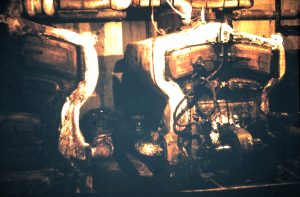
Cluny Boilers photo Findhorn Foundation
We used to take the guests into the boiler room, and finally I began to realise that they’d just walk in, look around, and when they’d come out someone would say ‘What’s in there, what’s in there?’ ‘Well, I don’t know, there’s a boiler.’ So we decided not to have the boiler room be a part of the tour after a while; it wasn’t worth it!
Moving upstairs again we’re now coming into the Veranda Room which is next to the Beech Tree Room. We have a few sitting rooms around the building that people can go and write letters and carry on conversations. Quite often this particular room is used by departments doing their attunements. This is a particularly nice room because of the view. In the early days we used to have cafe tables and umbrellas out on the terrace, and sit out there and have our coffee.
The library has both tapes and books — quite a good selection. Many tapes are by people over the years who have come here for conferences, and shared of their wisdom and inspiration. It’s a self-service library, has been from the beginning. I was the first librarian, besides my night porter duties. The library allows people to do some good reading and listening while they’re here. Almost all of the books have been donations. We have excellent libraries, both here and at the Park, based on contributions from former guests and from people from the outside. One of the beautiful aspects of life here has been that one way that people can support us if they can’t do so financially is to give us books. That’s really worked out well for us.
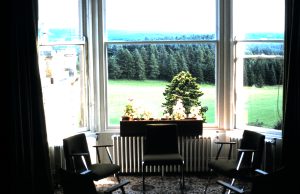
Cluny Sunroom photo Findhorn Foundation
The Sun Room is another example of a sitting room, so called because often there’s a lot of sun here. It’s been recently renovated, repainted. It has a beautiful view overlooking the front entranceway and the golf course, and is often used for interviews or attunements. During the winter a little cold.
Here in the Reception area, I’ll say something about Cluny time. We always tell the guests to be aware that this clock may not be right, but it’s right. That’s what we go by. The bus leaves by that clock and if you’re not here it doesn’t matter what your watch says, you’re wrong. And sanctuary starts by this clock, and so forth. The clock is over the door of the porter’s palace, which I named back when I took a look at what was being done to renovate it for me. It was an old hole when I got here, and since my night porter duties were going to require me to stay up at night cleaning the building and being security, some people thought that I should have a better space to live. So they did some wallpapering in here and created a nice little room for me, which I ended up never using to sleep in, because I was too busy working. It’s been turned into a beautiful place, where we store our house care facilities, and have our lost and found. The wine cellar is through the doorway in behind, where we keep our liquid refreshments stored.
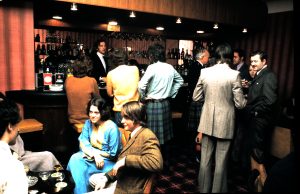
Cluny Bar photo Findhorn Foundation
The smokers’ room was originally the famous, or infamous, Cluny bar. This was used as a bar for quite some time after the community came in to the use of Cluny, particularly during our October conferences. Peter’s always been very strong about the value of the social time, and to him this room was as important as the Hall for the October conferences. He used to insist that we have late buses to bring people over from the Park so they could socialise after events and really get it together.
I had difficulties with this room and with our running a bar in a new age community. Then I was told a story once by David Wilkinson, a former member of the community, who is a Methodist minister. He was sharing once how he had felt the same way as I did. When he was a little child, about five or six, his father, who was also a Methodist minister, told him things about life; for example, ‘Don’t ever go into a bar.’ He remembers as a five-year-old boy wondering ‘Well, wait a minute. Why not? I might some time experience something in a bar that would be important for me. If I don’t open myself to life’s experiences, I’m not fulfilling myself.’ Years pass. He’s in the Cluny bar one night. A fantastic time going on after an October conference evening in the Hall. The place is filled with noise and cigarette smoke and drinks, and he’s in this conversation with Peter Caddy. And it’s one of the most profound conversations that he’s ever been in in his life. He’s really being moved. And all of a sudden, in the middle of it, he flashed on that five-year-old boy who had decided to go against his father’s wishes, and allow himself to be in a bar. The Cluny bar to him was confirmation of being open in life to experiences like that. So it helped me realise that yes, things can happen even in a bar. Later we clarified that our license didn’t really cover it for use as a bar, so it’s become the smokers’ lounge.
The ballroom is also a tremendous place for the community. We’re really blessed to have a room like this in Cluny. We’ve used it over the years for sacred dance, for profane dance, for special musical events, for sharings. This is the room that we used as the dining room while the dining room was being worked on after the fire. I’ll tell a little story about this room. Back in the days when Peter and Eileen were managing Cluny as a hotel, a party was going on here in the ballroom and some gentleman happened to make a comment in Peter’s hearing. He remarked, ‘Wouldn’t it be amusing to have a horse in a ballroom.’ Peter slipped out and made some arrangements and came back with a white horse, and that is the origin of the White Horse label for Scotch whisky. This very ballroom.
Room 7 used to be the office of the Game of Transformation. We used Room 8 as our sanctuary while the original sanctuary was closed up because of the fire. For years Room 8 was used particularly as the home of the LCGs in the building. Before that it was used for various things: a bedroom; a party room. We used to have birthdays for the family in here.
The Education Branch office was a bathroom turned into office facilities. A window was knocked out from a solid wall to let a little more light in here.
Here is our new age book shop. We’ve had a lot of good reports over the years about the book shop. People have been able to get books at Findhorn that they’ve not been able to get any place else. And of course we sell other things in here that help us get through our lives, like Ritter chocolate bars
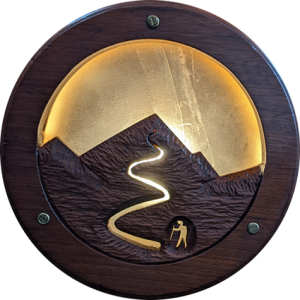
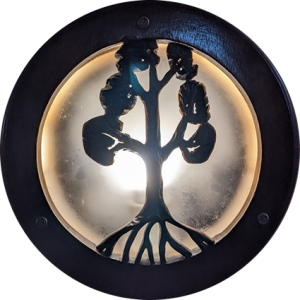
The woodwork covering the former blank window lights on our main stairway was done by different people who worked with different themes for each floor level. Three levels of very good woodwork now decorate this stairway.
The annex part of the hotel was built onto the original building. It used to be a part of the Cluny Hydro facility, where the shower stalls were, and the water setup for healing purposes. We had to pull out a lot of toilet and water facilities to convert the annex. Members quarters are down the back hallway. The Sanctuary was the former billiard room. When we came into Cluny it still was being used as a billiard room — of course some members of the community wanted us to keep it as a billiard room!
The sauna is back in the far corner of the annex. This was built around 1980, after a number of years of the members at Cluny wanting to be able to upgrade our personal life here a bit. Some members did a beautiful job of creating an excellent sauna and hot and cold showers.
And moving into the Sycamore Room, so named recently by a major renovation by Eric Franciscus and others, turning it from an old dump of a room into the room that you now see. The doorway in the back of the Sycamore Room leads into another room we call our Bodhi Room, which is our healing room for various forms of massage and healing treatment: Bach flower remedies, shiatsu, spiritual healing, polarity therapy. Again, this was all quite a hole, and when we first came into the community, and over the years, it’s finally had a chance to have some attention paid to it. This room was created around ’79 to ’80, and has been used for healing purposes ever since.
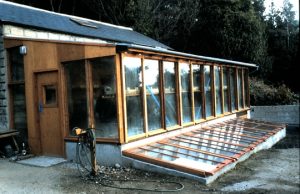
Cold frames next to the Garden shed photo Findhorn Foundation
The Greenhouse is used during the winter to cultivate for planting out in the spring, and also to grow plants for the building. To help us bring nature indoors, we have about 250 plants in the house.
At the side of the hill here, is the original deep freeze for the hotel. Then it had slabs of beef and frozen vegetables, and we turned it into slabs of bicycles, as our bicycle shed. It was quite a project to clean out all the former ice equipment and thaw it out with picks and so forth. We also use this area for storage for wood for our various fireplaces in the building.
Maintenance headquarters is right next to the potting shed. This has also been upgraded quite a bit over the years. This room used to be open into what we call Pathways which is our paint storage room, and furniture storage. By putting a stove in here it helped the maintenance department get some return on all of their good work in the house; we used to freeze in the maintenance department in the good old days. What kinds of equipment do we have? We have a table saw, band saw, some nice vices, a few drills. We just purchased a cordless drill, which is really handy in this building. And we’ve got a walky talky – called Pixie and Dixie – which is really handy for us. We’ve been using it quite a bit with the recent water problems.
(Editor’s note: This historic document A TOUR OF CLUNY with Stan Stanfield was initially transcribed and edited by Charles Petersen in February 1986. To allow us to create this post it was digitised by Liz Wigglesworth in 2023. When creating the post have added some images, mainly from the Findhorn Foundation Archive.)

After leaving university before graduation on a spiritual quest for Answers to Life, I am still here to help see in the New Age, which is getting closer by the day – and is NOT the ‘New World Order’.


Leave A Comment