


Click to see whole book
Click here to read the introduction to the series of posts relating to Decision-making Structures.
Historical Summary
From the outline presented above we can see that in general terms there has been a slow but steady movement away from the rigidly theocratic system which existed in the early days of the Community. This involved a series of steps in the direction of greater participation and inclusiveness such as publication of Core Group minutes, and certain focalisers being appointed in consultation with the body rather than directly by management. However, only rarely was there a clearly enunciated framework for decision making procedures to replace the one preceding it.
This was all very well when the transfer of power was from say Peter to Core Group, as there were very few individuals involved, and all had a relatively clear understanding of the process. However the situation became very confusing when this continued through a series of events that took place over twenty years or more, with no official documentation, and subject to varying interpretations.
Even this was workable when the main thrust of developments was clearly from autocracy towards greater community involvement. However at some point during the nineteen eighties the Foundation reached the point when the understandable desire of the body to have greater say in events began to conflict with efficient day-to-day management. Paradoxically a perception began to grow amongst Foundation ‘managers’ that too many decisions were being taken in a way that involved the lowest common denominator rather than the highest common factor, but at the same time, a feeling began to emerge in the body as a whole that the managers were becoming an unaccountable oligarchy.
This is part and parcel of the inevitable conflict between efficiency and participation, but what made the problem really intractable was that there was no suitable ‘constitution’ to fall back on. As the Foundation and Community diversified, the only means of deciding, for example, which groups should be allowed to come to certain decision-making meetings was to have the Management Committee reach some kind of arbitrary conclusion. Needless to say this state of affairs pleased virtually no-one.
Specific Issues
In order to resolve this deadlock we agreed to take a more detailed look at some of the specific issues involved. These seemed to be:
- Confusion about Legal, Spiritual and Administrative ‘realms’
- General Decision Making Procedures
- Line Management
- Appointments and Reviews
- The Roles of Foundation-Wide Meetings
We will look in some detail at each of these in turn, but first it will be useful to examine some of the general principles that the very process of exploring these issues turned up.
Some Important Principles
Simplicity
As Scott Peck has wisely pointed out, there is a very definite trade-off between organisation and genuine community. On the one hand we must organise ourselves to survive, but if we are to maintain the community spirit which provides one of our main sources of inspiration here, we must avoid any semblance of over-government. Thus even those members of the Community with a fairly analytical bent would view with absolute horror the thought of someone making a sensible and agreeable proposal at a meeting, only to have someone stand up waving a piece of paper, and quoting an obscure sub-section of our ‘standing orders’ which prohibited such an action, and throwing the entire meeting into turmoil and angst. As has been said about another such document:
“The Trust Deed does not capture the wholeness of what this place is about. The charity was set up to receive donations. The Deed specified what things could be done legally. However, the Spirit of Findhorn could not be encompassed by the Trust Deed (so said the Trustees at the time!) We must not hold onto it as our only measure, but rather must broaden our vision of what really takes place here.”
David Spangler to Education Group, 1993
A first principle in all the discussions was therefore that whatever solutions we arrived at should be in essence simple and easy for everyone to recall, rather than some sort of comprehensive written constitution.
Consensus
There are a variety of possible definitions of this word, and the one we have chosen may not suit everyone. However, from the start it was very clear that establishing some kind of agreed consensus was of great importance. Indeed the way in which these agreements themselves were arrived at were a powerful example of how consensus building can work.
This is not to say that by and large most Foundation decisions had not previously been made in a consensual way, but the creation of a clearly defined and explicit means of achieving it have, for the time being at least, increased the general level of confidence in our ability to achieve clear decisions on complex matters by this means.
Balance
We implicitly agreed that the tension between effective participation and efficient management was one which required a balanced solution rather than an extreme one. For example, as we shall see, some Foundation managers are appointed in an essentially democratic way, others whose jobs are of a more technical nature, are selected by Management Committee itself.
Goodwill
These procedures are designed for an organisation which expends considerable effort on community building, and most of the members of which have received some significant training. It is hard to imagine them working in situations where the level of goodwill is low, such as in most modern political fora.
Let us now return to the specific problems listed above. For each issue there will be a short description of the problem, followed by the agreed solution, and a short commentary about the way it was arrived at, and its significance.
Confusion About Legal, Spiritual and Administrative ‘Realms’
This challenge is the need to bear in mind that there are three distinct but overlapping worlds within which different procedures apply. It is important to have an understanding of the roles of the key bodies which inhabit them, and which exist to carry out our various objectives.
The Legal Realm
This is both the most durable and rigid of the three realms. The situation is very clear here. As a charitable Trust the Foundation is in law controlled entirely by the Trustees, who must act within the terms of the Trust Deed. The Trustees are formally responsible for the administration of the Foundation. The Trust Deed specifies the aims of the Foundation, and the Trustees must not allow its activities to go beyond either the bounds set out in that document, or the limits of financial prudence and legal propriety.
The Trustees accept that the Foundation is largely self governing, but no internal policy can ever over-rule the principle that any decision on any matter involving the Foundation can be made by a majority of the Trustees. Period.
There are normally about ten Trustees, some living within the Foundation, the rest elsewhere. The ‘internal’ Trustees meet at Findhorn regularly; the whole group meets twice a year. All of them have a long-standing connection with the Foundation, most having lived here for several years. Whenever one of the Trustees leaves the Board the remaining Trustees decide through discussion and meditation who, if anybody, should be invited to join the Board.
The Trust Deed also allows for the creation of a Management Committee to take care of the day-to-day administration of the Foundation, and specifies what it may or may not do. Note that legally speaking the workforce at large have no formal say whatever in the running of the Foundation although obviously the realities are more complex and inclusive than this.
In practice the Trustees tend to act as fail-safe on the overall system, rather than a hands-on management group. Nonetheless, in the Legal Realm, which is the clearest and most fixed of theses states, the situation is and was already perfectly clear.
The Spiritual Realm
This is at the opposite end of the scale to the legal. This realm is the most intangible of the three. Core Group is the Community body appointed to oversee our spiritual affairs. It plays an important part in ensuring that the spiritual integrity of the Community (as opposed to the legal integrity of the Foundation) is maintained at a high level. Here, we are all brothers and sisters in the One Light with total freedom. As in:
“He offered me no solution for any of my problems and He did not tell me what to do. The Masters never do. They never tell a disciple what to do or where to go, or how to handle a situation, in spite of all the bunk talked by nice, well meaning devotees.” Alice Bailey, ‘The Unfinished Autobiography”.
The spiritual realm is of course the reality which is hidden behind all the other facades in our life, but the set of issues under consideration here are not primarily concerned with the functioning of a ‘spiritual community’ in this sense. In fact they are about the third main realm:-
The Administrative Realm
This is somewhere in between the other two. It has a degree of structure, but this is for internal convenience, and the organs and personalities within it do not have a strict legal definition for the most part. This realm includes elements of compassion, caring and spiritual work, but it also demands clarity and an agreed line of authority to resolve problems.
The co-ordinating body for the Administrative Realm is the Management Committee referred to above. The purpose of this committee is three-fold.
a) to co-ordinate discussions of business that concern more than one aspect of the Foundation/NFD.
b) to make decisions for the whole in conjunction with the relevant managers/focalisers of the different aspects. (Although there is certainly wisdom in the adage that decisions should be taken at the lowest, rather than the highest possible level in any administrative structure.)
c) to perform certain duties on behalf of the Trustees e.g. approval of budgets and extra-budgetary capital expenditures. As a matter of policy two Trustees are required to attend any meeting where such decisions are made.
The members of this group usually include: the Focaliser of the Foundation; the Focalisers of the Park and Cluny Hill College; the Focalisers of the Personnel, Finance and Education departments; the Managing Director of NFD Ltd.
Solution – Hopefully, simply pointing out the potential for confusion that inaccurate perceptions of these realms can cause will be enough to remedy much of the difficulty they engender, and largely eliminate the problems posed by these apocryphal queries: –
Neophyte Associate – ‘I came here to join a spiritual community, why can’t I have a caravan and allowance like all the other members?’
Foundation Member – ‘What right do the Trustees have to discuss such and such? – it should be the members who deal with that issue.’
Trustee – ‘I don’t understand all this financial stuff – isn’t it up to the Community to decide how to deal with it?’
General Decision Making Procedures
This problem essentially concerned a failure of internal education. During the course of the nineteen eighties, most members of the Community generally believed that most decisions were to be made by ‘consensus’, without there being either a clearly agreed definition of the word, or an identifiable set of circumstances when a lack of consensus could still lead to a clear decision.
After some considerable discussion it was finally agreed that decisions at all meetings should ideally be made by unanimity, failing that by consensus. If consensus cannot be reached, the following applies.
Foundation and Community-Wide Meetings
If the chairperson of the meeting so moves, a decision can be made by a 90% majority of those voting, at a subsequent meeting.
The chairperson of a meeting who invokes a majority decision shall be required to place an article in the Rainbow Bridge[1] (or its successor) explaining the background, reasons and decision. This must be done both in advance of, and subsequent to the second meeting.
All Other Meetings
If the chairperson of the meeting so moves, a decision can be made at that meeting by a two-thirds majority of those voting. The chairperson is similarly required to advertise the background, reasons and decision.
It was further agreed that these procedures could be amended by a meeting of the Selectorate, but by a two-thirds majority, rather than 90% if required.
‘Consensus’ was defined as everyone involved agreeing to the course of action, or agreeing to be a ‘loyal minority’. A ‘loyal minority’ was defined as being made up of those who may disagree with the decision as such but who agree to support the enactment of the decision. It was made clear that it should not be composed of individuals who agree to go along with a decision but then act in a subversive way afterwards.
Commentary
Much of the discussion of these matters centred around how, if consensus could not be reached, a majority decision of some kind could be made. At first it seemed as if a simple two thirds majority would prevail in all circumstances. However, it was also proposed that for Foundation-wide meetings a 90% majority should be required. This created the spectre of 85% of those involved wanting to change these untested rules, but being unable to do so. Thus “Pierce’s Amendment”- the extraordinary solution of allowing constitutional change to be made by a smaller percentage than that required for an ordinary item of business – was proposed and accepted as a compromise to allow those who felt that 90% was too high a figure to accept the entire package.
It is interesting to note that so much time was spent on dealing with circumstances that most of those involved agreed were likely to be extreme. Instances of a formal vote being taken at a meeting of any kind in the Foundation are very rare, and I can recall only two or three of any significance which I have been involved in over the twelve plus years I have been active in the Community.
Those familiar with constitutions will note the absence of a quorum. This was generally felt to be unnecessary, suggesting a high degree of trust in those responsible for calling meetings (see below), and a low tolerance for those who fail to attend but complain afterwards about decisions made.
Finally on this subject, it is well worth noting that a majority vote, usually thought of as the pinnacle of western political process, and the safeguard of human rights, is commonly regarded as a failure here.
Line Management
One principle needs to be clearly stated before any sensible examination of this topic can be undertaken. Leadership and Management are entirely different functions. Leadership in a spiritual community can be assumed by anyone, who by demonstrating certain qualities of being, can provide inspiration and encouragement for others. It is a personal presence entirely independent of one’s job.
Management on the other hand can only be entrusted to a few individuals at a time. It is not possible for all of us to have an overview of finances, personnel needs, the quality of the educational programmes, and the state of the electrics in the Universal Hall. We therefore require some integrated system so that each individual knows how their tasks and responsibilities blend with the whole.
Like any organisation, the Foundation and indeed Community have their share of individuals who are suspicious of such management necessities. It is therefore worth pointing out that one of the most important features of new age consciousness is that it emphasises personal empowerment, co-creation and synthesis. As one experiences this, perceptions of rigid hierarchical structures imposing their will from above tend to diminish.
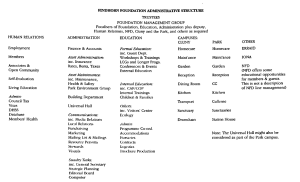
Essentially the problem to be resolved in this context was not one of lack of clarity, but lack of communication. The enclosed diagram represents the community structure as agreed at a Foundation-wide meeting in the spring of 1993 and later amended by Management Committee. Further proposals to amend this structure are covered in the section on The Role of Foundation-Wide Meetings below.
Appointments and Reviews
Most positions in the Foundation are filled by a process involving the Human Relations Department (a.k.a. HRD, or Personnel), the relevant area focaliser, and the individual themselves. This simple process needs no elucidation here. HRD have also recently introduced the practice of regular reviews for all Foundation staff. Some positions do however generally require a wider agreement. Prior to the following proposals being arrived at there had never been a clear set of guidelines to cover this subject. The notion at the heart of this section is then that there are certain prominent positions which need some kind of more public review if the management is to continue to receive the blessing of the membership at large. The following is an overview of the currently agreed system.
Foundation Focaliser Appointment and Review
The selectorate shall appoint the Foundation Focaliser, who shall also seek the approval of the trustees.
The Foundation Focaliser shall be reviewed by the selectorate every two years. Any individual receiving less than a two-thirds majority supporting them in the post shall be asked to step down.
Core Group Appointments
A Core Group shall be appointed by the Selectorate every two years by a method to be announced in advance by the Foundation Focaliser.
Managerial Appointments
The Park and Cluny Focaliser shall be appointed by their respective Families[2] with the approval of the Foundation Focaliser.
The Education Focaliser shall be appointed by the Foundation Focaliser with the approval of the Education Group.
The Administration and HRD focalisers shall be appointed by the Foundation Focaliser with the agreement of the Management Committee.
Managerial Reviews
The Management Committee as a group shall organise an annual meeting of the selectorate for the purposes of feedback, assessment and dialogue. Should any individual receive less than a two-thirds majority support in their post, the group which appointed them will be asked to review their appointment.
Commentary
The general principle at work here is that the Foundation focaliser is appointed by a widely defined group (the Selectorate) which incorporates not just the workforce of the Foundation, but also others acting in the role of ‘elders’. Part of the Foundation focaliser’s mandate involves being able to create a suitable management team who shall be selected in co-operation with the group of people they are both responsible for and responsible to. Such appointments will hopefully also give the incumbents of the various positions a clear mandate to get on with their jobs.
The procedures are then a mixture of collective involvement – (Foundation, Park and Cluny focalisers) and appointment by a group of colleagues or peers (Education , Administration, HRD). The importance of the former kind is obvious. However it was generally agreed that a process that resulted in all such individuals being appointed by the kind of ‘democratic’ collective selection process notorious for encouraging short-term popularity at the expense of long or medium term needs was undesirable. These two procedures are thus aimed at providing a suitable balance between participation and organisation.
A final footnote is that it was also agreed at some distant point in the past that the Erraid Focaliser should be appointed by the Erraid family, but he/she should also seek the approval of Management Committee.
The Roles of Foundation-Wide Meetings
This is a complex subject, and was clearly at the heart of much of the confusion which existed. The main remit of the exercise was to address these collective gatherings and determine:
a) Some suggestions for their administration.
b) A clear description of which individuals and groups are empowered to take which decisions.
c) An agreed list of subjects to be brought to this collective forum for a decision.
Organising Foundation -Wide Meetings
There are essentially four purposes for any meeting, or more accurately for any individual item on the agenda of a given meeting.
1) To provide social and spiritual interaction.
2) To disseminate information.
3) To receive feedback on a proposal or idea.
4) To make a decision.
The first item is fairly straightforward and easy to recognise. Meetings usually begin with a meditation, and end with ad hoc socialising, and sometimes these are more useful than the contents of the discussion itself. During the meeting warming up exercises are also frequently used, and the value of these should not be underestimated. Sometimes, in all frankness, we organise meetings just so we can be together – and why not, as that is surely the essence of community?
The second purpose of information sharing is self evident.
The third purpose of ‘testing the waters’ is similarly obvious, although sometimes the results come perilously close to a de facto decision.
The fourth purpose is the main subject of this section, but before examining it, it is important to note that these purposes are frequently confused. It is therefore an important part of any focaliser of a meeting’s task to clearly identify for all concerned which category any given event is in, both at the meeting and in the pre-meeting publicity. It is frustrating for both the managers and supporters of any given event for there to be misunderstanding.
It is also vital that as much information as possible about the topic be circulated in advance. Similarly, we sometimes have terrible failures of memory and communication because community meetings are not minuted or properly reported afterwards.
Attendance
As the Community as a whole has become more pluralised than once it was, selecting the appropriate invitees has become something of a learning process in itself. For example inviting ‘members’ is a guarantee of confusion – members of the Foundation, associates group, Community, public, etc.?
In all circumstances it is clearly important that those who call the meeting also make it clear in advance who is eligible to come, and who is eligible to speak, and who is eligible to participate in any decision making procedures.
After considerable discussion it was finally agreed that:
Attendance at Foundation meetings for the purposes of making a decision shall be open to:
To Speak and Decide – Foundation Members [3]; staff builders and Foundation employees who have completed an orientation programme.
Silent Observers – Others as invited from time to time by the Chairperson of the Meeting.
It was also agreed that
a) the chairperson of the meeting would ordinarily be appointed by Management Committee
b) the chairperson could invite individuals to assist in the facilitation of the meetings, and
c) that the position of Associates in regard to these meetings would be reviewed at a later date.
Appropriate Decision Making Subjects
The function of this section is to identify subjects which should come before such a Foundation-wide meeting for a decision. Given that almost all such decisions would probably otherwise be taken by Management Committee, what this boils down to, is ‘how shall management be accountable to the body as a whole?’
There was clearly a desire for Community meetings to be used for more decisions in a structured way. Too few would frustrate and alienate the congregation, too many would place strains on the organisation’s efficiency. Above all, lack of clarity about this subject confused everyone.
It was eventually agreed that:
Management Committee would be responsible for organising Foundation Meetings to decide upon a variety of subjects, including an annual budget, any asset sales of over £25,000, an annual agreement about priorities for the year ahead, and major land-use planning decisions (the full text is presented below).
Some of these subjects will probably be covered at the annual ‘internal conference’, when the Foundation personnel take a few days to be together, to review the past year and to set goals for the future. Some sessions are for Foundation staff and students only, and some are open to Associates and longer-term guests of the Foundation, depending on the issues or themes on the agenda.
Final Thoughts
There are a number of related issues which need to be addressed if sound decision making is to be achieved in any organisation. Here are few pitfalls to watch out for:
1) Firstly, leadership, as opposed to management was mentioned briefly above. If individuals in the organisation do not empower themselves, collective weakness is the only possible result. It is vital to stress once again the importance of taking individual responsibility for decisions and their consequences. It is a key to understanding Community life. If, to paraphrase Section 5, we believe in a Universe created by a God of Love who has offered us free will and the ability to determine our lives within certain self-imposed karmic restraints, then taking full responsibility for our lives must be a prime aim.
Conversely, when the going gets tough, it is all to easy for managers who are under pressure to get things done, to imagine that community opposition is created for reasons of personal malice. Sometimes individuals who cause a fuss over a particular issue are playing a role akin to that of a fuse – when they pop, it is to prevent worse damage happening elsewhere. When asked about internal dissent within the PLO, Yasser Arafat once said, “I am not a leader of sheep, I am a leader of freedom fighters. I am proud of opposition![4]”
2) Secondly, the above ideas put a certain onus on chairmanship. I believe that is as it should be. Those who seek responsibility should be given the appropriate authority to carry out their tasks. On the other hand, good chairmanship is not an innate gift. It can be learned, but if exercised ineffectively, no constitution, however simple or elaborate will save the day.
3) Thirdly, good decision making procedures are not designed to avoid conflict. On the contrary, they are designed to tease hidden conflicts out into the open where people of goodwill can listen to one another’s problems and then find appropriate solutions[5]. In other words they channel conflict in appropriate ways, rather than ignore it or cover it up.
4) We need to continually bear in mind that our work is part of a social and spiritual experiment; we are not cogs in some Divine Master Plan, deviations from which cannot be tolerated. A little humour goes a long way.
5) Rather than saying ‘No’ to a proposal, which might cause offence, we sometimes ‘turn it into a process‘ with no clear definition or decision attached to it. If an individual or group does not want something to happen it is usually better for everyone to be clear about that from the outset.
6) Similarly, difficult decisions sometimes hide behind ‘attunement‘. On the one hand we habitually use ‘attunements’ to reach decisions. This is right and proper practice for achieving individual and collective centring from which space good decisions can be reached. On the other hand it is profoundly disempowering to be told a group did not agree to your proposal because “we attuned.” It is better to avoid giving this as the sole reason for a decision.
7) The tyranny of the minority. If we are engaged in an important community building exercise then everyone’s contribution is obviously welcome. We need to take into account the ideas of the hurt, the wounded and the shy. On the other hand if 100 people are discussing the new bus timetable and you, and only, you don’t like the suggestion you might try going along with everyone else just to see what it feels like.
8) Finally, an organisation without a clear sense of purpose may survive, but it cannot thrive. All good job descriptions and the responsibilities they imply should relate to a central vision statement of some kind.
[1]The Foundation’s internal weekly newsletter.
[2]The Cluny family is comprised of those members of the Foundation who live at Cluny Hill. The Park family has a similar composition, although the more complex social conditions there have led to various precise interpretations.
[3] Again, this terminology has been overtaken by events and should presumably be amended to read ‘Foundation staff and students’ or some variant thereof.
[4]Television interview in 1993 shortly after the White House accord.
[5]Community practice has recently found an effective theoretical background to lend it credence in the work of Process Oriented Psychology, which encourages the expression of every voice, even those usually suppressed or dormant, so that an organisation or group can discover the true nature of the ‘field of consciousness’ they are operating in.






Leave A Comment