


This article was previously published in the One Earth Magazine Vol 4, Issue 2, December/January 1983/84, p 16+17
***
Interview with Otto Rigan and Mayme Kratz by Roger Doudna
For seven weeks, from mid-August till early October, Mayme Kratz and Otto Rigan from the United States, and Janet Banks from Erraid, joined the Findhorn community in its effort to complete the Universal Hall before the Wilderness Congress. Their task was the creation of a magnificent stained glass window in the main foyer, designed for us the previous year by sculptor/builder James Hubbell. It was a task to which they gracefully donated their own time and creative skills with unswerving dedication.
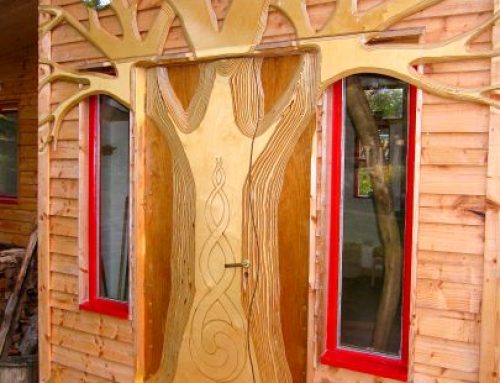
Having completed the whole window in exactly six weeks, Otto and Mayme then remained for an extra week to design and superintend the building of the foyer doors with their bejewelled stained glass angelic wings. The doors were completed at midnight on October 9, and the Wilderness Congress commenced in the Hall early the following morning. During that final week, Roger Doudna managed to catch them for an hour and to conduct the following interview.
Roger was the ideal person to talk with them, as he too was intimately involved with the window. He had fallen in love with the design the previous year, and when he heard this summer that Otto and Mayme had two months free in August and September and were willing to do the window, he and Terry Killam donated the money necessary for the project to go ahead. He also did the preliminary carpentry and facing work for the window, and shepherded it through the labyrinthine ‘highways and by-ways ‘ of the construction process.
Both Mayme and Otto have worked with James Hubbell for the past few years. Mayme did all the glass work for the elegant palace doors of Abu Dhabi, which James designed on commission from an Arabian Sheik. She is also a stained glass designer and artist in her own right, specialising in what she calls ‘kites’, ethereal-seeming hanging creations which appear to be much more than just glass and lead. Otto too is a stained glass artist, as well as one of the leading US authorities on stained glass work. He has written several books on the subject, including two on James’ work: From the Earth Up and The Palace Doors of Abu Dhabi.
Roger: You describe yourselves as ‘stained glass artists’ rather than stained glass crafts people. What does that mean?
Otto: There used to be a real distinction between artists and crafts people in the stained glass field, but that distinction has changed dramatically in the last decade. Traditionally, windows were produced in large studios-which essentially were factories – just as printers print books: the person running the press doesn’t write the book, which is considered the ‘art’ side of the process. Similarly in the stained glass field, the artist was contracted to do a design which was then handed over to a contractor in a stained glass studio who would build it. The ‘contractors’ saw themselves purely in a facilitating role. But in the last ten years or so more individuals have adopted the medium of glass as an expressive form, and due to the change of scale in stained glass work they either cannot afford to have someone else build for them or they have no plant to back them up, so they craft the work themselves. All the roles that used to be played by many people are now often undertaken by one person, so they can really call themselves whatever they want.
‘Stained glass artist’ is perhaps a presumptuous title, but it is one that we align ourselves with because we don’t take the medium for granted. In doing James Hubbell’s design for this Hall window, for instance, we are more than just stained glass crafts people. We are facilitating his design, but hopefully we have put enough of ourselves into this project to transcend being just facilitators. Numerous creative decisions had to be made without James here, and those decisions affected the overall aesthetics of the window, the art in the window.
Roger: In other words, you regard the design as a work of art.
Otto: Absolutely.
Roger: So you see yourselves as artisans by virtue of your facilitating that design, and as artists by virtue of your putting your own creative work into it. What were you putting into it?
 Otto: Personally I took on the role of organiser. James, through his inspiration, did the design in response to his experience of being here, of seeing the Hall, and of talking with the people involved with it. He did a small water-colour of the design, which is his traditional approach. He likes to design rapidly and on a small scale, and to have it vague enough so that he is able, when it changes scale, to be sensitive to what is needed in that moment, to the exact glass, to the exact opening. Well, he wasn’t around for the second step. He was around for the gestation, which only he could have done, since this is his signature work.
His sketch for the window was about 12 by 14 inches. On that scale you simply cannot work out all the subtle linear, structural and colour challenges you will meet in the reality of building it. So, as on-site organiser and planner of the window, I took the small water-colour and redrew it into a full-scale working pattern with the 30 separate glass units. In many cases I changed it, in keeping with what I thought he might have done. So I couldn’t help but get mixed up in the design, and that is where the creative act came in as far as I was concerned.
For instance, James had no reference to where the crystals in the window would go: we had to decide that. We had a list of lead sizes, but no indication as to which lead went where; and different leads can change the character of a window tremendously, giving emphasis or de-emphasis to particular areas. I also added shapes and shadings of colour that were not in the original design but which were necessary because the window needed more of a transition between the colour sections and the absolute clarity of the sections around them. All these are creative rather than mechanical decisions, although they are based on the mechanical make-up of the window.
 Mayme: Once Otto completed the drawings and colour-coding, the work came on to me and Janet, and during the stage of actually cutting the glass and building the window, it changed again. Although the window is Hubbell’s conceptual piece, it is not really totally his work anymore, because it has gone through many improvisations around his central theme. It’s like somebody giving you a piece of music they have written, and the way you play it is much different from the way they would play it. In order for me to build a window I have to have a part of myself in it, to feel I am saying something that the designer hasn’t said at all. For me that comes in the use of the glass. In working with James, I have always had the freedom to use the glass in whatever way I please, and to change the line of it if that seems appropriate. I would say that that is where my own creativity comes in.
Otto: Every piece of glass has particular characteristics, flaws and fluctuations in tone, which give uniqueness to each part of that sheet. What gives the overall window a sense of cohesiveness and movement is a sensitivity to the characteristics of each piece of glass. If you were simply to stamp out coloured pieces according to the original design, the window would seem dismembered and give a non-cohesive feeling. You need to make the glass itself work, so the window isn’t just a bunch of coloured pieces.
Roger: How would you describe the nature of Hubbell’s influence on the two of you?
Otto: He has had a monumental effect on me, and I am still trying to come to terms with exactly how to define it. His initial effect on me was more philosophical than aesthetic. It had to do with how he went about doing things, rather than what he did. Even though what he did proved to me that whatever is behind him has a definite force. It wasn’t the specific shapes of his buildings or architecture or stained glass that inspired me, but the fact that he had done it at all, and that he had done so much. And he had done it by drawing from a resource which is abstract, that comes from between his ears. It is a way of seeing and believing that has led him to do what he does in a highly individualistic way, at a time when everybody else is normally settled in particular schools of thought and expression. If I had been the designer of the Hall window, what I would have done would be immensely different. My colour palette, my architecture and my aesthetics are different, but what I respond to is his spirit and sense of freedom.
Mayme: James has been my teacher; working with him has felt the same as all six years of university. What he taught me wasn’t technical so much. The biggest thing I gained was the ability to do something spontaneously – if I had an idea, to make it happen and not be afraid. The most valuable thing has been his philosophy that nothing is really a mistake, that it is all a learning process. Because of his being my teacher, I now have to decipher what is his and what is mine in my work, and I have been doing that for the past year and a half.
Roger: Now that the window is complete, what is your feeling towards it?
Mayme: It feels like my grand graduation, because it has given me clarity about what is mine and what is his. I did the best I could in interpreting his design and I have a good feeling about it, but it is not what I would do: it is his.
Otto: I think it is one of Hubbell’s best windows. I have seen and photographed everything he has done, and as a critical observer I have to place it very high among his installations. It works as a counterpoint to the architecture of the building and, as a link to the ideas of the community, it is really right on.
I have also really appreciated the whole working situation with this project. My feeling about it is that it has been like doing the windows of Chartres Cathedral in the 12th century. We got to do it on site, to be part of the whole building procedure and never to be separate from the building itself. To get from one studio to the next we would have to walk through the chips of Ian’s stonework and under his scaffolding; and we continually got support from others working in the Hall. There is something very exciting about that. And while in one sense the window is not ‘ours’, in another sense it is our window-just as it is Janet’s and James’ and yours and Terry’s and the whole community’s.

Idealistic philosopher who has tried to ‘change the world’ by living at, and contributing to, the Findhorn Community and its work.


Leave A Comment