


Sir George Trevelyan was born into a minor noble family in the north of England in 1906. It was a liberal family atmosphere sharing evening parties with George and his sister throwing poetry back and forth across the table to each other. This extraordinary gift for memorizing poetry was a key factor in George’s later work.
During his youth he studied with the Arts and Crafts movement. He also took great enjoyment in walking and joined the wandering groups of youth in Germany before the war where he encountered the Bauhaus movement, and among many other people, Bernhard Wosien, a lifelong friend, whom he later met again through the Findhorn community. With the advent of war they lost touch with one another.
George’s father was instrumental in helping the educationalist Dr Kurt Hahn, founder of the Salem school in southern Germany, to escape during the rising oppression of the Third Reich, organising a tennis match close to the borders of Switzerland and making a daring escape over the border.
When Dr Hahn established Gordonstoun School in Moray he asked George to work for him. Among other things George was a master cabinet maker, and made a large table which still stands in Gordonstoun school.
Coming from an agnostic background, it was during the war that Sir George had a moment of awakening at a course on organic gardening. The organisers persuaded visiting lecturer to speak about Steiner’s work. As George was introduced to the idea of angels, reincarnation, the significance of Christ and many other ideas, he was aghast. He states that he stood at the back of the hall and felt as if the speaker was speaking solely to him, at each point he found himself saying ‘Yes, yes’.
In 1947 the British government set up a scheme of adult education centres to improve the skills of soldiers returning from war. Sir George was offered and accepted the post of warden at Attingham Park in Shropshire. It was here he pioneered residential weekend courses, in subjects such as art appreciation and eventually in spiritual education. His first experiment in that field was called ‘Death, the Great Adventure’. Since the centre was partly funded by the Local Authority as the course approached he was afraid that they might disapprove. He said to his secretary ‘Don’t ever let me do anything so rash again.’ It proved to be their most successful course to date.
 Sir George had a gift for the mot juste and for offering great ideas with a simplicity of language, enthusiasm and clarity of vision that they might be grasped by any who heard him. Often calling on his beloved poetry to illustrate some point, he spoke widely on topics ranging from spiritual awakening, the migration of the soul in myths and fairy tales, the role of birds in nature, the living universe, music, architecture, heraldry, Shakespeare and Omar Khayyam, drawing from sources as far apart as Goethe and Teilhard de Chardin.
He has been called the Grandfather of the New Age in Britain and is still held as a pioneering figure by all who met him or have read his work. His lectures were a balm to the soul and his insights quenched the longing in those seeking a deeper understanding of the world about them.
Sir George was involved in many of the early movements including the Soil Association, which pioneered organic farming in Britain.
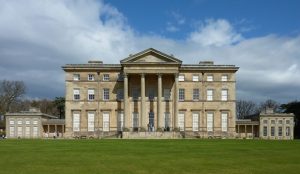
Attingham Park
One of the weekends he put on at Attingham Park in 1965, was to bring together various voices of the ‘New Age’. As guests arrived there was a small altercation at the registration desk when a man turned up completely unexpectedly. Sir George’s secretary was explaining to the man that it was impossible to accept him as all the places were booked when Sir George overheard the conversation and made enquiry. The man was Peter Caddy who had hitch-hiked down from Findhorn to take part in the weekend. When Sir George heard who it was he declared Peter must join the conference as here was a man doing the work that the rest were only speaking about. He asked Peter to address the gathering.
In 1968 Sir George visited the community and stayed there. In his introduction to The Findhorn Garden Parts 1-4, he describes the abundance of the gardens despite the poverty of soil and declared there must be a ‘Factor X’, which the community declared was the role of the elementals and Devas in taking part in ‘the experiment’. For George this was a demonstration of the New Age in action. Sir George concludes that introduction with the words:
“The possibility of co-operation with the devas should be investigated seriously. The time has come when this can be spoken of more openly. The phenomenon of a group of amateurs doing this forces it into our attention. Many people are now ready to understand and that enough should understand and act on it is possibly of critical importance in the present world situation.”
This is no less true today than when he first wrote the words.
He actively encouraged ROC to give a talks at Attingham Park and London in 1969, on his work with the Elementals. It was the first time ROC had given such talks publicly.
-

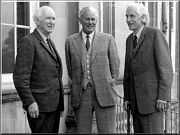
- ROC, Peter Caddy, Sir George Trevelyan
-

- Sir George Trevelyan and Eileen Caddy
-

- Peter Caddy and Sir George Trevelyan
It was the beginning of a long friendship with Findhorn as Sir George supported the community in its various guises and took on the role of the opening, and often closing, speaker at conferences through the 70s and into the 80s. When the Findhorn Community formed a Foundation Sir George was among the first trustees.
He was also present at the seminal television broadcast ‘Mainly Magnus’ recorded in the Community Centre by the BBC in 1973.

Mainly Magnus 1973 photo Findhorn Foundation
Extract from the Timeline:
1906
Sir George Trevelyan born in north of England
1965
Peter meets Sir George Trevelyan at Attingham Park
1968
Sir George Trevelyan’s first visit to Findhorn
1971
Craft Studios officially opened by Sir George Trevelyan at Pine Ridge, September
1972
First Trustees include Sir George Trevelyan, Joan Hartnell-Beavis and Ross Stewart
1994
Sir George Trevelyan’s last visit to Findhorn
1996
Death of Sir George Trevelyan
Publications by Sir George Trevelyan include
 Exploration into God: A Personal Quest for Spiritual Unity, Gateway Books, 1991. White Crow Books, 2012.
Operation Redemption: A Vision of Hope in an Age of Turmoil, Turnstone, 1981. White Crow Books, 2012.
A Vision of the Aquarian Age: The Emerging Spiritual World View, Coventure (UK), 1977; Stillpoint (USA), 1984. White Crow Books, 2012.
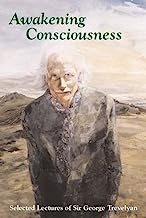
Awakening Consciousness, selected lectures, compiled by Keith Armstrong, Godstow Press, 2008.
Magic Casements: The Use of Poetry in the Expanding of Consciousness, Sigo Press, 1991.
Summons to a High Crusade, Findhorn Lecture Series, Findhorn Publications, 1986 – a collection of Lectures edited by Jeremy Slocombe
He wrote forewords to many books including:
The Mysterious Story of X7
The Teachings of the Essenes
Man Seen Afar
Pi in the Sky
Find out more:
Stories about Sir George Trevelyan on this website are listed under his profile.
You can also find stories referring to Sir George following this link to his tag.
See also
- A wonderful website dedicated to Sir George Trevelyan provides an extensive archive of his life and work.
- Sir George Trevelyan and the New Spiritual Awakening, biography by Frances Farrer, Floris Books, 2002.
- On YouTube: treat yourself to listen to Sir George speak. There are some informal ‘family videos’ which give a good sense of his presence, as well as more formal presentations.
We give thanks to Sir George Trevelyan’s archive for the permission to use images from their archive on this website.
Exploring classical philosophy of India and Greece, studying Kabbala, Tarot and Astrology; Sacred Dance teacher from 1980 onwards, established first SD Library. 2010 returned to create current Archive.
Websites:


Leave A Comment