


Richard St. Barbe Baker (9 October 1889 – 9 June 1982) was known as the Man of the Trees as he had been an advocate for trees for most of his long life. He planted trees and even more importantly planted ideas about the importance of trees all over the world. The charity he founded, now called International Tree Foundation, has just celebrated its 100th anniversary in 2022 and has branches in many countries. He was away ahead of his time and in many ways his vision and mission is more relevant today than ever before.
From early on he had a strong spiritual foundation, as he joined the Bahá’í Faith shortly after 1924.
Richard visited Findhorn for the first time in 1969 and spoke at the One EarthGathering in 1979. His impact on the Community cannot be understated as nature conservation, restoration, rewilding and now regenerative agriculture were very much alive in many different projects throughout the history of the Community and continue to be so today. His memory is honoured in the Community’s memorial grove called St. Barbe’s Wood between the Barrel and the Bag End clusters.
Early Life and Work
Richard St. Barbe Baker lived with his family in Beacon Hill, Hampshire, and early on he was attracted to the garden and the surrounding forest. In 1910, aged 21, he travelled to Canada and lived in Saskatchewan, studying and doing evangelical work. During a brief stint working as a logger, he became aware of the devastating effects of soil degradation.
Following his return to England after serving in France during World War I, he studied biology and botany in Cambridge. After his graduation he went to work in Kenya. Through his awareness of the detrimental effects of deforestation he recognised the results of centuries of land mismanagement and sought to remedy those by setting up a tree nursery and founding an organisation with local people called Watu wa Miti (= Men of the Trees). This was the beginning of what would become the international organisation with that name, and eventually the International Tree Foundation.
He also worked in other African countries, such as Nigeria and the Gold Coast, as well as in Palestine.
During travels throughout the USA, he started writing and lecturing, and became involved in conservation campaigns, such as Save the Redwoods. This work had a much greater impact and reach when, at the invitation of President Franklin Roosevelt, he established the Civilian Conservation Corps in the late 1930s.
Worldwide Impact and his Influence on the Community at Findhorn
After World War II he travelled to all corners of the world promoting the idea of reforestation. His organisation, Men of the Trees, grew tremendously, with branches in over 100 countries. In the 1950s he inspired many with his audacious vision to reclaim the Sahara through coordinated tree planting. Even though it has taken decades, the idea is still alive and being implemented through the Great Green Wall project by the African Union.
His travels also brought him to Findhorn in 1969 where his dedication and vision were greatly appreciated. He influenced the Community in its formative years with projects that continue to shape the Community to this day.
A tree nursery was established in the grounds of Cullerne House, and he inspired many Community members to dedicate themselves to nature conservation, reforestation, and Earth restoration. Vance Martin, Geoff Oelsner and Leona Graham contributed much to the work of the Wild Foundation. The 3rd World Wilderness Congress was the first big conference held in the newly completed Universal Hall in 1983. Alan Watson Featherstone went on to set up Trees for Life which, since 1989, has done pioneering work in restoring the Caledonian Forest and continues to inspire thousands of people through its many different projects, including its demonstration centre for rewilding in Dundreggan, a 10,000 acre estate in the heart of the Scottish Highlands.
To acknowledge this significant influence on the Community, a memorial wood was set up in 1975. St Barbe’s Wood is located between the whiskey barrel houses and the Bag End cluster in Pineridge. Over the decades memorial trees to many beloved members have been planted there. So many, indeed, that it had to be expanded into the woodland to the East once that came into the ownership of the Community.
The Spiritual Dimension
Growing up in a family of farmers, parsons and evangelists he was initially destined for the ministry. In 1924 he was introduced to the Bahá’í Faith which he embraced. In the same year he met and won the support of Shoghi Effendi, then head of the Bahá’í Faith, who called Richard St Barbe Baker “the first member of the English gentry to join the Bahá’í Faith”. Shoghi Effendi in turn became the first life member of the Men of the Trees in Palestine, thus facilitating the support of Muslim, Jewish and Christian leaders for a reforestation programme.
Thus practical reforestation work and the spiritual dimension were closely linked which of course also applied to his influence on the spiritual community at Findhorn.
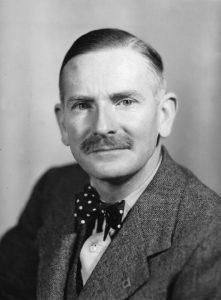
Richard-St-Barbe-Baker under license from National Portrait Library, London
Publications and Media
Richard St Barbe Baker has authored over 20 books during his lifetime. This is just a small selection
My Life, My Trees (2nd ed.). (1985) [1970]
Man of the Trees: Selected Writings of Richard St. Barbe Baker (1989,1993)
Trees for Health and Longevity (1981)
Caravan Story and Country Notebook (1969)
Sahara Conquest (1966)
Famous Trees of New Zealand (1965)
Why I am a Vegetarian (1957)
Wikipedia – Richard St. Barbe Baker
The International Tree Foundation
You can find other stories about Richard St Barbe Baker on our website by following this link to his tag.

Originally German, I came to Findhorn in the search of ‘It’. I found ‘It’ in our way of sharing our spirituality in our daily lives, privileged to work with my focus on Healing in the widest sense.


Leave A Comment