


This article of Johnny Brierley, Director of AIM (Alternative Investment and Management) and Alex Walker, Managing Director of New Findhorn Directions (NFD) exchanging views with Carol Alexander was previously published in One Earth magazine Issue 18, Summer 1995.
Alex: From the mists of time the Vedic philosophers and countless wise spiritual beings have taught that the world around us is an illusion. It is as much the construct of our mind as are our dreams, although it operates in a different way and has different consequences. No one embarks on a discussion about the dream they had last night by saying it took place in a sustainable community! Our aim here is to work with our inner realities. It is more important to me to have a bona fide relationship with someone in a way that sustains our ability to understand the cosmos and grow together, than to worry about whether I should charge them £5 more or less for goods or services.
People who choose to join a community such as this one usually do so out of a wish to find some meaning to their lives beyond the gross materialism of the society they live in. Many guests and residents are from the relatively wealthy countries of the world and amongst other things they are questioning or actively rejecting the economy and authority they have been experiencing. They are therefore reluctant to have to come to terms with the fact that the Foundation still has no function within that world, and in fact can only survive by interacting with the established financial, political and legislative structures. Many have a confused and difficult relationship to authority and money.
Johnny: What seems to run through all spiritual communities is an ambivalence toward material wealth; the feeling is that creating wealth is unspiritual, but the underlying wish is for comfort and a reasonable standard of living. This ambivalence stops individuals and businesses from becoming abundant. Although people contact me to discuss ways in which they can bring abundance into their lives I have always experienced a difficulty in engaging with individuals both from the Foundation and wider community on topics of finance and funding. For example I have tried on three occasions to land a conference here around the subject of money and sustainability, but it keeps getting side-tracked. lt is definitely a shadow side we just don’t want to look at. Even the forthcoming conference on Eco-villages runs the risk of not adequately adressing the question of sustainable economics. There is little point in focusing on eco-housing if we don’t consider how they might be funded and maintained by developing the resources and economic base of the community they are to serve. It is a very difficult subject to discuss but it does need to be focused upon, to give answers a chance to emerge.
Could you say something about the present financial structure of the Community?
Johnny: There is a four-tiered system operating here. Firstly there is the Foundation itself: with its Educational Programme. This has a turn-over of about £1 million a year. which pays for Foundation activities, maintains its properties, tithes to other initiatives and sustains its workers, not in any luxury, but it provides them with bed and board , and pocket money (about £180 pr month). There are few material advan1ages to working for the Foundation, but there are other advantages which is why people work there.
Then there is New Findhorn Directions, begun 16 years ago to shelter new businesses and provide w0rk and income for a growing number of associates and those who come to live in the wider community. In the early days, many who wanted to be here either had to have money put aside from previous employment or other sources of income. For some that meant Social Security. This was considered to be an undesirable and, in any case, unsustainable situation, so employment and income needed to be generated locally.
The Foundation was the ‘greenhouse’ for many of these businesses as ‘seedlings’ which, when they grew bigger, were moved into the ‘cold-frames’ of NFD (because the Foundation’s Charity status does not allow it to house potentially profit-making 0rganisations within it). If the business looked as if it was becoming commercially viable then it was moved out into the outer world, into the ‘garden’. NFD is now a sustainable economic force with a turn-over similar to that of the Foundation.
The third tier contains the independent businesses. These days not all of them begin under the wing of NFD. Some arc very small fledglings, barely sustainable and struggling. One of the advantages of this community is that everything is low cost, so the start-up costs for new businesses are also low. Compared with the potentially unsustainable capitalist economy we are experiencing in the rest of thc world, there are huge advantages in little businesses which have not yet become used to the materialistic life-style which the rest of society expects.
The fourth tier is the people who generate income from outside, either through their own businesses in other parts of the country, through caring relatives or Social Security.
Do you think the Community is becoming increasingly capitalist and losing sight of the original impulse to share?
Alex: The Foundation has no choice but take notice of the fact that it is living in a capitalist society. It has to bring in an income upon which it can sustain itself. It is set in a Western economy with all the advantages that implies, but in a relatively isolated area which, by European standards. is not wealthy. There is a shortage of work and not much cash circulating. Arguably, that is also a benefit. We are living in a much less materialistic society than exists elsewhere. There is some wealth but it is not ostentatiously displayed and we are not dealing with a yuppified section of the population. For me wealth is like a pair of shoes. If the shoes are too big or t00 small there will be pain. Everyone looks for the size that suits them, a level at which they can function comfortably. There isn’t any ‘standard size’. lt is a part of the diversity of wealth that some will feel happy wandering the countryside as mendicants, whilst some amass wealth with which they may or may not improve society and the environment.
For this article it might be useful to look at what we mean by ‘sustainability’. I don’t know of any reliable system by which you could define sustainability. We can use our common sense and say that a Third World city of four million people where one quarter live in shanty towns, where infant mortality is high, sickness rife and air pollution is destroying the agrarian environment, is not sustainable. In any case it is not an acceptable situation. But when can any community call itself ‘sustainable’ unless we go back to a virtually Stone Age technology where the economy might trundle along without reference to the outside world?
The Foundation is, by and large, dependent upon people travelling hundreds of miles to visit it and I know of no analysis which can tell us if busing people by plane around the planet is a sustainable activity or whether in ten years’ time we won’t have punched a hole in the ozone layer and be unable to carry on! The concept of sustainability is becoming popular because it sounds quasi-scientific, but if we are to be truly scientific we would have to run experiments. As it is, anything we say has to be ‘best guessing’. We are unlikely to know for a generation or so what the outcome of any policy will be.
Johnny: Certainly one cannot discuss a local economy without putting it into a global context. There are parameters already existing out there which show us what is desirable and what isn’t, and those are what we should be working with here at a level where it is possible to experiment. Part of me welcomes news of boardroom decisions to give dramatic increases on £1/2 million salaries because it is so visibly ludicrous. It helps to fine-tune people’s attention to what is going on, demonstrating that there are things happening which cannot be justified. LETS (Local Energy Trading System) is one of the initiatives which has arisen as a response to the deteriorating economic situation. It hasn’t caught on so fast here because one of its attractions is the formation of community and we already have that, but in many cities where people are feeling separated and alienated it gives the opportunity to really engage, to be tangibly in contact with others and create the satisfaction of self-empowerment. I love this word ‘engage’! The process of earning is no longer simply a mental excercise, it is sweat and involvement, and there is no one without a skill they can offer.
Why do you think the contribution system (payment by donation) never caught on in the Foundation, although it has been working well at Newbold House. Lionel Fifield, who was here during the 80s, extolled the system as truly ethical and in harmony with higher spiritual purpose, suggesting that it was the most appropriate system for the Foundation to be using. Is there simply not enough trust?
Alex: It is unreasonable to compare the Foundation with Newbold House which is a much smaller concern. There they can have discussions with each guest on the donation principle and their running costs, which are in the conscious awareness of the whole group. There is a wide discrepancy between the understanding of the funding of the Foundation amongst people who come in for a short time each week to work, and those who live and work here, so guests may be given quite the wrong picture. There is also the fact that large numbers of people travel long distances to be here and I personally would not want to travel from New Zealand to Scotland without knowing the kind of money I would need to pay my way. Guests of Newbold House have the workshop prices in the Foundation brochure as a guide. The Foundation actually experimented with this system for the Abundance Conference but experienced a significant drop in income and, rightly or wrongly, took this as a sign that the system wouldn’t work. Maybe we still have more inner work to do on this one, but for the moment we have to draw in our horns. The bills have to be paid.
Johnny: Lionel himself has found that when he takes his workshop on tour and asks for donations he comes home with 20% less than when he asks for a fixed amount. If we look at that from a certain cosmic perspective we might say that Lionel actually needs 20% less than he is charging! There is certainly an argument that says spiritual education should be free, but the fact is the Foundation doesn’t attract enough funding in other ways to make that possible. Somebody has to pay the bills and pay the people who work there. Fundraising may help to enable that to happen. At the moment a substantial amount of bursaries are available but it would take a huge sum to finance totally free workshops.
From time to time the Foundation puts out requests for donations from people who have an interest in its work. I know I feel uncomfortable about fundraising. What are your views on the subject?
Alex: I believe it is perfectly legitimate to make it known that you are engaging in an activity and that for the activity to be successful you require support. At the end of the day if you are doing a good job there are people who would like to support you. It is delinitely wrong to believe that the world owes you a living however. Somewhere between the two it must be possible to find the appropriate action.
Johnny: As far as I am concerned it is fine for me to decide what I want to raise money for, then it is up to people to decide how they want to respond. Mercury Provident, the Anthroposophical banking system, oerates on the same basis. They present individual projects, for instance agriculture or permaculture projects, and people interested in supporting these can do so. The owners of capital have always sought too high a financial return for it. The enterprises funded through this bank do not have to conform to a composite level of interest which would be crippling for the smaller ones. For example a Steiner school which receives no state funding and does not charge fixed fees, can fund itself by taking out a loan with Mercury Provident and choose a level of interest which it can realistically afford.
There are evidently initiatives being taken in many quarters to create a viable and fair economy but as yet they are limited in their sphere of influence. Do you think we are going to see a complete breakdown of the capitalist system and the disastrous collapse of the economic structures world-wide, as is being predicted?
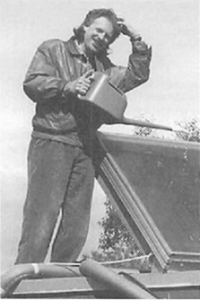
Alex Walker: Hoping to propogate new business growth?
Alex: Clearly things will have to change but I believe they can change in a such away that will avoid large-scale catastrophe. I would rather focus my attention on what can be done to effect those changes than on a possible disaster which would bring hardship to many vulnerable people. As we understand more about the workings of the present economy there is a great deal of guilt evinced and I am not convinced that upping the level of guilt is actually going t0 help. I would rather we presented a set of principles that could guide individuals to a healthier life-style than that we went around prophesying doom and making everyone feel miserable.
It is my belief’that God wants us to continue to be incarnated on this planet and that He intends there to be a sustainable life-style. No doubt there is enough for our needs but not for our greed. A hundred million children go to sleep hungry each night yet there is enough food to go round, it is just that some of us are greedy, inefficient and stupid and fail to connect causes with solutions.
Ordinary people would, in general, like to support genuinely equitable, sustainable solutions if only they knew there was a sensible way of doing it. But for those of us who have children, for instance, could we really opt for a level of sustenance which meant that one out of three of them might die in infancy? There are profound moral questions raised here. The image at the moment is that sustainability means low living standards, but there could be a more positive vision and with that in mind it would be easier for people to make the necessary adjustments. I have heard Jonathon Porritt say that only one quarter of the world’s current population could be sustained at the level of, say, Sweden. But the corollary of that is, the entire world could be sustained at the level of Swedish life style if we could do it with a quarter of the materials necessary at present. This is not an implausible probability and I would rather we were working toward that end than planning what to do in the event of a collapse.
“The goal should be a new economics, one that knows we are all interconnected and that sustainability must be viewed in its global context lo be meaningful”
Johnny: It would be possible if energy consumption were cut. Cars can now be produced which arc four times as efficient, houses built which take very little heating and can be solar powered; food production can be more efficient and with care we can feed ourselves without damaging the planet irreparably. But there has to be an immense shift in consciousness in order for all that to happen. At the moment there are too many vested interests, in petroleum sales for instance. Changes will have to happen fast. The developing world is beginning to want what we have; as television reaches them they are going to be putting tremendous pressure on us. We have the technology now to utilise the sun to meet all our energy needs: we also have the necessary consciousness. We just need to get on and do what we need to do. The goal should be a new economics, one that knows we are all interconnected and that sustainability must be viewed in its global context to be meaningful. The Ahrimanic veil of material illusion has pinnacled. Maybe now we are ready to enter the Age of Light. Perhaps what is happening in the advances in light technology, from fibre optics to solar power, is a metaphor for what is happening on a higher level. Hopefully this will herald a reawakening of our global consciousness, a sort of collective Enlightenment! But we have to keep up the inner and outer work wherever we are so that, by the re-Imagination of the world and the re-Divination of business, we can create that new economics.

Born in Ireland, worked as chartered surveyor from 1971. A career break during an existential crisis brought the family to Findhorn. The spiritual journey shaped an abiding passion for pilgrimage.




Leave A Comment