

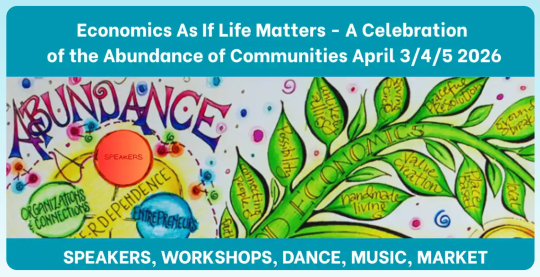
It was such an amazing whirlwind experience to organise this conference, the first one in the Universal Hall since 2019, in less than three months. I followed my inspiration and with lots of miracles, help and enthusiasm from many, here in the Community, in this part of Scotland and from across the world, this event came about.
I am telling this story through the videos we produced and the conference report that Brian Connolly, who was our poet in residence, produced.
My introduction gave the context and allowed the audience to settle down.
It honours David Hoyle who has been a driving force behind community economy – click here to learn more about David Hoyle.
Following is Brian Connolly’s report on the conference and his reflections afterwards which he has posted on LinkedIn. I want to give a big THANK YOU! to Brian for his permission to share his post here.
This is my second visit to Ecovillage Findhorn, and it already feels like a different kind of returning. The first time I came, I was a curious practitioner, drawn by Donnie Maclurcan’s post-growth thinking and wanting to feel what embodied economics actually meant in a room full of people. This time, I arrived as poet in residence at the Spring Conference 2026: Economics as if Life Matters, carrying the brief of translating economic philosophy into verse. This conference brought to life the concept of well-being economics and wealth in our communities.
Opening: Connection Before Content
The conference opened with a welcome. Dorota Owen, the event’s organiser, set the scene, followed by Lisa Mead, Chief Officer of Ecovillage Findhorn CBS, who spoke about what had drawn people to this place and this gathering: a shared concern about the current state of the economy, a hunger for profound shifts in who and what an economy is actually for, and a desire to join with others working on the same questions. The opening circle itself was led by Barbara Swetina, who invited participants to embody the principles the conference would spend three days discussing.
We formed physical connections with those beside us, and we sang together. “Lean on me and know you are safe and that you are loved.” Not as a performance, but as a practice. The message was explicit: be curious, be connected, build on relationships, travel not by force but by feeling.
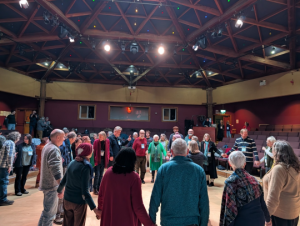
I have attended many conferences in my working life. I have opened events with icebreakers and sat through welcome addresses that could have been emails. I have rarely been asked, in the first twenty minutes, to physically connect with a stranger and sing. If we are genuinely trying to build economies grounded in care, connection, and mutual regard, then starting an economics conference with an act of care, connection, and mutual regard is not a warm-up exercise. It is a statement of method.
Donnie Maclurcan: The Radical Act of Noticing
Donnie Maclurcan is co-founder of the Post Growth Institute, a Findhorn Fellow, and the conference’s keynote speaker. It was a privilege to introduce him, having first encountered his thinking six months ago. His central thesis is bold but evidence-based: not-for-profit enterprise is not a marginal or idealistic alternative. It is already, in measurable terms, at the heart of significant portions of the global economy, and it is growing. What distinguishes not-for-profit structures is that surplus is reinvested in community benefit rather than extracted as private profit, eliminating the growth imperative that drives ecological destruction and inequality.
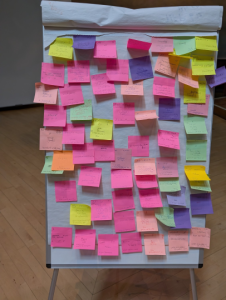
Donnie’s session drew on this evidence base but refused to stay at the level of statistics. His approach to facilitation embodied the argument. He offered prompts to the audience, creating small moments of unexpected connection that cross professional divides. He returned repeatedly to the idea that cooperative models have deep roots that predate the assumptions of our current economy, and that the question of how you add value has always been present, but the systems we built to answer it have changed dramatically and not always in directions that serve the many.
His framework for asset-based community development landed with particular force for those of us working in economic development. Start with strengths, not deficits. Create safety, which inspires creativity. Ask what is strong, not what is wrong. Build relationships grounded in genuine self-knowledge. Create space for silence, because silent reflection opens more inclusive spaces where more people feel able to participate. His ‘Offers and Needs Market’, a process for exchanging goods, services, housing, and skills, is now practised in more than 35 countries. The principle behind it is straightforward but persistently overlooked: every offer has a place, and the right question is not how you add value in economic terms but how you add value in human ones.
“You are enough.” Said plainly, in a room full of professionals, with nowhere to hide behind a role or a title. It is what makes circulation possible; when we stop grasping and start passing things on.
The Regenerative Pact: From Pioneer to Planetary Movement
The session from the GEN – Global Ecovillage Network placed Findhorn within its global context. GEN was founded at Findhorn in 1995, when the first international conference of ecovillage members was held here, and its Regenerative Pact was presented back at this same site thirty years later. That arc, from pioneer community to planetary movement, was not incidental to the session.
The session was led by Amena Bal, serving Trustee and President of GEN, who lives at TI Ecovillage on the outskirts of Bangalore, Karnataka, India, a project that began in 1995 as an experiment in eco-friendly development. Her core argument was that in a world where capital concentrates in the hands of the few, the underground networks of connection, communication, and trust that GEN has spent thirty years building become vital pathways for change. How do we strengthen one interconnected GEN? How do we grow and scale leadership without replicating hierarchy? How can people from other movements feel truly welcome in the network? These questions landed with particular force for those of us working on community wealth building in Scotland, where similar tensions between scale and relationship, and between legislation and culture, are very much alive.
TI Ecovillage was a 2020 Hildur Jackson Award winner, GEN’s annual prize for projects bringing the most impactful regenerative inspiration to a broad audience. The community’s achievements are practical and measurable: groundwater regeneration through rainwater harvesting, solar electric power across a significant proportion of residents, and over twenty years of tree-planting and surface-water management that has improved groundwater for the surrounding area. This is not an aspiration. It is evidence, and Amena presented it as such, grounding the session’s larger arguments about the regenerative economy in lived, documented practice.
The second part of the session was presented by Eva Goldfarb, GEN’s Communications lead, who introduced the new GEN member platform and ecovillage map, due to launch this summer. Her presentation addressed something anyone trying to build movement infrastructure will recognise: the problem of visibility. How do communities find each other? How do people with offers connect to people with needs? How does a network of 6,000 communities across 114 countries become legible without losing the texture and particularity of its members?
The new platform is designed to address all of this directly. A rebuilt ecovillage map will allow people to find communities and projects geographically and thematically, and, crucially, it will include a needs-and-offers function, deliberately echoing Donnie Maclurcan’s ‘Offers and Needs Market’, extending that principle from the facilitated workshop into a persistent digital infrastructure. The platform is also conceived as a deliberate move away from dependency on commercial social media such as Facebook, where community knowledge and relationships are hosted on infrastructure owned by and optimised for profit extraction. That GEN is investing in its own platform to mutualise resources and strengthen trust speaks directly to the Regenerative Pact’s argument: economic alternatives require their own communications infrastructure, not borrowed space on platforms built for advertising.
The connection between Amena’s community in Bangalore and Eva’s platform work felt like a coherent argument in two registers. The regenerative economy is simultaneously local and global, and what connects those scales is not hierarchy but trust, not extraction but circulation, and not a platform that monetises attention but one designed to strengthen the bonds that make genuine economic alternatives possible.
Dr Karambu Ringera: Power, Place and the Children in Our Care
Dr Karambu Ringera (PhD) founded International Peace Initiatives in 2002 after meeting 35 women in Meru, Kenya, many living with HIV/AIDS, who asked for help sending orphaned children to school. From that single conversation, and a fundraising dinner that raised enough to send seven children, grew an organisation whose reach now extends across education, enterprise, and community empowerment.
At the heart of her work is the Kithoka Amani Children’s Home in Meru, caring for approximately 73 to 75 children who have lost parents, primarily to HIV/AIDS. This is not an institutional orphanage: children remain embedded within their community, attending local schools and maintaining connections with extended family. She has since founded the Tiriji Eco Centre, a permaculture and regenerative culture training centre near Meru where “tiriji” means, fittingly, “the place of abundance.”
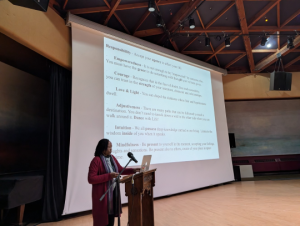
Her philosophy of development is rooted in a refusal of the aid model. She does not help people. She accompanies them. The distinction carries the weight of an entirely different approach to what development means and who it is for. When she spoke of creating safe spaces for the children in her care, she was describing not just a physical environment but an economic one: a context in which children are not defined by what they lack but by what they carry, what they know, and what they are capable of becoming. She spoke of the children as future ambassadors, of the land needing to be healthy for them to grow within it, of evolution as co-creation rather than imposition.
She reminded the room that what she provides is not an orphanage. It is a home. And home, she suggested, is a parent within us. When we talk of place, we encompass individual identity. That reframing of place as something carried internally, rather than something done to or for communities from the outside, speaks directly to what gets missed in so much economic development practice.
Guy Dauncey: The Economics of Kindness
Guy Dauncey, FRSA is a Findhorn Fellow and the author of ten books, the most recent of which, Economics of Kindness, provided the frame for his afternoon session. His starting point was bracing: the scale of the crises we face, from climate disruption to biodiversity loss to housing unaffordability to democratic erosion, is matched by the scale of the response that already exists and is largely invisible to mainstream economic thinking.
He posed the central question with disarming simplicity, “What is the economic value of kindness?” He then built a case that the barriers to a kinder economy are not technical but cultural. His analysis identified five dominant stories of selfishness underpinning our current economic order: dominating others, maximising capital accumulation, neoclassical economics, the personal or market logic, and the environmental. Against these, he set a taxonomy of cooperation and asked what it would look like to take cooperation as the structural default rather than the exception. Findhorn itself provides sixty distinct co-operative and social enterprise organisations as living evidence that this is not utopian.
Dauncey drew on examples from South Korea, cooperative models from Mondragon in Spain to Grameen Bank in Bangladesh, pointing to an international evidence base that cooperative and social economy models are embedded in major economies across the world. The animating logic throughout was consistent: our job is not to despair but to complete the work. That work begins with the most overlooked economic variable of all: loneliness. Building community wealth requires confronting loneliness first, because no economic framework that ignores the social preconditions of human flourishing can deliver what it promises.
Joanna Hunter: Consciousness and the Inner Economy
Friday’s evening session with Joanna Hunter, a spiritual teacher and international speaker, occupied different territory from the day’s earlier sessions but posed its own challenge. Her argument was essentially this: our economic systems are downstream of our collective consciousness, and if we want different outcomes, we need to examine the inner architectures that generate them. The difference between knowing something and believing it. The flavours of inner belief that shape what we think is possible. Abundance consciousness versus lack consciousness.
The tension between this frame and the more structural analysis of the earlier sessions was, itself, productive rather than problematic. Both things can be true simultaneously: systems shape consciousness, and consciousness shapes systems. A conference willing to hold that tension without resolving it into a single answer is doing something more honest than most
Saturday Morning: An Economy You Can Walk Through
The Saturday morning was when Findhorn’s power as a conference venue became most vivid. The programme moved out of Universal Hall and into the ecovillage itself, beginning with a visit to the green burial site managed by the Findhorn Hinterland Trust.
The Findhorn Hinterland Trust manages approximately 35 to 50 hectares of nationally significant dune, woodland, and coastal habitat east of Findhorn Village. Its Wilkies Wood Green Burial Ground is Scotland’s first community-led burial site, operating under a 100-year stewardship commitment. The first burial took place in April 2007, and around 50 burials have been completed with 93 lairs pre-purchased. No headstones or mementos are permitted. Graves become part of the woodland. The philosophy is a return to nature’s cycle, creating a living memorial in the form of a beautiful, growing wood. Revenue from burial lairs funds the Trust’s conservation work, bridging death and ecological regeneration in a single, elegant model.
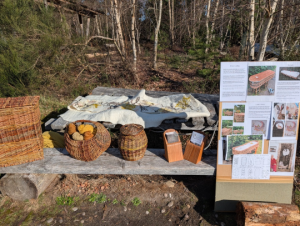
Presenting alongside the Hinterland Trust was Naturally Useful, the Community Interest Company founded by Karen Collins at Marcassie Farm, seven miles from Findhorn. Karen grows 20 to 25 varieties of willow on approximately one acre of withy beds, coppiced every January, providing 96% of the material for all products. Willow coffins are priced at £650 to £750, and people can come to the workshop and make their own over four days, a process Karen, who is trained in counselling, describes as intimate and story-filled. For every coffin sold, Naturally Useful plants a tree through Trees for Life. Here is an enterprise that takes the most universal of human experiences, death, and builds around it a practice of craft, community, ecological return, and economic sustainability. The coffins are beautiful. The willow regrows each year. The wood receives us back. It is hard to think of a more literal expression of an economy as if life matters.
The visit to the green burial site was followed by the Artist Hunt, a walking tour of the ecovillage produced by Theatre of the 7 Directions, which allowed conference participants to move through the living economic ecosystem of The Park. Along the route, residents opened their studios and workshops, demonstrating the range of enterprise that constitutes daily economic life at Findhorn. The pottery studio, craft workshops, and a community market and picnic at the Youth Building and Village Green gave the morning a texture that no conference hall can replicate.
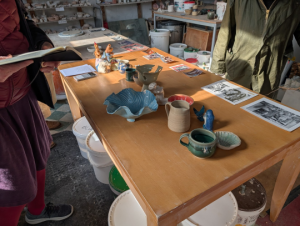
Among the most striking encounters was a demonstration of Music of the Plants, a technology developed by Findhorn’s sister community Damanhur in Italy. Electrodes attached to a plant’s leaf and root system detect bioelectrical variations, which a MIDI interface converts into audible music. Each plant produces a unique sonic signature, and researchers have found that plants can learn to modulate their sounds over time. Whether one approaches this as science or as poetry, the underlying idea, that the natural world is communicating and that we might have the instruments to listen, felt entirely consonant with the weekend’s themes.
Participants also encountered the Game of Transformation, created by Joy Drake and Kathy Tyler and now facilitated in over 25 countries by more than 1,000 trained facilitators. Both creators have returned to live at Findhorn, and their organisation InnerLinks is now based back at The Park. The game operates across physical, emotional, mental, and spiritual dimensions, and has in its various forms reached hundreds of thousands of people worldwide. That a game created in a caravan park on the Moray coast has become a global tool for personal and collective transformation is itself a small piece of evidence for Donnie Maclurcan’s argument: what is already here, already working, at scale, right now, is more substantial than our economic frameworks typically acknowledge.
Editor’s Note: please click here for more stories about the Artist Hunt.
What Findhorn Offers Scotland
I left at lunchtime on Saturday carrying more questions than I arrived with, which is probably the right outcome. What I found myself thinking about on the drive south was not just what had happened in that room, but what it meant for the work waiting for me at home.
Alongside my role as poet in residence, I attended Findhorn mindful of my role as a representative of Wellbeing Economy Alliance Scotland (WEAll), a network of over 150 organisations committed to redesigning Scotland’s economy so that it delivers social justice on a healthy planet. WEAll Scotland’s manifesto for the 2026 Scottish Parliament elections frames its ambitions around five needs of a wellbeing economy: dignity, fairness, nature, purpose, and participation. Those five words had been present, unnamed, in almost every session of the conference. Dignity in Dr Karambu Ringera’s insistence that she accompanies rather than helps. Fairness in Donnie Maclurcan’s evidence that surplus reinvested in community benefit serves more people than surplus extracted as private profit. Nature in the music translated from the bioelectrical signals of plants and in the woodland slowly becoming a living memorial. Purpose in Barbara Swetina’s opening circle and the singing. Participation in every offer laid on the table, every need named without apology.
WEAll Scotland’s manifesto calls for redesigning our tax and spending decisions to prioritise dignity, fairness, participation, purpose, and care for the natural world, embedding wellbeing outcomes at the heart of budgeting, investing upstream in communities, and using Scotland’s existing powers to share wealth more fairly. These are the right ambitions. What Findhorn does is show what it feels like when those ambitions are a daily practice. It is the space in which the work happens.
WEAll Scotland has argued that change at the scale and pace needed requires a broad and resilient movement, with component parts working at different places in the system, and that no single organisation, government, or sector can deliver this transformation alone. That framing resonates strongly with what the conference was doing. The Regenerative Pact, the new GEN platform, Donnie’s Offers and Needs Market: these are all component parts of a movement working at different places in the same system, often invisible to mainstream economic discourse but quietly, persistently building the evidence base and the practice that policy needs.
Between the Legislation and the Life
This brings me to what I think is the most interesting question. The Community Wealth Building (Scotland) Act is now law, and that matters enormously. It represents years of advocacy, coalition-building, and patient argument and it gives real institutional force to the levers of community wealth: anchor institution spending, democratic ownership models, fair work, land reform, local supply chains. It is a foundation to build on, and Scotland is right to be proud of it.
What Findhorn invites us to consider is what sits alongside and beneath that foundation. Legislation is a container. It creates the legal and institutional conditions for community wealth building to happen, but the culture, the relationships, and the daily practice that fill that container cannot be mandated into existence. They have to be grown, which takes time, trust, and a willingness to start with what communities already hold rather than with what they are assumed to lack.
Community wealth building as an economic toolkit is well understood: procurement reform, democratic ownership, fair work, land stewardship. These levers are important and the Act gives them new force. Yet community wealth as a lived reality, as the thing that actually makes a community wealthy in the sense that Findhorn understands wealth, is built in the spaces between the policy instruments. It is built through the patient accumulation of relationships across sixty co-operatives, and through a community that spent years raising bonds from its own members before it could buy its own land.
The legislation and the life are not in tension. They are complementary, and Scotland needs both. WEAll Scotland has argued that economic models that focus too narrowly on growth and productivity for their own sake fail to translate into more secure jobs, higher wages, decent housing, or a healthier natural environment, and that Scotland needs to be bolder in its approach to economic change. Part of that boldness might mean being willing to learn from communities like Findhorn, not as alternatives to policy but as sixty-year experiments in what a different kind of economy actually requires of people and institutions.
The conference did not offer Scotland a prescription. What it offered was a demonstration: that the economy we aspire to is not just theoretically possible but already, imperfectly, persistently happening. The question it leaves me with is not whether a wellbeing economy is achievable. It is whether we can learn more from the places where it already exists, and whether we are prepared to build patiently from what is strong rather than only fixing what is wrong.
What I Came Here to Learn
I came here knowing the word for house is where we get economy, and ecology too, the same root reaching, the same soil beneath both. But knowing a thing and feeling it are different kinds of arrival.
I came not as an expert but as someone who has spent years standing at the edge of systems, trying to hear what they whisper underneath, the murmur beneath the margin, the life beneath the ledger.
I’ve used words like anchor and alignment but I’ve also wondered whether the words we are given are the words that will carry us.
I’ve watched wealth pool and stagnate, circling the same slow drains, leaving places thinner than it found them. What if we exchange Wall Street for Main Street. Living systems thrive on circulation, a story told slowly in a room becomes everyone’s story.
I came here to learn that abundance is not a surplus but a quality of attention, the willow working its way back each January, the food that rises from composted grief, the way a community asks not what is wrong but what is strong, the way the real wealth runs in rivulets, not reservoirs.
I wanted to feel the shape of a new economy not just think it, to step into a circle of people and sense the system shifting, to know in my bones what my brain has been circling for years: that connection is the currency, that care compounds differently than capital.
You are enough. I heard it said here and felt the economy shift. Not a slogan but a foundation, the ground beneath the household, the thing that makes circulation possible when we stop grasping and start passing things on.
And if I leave with nothing else, I’ll leave with this: that the economy is a household and every household I have loved runs not on accumulation but on the small, repeated, patient acts of passing things on.
All views expressed in this article are mine and do not represent the organisations referenced throughout.
Photographs by Brian Connolly.
***
***
One amazing outcome of the conference is the launch of Ecovillage Findhorn TV which gives access to videos of all the conference presentations, and soon much more.

Mother of 3 ( Anya, Rose, Michael ) who were raised in the Community from 2003 onwards. Teacher, speaker, GEN Ambassador, Interfaith Minister and Director of Newbold Trust and Kalikalos Holistic Centre in Greece.




Leave A Comment