


The following article was first published in One Earth Magazine Issue 15 Autumn 1994
***
Some people come to my workshops or presentations with the idea that I am going to teach them how to manifest what they want in their lives. The bad news is that I am not going to do that. The good news is that you already do manifest everything in your life; you already do create your own reality in every respect. Within the broad guidelines set up between your Soul and God before you were born, you have total free choice to create what you want in your lile. The task then is to slow down the process in order to discover how we do it, so we are then able to adjust things and, if desired, create a different reality for ourselves to the one we are creating now.
I first became interested in the subject of manifestation while reading David Spangler’s book, The Laws of Manifestation.
There are many techniques of Manifestation which include visualisations, meditations, affirmations, etc. The following is a summary of some of the ideas about manifestation that are true for me personally that I like to explore in the various workshops I give both at The Findhorn Foundation and elsewhere.
Thoughts
There is an acronym in the computer industry which is ‘GlGO’, which means, ‘Garbage In, Garbage Out’. If I feed accurate information into my computer then when asked, my computer will feed accurate information out; if I feed in rubbish, it will feed me back rubbish. What l call the ‘SubConscious Computer’ (SCC) in my brain is even more efficient than the Apple or PC on my desk. My SCC cannot tell a truth from a lie, has no sense of humour, always works in the present tense and always says “yes”. Whenever any of my senses picks up the message that I am a good or loveable person, or have done something well, my SCC says, “yes” and stores it away. Likewise, any time I pick up that I am a bad, worthless, or unloveable person, or have screwed something up, my SCC just says “yes” and stores it away. What l think about myself will be based on this information and my self-image, whether good or bad, will be determined by the ratio of positive to negative input and my own ability to recognise consciously what is true and what is false.
A study carried out in the United States revealed that 80 percent of input to the children being surveyed was negative-“Don’t do this!” “Don’t do that!” “That’s bad!” Children are particularly vulnerable to negative programming as they have not yet learned how to screen out the true information from the false. If the vast majority of information going into children’s ‘computers’ is negative, it is small wonder that when they grow older, their self-esteem may be low. This unconscious Lack Of Self-Esteem can set them on a path of automatically thinking of themselves as ‘LOSErs’.
I find that using affirmations is a good way of loading up my SCC with data of a positive nature. It takes time and patience, but when the positive input becomes greater than the negative, life takes on a new outlook. There are many good books and articles on affirmations and different ways to use them. “I will stop smoking tomorrow” is not a good affirmation, because ‘stop’ is in the negative and ‘tomorrow’ never comes. Always make your affirmations positive and word them in the present: “My lungs are clear and healthy now. My body is vibrant with health now.” Including a ‘response’ column is also a good way to record and monitor your affirmations and how your responses to them begin to change. For instance, “I am a beautiful Christ-filled being”- reponse: Rubbish! “I am a beautiful Christ-filled being” – response: Maybe! “l am a beautiful Christ-filled being” – response: Sometimes. After all, what is actually wrong with saying, ” l am a beautiful, Christ-filled being”? Nothing! Say it now. Say it out loud. Say it every day, lots of times – because, in fact, it’s true.
As much of our communication is done through words, it is also valuable to look at the words we use. Using ‘I’ statements empowers me to express what is true for me; it also calls me on my desire to blame otl1ers. If I say that I ‘can’t’ come to a party because I have to babysit, that is not true. There is never a ‘can’t’, there is always a choice: I ‘won’t’ come to the party because I have chosen to babysit instead. I also like to use the word ‘challenge’ or ‘opportunity’ instead of ‘problem’. ‘Problem’ implies something blocking me which I cannot control – Life, God, the Universe or even my own soul – a good reason ‘why not’ or for playing ‘victim’; ‘opportunity’ on the other hand expresses the reality of choice: I can choose to face the situation, to grow through and move beyond it. Another one to use is ‘and’ instead of ‘but’, so you don’t compromise a positive statement with a ‘but’: “My life is just great, but …. ” With this kind of awareness you may find that there are other words you might want to change. Also, be aware of all the messages you give to your SCC. If you catch yourself saying, “I must be mad,” remember that your SCC just says “yes” and will store that away.
Feelings
“Thoughts create and feelings bring alive”. It’s as if thoughts create the two dimensional plan on paper while feelings bring it off the paper into solid reality, adding a third dimension. Take a look at something that you would like to create in your life. How do you feel about it? Is it exciting? ls it scary? Is it wonderful? ls it sad? Does it frustrate you? Are you prepared to get up and be enthusiastic about what you say you want?
Take a look at the energy of ‘fear’. Fear is the same energy as excitement. If I lean away from something, I experience fear. If I lean towards it, I feel excited, enthusiastic. The word ‘fear’ provides another useful acronym: FEAR = False Evidence Assumed as Reality. Note the word ‘false’. If I deny the uncomfortable feelings (anger, fear, pain) I also cut myself off from other feelings like love, joy and peace. You either feel or you don’t. You either stay on the long, straight line in the middle of the graph-paper, or soar and plummet, to joy, to fear, to love, to anger. The former is more comfortable, but you risk dying of boredom; the latter is scary, beautiful and exciting. We can turn that fear around by leaning towards things and letting the excitement out, letting it carry us into the magnificent, abundant world that is our birthright.
Choices
I often meet people who do not manifest what they want to, because they are not prepared to make choices. They are so scared of making a mistake that they forever stand at the water’s edge, not daring to try. The universe responds to decisions. When you make a choice, the world responds with either, “Good one” or, “Uh oh. Not so good. Try again.” Unless we try, we will never know. When I drive a car, I make decisions, many of them life and death decisions. I get feedback all the time, and then make new decisions based on that feedback. If I go around a corner too fast, the tyres squeal -“Oh dear, too fast, slow down! A bit too close to the kerb on the left, steer to the right. A bit too much to the right, steer to the left …. “. Driving to work in the morning, I take hundreds of risks, without thinking too much about it. This is how we use the gift of feedback. We make decisions and then get the response.
Beliefs
We create beliefs from information taken in as children or as adults. Beliefs become very powerful and affect the structuring of our psyche. Beliefs are nor bad or good in themselvcs, but they are worth taking a look at once in a while. Some of the beliefs I discovered in myself were things like, “I believe that material abundance and a life dedicated to spirit are incompatible.” ”I believe you have to work hard for what you want.” “I believe that if I jump off the top of a skyscraper, I will accelerate towards the ground at 32ft/second squared and be killed.” The one that keeps all the others in place is, “l believe that my beliefs are difficult to change”. If I could shift this one, then I could change all the others very easily. How many of our precious beliefs do we unknowingly keep in place, creating unpleasant situations for ourselves, rather than being able to live lives of adventure by dropping our beliefs and treating each situation as a first? The truth is that there is a security in all those beliefs: we like them, we know them, they are familiar. Do we want to lose that security? If we lost that group of ‘givens’ which we understand as ‘truths’, then there would be no separation between us and God, there would just be us (personality) and spirit – now “That feels scary!” So we expend a lot of energy in proving our beliefs to be true. When a particular belief proves to be untrue, we feel uncomfortable. Having said that, some of these beliefs are, I think, useful. For instance, until I know that I can fly, then my belief in the law of gravity if I jump off a skyscraper keeps my physical body alive. So, what beliefs of yours could you shift, change or drop? If your creative ideas don’t work, then what do you want? Why do you want it? Why do you not want it? (what do you gain by not having it?) If you do not have this thing, then up to now you have ‘not wanted it’ more than you have ‘wanted it’.
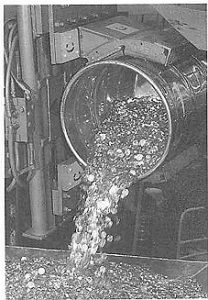
coin manufacture courtesy of the Royal Mint
Success and Failure
It is also important to look at success and failure. I believe that my dear faithful, SubConscious Computer registers successes and failures, but does not care about size. So when I get out of bed it registers ‘One Success’. When I climb Mount Everest it registers ‘One Success’. Similarly, with failures, it does not care if I stub my toe or wreck the car. lt just registers ‘One failure’ or ‘One slip-up’. So at the end of the day my success rate is counted by the number of ‘S’s versus ‘F’s.
But as many people tend to focus more on their failures rather than sucesses, it is important to take time to appreciate the many successes in our lives, however small. Try writing down a list of 20 successes that you have had today. If you stop to think about it, you got out of bed this morning without falling over, you got dressed, washed, made breakfast, caught the bus to work, and on, and on. Each or these is a success. The fact is that when things become easy for us, we stop regarding them as a success. Ask a three-year-old if tying its shoelaces can be considered a success. Once upon a time we were cheered and clapped by mum and dad just for walking three steps. Why should frequency detract from the glow of achievement? Most of us lead very successful lives if we will just take the time to acknowledge our successes.
We need to start small and gradually build up momentum, faith and trust. If I were to train with weights and tried lifting the heaviest ones first, I would only succeed in convincing myself that this was not for me. But if I start with a lighter weight and gradually build myself up to lifting the heavier ones, each success will lead me to try to lift a bit more. It’s the same with creativity. Spiritual muscles are built up gradually.
If l want to be a millionaire and decide to do it by next week, well everything’s possible, but I think it more likely that I’ll become disappointed and go back to selling insurance. Whereas if I start off aiming for something less daunting, I will be able to build each success upon the previous ones. Aiming too high is a very good way of creating an excuse for failure and hence of sabotaging our creativity.
Clearing Out
Once I was complaining that I wanted some new clothes and a friend wisely asked where I would keep them. ”Well, in the wardrobe of course,” I said and went to look there. In fact there was no room in my wardrobe because it was filled with old things that I never wore, but didn’t want to get rid of, ‘just in case’. Of course my ability to draw new clothes into my life was being clogged by this unnecessary baggage. Try looking at your bookshelf – all those books that “I’ll read one day” or “So-and-so gave me that, I must keep it.” Try the tape collection -“Oh, I’d forgotten I had that.” You put it into the player, listen filled with nostalgia for a while and back it goes onto the shelf and you say to yourself, “I must make time to listen to music more often!” Familiar?
It’s a wonderful feeling to have a good clear out, because you clear out other things in yourself as well. Keep it moving, freshen up your life. As you pass things on, you also become the source of other people’s manifestation or should I say ‘God’s channel through which others can draw their needs or wants’. When I have a clear out, something I pass on to a friend often turns out for them to be just what they wanted.
As you clear the shelves and cupboards, look inside your head and heart, and see if there are old thoughts and feelings that could be cleared out. Grudges, blames, antagonism towards others or towards yourself (in the form of guilt). When I see ‘whatsisname’, do I still recall the time s/he did so-and-so to me 15 years ago? Do I need that? Clear it out, move it on, start afresh. Spring clean on all levels.
Right Custodianship
If I want to manifest a new car in my life, how have I been looking after the old one? If I am not prepared to look after things in my possession, why would the Cosmos entrust me with more? If I want a new and wonderful relationship, am I honouring and cherishing my present partner or my friends? Am I being good to my own body?
Gratitude
One of the most vital energies around creativity is to say ‘Thank you’, to have an ‘Attitude of Gratitude’. ‘Thank you, thank you, thank you’ is the best mantra I know. Whatever happens, always take the time to say thank you after you have created something. Even if what has happened does not feel like something positive, there is a gift to be grateful for in there, somewhere. Everything is perfect in hindsight.
Purpose
For me, manifestation is primarily about clarifying our purpose. Most of us have rather hazy ideas about what we really want. The various ways of getting clearer on what we want, automatically show us where and what we need to work on. As we work on and clear our blocks, the vision or purpose gets so clear that the ‘bringing about’ happens very easily. What do you want? Be precise! Write it down. When do you want it? Give a time. Will you know when you have achieved it? (e.g. ‘Being more loving’ is a difficult one to measure!) ls it so big and seemingly impossible that you are sabotaging yourself straight off? Is it so insignificant that it’s no challenge anyway? Start with ‘I intend’. The word ‘intend’ contains a power and direction which are not present in words like ‘want’, ‘wish’ or ‘try’.
One of my favourite ways of exploring and clarifying purpose is a model I call the ‘Why Tree’. In this exercise I write down my intention or purpose and then begin to ask the question ‘Why?’ Example: “I intend to create a joyful, on-going, one-to-one, loving, sexual relationship with a woman, now.” Why on-going-what’s wrong with one night stands? Why one-to-one? I feel safer with lots of girlfriends and no commitment. Why loving – can’t we just be pals? Why sexual? Platonic friendships are safer. Why relationship? I can be fine on my own. Why with a woman? I feel safer with a cat or my men-friends. Why now – can’t it wait?”
Here we have seven questions arising out of one intention and providing seven answers. From each of these answers may come one or more new ‘Why?’ questions to answer. As my ‘Why Tree’ grows and branches, it blossoms with information to fill out and focus my intention. You need to be very honest in this exercise. It may be useful to work with a friend on this. Others often see subtle things that are key issues in our words and answers better than we can.
As you clarify your intention, you may discover that your initial intention was not what you really wanted. Some may say that the intention was wrong, but in fact this is not true. Discovering that this something was not really what you needed means that the manifestation is complete. You got what you truly needed, which was the information that you were on the wrong path.
The point of manifestation is not to acquire things or money. This may well happen; which is very pleasant, but it is not the purpose. No manifestation is complete unless there has been an equivalent elevation in consciousness. Sitting with a pile of gold or bank notes in front of you is not the completion of the exercise. We need to stop and recognise our own ability and power to co-create with God. We need to realise our ability to do this consciously, rather than having it (or believing it to) ‘Just happen to us’. As David Spangler puts it, there is actually only one Law of Manifestation, and that is ‘To be’ – to be our full, God-centred and Spirit-inspired selves.
Richard Mark-Coates is currently focaliser of Education and lives with his wife Pia in Findhorn village.

Lived at Cluny, on Erraid and at the Park for 50 years. Held many roles and positions of authority.




Leave A Comment