


This article was previously published in the Reforesting Scotland magazine 37 Spring 2008 p 17+18.
***
“Twice every 24 hours the sea floods the great expanse of Findhorn Bay and retreats again. And every year in October large flocks of greylag geese skein down from the skies to overwinter in the bay. Bay Cottage, home to the furniture maker and-wood carver, Richard Brockbank, overlooks this expansive seascape where, on high tides, the waters lap to the very edge of the garden where a fenced vegetable plot fronts his workshop.
The workshop is a spacious wooden shed, whose interior brings to mind a sacred space where polyphony is composed by planing and carving tools, the sound of the sea and the communal cronking of the geese. Positioned, seemingly at random, throughout the shed are pieces of furniture – benches, desks and dressing tables – honed out of tree trunks and branches, with a sinuous quality about them, suggesting the movement of waves or tide marks on the sand.
 A small showroom at the entrance displays a range of Richard’s work: mirrors whose frames range in shades from dark brown to honey, depending on the tree selected for the purpose; more benches whose curvaceous seats have become something of a Brockbank trademark; diminutive chests of drawers for trinkets and treasures and containers for angel or tarot cards. When you study these small items you notice that each one has a subtly different character from its neighbour on the shelves. Because of the workshop’s proximity to the international spiritual community, the Findhorn Foundation, visitors and guests often select a souvenir from the showroom that somehow symbolises the spirit of the place.
Richard Brockbank has recently completed a bench with a sinuously carved back and a corner cupboard, both private commissions. And last year his work was represented at the Rendezvous Gallery in Aberdeen. He traces his craft roots to the arts and crafts movement by way of his teacher, Kenneth Marshall, who in turn learned from Edward Barnsley. The tools of his trade are arrayed on and above his high dusty workbench. Carving tools and planes and, invaluable for shaping, several old wooden spoke shaves he’s had for years. Traditionalist, he may be, but there are few right angles to be seen in the work, except out of necessity, when, for example, the legs of a bench must support the seat.
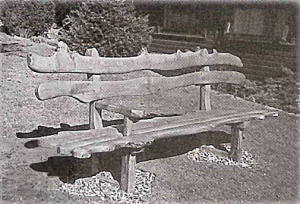

The well-rounded solidity of the pieces invites the beholder to touch them and wonder about the trees they arose from. Whether he’s working with oak, ash, elm, cherry or sycamore, Richard’s conscious intention is to allow the tree to live on in a different form. He likes to quote the American designer George Nakashima who said something to the effect that every tree, and every piece within the tree, has got another use and it’s up to the maker to find that use, and use his skills to let the tree continue living and to do it in a way that touches people’s hearts. “That really strikes a chord with me”, Richard confirms.
Morayshire is well supplied with woodlands ranging from ancient mixed forests, such as at Rothiemurcus and Abernethy, to the private estates. The Darnaway Forest is a favourite haunt of Richard Brockbank and he has worked with Darnaway timber. “There is timber about if you know where to look for it”, he says. While there are no big sawmills in the area, there are small operations and he often buys from a friend in the nearby market town of Forres, who cuts and dries local trees.
“Different trees have different energies”, he says, and goes on to tell the story of one particular table, made of ash, which stood unsold for years. Then, one day, a customer arrived, a healer, looking for a special worktable. She fell for the table on sight and bought it immediately. “You see”, Richard explains, “she knew that ash has healing properties”. Where possible he prefers to use locally grown wood. Only occasionally, when he is commissioned to supply furniture for a built-in bedroom, for example, does he resort to using imported timber.
Bay Cottage and workshop is around staying when he visited me to make the a mile from the picturesque village of Findhorn and only a stone’s throw from the entrance to The Park campus of the Findhorn Foundation where Richard Brockbank’s Tree of Life and two carved panels can be seen at the Universal Hall. Before he came north from England to settle in the area he had been a Quaker. However, years of working at his craft, as well as proximity to the Findhorn Community, have reshaped his faith. These days he crosses the road to The Park almost every day to shop at the Phoenix Store, to help in the community kitchen, to attend meetings and, most importantly, to meditate in the sanctuary.
“My most vital connection to the Findhorn Community is the morning meditation. Sometimes thoughts come of how to approach a piece of work when I sit with the community in silence, or maybe I’ll discover ways round certain problems, other times I’m just there.” He goes on to mention certain practices of the community that inspire his creative process. “Work departments at the foundation tune in to each other and to the tasks in hand before a work shift starts. Angels or guides are frequently invoked and I do that myself before I start work. You see, as a human being I exist on the physical dimension – I actually do the planing and carving – but when I’m at work, I sense the presence of some other spirit with me in the workshop. A presence that I could say transforms the place into a temple for the creation of beauty. Inevitably, my work is infused with some of my beliefs which are actually in tune with the comment of the great 16th-century Quaker, George Fox, ‘There is that of God in every man’. It is not only a New Age thought that man contains the divine. Indeed, all the great spiritual traditions hold that each living thing, each plant and tree, is imbued with a deva or angel that guides the particular way it grows.”
Eleven years ago Richard was offered a commission by the Nepal Trust which was inaugurated by Findhorn Foundation friends. They wanted a Tibetan-style door frame that would front the health centre they intended to built in the mountains as a link between Scotland and Nepal. Dry larch from Darnaway estate was selected for the frame which was decorated with Celtic symbols derived from the Book of Kells, a Tree of Life, the Staff of Caduceus and a dragon-like creature on the lintel.
 Richard believes in meaningful coincidence, which occurs quite frequently in relation to his work. “It’s an interesting thought that, as some people say, the Celts came from the Tibetan area and one day when I was out walking in Nepal I came across a dragon carving almost identical to the one I had carved though I had never seen one before. Another time I carved a cross for the vicar of a church at Dulwich who reported that, after it had been installed, members of the congregation couldn’t refrain from touching it. He was dumbfounded when I told him the piece had been carved from a ‘Cedar of Lebanon’ tree from the woods at the thirteenth century Pluscarden Abbey, which was where he had been staying when he visited me to make the commission.
“It’s as if there’s some being out there putting all the threads together,” Richard says. “And I do believe that some spirit guide led me to work in wood. After I got a taste for it at boarding school, when I’d do woodwork in the evenings, I put it behind me to study engineering. Only when I was in my late twenties did it hit me that wood was my medium, my passion. I do know that one of my ancestors was a furniture maker and perhaps I was myself in a previous life. All I can say with certainty is that using my energy to make trees that have been felled live again in new forms is part of my destiny.”
Sheila Mackay is the author of Early Scottish gardens: A writer’s odyssey (Edinburgh University Press) which is available to order through bookshops or from www.eup.ed.ac.uk
Please click here for more information about Reforesting Scotland.

I am a published Author and live in Edinburgh these days with my partner, the artist Geoff MacEwan



Leave A Comment