


Click to view e-book
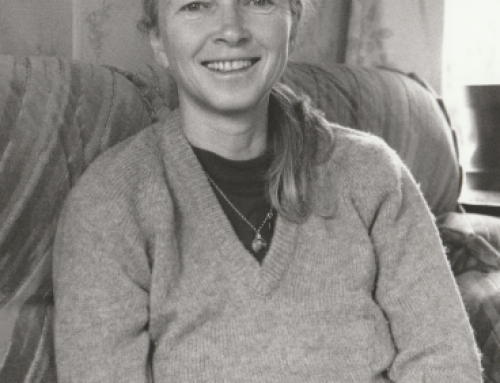
Scots-born Maria Cooper signed up for the month-long Applied Ecovillage Living programme in 2016 and today enjoys her dream lifestyle and livelihood in The Park as a self-employed permaculturist, food grower and sustainability course facilitator.
She’s also studying for a Masters degree through the Centre for Alternative Technology (CAT).
‘My most vivid early memory was of the community as a continuous journey of and exploration,’ she recalls. ‘Every day I would discover new places and aspects of the community. Whenever I thought “Ah, now I’ve seen it and understand this place”, something else would appear that would prompt more openness and embracing of the unknown.
‘It could be something as simple as visiting the vast openness of the beach. Each time I would inadvertently end up taking a different one of the many small paths through the gorse bushes, get a bit lost, but have a lovely walk and mostly reach the beach.
‘Similarly, experiencing different spiritual practices – meditating, singing, dancing, being in nature, physical work and exercise, reading, writing, attuning – helped me become more authentic in
my expression of myself.
‘I was struck by the honesty and transparency I was met with and found this messiness or richness of co-existence extremely touching and inspiring. This wasn’t some ideal place where everything was defined and already figured out, and all I had to do was follow the path.
‘It’s more like a continuous laboratory interacting with all aspects of life. We’re learning as we go along.’
Maria enjoys a simple life in a shared home fashioned from whisky vats and recycled materials, surrounded by a garden officially recognised as a permaculture demonstration site.
‘Living in the community has helped me have the lifestyle and the livelihood that I want: I have a rather wild garden from which I get 90% of my fruit and vegetables all year round, the little income that I need I can get through holding courses (which means meeting interesting people and exploring topics I am passionate about) or working for the community.
‘It allows me to explore what a holistic and integrated lifestyle can look like. It’s an opportunity to engage with concepts such as happiness, sustainability, resilience and adaptability both in theory and practice, giving a felt sense and embodiment to what otherwise easily becomes siloed into mental models, idealistic values and everyday habits.
‘I feel like I’m reprogramming my brain to be able to live simply in a world of extreme complexity.’

She’s recently been appointed the head of the planning group for The Park, tasked with ensuring that all new buildings and retrofits mirror the increasing necessity for environmentally, socially and spiritually sustainable buildings.
Social and community impacts must be considered along with adaptability to future needs and climate change mitigations, water harvesting and conservation, the widespread use of natural materials and a movement away from fossil fuels, cement and plastics.
The vision for the future is bold and exciting and includes extremely energy efficient houses that require minimal energy input while still being practical, comfortable and affordable.
The community grew as people responded to a vision of planetary change and she says: ‘The practice of continuously listening and opening up to what can emerge, and not being afraid of trying to practically follow this impulse, has been a strength of the community.
Slowly, we are becoming a small example of a village embedded in the networks required for sustainability and resilience on a bioregional scale.
‘I think the complexity, interrelatedness, unpredictability and contextual nature of the issues we are facing on a planetary scale today require the very humbling insight that no one person, organisation or movement can even conceptualise all the details of the solutions required. We have to collaborate.
‘As a community, I think we can contribute by holding that invitation to reconsider what it means to live a good life, be successful and happy. Does it have to depend on maximum convenience, being well-known, well-networked, well-travelled, well-funded, influential, constantly stimulated, entertained and distracted? Or can I find feelings of success and happiness in simpler, everyday life? I believe that we are a place where people can start that journey, or be nourished on their way.’
Maria Cooper
Permaculturist + facilitator
from UK & Sweden
First Findhorn visit » 2015

Born in Scotland, lived in Sweden. With my young son, I enjoy a sustainable life as self-employed permaculturist, food grower, sustainability course facilitator and researcher.



Leave A Comment