


Summary
The concept of affordable housing in The Park evolved in 2010 during the development process of the Magic Triangle by Duneland Ltd. It was made possible through a very close and effective collaboration with the Moray Council Housing Department and a dedication by the Duneland board ‘to do right’ by the Community.
The Community involvement in both the concept of affordable housing and particularly in the fundraising campaign was galvanised by the idea of securing Community Care Flats. This then was extended to embrace all housing needs, creating the Full Spectrum Initiative. In the end Park Ecovillage Trust took responsibility for the Community owned housing on the Whins. Ekopia holds the responsibility for the allocation process for these and other affordable housing.
This post describes this Community involvement, the design and concept of Community Care Flats as well as the allocation process. It also reflects on successes and failings/learnings over the years highlighting that there is still a lot more to do.
***
Following several years of Community consultation, Listening to the Land and other explorations, the Duneland Ltd embarked in earnest on a journey to create a 25 unit co-housing cluster in East Whins in 2010. One of the members of the board of directors, Cornelia Featherstone, was also an active member of the Community Care Circle (CCC) (later changed to Caring Community Circle as we were not a service provider) and was delighted when the Duneland board, acting as ‘client’ for the architects, agreed to specify that the 6 ground floor flats were fully accessible and suitable for care at home. This was a significant step as it meant that the specification would exceed present building regulations, and therefore costs would be higher. To prioritise care in community over low cost was a courageous step at a time of a significant economic downturn due to the 2008 crash of the financial markets.
The design
By that stage we have had quite a bit of experience of ‘looking after our own’ in their own home. The first longer term experience came in 1996 when we looked after Joanie Hartnell-Beavis in her bungalow right next to the Community Centre. In the following years we managed to support several others, some to the point of being able to die peacefully at home as Joanie did. This included Eileen Caddy who received an increasing level of care in her own home for over three years before she died there on 13th December 2006.
Consulting extensively with several of the carers who were part of those teams, and with the amazing help of a local Occupational Therapist (OT), Duneland board created a design brief with a very high ‘accessibility’ spec for those flats (much higher than official planning procedures required at the time, although those have caught up in recent years).
Community Involvement
Cornelia remembers: “One day in my morning meditation I had a very clear sense that those 6 flats will be snapped up by forward thinking folk in their ‘golden years’ who take this opportunity to take responsibility for their own ageing in place. This might mean that the use the flats were intended for may well only come to the fore in 20 years! I heard a clear ‘instruction’: “secure two of those flats for the CCC to use as care flats!” I took this to the next weekly Elders Meditation and the circle said emphatically – Yes! Let’s try and go for 3 of the flats!”

We published this article in the Rainbow Bridge on 28th May 2010(click arrow on the left to see the text)
The Magic Triangle development is getting underway. Duneland Ltd has designed six flats to meet the demanding needs for end-of-life care in the community. We have built on the experiences of families and carers who have looked after their own here in the community over the last decade or more.
It was Eileen in 1996 who put all her efforts behind looking after her friend Joannie here in the community rather than having her cared for in hospital or a nursing home. We managed to look after Joannie for three months before she died peacefully in her beloved bungalow – a deeply rewarding and transforming experience for all involved.
Almost ten years later we looked after Eileen in her home – and it was for almost three years! with 24 hour care for two of those! Again it was a deeply healing and nourishing experience for so many. And of course there were many more community members we have looked after since Joannie, some for months others for years.
And it is these experiences that give us the confidence to know this is the Right Thing To Do – and that We can Do It!
So now we have the opportunity to create a structure that will facilitate looking after our own. The flats on the Magic Triangle have attracted a lot of interest already and there is no question that we will be able to sell them easily.
But will that be the highest and best for this community?! There will be six owners of flats who may live there for ten or twenty or even thirty years before they need the high spec facilities these flats have to offer.
In the meantime elsewhere in the community there may be an elder who is failing in their own home, needing to be looked after there – which may be impossible due to the restrictions of the accommodation – in a bungalow or even in a house.
So what to do?!
We have discussed this idea in the Elders Circle last week – and shared the following proposal. The Elders Circle gave their unanimously backing for it. An idea whose time has come?! So here it goes:
The proposal is to put two or three of the flats into community ownership. They can be rented out on short-term contracts (perhaps to people with pressing housing needs) with an understanding that should a community member require care in the community which is not possible to deliver in their own home that the tenant would have to be moved.
Community Ownership
This will be an attractive and secure proposition for investors in the community and on the ethical investment market. It will not be high risk, hence no high return, and therefore appeal to those who want to do good with their money and feel nourished by it whilst having a reasonable return through the rental income. Investments can be small or big – according to an individual’s means. These investments offer an opportunity to do the right thing, to look after our own and to touch the hearts of many.
As to the legal structure there are several possibilities. Either an existing organisation such as Ekopia, Duneland Ltd., or NFA (if it changed its organisational structure), owns the property and manages it for the investors, or a new organisation is set up specifically for this reason – owning either just those flats or other community properties as well.
Interested? Please get in touch!

Fun-draising photo Roy Chillingworth
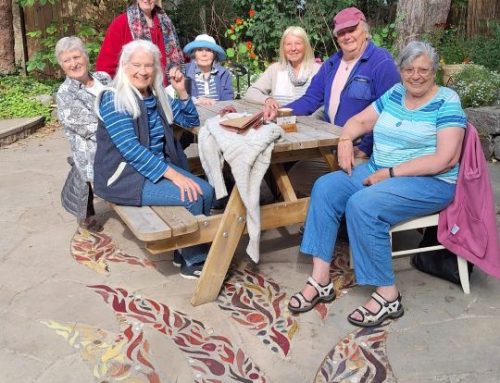
The start of a process of intense fundraising – and in this instance there was indeed a lot of fun in the fun-draising! We had numerous coffee mornings and afternoons in the Community Centre.
CCC members and others baked delicious cakes and cookies, Helen Kalis knitted dozens if not hundreds of woolly hats. They were sold during the events along with bric-a-brac and other treasures and each event made us some money – not the thousands of pounds we needed but certainly hundreds.
The effort was also joined by a group of young people who held the vision of putting two of the terraced two bedroom houses within affordable reach through the concept of shared ownership as an immediate step with more accommodation suitable for young people and families to follow. The concept of intergenerational living started to gather momentum. We called our endeavour the Full Spectrum Initiative which later changed to the Park Housing Cooperative.

Angus Marland wrote this article for the Rainbow Bridge on 5th October 2010 (click the arrow on the left to read the text)
The Park mirrors the world: until recently humanity perceived that there was space enough in the world for unlimited growth, but now we are encountering edges and boundaries which mean that we have to make conscious decisions based on a finite planet with a sensitive environment. Such is the case for The Park as we approach our 50th birthday.
The Park 20:20 vision is one way of describing our need to plan for the next decade up to 2020 in order to create a Park environment that works for the community as a whole.
Some issues that are being addressed in relation to The Park are:
- Its composition, including infrastructure and ‘cluster communities’
- The ratio between FF co-worker housing, private owner-occupiers, private owner-occupier + tenants, and NFD / private rental accommodation
- Guest accommodation, educational facilities and visitor services
- Equitable sharing of operation and maintenance of The Park by the community as a whole.
The Park is an extraordinarily special place, it is a real privilege to live here, and the Park Housing Co-operative is one strategy to assist it to fulfil its purpose over the coming decades, with a realistic ratio of age groups having access to housing….. i.e. a Full Spectrum.
Its vision seeks to be equitable and fair, and to provide living and working opportunities for the new generation of Park custodians. It embodies a long-term mechanism to bring this about, and its goal is to manage the allocation of housing principally through the financing of affordable rental and shared equity houses.
Its first project milestone is to raise the required finance to create 4 affordable homes in the first phase of Duneland’s East Whins development though donations, interest-free and interest bearing loans. Each of these require at least £30,000 of donations, £30,000 interest-free loans and interest-bearing loans. The second milestone is to secure a further 4 homes on East Whins which Duneland Ltd. is holding back from sales at the moment.
Duneland had to set a March 2011 deadline for this offer. If the community cannot raise the funds by then, some of these units will have to be placed on the open market and the provision for affordable homes (or plots for the same) will instead have to be offered to an outside housing association with the Moray Council list of priority people requiring housing.
The Park Housing Co-operative is intended to be a long-term project which could eventually bring a substantial amount of privately owned housing under the control of the community, and in this way we will be able to offer housing to the optimum age and skill spectrum of people to keep The Park as the amazing planetary resource that it already is.
Angus
Upcoming Events:
‘Coffee Afternoon’ fundraiser Wednesday 20th Oct 3 – 5pm – CC
Q&A evening Tuesday 26th Oct 7.30pm – CC
Sunday Slot Sunday 7th Nov12.30 – 2pm – CC
Brunch Fundraiser Sunday 14th Nov 11am – CC
This project was supported by Ekopia with administrative and logistical support and gathered momentum.
Funding and Ownership
 With all this enthusiasm and input of information and inspiration, more and more pledges of donations, interest-free loans and low-interest loans came together.
By the end of the campaign in May 2011 we had raised the funds for two Community Care flats for rent, and two terraced houses for shared ownership.
After much deliberation Park Ecovillage Trust (PET) accepted to expand its focus beyond the educational project they were involved in, and took on the responsibility for these properties on behalf of the Community. As a membership organisation and charity it had the right legal structure to create community engagement as well as long term sustainability.
Allocation process
Through Community consultations the allocation criteria for these homes were finalised for the first allocation process in 2012. For greatest fairness and objectivity, the Community decided that the process should be overseen by a group of representatives from different Community organisations and held by Ekopia as another Community membership organisation that was not involved in landlord-tenant relationships. The Land and Housing Trust (L&HT) was set up which oversees the Housing Support Policies. When a property comes up for allocation, the L&HT chair organises the allocation process in a committee made up of representatives from Ekopia, FF and the NFA. The committee considers all the applications and makes decisions by attunement.
 In 2016 the construction of 6 newly built affordable flats owned by PET in West Whins triggered an extensive review process, using a survey, focus groups and a large Community meeting to revise the procedures. One of the main outcomes was that a point system was introduced to make the process more transparent and the attunement more ‘information led’. For the report please see Appendix 1.
There are different Housing Support Policies for the individual affordable properties, and they include the Allocation policy and the CCC Health and Care Questionnaire. The latter only applies to those designated care flats.
A list of affordable housing options can be found on the Ekopia website by clicking here.
Please see the Appendix 2 for the policy documents relating to the East Whins care flats.
Following some challenges PET instituted a couple of additional landlord policies in 2021 requiring the tenant to provide
- a guarantor and
- pay a 2 month deposit before entry.
The concept
The innovative concept of the Community Care Flats utilised an existing tenancy arrangement called Short-assured Tenancy. The CCC engaged with the Community to explain this in several meetings and articles well ahead of the allocation to ensure that it is understood.
The final policy was published in August 2013
 Community Care Flats At East Whins
Summary of an innovative concept that is evolving in the Findhorn Foundation Community
A brief history
When the Duneland board acted as the client group for the architects of the co-housing cluster at East Whins a lot of thoughts went into the concept of the ground floor flats. This came soon after Eileen’s death, who had been successfully cared for in her own home for three years of increasing dependency. Based on those experiences the brief was to make the flats compliant with the specifications for “housing for varying needs”, i.e. wheelchair accessible. In April 2010 it dawned on us that these flats would be sold to individuals who may well not need these specifications for another twenty or thirty years and that the resource would be removed from those who may need it.
The NFA Elder-circle considered this and came up with the bold vision to secure 3 of the flats for community control so that the resource could be made available should the need arise. Thus the foundations for what became the Park Housing Cooperative (PHC) were laid. The voluntary group of the PHC did sterling work in raising substantial funds over the last 18 months enabling the community to buy 2 of the ground floor flats (along with two 2-bedroom houses). And so the concept of Community Care Flats can become reality.
The concept
The flats are a resource for our community that may allow us in the future to prevent a member from having to stay in hospital or to go into a nursing home because their accommodation is unsuitable for them to be cared for at home.
In our experience people prefer to stay in their own home until the end if at all possible. Given the quality of accommodation in the community with caravans/bungalows at The Park and rooms in the busy hive of Cluny, as well as other homes that may not be suitable, this is often not possible.
Should the situation arise that someone would become so dependent on care that they would have to stay in hospital or be transferred to a nursing home, the Community Care Circle will work with the sitting tenants in the flats and with the Land and Housing Trust (L&HT) Committee to find a solution that will enable the person to return to the community and be cared for here in one of the Community Care Flats.
We hold the vision for this to be a graceful and mutually enriching experience for the cared for, the sitting tenant, the carers and the community as a whole.
One of the care flats is already used in this way and has saved a lovely inspiring lady from whiling her time away in a local nursing home. The second flat has had its first tenant who is now leaving to move to a bigger house that will allow him to care for his elderly mum. GO! Care in Community!!!
With this emerging experience we know that good communication with the sitting tenants and the L&HT is crucial. Under the terms of the short assured tenancy, the tenant would be under a standard two month notice period, which would be given should this situation arise. However, the person who needs to be cared for may need the flat earlier than two months time. We have ideas of how this may work: the cared for may offer their own home as a house swap, if there is already someone in community care in a flat it may, in some circumstances, be possible to share the flat with a second person in need of care – who knows – only the future can tell how it can pan out. What we need to do at the moment is to hold the integrity of this beautiful vision, communicate it clearly and attract tenants that are inspired by the concept and not afraid to be part of a process that may ask flexibility from them in return for the reward of living in low-cost housing of a high eco standard (with consequential low running costs) and being part of a caring community.
We are also talking with two private landlady/lords to see if they can put their rental accommodation into the Care Flat pool to give a greater group to hold this service aspect and allow for an attunement process as to who could accommodate an arising need with easiest grace. THANK YOU to our amazing caring community!
The NFA Community Care Circle August 2013
In the end this mechanism was never acted upon as in the one situation when someone applied they didn’t fulfil the criteria of preventing “a member from having to stay in hospital or to go into a nursing home because their accommodation is unsuitable for them to be cared for at home.”
This was a very challenging experience for all involved. It highlighted to the CCC volunteers that the high ideals of the concept created a difficult ethical conundrum and placed a significant strain on social relationships. And in many ways it came as a relief when the new tenancy law which came into force in 2017 abolished short assured tenancies and therefore rendered that mechanism null and void.
Now the Community Care Flat allocation policy applies only in the event when a tenant terminates their tenancy agreement.
By 2024 allocation of the two flats had occurred 6 times, and only in two instances early on there was no applicant with health and social care needs and in one of those the tenancy was offered to a young family, as the need of young families was also given very high priority in the allocation consultations.
Since then all change-overs in tenancy saw several applicants with significant health and social care needs. This demonstrates the increasing need for such provision in our Community.
The service
The two Community Care flats have been a wonderful asset for some aspects of social sustainability in the Community. Two Community members who would have needed to go into a nursing home were able to stay in The Park, one for several years until care needs became too great for care at home, and another until death.
The need for such accommodation in The Park has been clearly demonstrated and health and social care needs are now being considered for other affordable housing tenancies in The Park.
Since the concept of Community Care flats was formulated in 2010, another designation has evolved: enhanced accessibility flats which was implemented with the Silvertrees affordable housing by New Findhorn Directions (NFD).
Successes and failures/learnings
At publication of this post, PET, on behalf of the Community owns 18 affordable homes, two of those are the dedicated Community Care Flats in East Whins. New Findhorn Directions (NFD, the trading arm of the Findhorn Foundation) owns a further eight units. Health and social care needs have been considered regularly in the allocation of those properties.

Building for the Future 3rd March 2015 photo Roy Chillingworth
With these 26 affordable units we have exceeded the vision expressed in a Community event called ‘Building for the Future’ in 2015. The slogan was 25 by 2025. This was made possible through effective collaboration with Moray Council and the generous support from the Rural Housing Fund.
We have come a long way from 2010 when there were no Community owned affordable homes and many of the places Community members lived in were unsuitable for providing care in the community. The building of permanent housing in private ownership has also contributed significantly to a level of social sustainability as many of the properties are ‘age-proof’ at least to some degree as ‘ageing in place’ has become more prominent in the awareness of individuals and the collective.
However there are several elements missing to secure the provision of care in the community as well as social sustainability and resilience.
- Homes for young people and families – in the narrow context of care in community this would support 2. .But more importantly, a resilient community depends on a wide age demographics
- Carers and personal assistants to provide care at home
- More sheltered accommodation, including nursing home care
Exploring 1. is beyond the scope of this post. Suffice to say that the lack of housing that can be afforded by people of working age is a major challenge throughout most of rural Scotland.
The issue of paid carers/PAs is presently a very difficult one. This is the same Moray wide, indeed the whole UK. There are just not enough people available to meet the demand. This is compounded by a culture of very poor working conditions, the very low pay in the social care sector and the exodus of care workers after the pandemic.
In The Park we were very lucky for a long time, when a large pool of carers were available to work in several care teams. They self-organised in an informal support network, the Findhorn Care Workers, and supported each other across different teams. There has always been a large number of community volunteers, willing to lend a hand in a neighbourly fashion. This is still the case today with the CCC Taskforce which has over 50 members willing to respond to requests.
Self-directed Support (SDS) through Moray Council provided the financial resources and one of the senior carers, Fay Blackburn, had the expertise to handle all the administrative requirements which were quite onerous. At one point she juggled 15 or more paid carers in five different care teams, in some cases providing 49 hours of care a week. Fay eventually retired along with a significant number of carers. With the resulting lack of carers and ever increasing bureaucracy and legal requirements which made SDS near impossible to manage, we have not been able to keep up the same level of care in community.
The attempts to establish a care agency in some form or shape within the Community were undertaken a few times but sadly have not (yet?) borne any fruit.
In recent years, when care needs reached a certain level, Park residents often moved to either care homes or sheltered housing in Forres or Elgin. Quite a few Community members now live in Housing Association accommodation or in a large over-50s retirement housing complex in Forres.
New initiatives are emerging with social get togethers of Community members in Forres. One initiative is called Ageing Gratefully (or Gracefully), there are also regular lunch clubs and other events.
With regards to sheltered accommodation in The Park, we can only report another set of valiant yet unsuccessful projects:
- 1998: with the development of the Field of Dreams the vision for a community care facility was proposed and strongly supported by several elders. One in particular was Elisabeth Grindley, who had been one of the architects on the Universal Hall and lived in her bungalow ‘Grindley’s’ in Pineridge. She was wheelchair bound and whilst her bungalow was suitably adapted, she could foresee the need for a specialist unit to provide more care. An elders survey showed that members wanted to stay in their own homes as long as possible and were not interested in moving into a ‘custom-built’ facility, even here in The Park. Therefore the concept was developed to have a multi-purpose house which was equipped with two units to provide full care in community when the need arose. At times when that wasn’t required, it would be run as a Bed&Breakfast. Part of the house would be the base for the Findhorn Bay Holistic Health Centre, which in some aspects was the forerunner to the CCC. The developers of the Field of Dreams, Ecovillage Ltd. were very supportive and reserved two adjacent plots for the project for quite some time. But sadly the project did not come off the ground.
- 2016 – for about 2 years we actively pursued the concept of creating several ensuite rooms/mini-flat first in one, then in another of the big houses on the Field of Dreams that were coming up for sale. The concept took inspiration from a very successful venture in the Netherlands, Thuis Huis, which translates as HomeHouse. The second project matured significantly with the positive engagement of an investor who wanted to be part of an innovative elders accommodation project. Sadly the sale fell through in the 11th hour.
Since then no new projects have been presented but the need for ‘something’ like sheltered accommodation continues to be the subject of conversations.
***
Appendix 1 – 2016 Allocation Review Process
Presentation of the Survey which then informed focus groups and the Community meeting in October 2016
Appendix 2 – policy documents relating to the East Whins care flats
The following are the policies in force today, we were unable to find historical copies but trust that this current information is valuable.
Housing Support Policies
Affordable Housing Allocation policy
CCC Health and Care Questionnaire
The Caring Community Circle aims to co-create an exemplary caring community culture from cradle to grave; holding awareness of the needs of people of all ages and linking volunteers and other resources to those in need.





Leave A Comment