

My name is Donnie Maclurcan. I’m Australian, and back in 2014 I was living in the US, on Shasta and Takelma lands, in Ashland, Oregon. I think it was through Roger, or maybe someone else, that I was invited to an event at Findhorn called the New Story Summit.
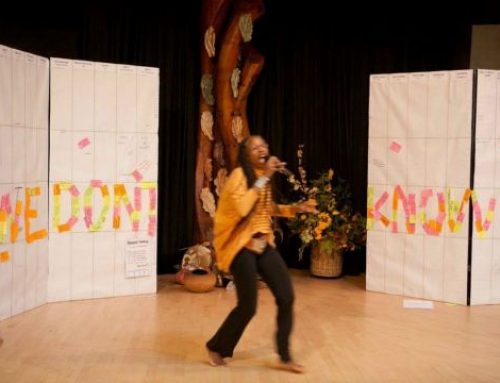
Some of you might remember it. It was largely held in the Universal Hall and attended by around 300 people, who had come from all over the world — many Findhorn Fellows at the centre of it — alongside invited guests from elsewhere. I came in on someone else’s dime, not really knowing much about Findhorn at all, just a few things I’d heard — even though I was living in Ashland, where there were a number of Findhorn Fellows I already knew. I just hadn’t realised they were connected to this place.
So, there I was, twelve years ago now, not knowing many people. I did know Bayo Akomolafe from before — he was one of the speakers — and I had a relationship at the time with Charles Eisenstein, who was also involved.
My first memory of the CC (Community Centre) was the cacophony whenever you approached. I don’t remember quite how big it was, but three hundred people inside for meals was certainly pushing it. Alongside having our meals there, I think some activities were held upstairs as well. I was cooking in the kitchen too. Over those three or four days we’d come in for morning tea, lunch, dinner — it’s all a little hazy now, but what I do remember clearly is what happened on about day three.
There’d been a bit of a stink the night before. Charles Eisenstein and Jodie Evans — who is key to this story, and a dear friend of mine to this day — had, on the third night, sabotaged an open space process we’d spent a lot of time setting up in the Universal Hall; all the structure for conversations we’d built. We arrived the next morning to find it torn down, and at that point nobody knew who’d done it. I remember walking into the CC into an atmosphere that was tense.
Now, I knew Charles at the time, and for those of you who know him, he’s an interesting person — not necessarily the easiest to be speaking with. That matters to this story, because all week people had been coming up to me saying, “You need to meet Jodie Evans. You have to connect with Jodie Evans.” I had no idea why they kept saying it. Jodie has red hair and is a very easy person to spot in a crowd like that. I’d seen her around, but there’d never been a moment to actually connect.
As it turned out, people had been saying exactly the same thing to her about me. So there came a point where Jodie and Charles — which made a lot more sense once I knew they’d schemed the open-space sabotage together the night before — were standing in the corner of a room, and I went over and introduced myself to Jodie.
Here’s what happened.
I said, “Hi Jodie, I’m—”
She cut me off. “I know who you are. People have been telling me I’ve got to talk to you all week.”
“That’s strange,” I said, “they’ve been telling me that too.”
“Where are you living these days?”
“I live in Ashland…”
She cut me off again. “Ashland? Ashland, Oregon? Oh, I’ve got a house there that’s on the market. Hold on a second.”
And with that she walked off, flipped open her phone, and left me standing there with Charles Eisenstein and the silence. I had no idea what had just happened — I felt like I was processing having been unexpectedly hit by a marvellous tornado. Jodie had spoken maybe forty words to me and then walked off to make a phone call. Charles and I just looked at each other, both of us thoroughly uncomfortable.
“Do you know what just happened?” I asked him.
“No,” he said. “I don’t know what’s going on either.”
Then Jodie came back. “Right, I’ve taken the house off the market. If you want to do anything with it, I’ll get the agent to sort it out. When are you heading back?”
“Next Tuesday,” I said.
“Great. When you land, call this person. Here’s my brother’s number.” And then she walked off.
I got back to Ashland and, in the end, took on managing that property for the next 6 years.
Here’s the part that still astonishes me. At that time, I was almost homeless. The apartment where my then wife and her son — whom I was raising — were living, was far too small for the three of us. I’d been living elsewhere, but I’d run out of money for the rent and had sublet the place while I was away, with no idea what I was going to do when I got back, because I simply didn’t have the funds to keep going.
Before I’d left, I had put my finger down on a map of the town and said, out loud, “I want a place for all three of us, for free, right here.” And that spot — the junction of Union and Auburn Street — turned out to be exactly where Jodie’s six-apartment property stood.
I took over that property and lived there rent-free for the next seven years. I managed it, brought in artists and activists to live there below market cost, and the property became a project of, and the formal address for, the Post Growth Institute. This gave me the income I needed and, in the end, allowed me to keep my visa and stay in the US.
I managed that property, and the fifty or so people who came through it, for the next six years.
Jodie didn’t speak to me again for the rest of the event. Forty words, all told. That was it. But I’ve kept up a relationship with her ever since — and all of it grew out of an encounter in the CC.

Guest Authors are contributors who are not COIF members (for various reasons).


Leave A Comment